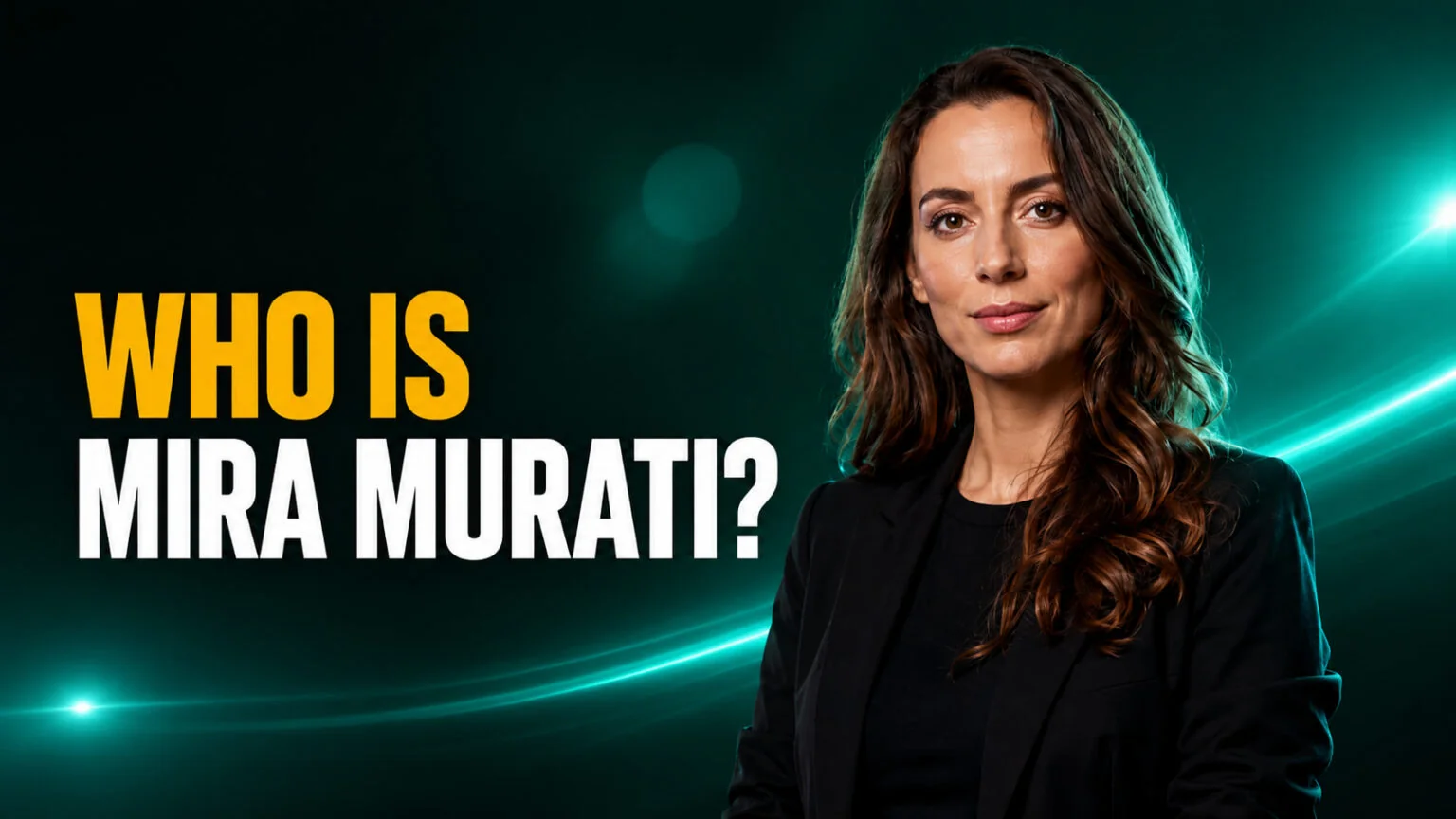
Mira Murati is the founder and CEO of Thinking Machines Lab and the former chief technology officer of OpenAI, where she led the development of ChatGPT, DALL-E and Sora. Born in Vlorë, Albania in 1988, she rose from a product role at Tesla to running the technology behind the most widely used AI products on earth, then walked away in September 2024 to build her own lab. In June 2026 she resurfaced after roughly 18 months of near-silence, unveiling a new class of AI she calls “interaction models.”
This biography covers who Mira Murati is, where she comes from, and how an engineer from a small Albanian coastal city became one of the most influential people in artificial intelligence. You will get her age, education, career timeline, estimated net worth, and the honest answers to the personal-life questions people search for most, plus a clear look at Thinking Machines Lab and what she is building now.
The Key Takeaways
- Born December 16, 1988 in Vlorë, Albania; she is 37 years old in 2026 and holds degrees from Colby College and Dartmouth College.
- She was OpenAI’s CTO from 2022 to 2024 and briefly served as interim CEO for three days during the November 2023 leadership crisis.
- She led the teams behind ChatGPT, DALL-E, Codex and Sora, some of the most-used AI products ever shipped.
- She founded Thinking Machines Lab in February 2025, which raised $2 billion at a $12 billion valuation in July 2025.
- Her net worth is estimated at roughly $1.4 billion, though figures are unverified and vary widely between sources.
Who Is Mira Murati?
Mira Murati is an Albanian-American engineer and executive widely regarded as one of the architects of the modern consumer AI boom. Her full name is Ermira Murati, and for six and a half years at OpenAI she translated frontier research into products that hundreds of millions of people now use every day. She was the public face of many of those launches, calm and technical where others were combative, which made her one of the most trusted voices in the field.
Since early 2025 she has been the founder and CEO of Thinking Machines Lab, a San Francisco research company structured as a public benefit corporation. She holds weighted voting control of the company, a deliberate choice that keeps the technical mission ahead of investor pressure. That positions her alongside figures like OpenAI’s Sam Altman and Anthropic’s Dario Amodei as one of the few people running a frontier-scale AI lab.
Mira Murati’s Early Life and Education
Murati’s path to the front of the AI industry started far from Silicon Valley, in a country still finding its feet after decades of isolation. Her education then took her across three countries and gave her the engineering grounding that still shapes how she works today.
Growing Up in Vlorë, Albania
Murati was born on December 16, 1988, in Vlorë, a port city on the Albanian coast, and grew up during the turbulent years that followed the collapse of communism in the country. Money was tight and the future was uncertain, the kind of backdrop that tends to either narrow ambitions or sharpen them. She showed an early aptitude for mathematics and science, and at 16 she won a scholarship to Pearson College UWC on Vancouver Island in Canada, earning an International Baccalaureate diploma in 2007, as documented in her public biography. Leaving Albania as a teenager set the pattern for a career built on betting on herself.
From Colby to Dartmouth and an Engineering Foundation
From there she took an unusually demanding academic route. She completed a dual-degree program, earning a Bachelor of Arts from Colby College in 2011 and a Bachelor of Engineering from Dartmouth College in 2012. During college she also spent a summer as an analyst at Goldman Sachs in Tokyo, an early sign of the range that would later define her career. Engineering, not pure computer science, was her foundation, and it shaped her hands-on, product-first approach to AI. Where many AI leaders come from a research-paper background, Murati came up building physical things that had to actually work.
From Tesla to OpenAI: Career Timeline
Murati did not come up through pure research. Her career moved through hardware, consumer products and partnerships before she ever ran an AI lab, and that range is exactly what made her so effective once she reached OpenAI.
Tesla, Leap Motion and the Move Into AI
Murati’s path into AI ran through hardware and product before it reached research. After Dartmouth she joined Tesla in 2013 as a product manager on the Model X, where she worked on early driver-assistance features and saw firsthand how machine learning could move from the lab into a shipping product. In 2016 she moved to Leap Motion, an augmented-reality startup, leading product and engineering as the company tried to make gesture control feel natural. Those years gave her a rare instinct for the gap between an impressive demo and a product people will actually use every day.
Rising to CTO at OpenAI
She joined OpenAI in 2018 as vice president of applied AI and partnerships, and her rise inside the company was fast. She became chief technology officer in May 2022, overseeing the research-to-product pipeline as OpenAI shipped the releases that defined the era. The role made her the bridge between the researchers pushing the frontier and the teams turning that work into products, a position that put her at the center of nearly every major launch. The table below traces the key milestones of her career so far.
| Year | Role / Milestone |
|---|---|
| 1988 | Born in Vlorë, Albania |
| 2012 | Graduates with a Bachelor of Engineering from Dartmouth |
| 2013 | Joins Tesla as product manager on the Model X |
| 2016 | Moves to AR startup Leap Motion |
| 2018 | Joins OpenAI as VP of Applied AI and partnerships |
| May 2022 | Becomes OpenAI’s chief technology officer |
| Nov 2023 | Serves as interim CEO for three days during the Altman crisis |
| Sept 2024 | Steps down from OpenAI after six and a half years |
| Feb 2025 | Founds Thinking Machines Lab |
| Oct 2025 | Lab ships its first product, Tinker |
| June 2026 | Unveils “interaction models” at Bloomberg Tech |
The Products Mira Murati Built at OpenAI
As CTO, Murati owned the engineering and product side of OpenAI’s biggest launches. She led the teams behind ChatGPT, the chatbot that brought generative AI to the mainstream in late 2022, and DALL-E, the image generator that did the same for AI art. She also oversaw work on Codex, the coding model, and Sora, the text-to-video system, along with the multimodal GPT-4o release in 2024.
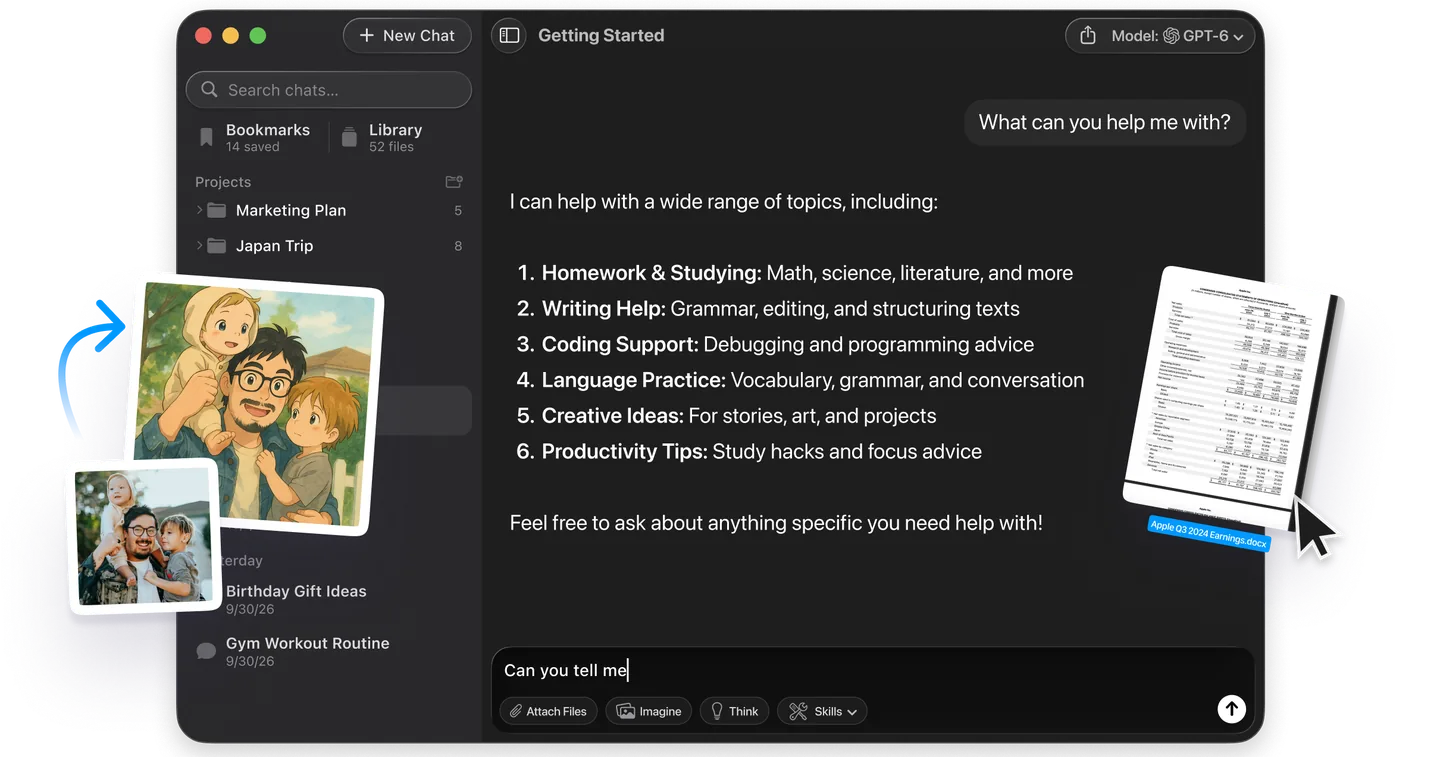
That portfolio is why her name carries so much weight in the industry. The models she helped ship are the same families that now power everyday AI apps, including Fello AI on the Mac, which lets you reach ChatGPT, Claude, Gemini, Grok and DeepSeek from one desktop app at a single price. Murati’s defining skill was never raw research alone, it was turning research into something people could actually use.
Why Did Mira Murati Leave OpenAI?
Murati announced her departure in September 2024, after six and a half years at the company. In her public note she framed it as a personal choice, saying she wanted to “create time and space to do my own exploration,” and that the moment felt right to step away. She had already lived through one of the most chaotic stretches in the company’s history.
The context mattered. Her exit followed a turbulent year of internal tension over the pace of product launches and safety reviews, and it landed the same day two other senior leaders, chief research officer Bob McGrew and research VP Barret Zoph, also announced they were leaving, as Fortune reported. A year earlier, during the November 2023 board crisis that briefly ousted Sam Altman, Murati had been named interim CEO for three days before Altman returned. By late 2024, the pull toward building something of her own had clearly won.
What Is Thinking Machines Lab?
When Murati finally launched her own company, she did it at a scale almost no first-time founder reaches. The team she recruited and the money she raised made the lab’s ambitions clear from day one.
The Founding Team and Mission
Thinking Machines Lab is the AI research company Murati founded in February 2025. She assembled a heavyweight founding team that included John Schulman, an OpenAI co-founder, along with former OpenAI leaders Barret Zoph and Lilian Weng. The pitch was simple and ambitious, build frontier AI that is more collaborative and more customizable than today’s closed systems, with research shared more openly. Structuring the company as a public benefit corporation with Murati holding weighted voting control was meant to keep that mission insulated from short-term investor demands.
The $2 Billion Seed Round
The funding matched the ambition. In July 2025 the lab raised about $2 billion at a $12 billion valuation in a seed round led by Andreessen Horowitz, with backers including Nvidia, AMD, Cisco and Jane Street. In an unusual touch, the government of Albania, Murati’s home country, invested roughly $10 million, a nod to the national pride she has come to represent. The company later sought a far larger round before investors passed, leaving it back at its original $12 billion valuation by 2026.
What Is Mira Murati Doing Now?
After more than a year of near-silence, Murati spent late 2025 and 2026 showing what the lab had been building. Two things define its direction so far, a developer tool that is already in the wild and a bold bet on a new kind of model.
Tinker: The Lab’s First Product
After roughly 18 months operating quietly, Murati returned to the spotlight on June 4, 2026, in a Bloomberg Tech interview in San Francisco, her first major appearance in about a year and a half. The lab’s first product, Tinker, had shipped in October 2025 as an API for fine-tuning open-weight language models, letting developers customize frontier models on the lab’s own infrastructure. It was a deliberate first step, useful to researchers and developers rather than a flashy consumer launch.
Interaction Models: A New AI Category
The bigger reveal was a new category she calls “interaction models.” Instead of the usual turn-based prompt-and-response loop, these systems are designed to process continuous streams of audio, text and video in roughly 200-millisecond intervals, capturing the interruptions, corrections and pauses of real human conversation. Murati declined to give release dates and shrugged off recent staff departures as normal for a young frontier lab. The direction is clear, she wants to change how people talk to machines, not just what the machines can say.
Mira Murati’s Net Worth and Personal Life
Murati’s success has made her wealthy on paper and intensely watched, yet she gives away very little about her private life. Here is what is actually known about her finances and her family, and what remains unconfirmed.
How Much Is Mira Murati Worth?
Estimates of Murati’s net worth cluster around $1.4 billion in 2026, driven almost entirely by her founder’s stake in Thinking Machines Lab and its multibillion-dollar valuation. Those figures are unverified, come from secondary sources rather than disclosures, and should be read as rough estimates that vary widely. Her wealth is on paper, tied to a private company, not cash in the bank, and it would rise or fall with the lab’s next valuation.
Is Mira Murati Married?
Murati is famously private about her personal life. She rarely discusses her family beyond noting that she grew up in Albania, and she keeps her relationships out of public view. Reports of a 2025 wedding circulated but were never publicly confirmed by Murati herself, and she has not named a husband or partner. That guardedness is deliberate, and it stands in sharp contrast to the very public nature of the products she has built. For readers comparing today’s AI leaders, her story sits naturally alongside those of Anthropic’s Daniela Amodei, former OpenAI colleague Andrej Karpathy, and DeepMind co-founder Demis Hassabis, with the wider field mapped out in our guide to the best AI models.
Conclusion
Mira Murati’s career is a study in turning research into products that reach everyone, first at OpenAI and now at her own lab. Whether Thinking Machines Lab and its interaction models reshape how we use AI is still an open question, but few founders bring her track record to the attempt. If you want to try the kinds of models she helped pioneer, start with Fello AI and keep an eye on Thinking Machines Lab over the next year.
FAQ
How old is Mira Murati?
Mira Murati was born on December 16, 1988, in Vlorë, Albania, which makes her 37 years old in 2026.
Where is Mira Murati from, and is she Indian?
She is Albanian-American, born and raised in Vlorë, Albania. She is not Indian, a common mix-up online; her roots are Albanian.
Why did Mira Murati leave OpenAI?
She left in September 2024 after six and a half years, saying she wanted to “create time and space to do my own exploration.” Her exit followed a turbulent year and came the same day two other senior leaders announced departures.
Is Mira Murati married?
Murati keeps her personal life private and has not publicly named a husband or partner. Reports of a 2025 wedding were never confirmed by her, so any claim about a spouse remains unverified.
What is Mira Murati’s net worth?
Estimates put it around $1.4 billion in 2026, based largely on her stake in Thinking Machines Lab. These figures are unverified and vary between sources.