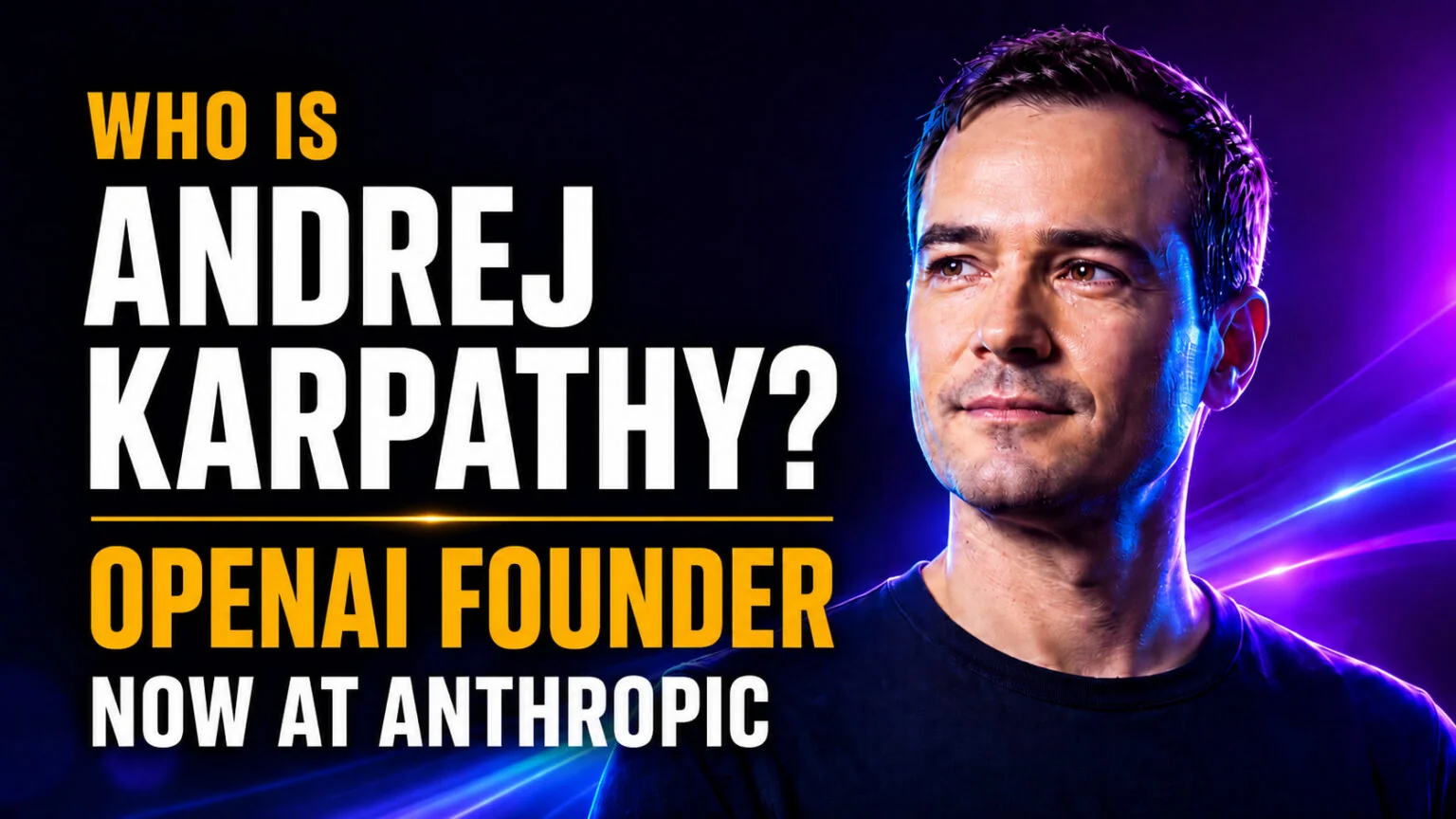
Andrej Karpathy is one of the most influential figures in modern artificial intelligence, a founding member of OpenAI, the former director of AI and Autopilot Vision at Tesla, and the founder of the AI-education startup Eureka Labs. In May 2026 he made headlines by joining rival lab Anthropic, the maker of Claude, to work on the pre-training team behind its frontier models. Along the way he coined the term “vibe coding,” wrote the widely cited essay “Software 2.0,” and built some of the most-watched AI courses on the internet.
This guide covers who Andrej Karpathy is, his full career timeline from OpenAI to Tesla and back, why his move to Anthropic matters, and the ideas that made him famous. You will also find his recent open-source work like nanochat and autoresearch, his views on AI agents, and straight answers on his age, education, and estimated net worth.
The Key Takeaways
- Born October 23, 1986 in Bratislava; a Slovak-Canadian AI researcher, now 39.
- Founding member of OpenAI (2015–2017) and Tesla’s AI director (2017–2022), where he led Full Self-Driving.
- Founded Eureka Labs in 2024 and joined Anthropic in May 2026 on its pre-training team.
- Coined “vibe coding” and authored the influential “Software 2.0” essay.
- His net worth is estimated at $50 million to $100 million, though he has never disclosed a figure.
Who Is Andrej Karpathy?
Andrej Karpathy is a Slovak-Canadian AI researcher born on October 23, 1986 in Bratislava, which makes him 39 years old. He is best known for his work in deep learning and computer vision, and for explaining hard AI ideas in a way ordinary people can follow. He has been named to the TIME100 Most Influential People in AI, and his tutorials reach millions of developers.
His academic path runs through three countries. He earned a bachelor’s degree in computer science and physics at the University of Toronto, a master’s at the University of British Columbia, and a PhD from Stanford under Fei-Fei Li, focusing on the intersection of computer vision and natural language. While at Stanford he created and taught CS231n, the university’s first deep learning course and still one of its most popular.
Andrej Karpathy’s Career Timeline
Karpathy has moved between the biggest names in AI, often at pivotal moments. Here is the full path from OpenAI to Tesla and on to Anthropic.
| Years | Role | Organization | Focus |
|---|---|---|---|
| 2015–2017 | Founding member | OpenAI | Deep learning, computer vision research |
| 2017–2022 | Director of AI / Autopilot Vision | Tesla | Full Self-Driving and Autopilot |
| 2023–2024 | Researcher | OpenAI (return) | Large language models |
| 2024–present | Founder | Eureka Labs | AI-native education |
| 2026–present | Researcher | Anthropic | Pre-training for Claude |
Karpathy first joined OpenAI as a founding member in 2015, then left in 2017 to lead AI at Tesla, where he ran the Autopilot Vision team and the company’s Full Self-Driving effort. He stepped away from Tesla in 2022, returned to OpenAI for about a year, and then struck out on his own. The through-line in his career is a focus on teaching machines to see and, increasingly, on teaching people to build AI.
Why Did Andrej Karpathy Leave Tesla and OpenAI?
Karpathy left Tesla in 2022 after five years building its self-driving stack, saying he wanted to return to his long-term passion for AI research and education rather than a single product. He rejoined OpenAI in 2023, but stayed only about a year before leaving again in 2024 to start his own company. His departures have been amicable, framed each time as a pull toward research and teaching rather than a falling-out.
What Is Eureka Labs?
Eureka Labs is the AI-education company Karpathy founded in July 2024, built around the idea of an “AI-native” school where an AI teaching assistant guides students through course material. Its flagship course, LLM101n, walks learners through building their own small language model, a “Storyteller AI,” from scratch using Python, C, and CUDA. The goal is to make training a real model approachable for individuals, not just big labs.
Why Did Andrej Karpathy Join Anthropic?
On May 19, 2026, Karpathy announced he had joined Anthropic, the company behind Claude, sending a jolt through the AI world given his OpenAI roots. He is working on the pre-training team under team lead Nick Joseph, the group responsible for the massive training runs that give Claude its core knowledge and capabilities. He is also helping launch a new effort focused on using Claude itself to accelerate pre-training research.
The optics are hard to miss. A founding member of OpenAI now helps train its fiercest rival’s models.
In his own words, Karpathy said he believes “the next few years at the frontier of LLMs will be especially formative” and that he was excited to get back to hands-on research and development. The move reads as a vote of confidence in Anthropic’s research direction, and it lands amid an intense talent war between the top labs. If you want the bigger picture of how these two companies stack up, see our breakdown of Anthropic vs OpenAI.
What Is Vibe Coding? Karpathy’s Big Ideas
Vibe coding, a term Karpathy popularized, describes building software by telling an AI model what you want in plain language and letting it write most of the code. Instead of hand-writing every line, you guide and steer the model, leaning on its output and your own judgement. The phrase caught on fast and now shows up everywhere from startup demos to job descriptions. If you want to try the workflow yourself, our guide to the best free AI for coding is a good place to start.
His other landmark idea is “Software 2.0,” a 2017 essay arguing that neural networks represent a new kind of programming. In this view the “code” is no longer written by hand but learned, with a model’s trained weights doing the work that explicit instructions used to do. The framing became a standard reference for how the industry thinks about machine learning, and it still shapes how engineers describe what AI is doing to their craft.
Karpathy’s Recent Work: nanochat, Autoresearch, and LLM Knowledge Bases
Karpathy stays famous partly because he keeps shipping. His project nanochat, billed as “the best ChatGPT that $100 can buy,” is a minimal, readable codebase that trains a small chat model end to end so people can see exactly how the pieces fit together. In March 2026 he released autoresearch, a roughly 630-line tool that lets AI agents run their own machine-learning experiments on a single GPU. Left running for about two days, the agent found around 20 changes that improved the model and cut training time to a GPT-2 benchmark by about 11 percent.
In April 2026 he sparked another wave with a post, seen more than 16 million times, arguing that people should stop treating language models only as chatbots or code generators. Instead, he suggested using them to compile raw information into living, interlinked Markdown knowledge bases, sometimes called an “LLM wiki.” He said he had shifted a large share of his own AI usage from manipulating code to organizing knowledge this way. To go deeper on building skills like this, see our guide on how to learn AI.
Why Karpathy Says AI Agents Need a “Decade”
Despite the hype around autonomous AI, Karpathy is a measured voice. On the Dwarkesh Podcast he argued that fully working AI agents will take about a decade to arrive, because today’s systems lack enough intelligence, multimodality, and continual learning to be trusted with real tasks. He also published what many called an open letter to software engineers, admitting he had “never felt this much behind as a programmer” as the profession is “dramatically refactored” by agents, prompts, and new tooling. His point is that the job is changing fast, not that engineers are obsolete.
Andrej Karpathy’s Net Worth and Personal Life
Karpathy has never publicly disclosed his finances, so any figure is an estimate. Independent profiles place his net worth between $50 million and $100 million, built from senior roles at OpenAI and Tesla, equity, and his own ventures. Treat that range as a rough guide rather than an official number.
He keeps his private life out of the spotlight, and there is no public record of a wife or partner. What he shares openly is his work, most of it free, from YouTube deep-dives like building a GPT from scratch to open-source repositories anyone can study. That generosity with knowledge is a big reason his name carries so much weight in AI.
The Bottom Line
Andrej Karpathy matters not just for where he has worked, OpenAI, Tesla, and now Anthropic, but for how he has shaped the way people understand AI. He turns frontier research into ideas and tools that ordinary developers can actually use, and his move to Anthropic signals where he thinks the next breakthroughs will come from. To see the founders building alongside him, read our profiles of Sam Altman and Anthropic CEO Dario Amodei, plus co-founder Daniela Amodei, former OpenAI CTO Mira Murati, alongside DeepMind co-founder Demis Hassabis on the Google side of the race, plus DeepSeek founder Liang Wenfeng driving the open-source push from China. For the head of Microsoft AI, see Mustafa Suleyman.
You do not need to pick a single lab to benefit from their work. With Fello AI you can use Claude, ChatGPT, Gemini, Grok, and DeepSeek side by side on your Mac for one monthly price, so you always have the best model for the task in front of you.
FAQ
Is Andrej Karpathy a co-founder of OpenAI?
Yes. Karpathy was a founding member of OpenAI in 2015, left in 2017 for Tesla, briefly returned in 2023, and is now at Anthropic.
What is Andrej Karpathy doing now?
As of May 2026 he works on Anthropic’s pre-training team, the group that trains the Claude models, while continuing his education work through Eureka Labs.
What is vibe coding?
Vibe coding is a term Karpathy popularized for building software by describing what you want in natural language and letting an AI model write most of the code while you guide it.
How much is Andrej Karpathy worth?
He has never disclosed a figure. Independent estimates put his net worth in the range of $50 million to $100 million.
Where is Andrej Karpathy from?
He was born in Bratislava, Slovakia, in 1986 and is a Slovak-Canadian citizen who studied in Canada and the United States.