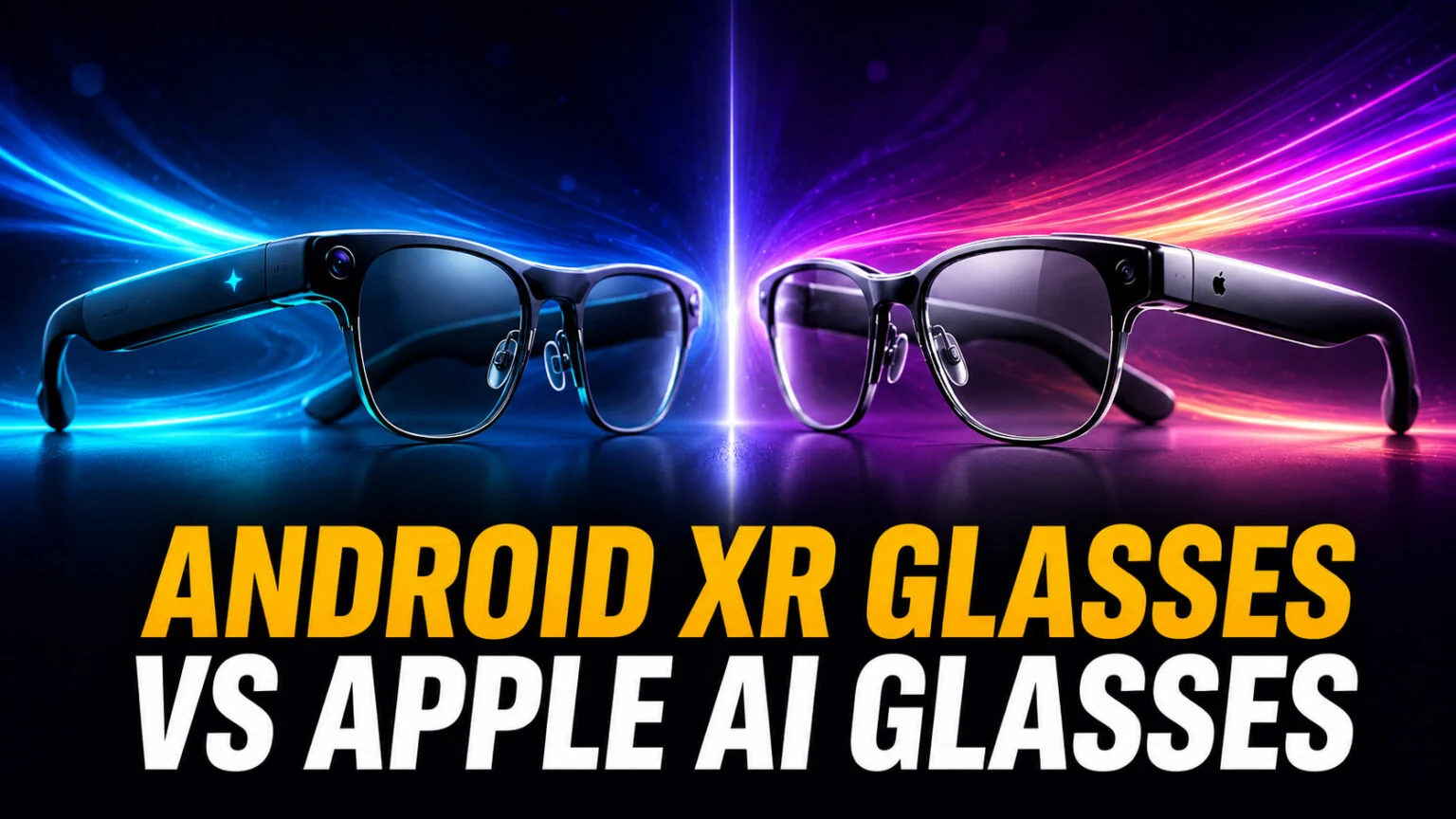
The smart glasses race just got real. Google and Samsung unveiled their Android XR glasses at Google I/O 2026 on May 19, and they are now on pre-order from $395 for a 10 December 2026 release, with partnerships with Warby Parker and Gentle Monster, and Gemini AI built into every interaction. Apple’s answer, code-named N50, is still roughly a year away, with Bloomberg’s Mark Gurman pegging a 2027 launch and production starting at the end of 2026.
That roughly 9 to 12 month gap is the entire story. If you want AI glasses on your face this year, Android XR is the only ticket, and yes, it works with iPhone. If you live deep inside the Apple ecosystem and can wait, Apple’s slower, pricier, more integrated approach is worth holding out for. This article breaks down both products side by side, covering release windows, hardware, AI, ecosystem fit, and which one you should actually buy.
The Key Takeaways
- Android XR glasses go on sale on 10 December 2026, co-designed with Warby Parker and Gentle Monster, from $395 and $449 respectively.
- Apple AI glasses (N50) target a 2027 release, with no display in Gen 1, hand-gesture controls, and an expected $799–$1,299 range.
- Android XR glasses work with both Android and iPhone; Apple’s will require an iPhone.
- Apple skips the display in Gen 1; Android XR ships an audio-only variant on 10 December 2026, and Google has given its display version no launch window.
- Both products run on AI assistants (Gemini AI vs Siri 2.0 with Apple Intelligence), but only Apple’s is integrating directly with macOS and Vision Pro down the line.
Android XR vs Apple AI Glasses: Quick Comparison Table
| Feature | Android XR Glasses (Google + Samsung) | Apple AI Glasses (Rumored) | Notes |
|---|---|---|---|
| Release window | 10 December 2026 (pre-orders open) | End of 2027 (Bloomberg / Gurman) | Android XR ships about a year earlier |
| Price | From $395 (Warby Parker), $449 (Gentle Monster) | $799–$1,299 (estimate) | Apple skews higher, as usual |
| Display | Audio-only; display version has no launch window | No display in Gen 1 | Tied for now |
| AI assistant | Gemini AI (Google has not named the model version) | Siri 2.0 + Apple Intelligence | Edge: Gemini today, Apple closing fast |
| Cameras | Yes (audio variant has cameras + mic) | Two cameras (high-res + gesture sensor) | Comparable; Apple adds gesture cam |
| Hand-gesture control | Not announced | Yes (primary input method) | Edge: Apple |
| iPhone compatibility | Yes (works with iOS and Android) | iPhone required | Edge: Android XR (universal) |
| Frame design | Warby Parker, Gentle Monster | Four in-house acetate styles | Tie |
| Chip | Qualcomm Snapdragon | Apple silicon (custom) | Apple’s first wearable chip |
| OS | Android XR | iOS 27 / new wearables OS | Different ecosystems |
Android XR Glasses: Shipping Fall 2026
Google’s Android XR is the platform behind Samsung’s Project Moohan headset, and now it’s getting its first true everyday wearable. The May 19, 2026 keynote at I/O confirmed what the rumor mill had been chasing for months: Samsung built the hardware, Google built the AI layer, and two well-known eyewear brands are designing the frames.
Design partners: Warby Parker and Gentle Monster
Google explicitly named Warby Parker for “refined and timeless designs” and Gentle Monster for “disruptive yet refined aesthetics.” Both brands plan to launch full collections later in 2026, which means several frame styles at launch instead of a single hero SKU. This is the same playbook Meta used with Ray-Ban, and it’s the right call, since smart glasses fail when they look like smart glasses.
Two versions, but only one this year
Samsung is shipping the audio-only variant first, on 10 December 2026. It comes with cameras, a microphone, and speakers, but no screen. A second variant with a small in-lens microdisplay for turn-by-turn navigation, messages, and contextual info is on the roadmap, but Android Authority reports that it won’t ship this year and has no firm launch window. Apple is skipping a display entirely in Gen 1.
Gemini AI features that were demoed
Google’s I/O demo leaned hard on Gemini AI’s real-time skills. The showcase, recapped by 9to5Google, included voice-activated navigation, live text and audio translation (with voice matching), notification summaries, calendar management, restaurant ordering through DoorDash, and Nano Banana-powered photo edits captured straight from the glasses. If you want the full Gemini story from this year’s keynote, our Gemini 3.5 review breaks down the model side of that story.
Pricing and compatibility
Google announced pricing on 12 November 2026: the glasses, sold as Intelligent Eyewear, start at $395 for Warby Parker frames and $449 for Gentle Monster frames, before lens upgrades. Pre-orders are open now, and the glasses go on sale on 10 December. They support both Android phones and iPhones, which matters: an iOS user can buy Android XR glasses without leaving Apple’s phone ecosystem, though some features are Android-only at launch. Our Google AI glasses guide covers which iPhones work and what iPhone owners give up.
Apple AI Glasses: Targeting 2027
Apple’s strategy is the opposite of Google’s. No I/O moment, no design partners, no on-stage demo. The story is being told through Bloomberg’s Mark Gurman, MacRumors, and AppleInsider, one rumor at a time. Production is targeted for the end of 2026, with a public launch in 2027.
The N50 codename and frame strategy
The internal code name is N50. Apple is currently testing four frame styles in acetate, a plant-based, lightweight material that flexes better than plastic. Reported styles include a large rectangular (Ray-Ban Wayfarer-inspired), a slim rectangular, a large oval, and a smaller refined oval. Color options reportedly include black, ocean blue, and light brown. We’ve covered the full lineup, materials, and design tradeoffs in our Apple AI Glasses breakdown.
No display, but hand gestures
Apple is skipping the display for Gen 1. No microdisplay, no AR overlay, no LiDAR, no 3D cameras. The bottleneck, per Bloomberg, is battery life. Instead, Apple is leaning on two cameras: a high-resolution sensor for photos and video, and a lower-resolution wide-angle lens dedicated to reading hand gestures. This is the same approach Vision Pro uses for input, and it’s the feature Android XR hasn’t matched.
Apple Intelligence and Siri 2.0
The glasses will run an upgraded version of Siri, often called Siri 2.0, powered by Apple Intelligence and shipping as part of iOS 27. The pitch is contextual awareness without a screen: ask Siri what you’re looking at, get answers, take photos, place calls, translate signs, and identify plants or landmarks. WWDC 2026 in June is where Apple will likely tease the broader iOS 27 + Siri 2.0 story, and our WWDC 2026 preview laid out the keynote expectations, and our WWDC 2026 recap covers what Apple actually announced.
Expected price and timing
Pricing is unconfirmed. Industry tracking puts the expected range at $799–$1,299, comfortably above Ray-Ban Meta’s $349 starting price on Meta’s US store (12 November 2026) and above Android XR’s confirmed $395 start. Bloomberg’s Mark Gurman reported in July 2026 that Apple is aiming to reveal the glasses at WWDC 2027 and sell them by the end of 2027. Ming-Chi Kuo expects 2027 at the earliest, with some risk of slipping to 2028 if Apple Intelligence development hits delays.
Android XR vs Apple AI Glasses: Five Key Differences
Five differences will decide which platform wins your face.
1. Ship date. Android XR ships on 10 December 2026. Apple ships 2027, potentially 2028 if delayed. If you want glasses this year, there is no Apple option.
2. Display. Android XR’s audio-only glasses go on sale on 10 December 2026 with no screen. Google has a display version in development but no launch window for it. Apple’s Gen 1 has no display at all and Gen 2 with an in-lens display is rumored for 2028. Neither company is putting a screen on your face in 2026.
3. AI assistant. Gemini is the most capable consumer AI assistant right now, with Gemini already handling live translation (delivered through Google Translate) and Nano Banana photo edits on the glasses. Siri 2.0 is the bet Apple needs to make work; it shipped with iOS 27 on September 14, 2026, but Apple still labels Siri AI a beta, so the gap is real.
4. Ecosystem. Android XR is cross-platform (works with iPhone). Apple AI glasses require an iPhone, but in return you get integration with Mac, Apple Intelligence, Photos, Messages, and Find My. Apple sacrifices reach for depth.
5. Price. Android XR starts at $395 (Warby Parker) and $449 (Gentle Monster). Apple’s estimates sit at $799–$1,299. If they hold, Apple’s glasses would cost roughly $400 to $850 more.
Should You Buy Android XR or Wait for Apple?
Here’s the honest answer for an iPhone user reading this in November 2026.
Buy Android XR now if you want the experience now, cross between Android and iOS, want live translation today, or don’t want to wait 12+ months for Apple. Android XR works with iPhone, so leaving the iOS ecosystem isn’t required, and the Gemini AI experience is strong right now.
Wait for Apple in 2027 if you live entirely inside the Apple ecosystem, care about Mac and Vision Pro integration down the line, want hand-gesture controls (Apple is the only one shipping them), prefer Apple’s privacy stance, or don’t trust first-gen products from any company. There’s also a strategic reason to wait. Apple’s Gen 2 in 2028 is rumored to add an in-lens display, on roughly the same timeline as Google’s 2027 microdisplay variant, which means Apple’s catch-up window is under two years.
For most FelloAI readers, the smarter move is to wait for Apple unless you have a specific use case (translation, accessibility, navigation) that Android XR solves now. The Apple ecosystem moat is real, and a $395 first-gen pair you replace in 18 months is rarely a good purchase.
What This Means for the Smart Glasses Market
Meta has had this category to itself for two years with Ray-Ban. That’s about to end. By Fall 2026, three major platforms will be competing: Meta Ray-Ban (cheap, social-first, no AI moat), Android XR (Gemini-powered, Samsung-built, fashion partnerships), and from 2027, Apple AI glasses (premium, iPhone-locked, gesture-driven). The result is a fast-moving market where prices will compress, AI features will leap-frog quarterly, and the platform with the best assistant will pull ahead.
Right now, that assistant edge belongs to Gemini. Apple Intelligence has work to do: Siri AI shipped with iOS 27 in September 2026 but is still labelled a beta, and it has to mature for the 2027 glasses to compete on AI rather than ecosystem alone. If you want to track the Gemini lineup behind the Android XR glasses, our Gemini 4 tracker covers the Gemini 4 models and what comes next. And if you’re price-sensitive on the Gemini side, the Gemini pricing breakdown shows what the full ecosystem costs today.
The Bottom Line
Android XR glasses ship first, work everywhere, and have the better AI today. Apple AI glasses ship later, cost more, and offer deeper iPhone, Mac, and gesture integration, but only if you can wait until 2027. The honest answer for most iPhone users: wait for Apple unless you have a specific Android XR feature you need now. The honest answer for most Android users: pre-order Android XR for 10 December and don’t look back. Whichever way you go, the smart glasses category is finally past the gimmick phase.
FAQ
When are Android XR glasses coming out?
Pre-orders opened on 12 November 2026, and the glasses, sold as Intelligent Eyewear, go on sale in stores and online on 10 December 2026. They only work with Google accounts from the US and South Korea.
When will Apple release its AI glasses?
Apple’s AI glasses, code-named N50, target a 2027 release, with production starting in late 2026. Bloomberg’s Mark Gurman is the primary source; analyst Ming-Chi Kuo expects 2027 at the earliest, potentially slipping to 2028.
Do Android XR glasses work with iPhone?
Yes. The Android XR platform supports both Android and iOS, so iPhone users can buy the Samsung-built Android XR glasses without switching phones. Google lists iPhone 13 Pro and above, and Guided Vision, Aira and Audible are Android-only at launch.
Will Apple AI glasses have a display?
No, not in the first generation. Apple is prioritizing battery life and a lightweight frame. A Gen 2 model with an in-lens display is rumored for 2028.
How much will Android XR and Apple AI glasses cost?
Android XR glasses start at $395 (Warby Parker) and $449 (Gentle Monster), confirmed by Google. Apple AI glasses are expected at $799–$1,299, which Apple has not confirmed.
What AI do these glasses use?
Android XR glasses run Gemini AI; Google has not said which Gemini model version powers them, and live translation runs through the Google Translate app. Apple AI glasses will run Siri 2.0 with Apple Intelligence, shipping as part of iOS 27.
A imagem de destaque deste artigo foi criada com a ajuda de IA.