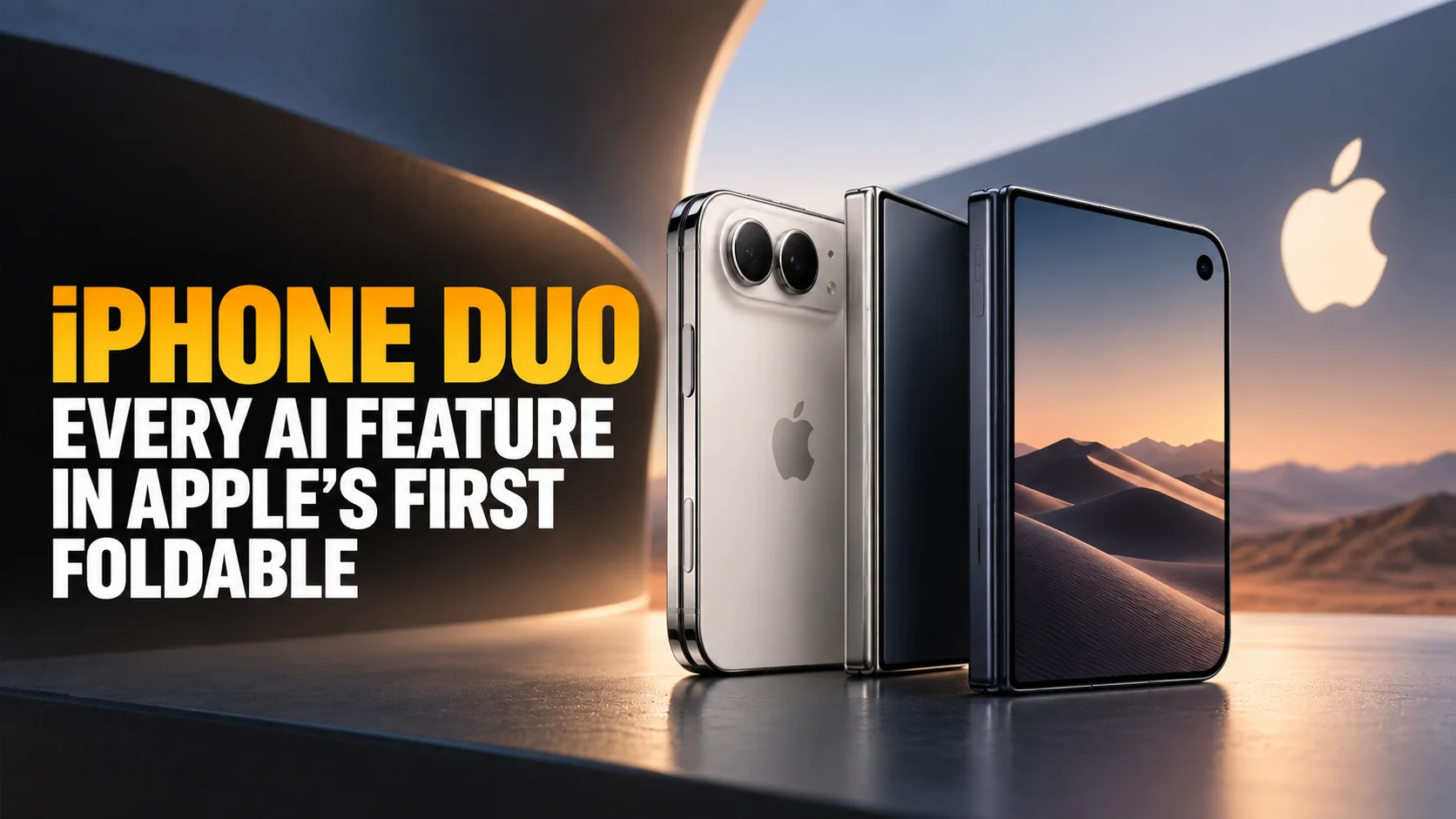
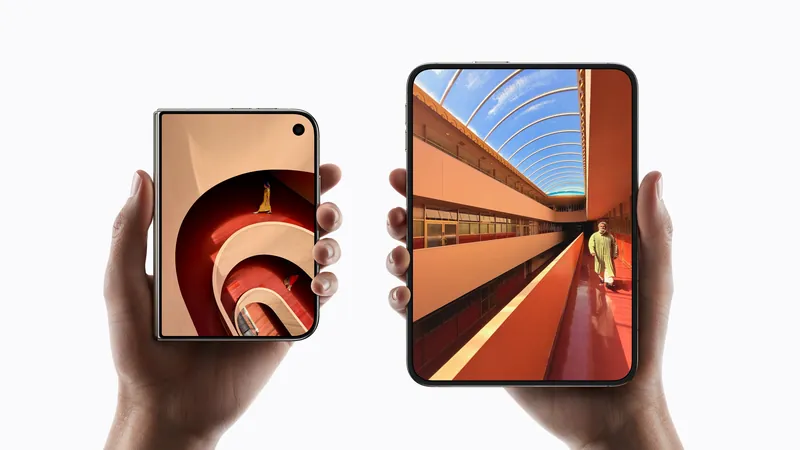
The iPhone Duo is Apple’s first foldable iPhone, announced on 9 September 2026. It opens to a 7.6-inch inner display and folds shut to a 5.4-inch outer screen, runs the A20 Pro chip, and starts at $1,999 for 256GB. Pre-orders open on Friday 16 October and it ships on Friday 23 October.
Almost every review you will read this week is organised by hinge, crease and camera sensor, which is fair enough for a folding phone. This one is organised around a different question, because the Duo runs the same chip as the iPhone 18 Pro. Identical silicon, identical Neural Engine. Which means every AI difference between a $1,999 foldable and a $1,199 Pro comes from the shape of the thing, not from its processor. That turns out to be a more interesting story than the hinge, and it cuts in both directions: there are AI features here that exist on no other iPhone, and there are two headline ones the Duo does not get at all.
The Key Takeaways
- $1,999 for 256GB, rising to $3,199 for 2TB. Pre-orders 16 October, in hand 23 October, roughly five weeks after the iPhone 18 Pro.
- Three camera features run on-device AI no other iPhone has: Smart Take, Duo Preview and Kid Cue. All three exist only because there is a screen on the back.
- Split View is the first time two apps have ever run side by side on an iPhone, and Siri AI can occupy one half while you work in the other.
- The A20 Pro is the same chip as the iPhone 18 Pro’s, with the same Dual 16-core Neural Engine and the same doubled AI compute. The fold is the differentiator, not the silicon.
- The Duo does not get Apple Reference Image or variable aperture. Both are iPhone 18 Pro exclusives, and the cheaper phone is the one that has them.
- Siri AI is not available in the EU at launch, and it is an English-only beta everywhere else until October.
What the iPhone Duo Costs and When You Can Buy It
Most coverage prints the $1,999 entry price and stops. The full ladder matters more than the headline, because the gap between the cheapest Duo and the cheapest iPhone 18 Pro is $800, and the gap at the top is the same $800 carried all the way up.
| Storage | iPhone Duo | iPhone 18 Pro | iPhone 18 Pro Max |
|---|---|---|---|
| 256GB | $1,999 | $1,199 | $1,299 |
| 512GB | $2,199 | $1,399 | $1,499 |
| 1TB | $2,599 | $1,799 | $1,899 |
| 2TB | $3,199 | $2,399 | $2,499 |
Those are Apple’s own listed US prices, before trade-in and before carrier credit. The Duo comes in two colours, star white and night sky, in grade 5 titanium polished to a mirror finish, with a 3D-printed hinge cover. The case is $79 and the Folio with the kickstand is $129.
Three Dates, Not One
Pre-orders open at 5 a.m. Pacific on Friday 16 October in more than 70 countries. General availability is Friday 23 October. A second wave of 28 more countries follows on Friday 30 October. That is a slow, deliberate rollout by iPhone standards, and it puts the Duo more than a month behind the iPhone 18 Pro, which reaches buyers on 18 September.
The practical consequence is good for you. By the time you can pre-order, independent reviewers will have had the phone for weeks, and the durability questions that matter most on a first-generation foldable will have real answers rather than press-release ones.
The AI Features No Other iPhone Has
This is the part the hardware coverage skips, and it is genuinely novel. A conventional phone has a camera on one side and a screen on the other, so the person taking the photo cannot see what the subject sees, and the subject cannot see the frame. The Duo has a screen on both sides. Apple built three AI features into that gap.
Smart Take
Smart Take is a camera mode that removes the need for a self-timer. On-device AI models running on the A20 Pro analyse the scene in real time and fire the shutter automatically when they see subjects posing, so the person who would normally be holding the phone can be in the photo instead. You prop the Duo up, you walk into the shot, and it decides when the picture is ready.
It is the clearest example on the whole device of AI doing something small and genuinely useful rather than something impressive and abstract. Everyone has a run of eleven near-identical burst photos where one person is blinking and the photographer is missing entirely. This is the fix. Apple lists Smart Take on both the rear camera system and the outer front camera, so it works in both directions.
Duo Preview and Kid Cue
Duo Preview puts a live camera preview on the outer display while you shoot from the other side. The subject can see their own framing and adjust, which also means you can take a selfie with the far better rear cameras instead of the front one, and still see what you are doing. On any other phone that is a straight trade between image quality and being able to see yourself. Here it is not a trade at all.
Kid Cue plays Peanuts animations on the outer display to get small children to look at the camera. It is not a serious feature and it is not pretending to be. It will also be the single most-used feature on this phone in a lot of households.

Siri AI Beside Whatever You Are Doing
The Duo is the first iPhone that can run two apps side by side. Apple calls it Split View, it has existed on the iPad for a decade, and its arrival on a phone changes what an assistant is for. You can hold a conversation with Siri AI on one half of the inner display while reading, editing or shopping in the other half, without either one covering the other up.
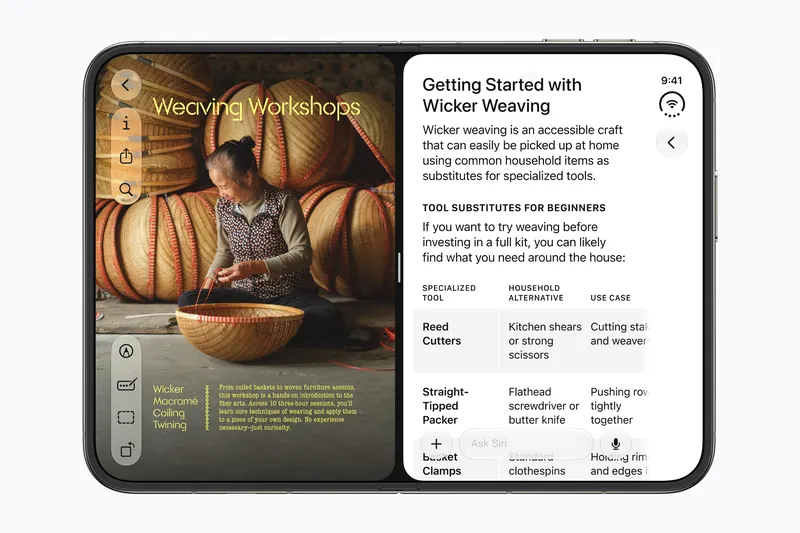
That sounds minor and is not. Every phone assistant until now has been a modal interruption: it takes the screen, you ask, it answers, it goes away, and you return to what you were doing and try to remember the answer. Side by side, an assistant becomes something you work next to. You can also open two windows of the same app, swap sides, and save app pairs to reopen later.
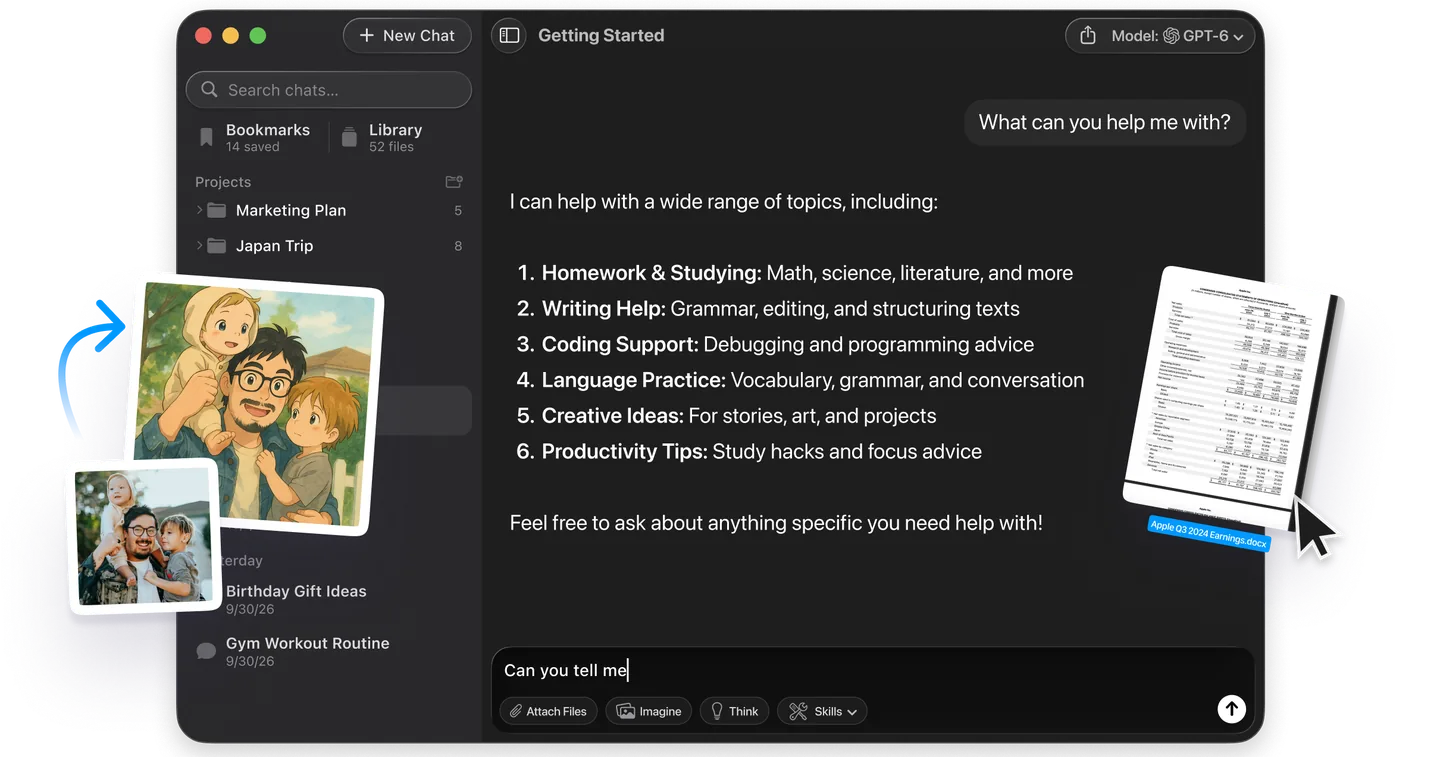
There is an obvious limit, and it is worth naming: Split View gives you one assistant, the one Apple ships. If the reason you want a second pane is to put a model next to your work, that is exactly the problem Fello AI was built around, and it already runs on iPhone and iPad with synced chats, with several models behind one interface rather than one vendor’s assistant behind a system gesture. Fello AI will support iPhone Duo from day one, so the second pane can hold Claude, ChatGPT, Gemini, Grok or DeepSeek on 23 October rather than whenever an update arrives. That matters most in the EU, where Siri AI is not available at launch at all.
Siri Camera Mode
Camera Control on the side of the Duo launches straight into Siri Camera mode, which lets Siri see what you see, answer questions about it and act on it. This one is not a Duo exclusive, and Apple ships the same capability on the iPhone 18 Pro. It is listed here because the Duo gives it a dedicated hardware button, which is the difference between a feature you remember exists and one you actually use. The Pro’s side of the same list is in the iPhone 18 Pro’s own AI feature inventory.
Which iPhone Actually Gets Which AI
Here is the split nobody is publishing. Some of this is exclusive to the foldable, some is exclusive to the Pro, and a surprising amount of it lands free on the iPhone you already own.
| Feature | iPhone Duo | iPhone 18 Pro | Existing Apple Intelligence iPhones |
|---|---|---|---|
| Smart Take | Yes | No | No |
| Duo Preview | Yes | No | No |
| Kid Cue | Yes | No | No |
| Siri AI in Split View | Yes | No | No |
| Apple Reference Image | No | Yes | No |
| Variable aperture | No | Yes | No |
| Siri Camera mode | Yes | Yes | No |
| Siri AI | Yes | Yes | Yes |
| Spatial Reframing, Extend, Clean Up | Yes | Yes | Yes |
| Photorealistic Image Playground | Yes | Yes | Yes |
| Safari Notify Me | Yes | Yes | Yes |
Read the bottom half of that table before you spend $1,999. Siri AI, the rebuilt Photos editing tools, the photorealistic Image Playground and Safari’s Notify Me all arrive as a free software update on 14 September on any iPhone that supports Apple Intelligence. None of it is a reason to buy new hardware. Our guide to using Apple Intelligence covers what those tools actually do.
The Two Features the Duo Does Not Get
This is the most surprising thing in Apple’s own materials, and it is verifiable in two places: neither the iPhone Duo press release nor the iPhone Duo technical specifications page mentions Apple Reference Image or variable aperture even once. Both are iPhone 18 Pro exclusives, and both depend on the new Main camera hardware that the Duo does not have.
Apple Reference Image is the more consequential absence. On the iPhone 18 Pro, a new sensor signs every pixel it captures, Private Cloud Compute develops that signed data into an unalterable reference photo, and the Photos app shows it beside the edited version like a digital negative. It is Apple’s answer to the question of whether a photograph is real, aimed at photojournalists first. If you care about proving an image is authentic, the $1,199 phone does it and the $1,999 phone does not.
Two caveats sit in Apple’s footnotes and they matter a great deal depending on where you live. Reference mode is opt-in rather than always on. It is not available at launch in China for regulatory reasons, and in the EU the capture side is not available at launch on iPhone 18 Pro models, although developing and viewing reference images still works. If you are buying in Europe, the feature that separates these two phones is one you cannot yet use to take a photo.
Support for SynthID, Google DeepMind’s watermarking standard for AI-generated images, is a separate matter and is not a Pro exclusive. Apple says it arrives “in a software update later this year” and will be included for most edited images depending on the edits applied, and it is listed for the Duo and the iPhone 18 Pro alike. Apple adopting a Google standard for identifying AI images is the quietest and possibly most consequential thing in either announcement.
Siri AI Is an English-Only Beta Until October
Apple is unusually plain about this in the small print, and almost nobody is repeating it. Siri AI is rolling out in beta with iOS 27 on 14 September, for supported devices set to English. French, Japanese, Korean, Portuguese and Spanish arrive in October. If you buy a Duo on 23 October expecting the rebuilt Siri in German, Italian or Czech, it will not be there, even though the wider Apple Intelligence feature set supports those languages.
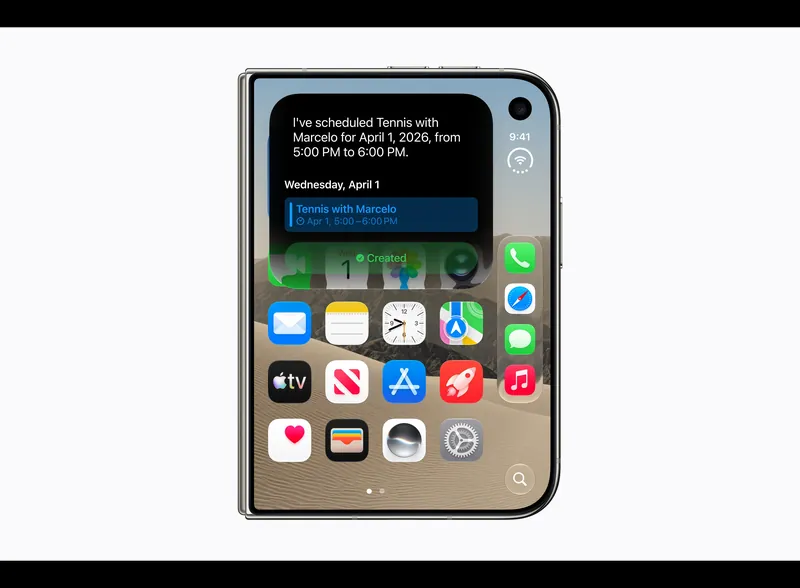
There is a larger exclusion in the same small print, and Apple has not lifted it: “Siri AI will not be available initially in the EU on iOS, iPadOS, and watchOS,” and features that rely on Siri AI are excluded there too. If you are reading this in Prague, Berlin or Dublin, the assistant that fills half of that Split View is not yours on launch day, whatever you spend. Apple says it is “working hard to find a path forward that preserves its users’ privacy and security.”
One more line worth knowing before you count on any of it daily: Apple states that Apple Intelligence features relying on server-side models, Siri AI and the intelligent photo editing tools among them, are subject to daily usage limits. Apple does not publish the numbers.
There is a second detail buried in the same footer: the Duo ships with iOS 27.1, not the iOS 27 that reaches every other iPhone on 14 September. Our iOS 27 tracker follows what lands in each release. If Siri in your language is the thing you actually want, it is worth knowing you can also replace Siri with ChatGPT, Claude or Gemini within the limits Apple has shipped.
The Chip: Identical to the iPhone 18 Pro’s
The A20 Pro in the Duo is the same part that ships in the iPhone 18 Pro. Built on a 2-nanometer process, it has a 6-core CPU with two super cores and four efficiency cores, a 7-core GPU with Neural Accelerators, hardware-accelerated ray tracing, and 50 percent more unified memory bandwidth than the A19 Pro.
The number that matters for AI is the Dual 16-core Neural Engine: 32 cores in total, which Apple says is double the AI processing power of the A19 Pro. That is the largest single-generation jump in on-device AI capability Apple has shipped in an iPhone, and it is what allows things like Smart Take to run continuously against a live camera feed without flattening the battery.
Apple claims the 6-core CPU is up to 20 percent faster than the A19 Pro and the fastest in any smartphone, and that the Duo sustains up to 35 percent better performance than the iPhone 17 Pro thanks to a custom vapor chamber and an M-series-inspired chip package. Treat the sustained-performance figures as vendor benchmarks until independent testing lands.
The Hardware Facts Worth Knowing Before You Decide
Four things about this phone will surprise people who have only read the headline, and one of them is a genuine downgrade from the Pro.
| Question | Answer |
|---|---|
| Does it have Face ID? | No. Touch ID in the side button, plus Apple Watch unlock |
| How heavy is it? | 254 grams, 5.2 mm thick open and 11.3 mm closed |
| Is there a real telephoto lens? | No. The 2x is a 12MP crop of the main sensor |
| Physical SIM? | No. eSIM only, worldwide, with no exceptions |
| Battery | Up to 31 hours video on the inner screen, 44 on the outer, 24 hours mixed use |
| Apple Pencil | Supported “later this year”, not at launch |
The camera system is a 48MP Fusion Main at 26 mm and f/1.6 with sensor-shift stabilisation, a 48MP Fusion Ultra Wide at 13 mm and f/2.2, and a 12MP Center Stage camera on the outer screen. The 2x telephoto is optical-quality rather than optical, meaning it crops the main sensor rather than using dedicated glass. On a $1,999 phone, against an iPhone 18 Pro that has both a real telephoto and a variable aperture, that is the clearest place the money is going somewhere other than the camera.
Should You Buy the Duo or the iPhone 18 Pro?
Since the chip is identical, this decision is unusually clean. You are paying $800 for a second screen and giving up two camera features to get it.
| Buy the Duo if | Buy the iPhone 18 Pro if |
|---|---|
| You carry an iPad mini as well as a phone and want to stop | The camera is the reason you buy a Pro phone |
| You want an assistant running beside your work, not on top of it | You want Apple Reference Image and provenance you can prove |
| You take a lot of group photos and are never in them | You want $800 back, or a 2TB Pro for less than a 1TB Duo |
| You are comfortable buying a first-generation folding device | You would rather let someone else test the hinge for a year |
If you are weighing the whole line-up rather than these two, our iPhone buying guide covers what is worth buying now and what is worth waiting for. And if the AI is your reason to upgrade at all, the honest answer stays the same as it was before the event: it is not, because most of it arrives free on 14 September.
What Nobody Knows Yet
Everything above comes from Apple’s own press materials and specification pages. A first-generation foldable raises exactly the questions a press release cannot answer, and it is worth being straight about which those are.
Nobody outside Apple knows how visible the crease is in ordinary use, how the hinge, built from more than 100 components, holds up after a year of opening and closing, whether the nano-textured inner display scratches in a pocket, or whether the dual-battery design delivers its claimed 24 hours in real conditions. Apple says the inner layers glide past one another like the pages of a book to relieve bend stress, and the phone carries an IP68 rating and Ceramic Shield 2 on the front. Those are design claims, not durability results.
The five-week wait before pre-orders is the useful part. Reviews will land well before 16 October, and on a device like this the reviews are the decision.
Frequently Asked Questions
What is the iPhone Duo?
The iPhone Duo is Apple’s first foldable iPhone, announced on 9 September 2026. It opens to a 7.6-inch inner display and folds shut to a 5.4-inch outer screen, runs the A20 Pro chip, and starts at $1,999 for 256GB. Pre-orders open on 16 October and it ships on 23 October.
What is Smart Take?
Smart Take is a camera mode on the iPhone Duo that removes the need for a self-timer. On-device AI models running on the A20 Pro chip analyse the scene in real time and fire the shutter automatically when they see subjects posing, so the person who would normally be holding the phone can be in the photo instead.
Does the iPhone Duo have Face ID?
No. The iPhone Duo uses Touch ID built into the side button rather than Face ID, so authentication works the same way whether the phone is open or closed. You can also unlock it with an Apple Watch. Every other current iPhone still uses Face ID.
Is the iPhone Duo’s AI better than the iPhone 18 Pro’s?
Neither is faster. Both run the same A20 Pro chip with the same Dual 16-core Neural Engine. The Duo adds camera AI that needs a second screen, such as Smart Take and Duo Preview, plus Siri AI in Split View. The iPhone 18 Pro adds Apple Reference Image, which the Duo does not have.
Do I need an iPhone Duo to get the new Siri?
No. Siri AI arrives as a free update with iOS 27 on 14 September for every iPhone that supports Apple Intelligence. It ships as a beta in English first, with French, Japanese, Korean, Portuguese and Spanish following in October. Apple states it is not available initially in the EU on iOS. The Duo itself ships later, on iOS 27.1.
How much does the iPhone Duo cost in each storage size?
Apple lists $1,999 for 256GB, $2,199 for 512GB, $2,599 for 1TB and $3,199 for 2TB in the United States, before trade-in or carrier credit. The iPhone Duo Case is $79 and the Folio with Kickstand is $129.
Does the iPhone Duo have a telephoto camera?
Not a dedicated one. Apple lists a 12MP optical-quality 2x telephoto at 52 mm, which is a crop of the 48MP main sensor rather than a separate lens. The iPhone 18 Pro is the model that gets the new variable-aperture main camera, which the Duo does not have.