Nano Banana 2.1 is Google's newest image generation and editing model, released on October 6, 2026 as an update to Nano Banana 2. Google says it beats every earlier Nano Banana model on visual design, mask-based editing and subject consistency. In the Gemini API it costs $0.0336 per 1K image, half the price of Nano Banana 2. Google deprecated Nano Banana 2 the same day and will shut it down on October 29, 2026.
The half-price headline is only part of the bill. Google tripled the input price and raised the text and thinking rate, and 2.1 now thinks harder by default. It also drops the cheap 512px size that Nano Banana 2 offered. This guide covers what changed, how 2.1 ranks against GPT Image, what it really costs, where to use it, and what developers must do before the October 29 cutoff.
The Key Takeaways
- What it is: Nano Banana 2.1 (
gemini-nano-banana-2.1) is an update to Nano Banana 2, generally available since October 6, 2026.- Price: images cost half, $0.0336 per 1K image against $0.067 for Nano Banana 2, but inputs cost triple, $1.50 per million tokens against $0.50.
- Ranking: #5 on Arena's Text-to-Image board (1328) and #6 on Image Edit as of October 6, the highest of any Google model, behind OpenAI's GPT Image 2.5 and GPT Image 2.
- Deadline: Nano Banana 2 shuts down in the API on October 29, 2026. Google names 2.1 as the replacement.
- Where to try it: the Gemini app, AI Mode in Google Search (tap the 🍌 icon), Google AI Studio, Flow, Stitch, Google Ads and the Gemini API.
What Is Nano Banana 2.1?
Nano Banana 2.1 is Google's high-efficiency image generation and conversational editing model, and the direct successor to Nano Banana 2 (Gemini 3.1 Flash Image). Google's developer documentation says it "maintains Flash-level speed and cost efficiency while delivering significant improvements in visual quality, prompt adherence, multi-turn character consistency, and text rendering." Its API name is gemini-nano-banana-2.1, and it launched straight into general availability, with no preview period.
Nano Banana 2.1 does not replace Nano Banana Pro. Google describes it as "the more efficient counterpart to Gemini 3 Pro Image (Nano Banana Pro)." The family keeps three tiers: Nano Banana 2 Lite for the cheapest images, Nano Banana 2.1 as the everyday model, and Nano Banana Pro for the hardest professional work. If the naming is new to you, our guide to what Nano Banana is explains how the brand maps onto Google's Gemini model names.
Google announced the model from its main account on X rather than with a blog post:
Meet Nano Banana 2.1, our latest image generation and editing model 🍌
— Google (@Google) October 6, 2026
This upgraded version outperforms our previous models across the board, with notable leaps in visual design, mask-based editing, and subject consistency to help you create more natural-looking images.
What’s New in Nano Banana 2.1
Nano Banana 2.1 improves five things over Nano Banana 2: image quality, editing inside a defined area, character consistency, wide and panoramic images, and how much the model reasons before it draws. These are Google's claims. The first independent votes, on Arena, put 2.1 well ahead of every earlier Nano Banana model.
Better Visual Design and Text
Google lists "improved visual quality and realism across 1K, 2K, and 4K output resolutions" and "enhanced text rendering and infographic layout accuracy" as headline updates. In practice this targets the work Nano Banana is already used for: posters, product labels, menus, diagrams and social graphics where the lettering has to be spelled correctly. Google DeepMind's Nano Banana 2 page still warns that the model "can still struggle with small faces, accurate spelling, and fine details," so proofread any text before you publish an image.
Mask-Based Editing
Mask-based editing in Nano Banana 2.1 means you change one part of an image and leave the rest untouched, by describing the area in words rather than painting a selection. Google's image generation guide calls this "semantic masking" and gives a template for it. Paste it into the Gemini app with your photo attached and fill in the brackets:
Using the provided image, change only the [specific element] to [new element/description]. Keep everything else in the image exactly the same, preserving the original style, lighting, and composition.Google's example swaps "the blue sofa" for "a vintage, brown leather chesterfield sofa" while the pillows and lighting stay put. For more patterns like this, our Nano Banana prompt guide collects tested templates for edits, restyles and text.
Subject Consistency and Reference Images
Nano Banana 2.1 accepts up to 14 reference images per request: up to 10 objects and up to 4 characters whose likeness it tries to hold across a series. Those caps match Nano Banana 2. What changes is how reliably faces and products stay recognizable over several rounds of editing, which Google calls "multi-turn character consistency." Nano Banana Pro takes fewer object references (6) but more characters (5).
Wide and Panoramic Images
Nano Banana 2.1 fixes the tiling artifacts that Nano Banana 2 produced on very wide and very tall images. Google's model page names the 1:4, 4:1, 1:8 and 8:1 aspect ratios at 2K and 4K. The fix matters for website banners, panoramic headers and tall phone wallpapers.
Thinking Is On by Default
Nano Banana 2.1 adds a medium thinking level and makes it the default. Nano Banana 2 offered only minimal and high, and defaulted to minimal, so 2.1 reasons more before it draws unless you tell it not to. That should help with crowded, multi-constraint prompts. Thinking tokens are billed, though, so the new default also nudges up the price of each image.
Nano Banana 2.1 Benchmarks: Where It Ranks on Arena
Nano Banana 2.1 is the highest-ranked Google image model on Arena, the crowd-voted leaderboard, but it does not take the top spot. As of October 6, 2026, it sits fifth on Text-to-Image with a score of 1328 from 5,312 votes, and sixth on Image Edit with 1428 from 12,985 votes. OpenAI's GPT Image 2.5 variants and GPT Image 2 lead both boards.
| Model | Text-to-Image score (rank) | Image Edit score (rank) |
|---|---|---|
| GPT Image 2.5 (sunburst, preliminary) | 1425 (#1) | 1524 (#1) |
| GPT Image 2 (medium) | 1383 (#3) | 1462 (#3) |
| MAI-Image-2.6 | 1333 (#4) | 1428 (#5) |
| Nano Banana 2.1 | 1328 (#5) | 1428 (#6) |
| Nano Banana 2 (with web search) | 1261 (#11) | 1387 (#14) |
| Nano Banana 2 Lite | 1250 (#15) | 1314 (#24) |
| Nano Banana Pro (2K) | 1248 (#16) | 1390 (#12) |
The gap to its own family is the clearest result. Nano Banana 2.1 scores 67 points above Nano Banana 2 and 80 above Nano Banana Pro on Text-to-Image, and about 40 above both on Image Edit. Arena shows Nano Banana 2.1, Microsoft's MAI-Image-2.6 and xAI's Grok Imagine 2.0 in an overlapping rank range, so treat fourth to sixth as a statistical tie.
Arena scores move daily; check the live Arena Text-to-Image leaderboard before quoting a number.
Nano Banana 2.1 vs Nano Banana 2, Lite and Pro
Nano Banana 2.1 is cheaper per image than Nano Banana 2 at every size it supports. It matches Nano Banana 2 Lite on the price of a 1K image and costs a quarter of Nano Banana Pro. Every figure below comes from Google's Gemini API pricing and model pages as of October 6, 2026. Prices are standard (not batch) rates in US dollars.
| Spec | Nano Banana 2.1 | Nano Banana 2 | Nano Banana 2 Lite | Nano Banana Pro |
|---|---|---|---|---|
| API model ID | gemini-nano-banana-2.1 | gemini-3.1-flash-image | gemini-3.1-flash-lite-image | gemini-3-pro-image |
| Status | Current, GA Oct 6, 2026 | Deprecated, shuts down Oct 29, 2026 | Current | Current |
| Input, per 1M tokens | $1.50 | $0.50 | $0.25 | $2.00 |
| Text and thinking output, per 1M | $7.50 | $3.00 | $1.50 | $12.00 |
| 512px image | Not supported | $0.045 | Not supported | Not supported |
| 1K image | $0.0336 | $0.067 | $0.0336 | $0.134 |
| 2K image | $0.0504 | $0.101 | Not supported | $0.134 |
| 4K image | $0.0756 | $0.151 | Not supported | $0.24 |
| Reference images | Up to 14 (10 objects, 4 characters) | Up to 14 (10 objects, 4 characters) | Up to 14 objects | Up to 14 (6 objects, 5 characters, 3 style) |
| Thinking levels (default) | Minimal, medium, high (medium) | Minimal, high (minimal) | Minimal, high (minimal) | Not listed |
The table also shows where Nano Banana 2 Lite still wins. Lite charges a sixth of the 2.1 input rate, so for high-volume 1K jobs with long prompts it stays the cheapest Nano Banana. Google adds that Lite is "not optimized for multiple reference inputs or multi-turn sequential editing," which is exactly what 2.1 improves. Our Nano Banana 2 launch coverage has the background on the February release that 2.1 now replaces.
Nano Banana 2.1 Pricing: Cheaper Images, Pricier Inputs
Nano Banana 2.1 halves the price of the image itself and raises the price of everything around it.
Google cut image output from $60 to $30 per million tokens, tripled input from $0.50 to $1.50, and lifted text and thinking output from $3 to $7.50. For a short prompt, the image is still by far the biggest line on the bill, so the request costs less overall.
What One Image Costs
Google's pricing page bills each output image by tokens: a 1K image (1024x1024) uses 1,120 tokens, a 2K image 1,680 and a 4K image 2,520. At $30 per million, that gives $0.0336, $0.0504 and $0.0756 per image. The Batch API halves those again, to $0.0168 for a 1K image, for jobs that can wait.
Here is a worked example, using our own arithmetic on Google's pricing page. A 1,000-token prompt that returns one 1K image costs about $0.035 on Nano Banana 2.1 ($0.0015 input plus $0.0336 output) against about $0.068 on Nano Banana 2 ($0.0005 plus $0.067). Both figures exclude thinking tokens.
The Costs That Went Up
Google bills thinking tokens at the text and thinking rate, which is now $7.50 per million. Nano Banana 2.1 defaults to medium thinking where Nano Banana 2 defaulted to minimal, and Google does not publish how many thinking tokens an image uses. The real cost per image is therefore somewhat above $0.0336 at default settings. Developers who want the lowest bill can set the thinking level to minimal. Google says the interim "thought images" are not charged.
Inputs are the other line to watch.
A workflow that sends many reference images, a video, or a long PDF with every call pays three times the old input rate. For those jobs, test your own traffic before assuming a 50% saving. Google's search grounding pricing is unchanged: 5,000 free requests a month shared across Gemini 3.x models, then $14 per 1,000. Our full Nano Banana pricing breakdown compares the API with Google's consumer plans.
Where to Use Nano Banana 2.1
Nano Banana 2.1 is rolling out across seven Google products at once. Google's launch thread on X lists them: "Nano Banana 2.1 starts rolling out today across @GeminiApp, AI Mode in Search, @GoogleAIStudio, @FlowByGoogle, @StitchByGoogle, Google Ads, and Gemini Enterprise Platform." Developers also reach it directly through the Gemini API as gemini-nano-banana-2.1.
AI Mode in Google Search
Nano Banana 2.1 in AI Mode is the quickest free route. Open the Google app and tap the 🍌 icon under the search box, then describe the image you want or upload a photo to edit. Robby Stein, who leads product for Google Search, confirmed the rollout less than an hour after the main announcement:
Nano Banana 2.1 is rolling out in AI Mode in Search!
— Robby Stein (@rmstein) October 6, 2026
Open the Google app & tap the 🍌 icon under the Search box to get started creating.
The Gemini App
Google names the Gemini app first in its rollout list, and Google DeepMind's model page links Nano Banana 2.1 straight to it with a "Try in Gemini" button. Google had not yet added a 2.1 entry to the Gemini app release notes or published new daily image limits. Until it does, the existing free and paid allowances apply. Our step-by-step Nano Banana tutorial walks through editing, multi-image prompts and downloads, and our free-access guide covers the allowance on each plan.
Flow, Stitch and Google Ads
Nano Banana 2.1 in Google Flow sits next to the older image models rather than replacing them. Stitch announced on launch day that 2.1 is live for hero graphics and vector-style logos in UI projects, and Google lists Google Ads in the same rollout without further detail. The Flow team spelled out what stays available:
Starting today, Nano Banana 2.1 is available in Google Flow.
— Google Flow (@FlowbyGoogle) October 6, 2026
With this update, you’ll find improved visual quality and subject consistency for both generation and editing tasks. You can still access Nano Banana Pro and Nano Banana 2 Lite in Google Flow.
Give it a try on your next project and let us know how your workflows feel!
Google AI Studio and the Gemini API
Developers can call Nano Banana 2.1 as gemini-nano-banana-2.1 in the Gemini API or test it in Google AI Studio. Google's pricing page lists no free API tier for the model. Google lists text, image, video and PDF as inputs, a 131,072-token input limit, Batch API support, and grounding with Google Web Search and Google Image Search.
Nano Banana 2 Shutdown: What Developers Must Do by October 29
Developers on Nano Banana 2 have until October 29, 2026 to switch, because Google shuts down gemini-3.1-flash-image that day. Google's changelog says it plainly: "Migrate to gemini-nano-banana-2.1." Four checks cover most of the migration:
- Change the model ID from
gemini-3.1-flash-imagetogemini-nano-banana-2.1. - Move any 512px requests to 1K or to Nano Banana 2 Lite, because 2.1 does not generate 512px images.
- Remove sampling parameters on Google Cloud. The Vertex documentation says seed, topK, logprobs, temperature and topP "aren't supported" on Nano Banana 2.1 and return an API error.
- Re-check your budget for input-heavy calls, which now pay $1.50 per million tokens, and set the thinking level explicitly, because 2.1 defaults to medium.
Google's Gemini API changelog carries the deprecation notice, and the Nano Banana 2.1 model page lists the full capability table.
What Nano Banana 2.1 Cannot Do Yet
Nano Banana 2.1 has three limits worth knowing before you build on it. It cannot make 512px images. Its Google Image Search grounding cannot use real-world photos of people from the web, according to Google's documentation. And every image carries an invisible SynthID watermark, so Google's AI label travels with anything you publish. On Google Cloud, the model also supports C2PA Content Credentials.
The evidence has a gap too. Nano Banana 2.1 is not yet on Artificial Analysis's image leaderboard, so Arena is the only independent ranking for now.
Make Images on a Mac Without a Browser Tab
Nano Banana 2.1 lives inside Google's own products, so on a Mac it means a browser tab. If your job is making images for posts, products or presentations, the faster habit is to generate them in the same window where you already write and research.
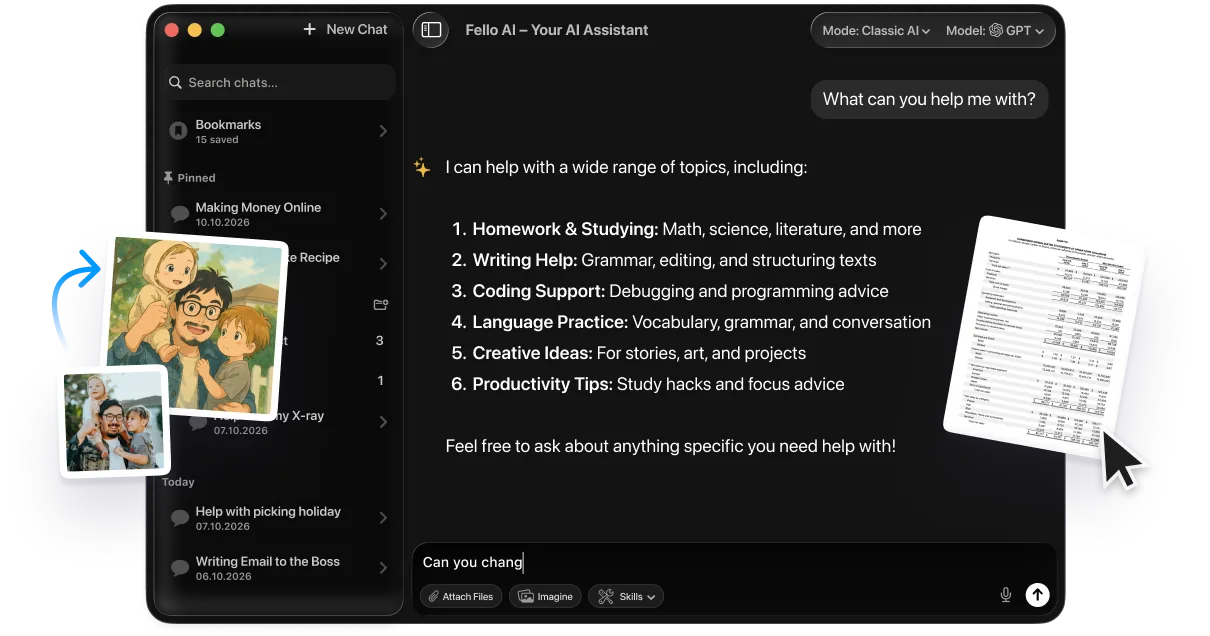
Fello AI does that in one native app for Mac, iPhone and iPad. It generates images with GPT Image right inside the chat, next to GPT, Claude, Gemini and Grok, so you can draft the caption and the picture in one conversation. Fello AI has a free tier, and paid plans cost $9.99 a month or $79.99 a year. It holds 4.7 stars from more than 27,000 App Store reviews.
Is Nano Banana 2.1 Worth It?
For developers, there is little to decide: Google is retiring Nano Banana 2 in the API on October 29, and 2.1 is the named replacement. The good news is that 2.1 is cheaper per image at every size it supports, and the higher input rate only bites on reference-heavy or video-heavy calls. Check those workloads first, set the thinking level on purpose, and move off 512px. For everyone else, the Arena votes say 2.1 is the best image model Google has shipped, though still a step behind GPT Image 2.5. Open the Google app, tap the banana, and test it on your own photos.
FAQ
When was Nano Banana 2.1 released?
Google released Nano Banana 2.1 on October 6, 2026. It launched as a generally available model in the Gemini API, with no preview, and rolled out to AI Mode in Google Search the same day.
Is Nano Banana 2.1 free?
Nano Banana 2.1 is free to try in AI Mode in Google Search and in the Gemini app, where each plan's daily image limits apply. The Gemini API has no free tier for it: images cost $0.0336 each at 1K and $0.0756 at 4K.
What is the difference between Nano Banana 2.1 and Nano Banana 2?
Nano Banana 2.1 is an update to Nano Banana 2 with better image quality, text rendering, mask-based editing and character consistency, plus fixed artifacts on panoramic images. Its images cost half as much in the API, but inputs cost three times as much, thinking defaults to medium, and the 512px size is gone.
When does Nano Banana 2 shut down?
Google shuts down Nano Banana 2 (gemini-3.1-flash-image) in the Gemini API on October 29, 2026. Google's recommended replacement is gemini-nano-banana-2.1.
Is Nano Banana 2.1 better than Nano Banana Pro?
On Arena's votes, yes: as of October 6, 2026, Nano Banana 2.1 scored 1328 on Text-to-Image against 1248 for Nano Banana Pro, and 1428 on Image Edit against 1390. Google still positions Pro for the most complex professional work, and Nano Banana 2.1 costs $0.0336 per 1K image against $0.134 for Pro.