The short version of Grok vs Claude: Claude is the stronger model by a wide margin, and Grok's price advantage is smaller than its rate card suggests. On Artificial Analysis's Intelligence Index v4.3.2, Claude Opus 5.5 scores 57.6 and Grok 4.7 scores 46.4. Through the API, Grok 4.7 costs $2 in and $6 out per million tokens against Opus 5.5's $4 and $20, but Grok spends far more tokens per job, so on the same tasks Opus 5.5 at its default setting comes out cheaper per task and higher scoring. Grok still wins on live access to X and on answering things Claude will not. For the launch detail on each side, see our Grok 4.7 benchmarks and our Claude Opus 5.5 breakdown.
That sounds simple, and it is the part almost every comparison gets wrong. These two companies publish benchmark scores at different reasoning-effort settings, on index versions that keep getting rescaled, and one of them does not serve its newest model in its own chat app. On one test they print different numbers for the same third-party model. This article shows where the figures come from, says plainly when two of them cannot be compared, and covers the thing none of the others mention: what happens when you try to use either one on a Mac.
The Key Takeaways
- Capability: Claude Opus 5.5 scores 57.6 on Artificial Analysis's Intelligence Index v4.3.2 against Grok 4.7's 46.4. The Grok chat app still runs Grok 4.6, at 44.3.
- Coding: on DeepSWE v1.1, Anthropic reports Opus 5.5 at 74.2% and xAI reports Grok 4.7 at 71.0%. On CursorBench 4.0 it is 57.8% against 46.3%, and both vendors print the same score for Claude Fable 5.1 on that test.
- Independent run: on Terminal-Bench 4.0 as Artificial Analysis runs it, Opus 5.5 scores 59.6% and Grok 4.7 scores 25.8%.
- API cost: per token, Grok 4.7 is $2 in and $6 out against Opus 5.5's $4 and $20. Per task on the index, Opus 5.5 at its default effort costs $1.34 against Grok 4.7's $2.73.
- Mac: Claude ships a native macOS chat app. The only Mac app xAI ships is Grok Bot, its agent product, so ordinary Grok chat is still a browser tab.
Grok vs Claude at a Glance
| Grok 4.7 (xAI) | Claude Opus 5.5 (Anthropic) | |
|---|---|---|
| Intelligence Index v4.3.2 | 46.4 (xhigh) | 57.6 (max) |
| DeepSWE v1.1 (coding) | 71.0% (high) | 74.2% |
| CursorBench 4.0 (coding) | 46.3% | 57.8% |
| Terminal-Bench 4.0, run by Artificial Analysis | 25.8% | 59.6% |
| Model in the chat app | Grok 4.6, paid modes only | Opus 5.5 on Pro and Max |
| Paid tiers | SuperGrok Lite, SuperGrok, Plus, Heavy | Pro, Max |
| Cheapest standalone plan | $10 a month (SuperGrok Lite) | $17 annual / $20 monthly (Pro) |
| API per 1M tokens | $2 in / $6 out | $4 in / $20 out |
| API cost per index task | $2.73 (high) | $1.34 (default medium) |
| Live social data | Yes, built on X | No |
| Native Mac chat app | No, agent app only | Yes |
Every benchmark figure in that table comes from xAI's or Anthropic's own published material, or from Artificial Analysis, and the sources are named in the sections below. The Grok subscription price is the one xAI lists for its own iOS app, because its web plans page does not render prices.
The Benchmarks Both Sides Actually Publish
This is the part that makes an honest comparison hard. xAI's Grok 4.7 announcement compares its model against Grok 4.6, GPT-5.6 Sol and Claude Fable 5.1, and never against Opus 5.5, which Anthropic released the next day. Anthropic's Opus 5.5 table never mentions Grok at all. So there is no chart anywhere with both models on it, and every comparison has to be built across two documents.
Where the two vendors agree about a third model
The way to check that two vendors' numbers can sit side by side is to find a model both of them tested. Claude Fable 5.1 is that model. On CursorBench 4.0, xAI and Anthropic both print Fable 5.1 at 51.8% and GPT-5.6 Sol at 41.7%. On GDPval-AA v2.1, both put Fable 5.1 at an Elo of 1735. On AA-Briefcase v1.1, both put it at 1678, and on HealthBench Professional both give 62.1%.
When two rivals report the same number for the same third model, their own figures on that test are on a common scale. That makes these four the cleanest comparisons available, and Claude wins all four:
| Benchmark | Grok 4.7 (xAI's figure) | Claude Opus 5.5 (Anthropic's figure) |
|---|---|---|
| CursorBench 4.0 | 46.3% | 57.8% |
| GDPval-AA v2.1 (Elo) | 1695 | 1846 |
| AA-Briefcase v1.1 | 1,657 | 1,822 |
| HealthBench Professional | 56.7% | 65.6% |
You can read xAI's full table in the Grok 4.7 announcement and Anthropic's in the Claude Opus 5.5 launch post and its system card.
Where the two vendors disagree
Terminal-Bench 4.0 is the exception. xAI's table puts Claude Fable 5.1 at 57.9%. Anthropic's own table puts the same model at 55.8%. Two points is not a scandal, but it means Grok 4.7's self-reported 38.0% and Opus 5.5's self-reported 66.4% are not on a proven common scale.
Fortunately, Artificial Analysis runs Terminal-Bench 4.0 itself, on one harness, for every model it indexes. Its figures are 59.6% for Opus 5.5 and 25.8% for Grok 4.7. Both are lower than their vendors' numbers, and the gap between them is wider, not narrower.
What only one side publishes
Anthropic reports SWE-bench Pro at 89.9% for Opus 5.5, along with SWE-bench Multilingual at 93.9% and Multimodal at 61.4%. It no longer reports SWE-bench Verified, the test most older comparisons quote, and xAI publishes no SWE-bench figure of any kind for Grok 4.7.
Grok, meanwhile, reports two tests where it beats Claude's most expensive model: EEBench, an electrical-engineering benchmark, at 64.0% against Fable 5.1's 56.4%, and the Harvey Legal Agent Benchmark at 19.6% against 6.7%. Anthropic publishes neither for Opus 5.5, so those results say Grok 4.7 is unusually strong on legal agent work and electrical engineering, and nothing about how it compares with Opus 5.5 there.
A note on how the numbers were produced
Anthropic states its configuration openly: unless noted, Opus 5.5 results use adaptive thinking at max effort, default sampling settings, and are averaged over five trials, with Terminal-Bench reported at xhigh. xAI's Grok 4.7 column is xhigh effort, except DeepSWE, which it marks as a high-effort score. The two configurations do not match each other, and neither matches what you get out of the box: Opus 5.5 runs at medium effort unless you change it. Benchmarks measure a configuration, not a personality, which is the theme of our guide to what AI benchmarks actually measure.
Grok vs Claude on Coding
Coding is the single most searched angle on this comparison, so it deserves a direct answer: Claude is ahead on every coding test that puts the two on a common scale, and the margin has grown. When this comparison ran on Grok 4.6 and Claude Opus 5, the one clean coding number had Claude ahead by a little over two points. It is now between three and thirty-four points, depending on the test.
The honest scoreboard
Start with CursorBench 4.0, because it is the coding test where both vendors agree on the reference models: Opus 5.5 at 57.8%, Grok 4.7 at 46.3%. Then DeepSWE v1.1, a set of 113 long-horizon engineering tasks written from scratch to avoid contamination: Anthropic reports 74.2% for Opus 5.5, averaged over five runs, and xAI reports 71.0% for Grok 4.7 at high effort. That three-point gap is the closest the two get. Then the independent run, Terminal-Bench 4.0 as Artificial Analysis measures it: 59.6% against 25.8%.
The earlier version of this comparison leaned on FrontierCode, where Anthropic and xAI both reported the same split and agreed on each other's score. xAI dropped FrontierCode from its Grok 4.7 card, so that like-for-like no longer exists for the current models. Opus 5.5 leads FrontierCode's main set at 54.6% by Anthropic's count, with no Grok 4.7 figure beside it.
Where the difference shows up in practice
Claude's advantage grows with the size of the job: long files, multi-step refactors, work that has to stay coherent across a long session. Grok's remaining practical edge is responsiveness. Artificial Analysis measures Grok 4.7 starting its answer in under a second, where Opus 5.5 at its default effort takes about 21 seconds to its first token. Once both are writing, Claude is the faster of the two: about 78 tokens a second for Opus 5.5 at medium against 52 for Grok 4.7 at high.
If you are choosing between subscriptions rather than APIs, note that coding tooling is a separate question on both sides. Claude Code comes with the Pro and Max plans and runs Opus 5.5 by default, covered in our guide to what Claude's coding plans cost. Grok 4.7 launched inside Cursor and xAI's own Grok Build rather than the Grok app, and Cursor's own costs are in our Cursor pricing breakdown.
Why Every Comparison You Read Disagrees
Search this topic and you will find articles confidently stating that Grok and Claude are tied, that Claude leads by six points, or that Grok leads on coding. They are not all lying. They are quoting different things and not saying so.
Benchmark versions get rescaled
xAI's Grok 4.6 announcement in August listed an Artificial Analysis Intelligence Index score of 61. Artificial Analysis's figure for the same model today is 44.3. Both are accurate as published. The index was rescaled in between, and it now includes Terminal-Bench 4.0 among its ten evaluations, so a score only means something next to its version number. On the current v4.3.2 index the order runs Claude Opus 5.5 at 57.6, Claude Fable 5.1 at 53.4, GPT-6 Astra at 52.7, the now-legacy Claude Opus 5 at 50.8, Grok 4.7 at 46.4 and Grok 4.6 at 44.3. You can check the live figures on the Artificial Analysis model page for Grok 4.7, and we track the wider ranking on our best AI models page.
The app and the API run different models
Grok 4.7 is available through the API, Cursor, Grok Build and third-party coding tools. xAI's announcement does not list the Grok app, and the app's own mode picker still labels its Expert and Heavy modes Grok 4.6. So a comparison of the Grok app with the Claude app is really Grok 4.6 against Opus 5.5, 44.3 against 57.6, while a comparison of the two APIs is Grok 4.7 against Opus 5.5. Claude has no such split: Opus 5.5 is in the Claude app on Pro and Max and is the model Anthropic's documentation tells developers to start with.
Effort settings are rarely stated
Both models run at several reasoning-effort levels, and they behave very differently between them. Opus 5.5 climbs from 51.2 at its default medium effort to 57.6 at max on the index. Grok 4.7 barely moves: 46.3 at high and 46.4 at xhigh, for about 37% more cost per task. Anthropic also reports that Opus 5.5 does worse on FrontierCode above medium effort, because the model starts making changes the task did not ask for. A comparison that does not name the effort level for both sides is not a comparison.
The practical lesson is the one we apply across every comparison on this site: a benchmark number without a version, a configuration and a surface is decoration, not evidence.
Grok vs Claude on Price
Pricing is where the two diverge most sharply, and the answer depends on whether you count subscriptions, tokens or finished tasks.
Subscriptions
Anthropic publishes its consumer prices plainly: Free at $0, Pro at $17 a month on an annual plan or $20 billed monthly, and Max from $100 a month. Opus 5.5 is included from Pro upward; the Free plan does not get Opus.
xAI's web plans page does not render its prices, but its iOS App Store listing does: SuperGrok Lite at $10, SuperGrok at $30, SuperGrok Plus at $100 and SuperGrok Heavy at $300 a month. The free tier gets only Grok's Fast mode; Expert and Heavy, the two modes that name a model, require a paid plan. For the full ladder, including the X Premium tiers, see our full breakdown of Grok's plans and the same for Claude, and the free tiers are covered in our guide to what Grok gives away.
Per token
Grok 4.7 costs $2 per million input tokens and $6 per million output, the same as Grok 4.6. Anthropic cut its top Opus price when Opus 5.5 launched, from $5 and $25 to $4 in and $20 out. On output, Claude is still about 3.3 times the price per token, down from roughly four times. Both companies also sell a faster variant at twice their standard rate.
Per task
The per-token price is not what you pay for a finished job, because the two models spend very different amounts of tokens getting there. Grok 4.7 is a verbose model, and it used about twice Grok 4.6's output tokens to run the same index. Artificial Analysis publishes what each configuration cost to complete its index tasks:
| Model and effort | Intelligence Index v4.3.2 | Cost per index task |
|---|---|---|
| Claude Opus 5.5, low | 42.3 | $0.55 |
| Grok 4.6, high | 44.3 | $1.86 |
| Claude Opus 5.5, medium (default) | 51.2 | $1.34 |
| Grok 4.7, high | 46.3 | $2.73 |
| Grok 4.7, xhigh | 46.4 | $3.74 |
| Claude Opus 5.5, max | 57.6 | $5.98 |
At its default setting, Opus 5.5 scores about five points higher than Grok 4.7 and costs about half as much per task. That reverses what used to be the strongest argument for Grok in this comparison. Two caveats keep it honest. These figures come from Artificial Analysis's task mix, which leans toward long agentic and reasoning work; on short, high-volume calls where neither model thinks for long, the per-token price is closer to what you pay, and there Grok is still cheaper. And the effort setting matters: Opus 5.5 stays cheaper per task than Grok 4.7 up to xhigh, where it scores 56.0 for $3.46, but at max it costs $5.98, more than either Grok configuration. For a broader view across vendors, see our AI pricing comparison.
Grok vs Claude on Your Mac
This is the difference nobody else writing about Grok and Claude seems to mention, and for Mac owners it is often the one that decides the question.
Claude has a chat app, Grok has an agent app
Anthropic ships a native macOS app for Claude chat. You install it, it sits in your Dock, it has a global keyboard shortcut and a menu-bar icon, and it behaves like software rather than a website.
xAI does ship a Mac download, and this is where most comparisons get it wrong in one direction or the other. The desktop app xAI offers is Grok Bot, its agent product, announced in August 2026. It runs on macOS, Windows and Linux, is included with every paid individual Cursor plan and Cursor Teams, and also works with a linked SuperGrok, SuperGrok Plus or SuperGrok Heavy subscription. There is no Mac app for plain Grok chat; xAI's own download links cover iOS and Android only, so day-to-day Grok on a Mac still means grok.com in a browser tab, the X app, or a third-party wrapper.
That distinction matters because the two are not substitutes. An agent that signs into your tools and works on its own is not what you want when you simply need to ask a question, and a browser tab gets buried, loses focus and reloads. We cover the workarounds in detail in our guide to running Grok on a Mac.
What about the agent products
Both companies now sell something beyond chat, and Grok Bot has a direct Anthropic counterpart in Claude Cowork, which we compare in Grok Bot vs Claude Cowork. The two are moving in opposite directions. Grok Bot is a separate product with its own usage allowance, while Anthropic is folding Cowork into the Claude app itself, starting with Pro and Max, as our Claude Cowork guide explains. Do not assume a Grok chat plan includes Grok Bot's agent usage.
Running both without paying twice
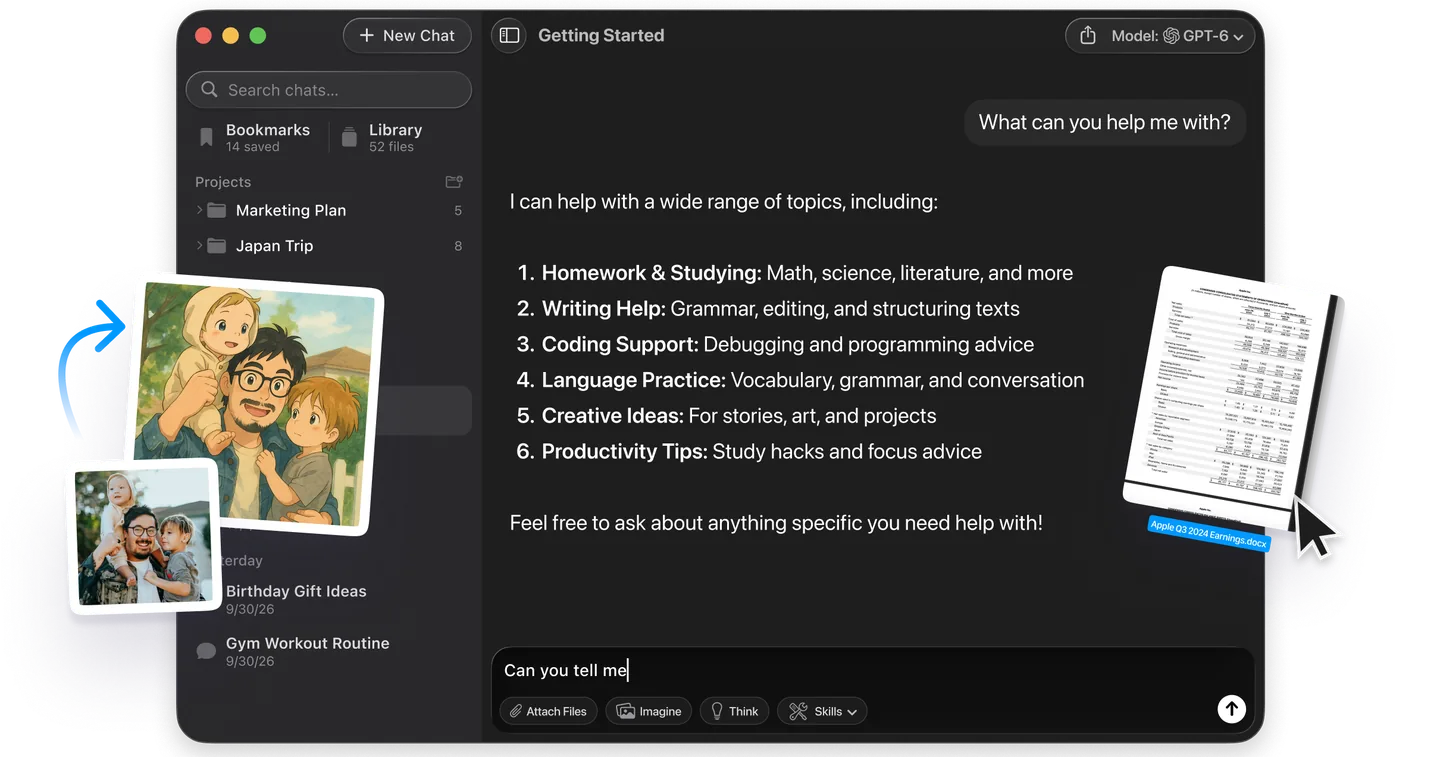
The honest conclusion of this comparison is that Grok and Claude are good at different things, which is an awkward answer if it means two subscriptions. A multi-model Mac client like Fello AI is one way around that: one native app, one keyboard shortcut, and several models behind it, so you can send the live-data question to one and the long reasoning job to another without switching tabs or maintaining two bills.
What Each One Refuses
Capability is only half of what separates these two. The other half is disposition, and it is a bigger practical difference than any single benchmark.
xAI positions Grok as willing to engage with political, edgy and unconventional questions. Anthropic builds Claude to decline more, and to hedge more when it does answer. Which one is better depends entirely on what you are asking. For a journalist testing how a story is landing, Grok's willingness plus its live access to X is a real research tool that Claude cannot match, because Claude has no equivalent social data source. For a lawyer, a clinician or anyone drafting something that carries liability, Claude's caution is the product, not an obstacle.
This is also the axis most likely to change without warning. xAI says Grok 4.7 ships with an entirely new safeguard stack, which it calls its strongest yet on refusals and jailbreak resistance while keeping refusal rates low for legitimate use, and the Grok app still runs Grok 4.6. Content policies get tightened and loosened far more often than model weights get updated, so treat any specific claim about what either one will answer today, including ours, as a snapshot rather than a specification.
Which Should You Choose?
Choose Claude if you want the better all-round model, you work with long documents or long codebases, you write for a living, or you want a real Mac chat app. Opus 5.5 leads Grok 4.7 by eleven points on the Intelligence Index v4.3.2, wins every coding test that puts the two on a common scale, and at its default effort does the index's tasks for about half Grok's cost.
Choose Grok if you need live access to what is being said on X right now, you want a model that argues back and refuses less, you want answers that start in under a second, or you are building a high-volume API product where each call is short and paying $6 per million output tokens instead of $20 changes the economics.
Choose both if you can, because the two are complementary rather than competing, and the sensible setup is one interface with both behind it. If you are still weighing the wider field, our Grok against ChatGPT and Claude against ChatGPT comparisons cover the third obvious option, and our guide to picking a model per task covers the rest.
Frequently Asked Questions
Is Grok better than Claude?
Not on capability. Claude Opus 5.5 leads the Artificial Analysis Intelligence Index v4.3.2 by 57.6 to Grok 4.7's 46.4, and wins CursorBench 4.0, the coding test where both companies agree on the reference scores, by 57.8% to 46.3%. Grok is better on per-token API price, on live access to X, on how quickly answers start, and on answering questions Claude declines.
Which is better for coding, Grok or Claude?
Claude. On DeepSWE v1.1, Anthropic reports Opus 5.5 at 74.2% and xAI reports Grok 4.7 at 71.0%. On CursorBench 4.0 it is 57.8% against 46.3%, and on Terminal-Bench 4.0 as Artificial Analysis runs it, 59.6% against 25.8%. xAI publishes no SWE-bench score for Grok 4.7, so the SWE-bench figures you see quoted for Claude cannot settle this comparison.
Why do different articles give different benchmark scores?
Four reasons. Index versions get rescaled, so xAI's August launch post lists 61 for Grok 4.6 while the live v4.3.2 index shows 44.3, and both were correct when published. The Grok app still runs Grok 4.6 while the API runs 4.7. Effort settings are rarely stated, and Opus 5.5 moves from 51.2 to 57.6 between its default and max effort. And the vendors' own tables do not always agree: xAI and Anthropic print different Terminal-Bench 4.0 scores for the same Claude model. Always check the version, the surface and the effort level.
Is there a Grok app for Mac?
Not for Grok chat. xAI does ship a macOS download, but it is Grok Bot, its agent product, which comes with paid Cursor plans or a linked SuperGrok, SuperGrok Plus or SuperGrok Heavy subscription and has its own usage allowance. For everyday chat on a Mac you are still using grok.com in a browser, the X app, or a third-party wrapper. Claude, by contrast, has a native macOS chat app.
How much do Grok and Claude cost?
Claude Pro is $17 a month on an annual plan or $20 billed monthly, and Claude Max starts at $100. xAI's App Store listing prices SuperGrok Lite at $10, SuperGrok at $30, SuperGrok Plus at $100 and SuperGrok Heavy at $300 a month. Both have a free tier. Through the API, Grok 4.7 is $2 in and $6 out per million tokens against Claude Opus 5.5 at $4 and $20, although on Artificial Analysis's index tasks Opus 5.5 at its default effort costs less per task.