Most lists of Claude prompts are ChatGPT prompts with the name changed. They still work, in the sense that any competent model will answer them, but they leave most of Claude on the table. Anthropic publishes a detailed prompting guide for its current models, and the techniques in it are specific enough that a prompt written for Claude looks visibly different from one written for ChatGPT: it carries tagged structure, it usually carries examples, and it puts long documents in a different place.
This guide collects 30 prompts organised by the job you are doing, starting with resumes because that is what people ask for most. Every section explains the Claude-specific reason the prompt is shaped the way it is, and each reason is sourced to Anthropic rather than to prompt folklore. Along the way we correct two claims that circulate widely and do not survive contact with the documentation.
The Key Takeaways
- Put your documents first: Anthropic states that placing long inputs above your question, rather than below it, can improve response quality by up to 30 percent in tests. Almost every resume prompt list does the opposite.
- Three to five examples: the documentation is specific. "Include 3-5 examples for best results", wrapped in example tags so Claude can tell them apart from your instructions.
- The XML claim is overstated: blogs repeat that tags deliver 20 to 40 percent more consistent output. That figure appears nowhere in Anthropic's guidance, which claims only that tags reduce misinterpretation.
- "Claude is literal" is model-specific: Anthropic lists literal instruction following as a difference for Sonnet 5 and Opus 4.8, not as a permanent trait of every Claude model.
- Say what you want, not what you do not: replace "do not use markdown" with a positive description of the format you actually want.
What Makes Claude Prompts Different
Before the prompts themselves, it is worth knowing what you are optimising for. Anthropic's prompting best practices guide is unusually direct about what changes results, and four of its points do most of the work.
Claude wants to be told explicitly
The guide's framing is memorable: "Think of Claude as a brilliant but new employee who lacks context on your norms and workflows." The practical consequence is that effort has to be requested rather than assumed. Anthropic notes that if you want "above and beyond" behaviour, you should "explicitly request it rather than relying on the model to infer this from vague prompts".
There is a test for this in the documentation that costs nothing to apply. Show your prompt to a colleague who has no context on the task and ask them to follow it. As Anthropic puts it, "If they'd be confused, Claude will be too." Most weak prompts fail that test on the first read.
Explain why, not just what
A rule with a reason attached outperforms a bare rule. The documentation's own example is a formatting instruction. Instead of "NEVER use ellipses", it suggests "Your response will be read aloud by a text-to-speech engine, so never use ellipses since the text-to-speech engine will not know how to pronounce them". Anthropic's comment is that Claude "is smart enough to generalize from the explanation", which means one sentence of context quietly fixes a dozen edge cases you never wrote down.
Use tags, but do not oversell them
Wrapping the parts of a prompt in tags such as instructions, context and input helps Claude tell them apart. This is where a popular claim needs correcting. Many prompt guides assert that XML tags produce 20 to 40 percent more consistent output. No such figure appears in Anthropic's guidance. What the documentation actually says is that tags "help Claude parse complex prompts unambiguously" and that wrapping each type of content in its own tag "reduces misinterpretation". That is a real benefit and a modest one, and it is worth using tags for that reason rather than for a statistic nobody can source.
Anthropic does recommend consistent, descriptive tag names, and nesting them when the content has a natural hierarchy. Note that the guide treats literal instruction following as a model-specific behaviour, listed as a difference for Claude Sonnet 5 and Claude Opus 4.8, and it warns that where a technique names a specific model you should "treat it as measured on that model" rather than assume it holds everywhere.
Show three to five examples
Examples are described as "one of the most reliable ways to steer Claude's output format, tone, and structure", and the guide gives a number rather than a vague suggestion: "Include 3-5 examples for best results." They should be relevant to your real use case, varied enough that Claude does not latch onto an accidental pattern, and wrapped in example tags. If you only have one example, the documentation suggests you can ask Claude to generate more from it.
The Ordering Rule Most Prompt Lists Get Backwards
This is the single highest-value thing on this page, and it is the one thing almost no competing prompt list does correctly.
When you are working with a long input, which Anthropic defines as roughly 20,000 tokens or more, the order of the pieces matters. The instruction is explicit: "Put longform data at the top", placing your long documents "near the top of your prompt, above your query, instructions, and examples". The documentation adds that this "improves performance across all models", and quantifies it: "Queries at the end can improve response quality by up to 30 percent in tests, especially with complex, multidocument inputs."
Now think about how every resume prompt you have ever copied is written. It opens with "You are an expert recruiter. Rewrite my resume to match this job description," and then tells you to paste your resume and the job posting underneath. That is precisely the order Anthropic says is weaker. Flip it: paste the resume and the job description first, then ask the question at the bottom. When you are handing over more than one document, the guide recommends wrapping each in document tags with source and content subtags so Claude can keep them straight.
Claude Prompts for Your Resume
Resumes are the most requested use case for Claude prompts, and they play to Claude's strengths: long documents, careful instruction following, and prose that does not read like a template. Work top down, because each step builds on the last. If you are still choosing a model for this job, our comparison of which AI is best for resume writing tests Claude against ChatGPT and Gemini on the same resume.
Tailoring to a job description
Paste your resume, then the job posting, then this. Note that the documents come first.
Prompt 1. "Above are my resume and a job description. Identify every requirement in the posting that my resume already satisfies but describes in different words. For each one, rewrite the relevant bullet to use the posting's language, without inventing any experience I do not have. Return a table with three columns: the requirement, my current wording, and the proposed wording. Do not rewrite anything you cannot ground in the resume above."
Prompt 2. "Using the same two documents, list the requirements in the posting that my resume does not address at all. For each, tell me whether it is a genuine gap or something I probably did and failed to write down, and ask me one specific question that would settle it."
The constraint against inventing experience matters more than it looks. The failure mode of resume prompts is fabrication that reads plausibly, and an explicit prohibition plus a grounding requirement is the cheapest defence.
Stronger bullets and summaries
Prompt 3. "Rewrite these five bullets so each one names an action, a method and a measurable result. Where a number is missing, leave a clearly marked placeholder rather than estimating one. Keep each bullet under 25 words."
Prompt 4. "Draft three versions of a professional summary for the role above: one that leads with years of experience, one that leads with a specific achievement, and one that leads with the problem I solve. Each under 60 words."
Prompt 5. "Read my resume and list the five strongest claims in it. For each, tell me what evidence an interviewer would ask for, and whether the resume currently supplies it."
Applicant tracking and formatting
Prompt 6. "Review my resume for applicant tracking system parsing problems: non-standard section headings, tables, columns, graphics, headers and footers, and date formats. Return a prioritised list of fixes, most damaging first, and say what each one should become."
Prompt 7. "Extract the ten terms from the job posting most likely to be used as keyword filters. For each, tell me whether it appears in my resume, appears in a different form, or is absent."
The cover letter
Prompt 8. "Using the resume and posting above, draft a cover letter of no more than 250 words. Open with the specific reason I am a fit rather than with my name and the job title. Do not restate the resume. Do not use the word passionate."
Prompt 9. "Rewrite that letter for a hiring manager who will skim it in fifteen seconds. Keep the strongest sentence as the first line."
Prompt 10. "Read the posting again and tell me the one concern a hiring manager would have about my application. Draft two sentences that address it without drawing attention to it."
Our guide to the best AI for a cover letter compares how different models handle that format.
Claude Prompts for Coding
Anthropic publishes its own prompt material for developers, so this section stays short and points you at it rather than competing with it. What is worth saying here is how the general techniques apply.
Prompt 11. "Here is a file and its test suite. Explain what the code does in plain language, then list every behaviour the tests do not cover. Do not write any code yet."
Prompt 12. "Review this function for correctness only, not style. For each issue, give me a concrete input that triggers it and the output you expect."
Prompt 13. "Refactor this for readability. Tell me what you changed and why before you show the code. If a change alters behaviour in any way, stop and say so instead."
Prompt 14. "Here is an error and the file it came from. List the three most likely causes in order of probability, and tell me the single cheapest check that would distinguish between them."
Prompt 15. "Explain this code to someone who knows the language but has never seen this codebase. Flag anything that would surprise them."
The "stop and say so" clause is worth keeping. Separating explanation from output, and asking for the reasoning first, is a reliable way to catch a misunderstanding before it becomes a diff you have to read. Anthropic's model-specific guidance for Claude Sonnet 5 covers how instruction following and tool triggering differ on that model. For a community-maintained collection organised as a repository, the awesome-claude-prompts list is the one most people are looking for when they search for it by name.
Claude Prompts for Writing and Content
Claude's prose tends to need less de-robotising than its competitors', which changes what you ask for. Rather than asking it to sound human, ask it to sound like you, and give it the raw material to work from.
Matching a voice
Prompt 16. "Above are four pieces I wrote. Describe my voice in terms a stranger could apply: sentence length, vocabulary level, how I open and close, what I never do. Do not praise the writing. Then draft the piece below in that voice."
Prompt 17. "Rewrite this paragraph three ways: shorter and blunter, same length but more concrete, and longer with one example added. Label each."
Prompt 18. "Read this draft and mark every sentence that states an opinion as though it were a fact. Do not rewrite them, just list them."
Editing and structure
Prompt 19. "Cut this to 60 percent of its length without losing any argument. Tell me what you removed and which cut you think is the most debatable."
Prompt 20. "Give me three structures this piece could use, with the argument each one makes strongest. Recommend one and say why the other two lose."
Prompt 21. "List every sentence in this draft that could be deleted without the reader noticing. Do not delete them yet."
On formatting, apply Anthropic's positive-instruction rule. Rather than "do not use markdown", its own recommended phrasing is "Your response should be composed of smoothly flowing prose paragraphs". The same logic applies to length and tone: describe the target rather than forbidding the thing you dislike. Our broader guide to writing AI prompts that work covers the parts of this that are not Claude-specific.
Claude Prompts for Business and Marketing
Prompt 22. "Above is our pricing page and three competitor pages. Build a table of what each plan includes, what it costs, and what is deliberately left vague. Flag anything where we are the outlier."
Prompt 23. "Here is a customer complaint. Draft three replies: one that fixes it immediately, one that explains a constraint honestly, and one that offers an alternative. No apology longer than one sentence."
Prompt 24. "Take this feature description and write the one-sentence version, the one-paragraph version and the one-page version. The one-sentence version must survive being read aloud."
Prompt 25. "Argue against this plan as the most sceptical person in the room would. Give me the three objections most likely to be raised and the weakest part of my answer to each."
Research and decisions
Prompt 26. "Above are five customer interview transcripts. List the complaints that appear in more than one, with the number of transcripts each appears in. Quote one line per complaint. Ignore anything mentioned only once."
Prompt 27. "Summarise this report for someone who has to make a decision from it today. Lead with what changed, not with background. Mark anything the report asserts without evidence."
Prompt 28. "Turn these meeting notes into a decision log: what was decided, who owns it, what was explicitly left open. If something was discussed but not decided, say so rather than inventing an outcome."
Prompt 29. "Draft the email announcing this change to people it makes life harder for. Acknowledge the cost in the first sentence. No more than 150 words."
Prompt 30. "Here is a document and the audience it is for. Tell me the three questions that audience will have that the document does not answer."
Prompt 25 exploits something Claude does well. Asking for the strongest opposing case, rather than for validation, produces materially more useful output than asking whether an idea is good. If you run this kind of work repeatedly, Claude Projects lets you keep the context and instructions in one place instead of re-pasting them.
Which Claude Model for Which Prompt
Anthropic maintains separate prompting pages per model because the models differ in ways that change your prompt. One difference is worth knowing before you start.
| Job | What to reach for | What to add to the prompt |
|---|---|---|
| Long document analysis | Any current Claude model | Documents above the question, wrapped in document tags |
| Everyday drafting | A current mid-tier model | Three to five examples of the output you want |
| Deep reasoning | An Opus-class model | An explicit conciseness instruction, see below |
| Code review | Sonnet 5 or an Opus model | Reasoning before output, and a stop condition |
The conciseness note is documented rather than folklore. Anthropic records that Claude Opus 5 "is an exception on verbosity: its default user-facing responses run longer than prior models'," and that adjusting effort "does not reliably change visible response length". The recommendation is to "prompt explicitly for conciseness instead". If you have been assuming a setting would shorten the answer, it will not, and a sentence in the prompt will. Plan limits shape which models you can reach, and our breakdown of Claude's pricing tiers sets out what each one includes.
Do Claude Prompts Work on ChatGPT and Gemini?
Partly, and the split is predictable once you know which technique you are relying on.
The portable parts are the ones that are really just good writing: being explicit about the output you want, explaining the reason behind a constraint, supplying examples, and describing the format you want rather than the one you do not. Those improve results on any current model, and they are why a well-built Claude prompt usually still performs respectably elsewhere.
The parts that do not travel cleanly are the structural ones. Tag-heavy prompts are a Claude convention, and while other models tolerate them, the guidance to use them comes from Anthropic and is calibrated to Claude. The document-first ordering is described in Anthropic's own documentation as improving performance "across all models", but the 30 percent figure is measured on Claude, so treat the size of the gain as a Claude number rather than a universal one.
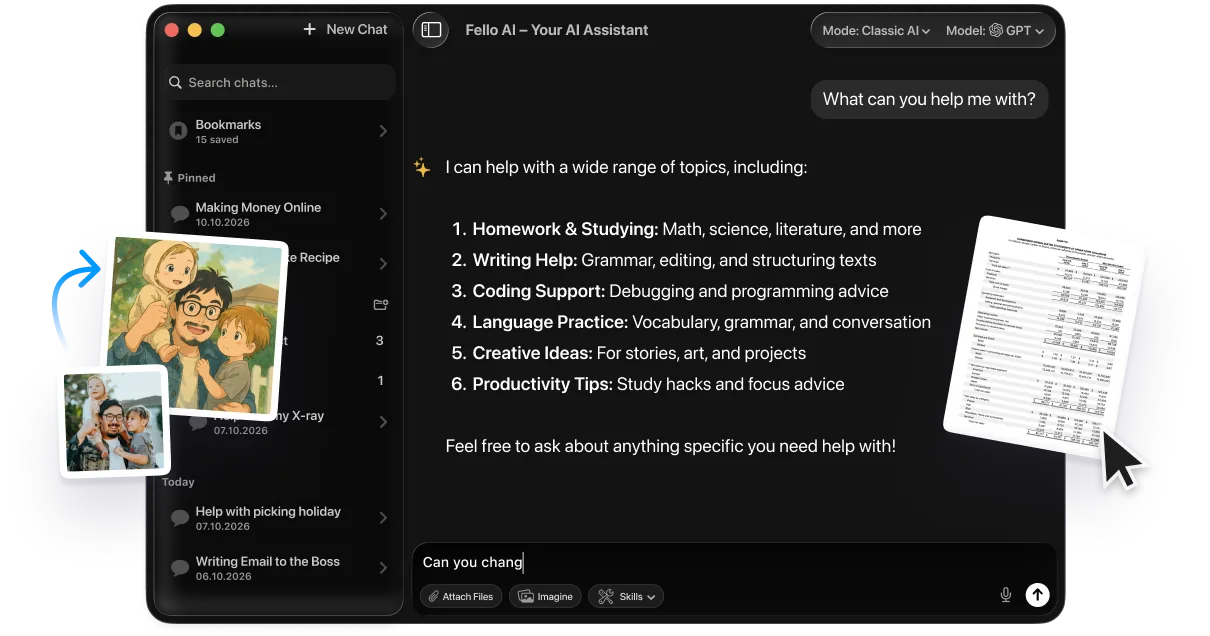
The practical consequence is that a prompt library is worth keeping model-agnostic in its core and Claude-specific in its packaging. If you run several assistants, keeping them in one place makes the comparison cheap: running Claude on your Mac alongside other models means you can fire the same prompt at two of them and keep whichever answer is better, rather than committing to one subscription and hoping. If you are still learning the fundamentals, our beginner's path through Claude starts further back.
Conclusion
The prompts above are useful, but the reason they work is more portable than the wording. Put your documents above your question. Give three to five examples rather than none or twenty. Describe the output you want instead of banning the one you do not. Ask for the opposing case rather than for approval. Those four habits will outlive every specific prompt on this page and every model version number attached to them.
And treat prompt statistics the way you would treat any other marketing number. The 20 to 40 percent XML claim is repeated across dozens of pages and is not in the documentation it is attributed to. The 30 percent ordering figure is in there, verbatim, and almost nobody uses it. That asymmetry is most of the edge available in prompting right now.
FAQ
What are Claude prompts?
Claude prompts are the instructions you give Anthropic's Claude models. They work like prompts for any assistant, but Anthropic documents techniques that suit Claude specifically: tagged structure to separate instructions from content, three to five worked examples, and placing long documents above your question rather than below it.
Do XML tags really improve Claude's output?
They help, but less dramatically than commonly claimed. Anthropic's documentation says tags help Claude parse complex prompts unambiguously and reduce misinterpretation. The widely repeated claim that tags deliver 20 to 40 percent more consistent output does not appear in that documentation and should not be relied on.
Where should I paste my resume in a Claude prompt?
Above your question, not below it. Anthropic advises placing long inputs near the top of the prompt, above your query, instructions and examples, and states that queries placed at the end can improve response quality by up to 30 percent in tests. Most resume prompt templates use the opposite order.
How many prompts do you get with Claude?
That depends on your plan rather than on the prompts themselves, and the limits move. Our guide to Claude's plans and pricing covers what each tier currently includes and how the usage windows work.
Do Claude prompts work on ChatGPT?
The general principles transfer: be explicit, explain your reasoning, supply examples, and describe the format you want. The tag-heavy structure is a Claude convention, and the measured gains quoted by Anthropic are measured on Claude, so treat the numbers as Claude's rather than universal.