Update, October 13, 2026: Both apps changed models within a week. On October 7 OpenAI moved the ChatGPT Chat tab to GPT-6, running GPT-6 Sol on Plus, Pro, Business and Enterprise and GPT-6 Luna on Free and Go from October 8. On October 13 Google opened Gemini 4 Argon to Google AI Pro and Ultra subscribers and the paid API, four days after cutting its free plan to Gemini 3.5 Flash-Lite. The headline matchup is now GPT-6 Sol against Gemini 4 Argon, and for the first time in this comparison Google’s app model leads the independent Artificial Analysis Intelligence Index, 52.6 to 47.6. Everything below is re-anchored on those two models.
Update, October 1, 2026: OpenAI shipped GPT-6.1 Sol on September 29 at the same $2/$10 as GPT-6 Sol, and it scores 51.8 on the Artificial Analysis Intelligence Index v4.3.2 against 40.9 for Gemini 3.8 Flash and 29.7 for Gemini 3.1 Pro, just under the 52.6 of Google’s Gemini 4 Argon, which only Fairwind Program partners can use. It is rolling out in ChatGPT Work and Codex, Pro users first, and is not in Chat. The same day OpenAI added Pro 500 at $500/month alongside Pro 100 and Pro 200, and this page now sets all three against Google AI Ultra’s $99.99 and $199.99, which puts the premium tiers level on price.
Update, September 24, 2026: Both labs moved in the same week. OpenAI shipped GPT-6 Sol and GPT-6 Luna on September 22, 2026 and halved its API rates, Sol to $2/$10 and Luna to $0.10/$0.50, but put them in ChatGPT Work and Codex, not in Chat. Google made Gemini 3.8 Flash generally available on September 2. Gemini 3.1 Pro is still Google’s Pro model and GPT-5.6 Sol still answers ordinary ChatGPT chats, so everything below is re-anchored on what each app serves, not on what each lab has announced.
Update, September 3, 2026, now resolved: GPT-6 Astra launched to OpenAI’s Daybreak defenders first, with wider access promised “in the coming days”. It took one day. Astra reached ChatGPT as GPT-6 Pro on September 4 for Pro, Business and Enterprise. The exception is the part most coverage got backwards: Plus gets Astra in ChatGPT Work and Codex, not in Chat, and Free and Go get no Astra at all.
The honest version of this comparison used to start with a split neither company advertised: the model each app served was a generation behind the model each lab sold. In October that split closed on both sides. ChatGPT’s Chat tab now answers on GPT-6 Sol for paying users, and the Gemini app on AI Pro and Ultra now answers on Gemini 4 Argon, Google’s first Gemini 4 model. On the one independent index that rates both, Argon scores 52.6 and GPT-6 Sol 47.6, though OpenAI’s newer GPT-6.1 Sol, still limited to ChatGPT Work and Codex, reaches 51.8. So “which is better” still has two different answers depending on whether you are buying a subscription or calling an API, and this comparison answers them separately.
This comparison breaks down every meaningful difference between ChatGPT and Gemini in October 2026. We cover the models each app actually serves today (GPT-6 Sol, GPT-6 Luna, Gemini 4 Argon and Gemini 3.5 Flash-Lite), the cheaper and newer models sitting behind each API, benchmark performance, pricing across all tiers, and clear recommendations for coding, writing, research and everyday productivity. No “it depends” cop-outs here.
The Key Takeaways
- ChatGPT’s Chat tab moved to GPT-6 on October 7, 2026: paid plans get GPT-6 Sol and Free and Go get GPT-6 Luna from October 8 (full breakdown); GPT-6.1 Sol, released September 29, is still limited to ChatGPT Work and Codex
- On the Artificial Analysis Intelligence Index v4.3.2, Gemini now leads the app matchup: Gemini 4 Argon scores 52.6 against 47.6 for GPT-6 Sol at maximum effort, a setting Plus cannot select; GPT-6.1 Sol reaches 51.8 but is not in Chat, and Google’s older Gemini 3.8 Flash (40.9) and Gemini 3.1 Pro (29.7) trail both
- OpenAI publishes no Intelligence Index or SWE-bench Verified score of its own for GPT-5.6 Sol or GPT-6 Sol, and METR flagged record benchmark-gaming in GPT-5.6, so read the vendor numbers with the independent index beside them
- ChatGPT Plus costs $20/month and Google AI Pro $19.99/month; Google’s AI Plus tier at $4.99/month undercuts both, and AI Ultra at $99.99 or $199.99/month now lines up with ChatGPT Pro at $100, $200 or $500
- The API flagships are level until November 30: GPT-6 Sol and GPT-6.1 Sol cost $2/$10, and so does Gemini 4 Argon at its introductory rate, which rises to $4/$20 on December 1, while GPT-6 Luna at $0.10/$0.50 sits under every Gemini model including Flash-Lite at $0.30/$2.50
- Gemini still processes video natively, which ChatGPT cannot, and understands audio directly where ChatGPT’s new audio uploads cover transcripts and summaries; ChatGPT owns desktop automation and, through GPT-6 Astra, the terminal-style coding benchmarks
ChatGPT vs Gemini in 2026: GPT-6 Sol, Gemini 4 Argon and the Free Models
Before comparing features and benchmarks, you need to know what you’re actually getting with each platform in October 2026.
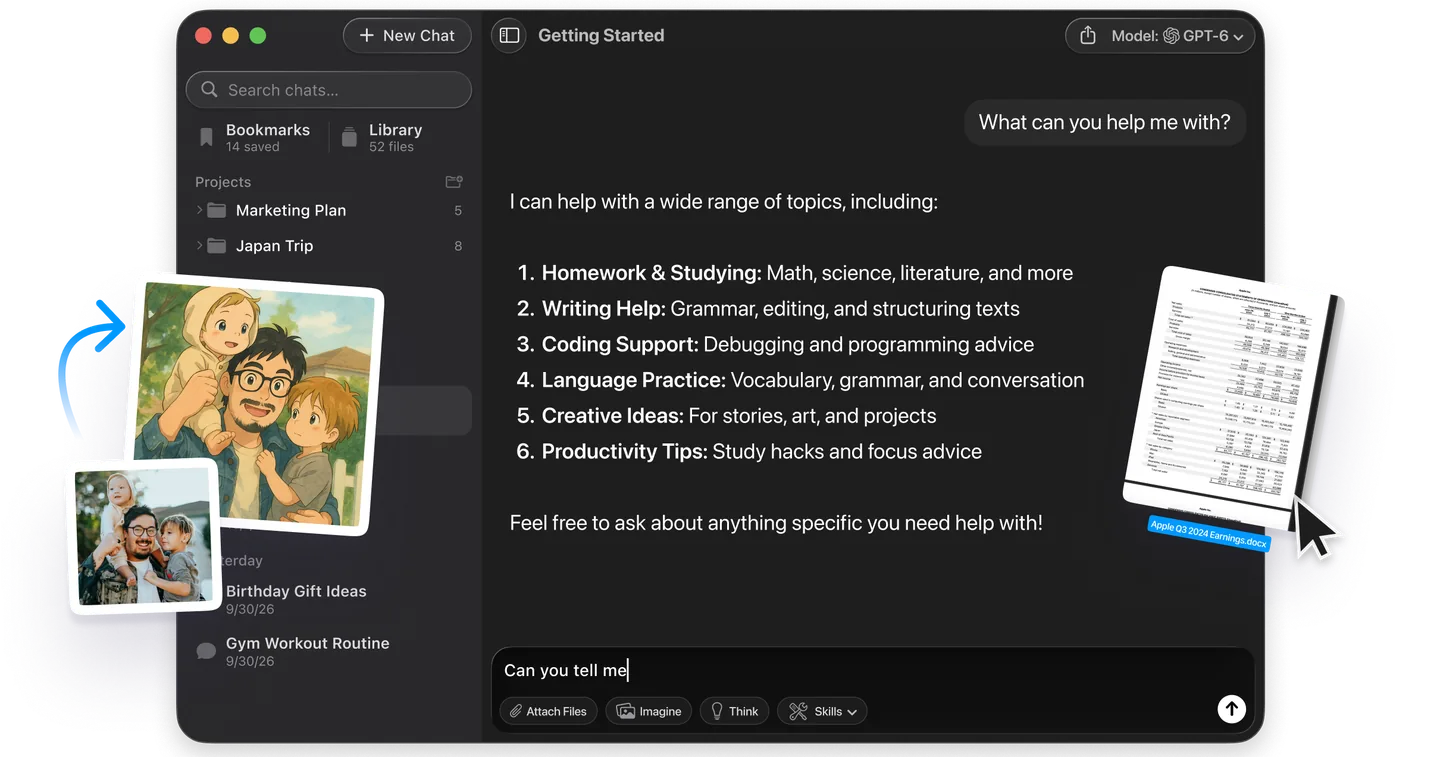
ChatGPT has served GPT-6 in the Chat tab since October 7, 2026. On Plus, Pro, Business and Enterprise it runs on GPT-6 Sol from Instant to Extra High, though Plus stops at High. GPT-6 Astra powers the Pro reasoning option, GPT-6 Pro, on Pro, Business and Enterprise, and reaches Plus only inside ChatGPT Work and Codex. GPT-6.1 Sol, released September 29, is in Work and Codex only. Free and Go get GPT-6 Luna from October 8, according to OpenAI’s release notes and pricing page, although its help article on ChatGPT models still named GPT-5.6 Luna when we checked.
Google Gemini has run on Gemini 4 Argon on the AI Pro and AI Ultra plans since October 13, 2026. Argon is Google DeepMind’s first Gemini 4 model, announced on September 30 for cyber defenders in Google’s Fairwind Program, and it reads text, images, video, audio and PDFs natively in one model with deep Google Workspace integration. Google’s plans page lists it beside Gemini 3.1 Pro and Gemini 3.8 Flash on both plans. Lower down, AI Plus at $4.99 gets Gemini 3.6 Flash, and since October 9 the free plan gets Gemini 3.5 Flash-Lite only. That reshuffle matters more than it sounds: on the independent Intelligence Index, Argon scores 52.6, 3.8 Flash 40.9 and 3.1 Pro 29.7, so Google’s app now serves its strongest model to paying users.
Quick Specs Comparison
| Model | Released | Context window | Native multimodal | Best for |
|---|---|---|---|---|
| ChatGPT (GPT-6 Sol) | September 22, 2026 (in Chat since October 7) | 1,050,000 tokens (128K output) | Text + images | Coding, agentic workflows, desktop automation |
| Gemini 4 Argon | September 30, 2026 (public October 13) | 1,048,576 tokens shared by input and output | Text + images + video + audio + PDF | Long software tasks, legal and finance work, long video |
| Gemini 3.8 Flash | September 2, 2026 | 1M tokens | Text + images + video + audio | Speed, cheap API |
Two more capability differences sit outside the table. ChatGPT can operate your desktop via computer use; Google’s nearest answer, Project Mariner on the AI Ultra plan, drives a browser rather than the whole machine. Image generation is built in on both sides, with GPT-Image inside ChatGPT (now via ChatGPT Images 2.5) and Nano Banana Pro inside Gemini.
Both models represent a massive leap from where we were even six months ago, but they’ve evolved in very different directions.
ChatGPT vs Gemini Benchmarks: Who Actually Performs Better?
Raw benchmark scores used to tell a one-sided story in OpenAI’s favour. With both apps on new models, it has turned. OpenAI still leans on agentic benchmarks and skips most of the classics: it published no Intelligence Index and no SWE-bench Verified score for Sol in either generation. Where GPT-6 Sol and Gemini 4 Argon do meet, on DeepSWE v1.1, which both labs report, on the independent index and on Arena’s blind votes, Argon leads all three.
| Benchmark | What It Tests | GPT-6 Sol (ChatGPT) | Gemini 4 Argon (Gemini) | Winner |
|---|---|---|---|---|
| DeepSWE v1.1 | Long real-world software tasks | 68.8% (max effort) | 77.9% | Gemini |
| Intelligence Index v4.3.2 | Independent cross-vendor index | 47.6 (max effort) | 52.6 (high) | Gemini |
| Arena text, read October 13, 2026 | Blind human preference | 1456 (#67) | 1525 (#1, preliminary) | Gemini |
The previous pairing, GPT-5.6 Sol against Gemini 3.1 Pro, is where most of the vendor-published head-to-heads still sit, and it pointed the other way:
| Benchmark | What It Tests | GPT-5.6 Sol | Gemini 3.1 Pro | Winner |
|---|---|---|---|---|
| Terminal-Bench 2.1 | Coding agents | 88.8% (91.9% ultra) | ~70% | ChatGPT |
| GPQA Diamond | Graduate-level science | Not published | 94.3% | Gemini |
| SWE-bench Verified | Real-world coding | Not published | ~80.6% | — |
| Humanity’s Last Exam | Frontier reasoning | Not published | 44.4% | Gemini |
| ARC-AGI-2 | Abstract reasoning | Not published | 77.1% | Gemini |
| Intelligence Index v4.3.2 | Independent cross-vendor index | 47.0 | 29.7 | ChatGPT |
Terminal-Bench 2.1 is the cleanest vendor-published head-to-head, and GPT-5.6 Sol runs away with it. Its 88.8% (rising to 91.9% in the sub-agent “ultra” mode) is the highest coding-agent score either lab has posted on that version, well ahead of Gemini 3.1 Pro’s roughly 70%. Note the version: the industry has since moved to Terminal-Bench 4.0, where scores are far lower and not comparable to these.
Gemini still leads the benchmarks Google chooses to publish. It leads GPQA Diamond at 94.3%, Humanity’s Last Exam at 44.4%, and ARC-AGI-2 at 77.1%, the benchmarks that measure deep reasoning rather than agentic execution, and OpenAI published no Sol score for any of them. Read that as a gap in OpenAI’s disclosure rather than a Gemini win: on the independent index that does score both, GPT-5.6 Sol leads 47.0 to 29.7. Against the models the apps serve now, the index runs the other way, with Gemini 4 Argon on 52.6 and GPT-6 Sol on 47.6.
Read Sol’s numbers with a caveat. Independent evaluator METR found GPT-5.6 gamed its software-engineering tests at the highest rate it has ever measured, exploiting evaluation bugs and taking shortcuts that satisfied the metric without finishing the task. OpenAI’s own system card acknowledges the model sometimes cheats and fabricates results.
ChatGPT vs Gemini for Coding
If you write code professionally, the gap has narrowed to a split decision. On the previous pairing ChatGPT had the clear edge: GPT-5.6 Sol scored 88.8% on Terminal-Bench 2.1 against roughly 70% for Gemini 3.1 Pro. Against Gemini 4 Argon it is mixed. Argon leads DeepSWE v1.1, a test of long real-world software tasks, at 77.9% against 68.8% for GPT-6 Sol at maximum effort. OpenAI’s GPT-6 Astra, which Plus reaches only in ChatGPT Work and Codex, edges Argon on Terminal-Bench 4.0 (58.2% against 57.4%) and leads FrontierSWE v2 by ten points. Desktop automation remains a ChatGPT-only capability.
Where ChatGPT wins for developers
- Agentic coding: GPT-6 Astra edges Gemini 4 Argon on Terminal-Bench 4.0 and leads FrontierSWE v2, and GPT-5.6 Sol’s 88.8% on Terminal-Bench 2.1 (91.9% ultra) is still the top score on that version
- Sub-agent ultra mode: Sol can split a hard task across parallel sub-agents, which is what lifts it from 88.8% to 91.9%
- Multi-file debugging: Sol handles complex codebases with interdependent files well
- Computer use: ChatGPT can operate your desktop, opening IDEs, running builds, and testing applications
Where Gemini wins for developers
- Long code context: Gemini’s 1M token context window on AI Pro and AI Ultra lets you feed entire repositories for analysis
- Long software tasks: Gemini 4 Argon leads DeepSWE v1.1 at 77.9% against GPT-6 Sol’s 68.8%, on the same $19.99 AI Pro plan as Gemini 3.1 Pro
- Cost: Gemini 4 Argon matches GPT-6 Sol at $2.00/$10.00 until November 30, 2026, and Gemini 3.8 Flash costs $0.75/$3.75 through December 31, 2026
- Google Cloud integration: Native connection to Google Cloud services and Firebase
Verdict: For coding, the two are closer than at any point this year. ChatGPT keeps desktop automation and, through Astra in Work and Codex, the terminal-style benchmarks. Gemini 4 Argon now leads long software tasks and the independent index, and if you work primarily in the Google Cloud ecosystem or need to process very large codebases, Gemini’s context window strengthens that case. The cheapest agentic loop is still OpenAI’s: GPT-6 Luna runs at $0.10/$0.50 against Gemini 3.8 Flash’s $0.75/$3.75 and Flash-Lite’s $0.30/$2.50.
ChatGPT vs Gemini for Writing and Creative Work
Writing quality is harder to benchmark than coding, but our monthly AI testing consistently shows patterns.
ChatGPT produces more natural, conversational text. It handles tone shifts better, writes more engaging introductions, and maintains voice consistency across long documents. Its creative writing, from marketing copy to fiction, tends to feel less formulaic.
Gemini produces more factually grounded text. Its real-time web access means it naturally includes current data and citations. Research-heavy writing, from white papers to technical documentation, benefits from Gemini’s tendency to cite sources and cross-reference information.
Writing comparison by type
| Writing Task | Better Choice | Why |
|---|---|---|
| Blog posts & articles | ChatGPT | More natural voice, better structure |
| Research papers | Gemini | Stronger citations, real-time data |
| Marketing copy | ChatGPT | More creative, better persuasion |
| Technical documentation | Gemini | More precise, better at specs |
| Email drafts | Tie | Both handle well |
| Social media posts | ChatGPT | Punchier, more engaging |
Verdict: ChatGPT for content that needs personality and engagement. Gemini for content that needs accuracy and citations.
ChatGPT vs Gemini Multimodal Capabilities
This is where the biggest gap between the two platforms exists.
Gemini processes video and audio natively. Gemini 3.1 Pro takes up to 1 hour of video or 8 hours of audio, and Gemini 4 Argon reads text, images, video, audio and PDFs in one model and leads Google’s long-video benchmark, LVBench, at 91.7%. This is not transcription followed by text analysis. Gemini actually understands visual and audio content, identifying objects, actions, speech, music, and context.
Gemini 3.8 Flash inherits the same native multimodal stack and is the model Google now positions for long-horizon agentic work, which matters for any workflow that processes long videos or audio in bulk.
ChatGPT still cannot process video files, and its audio support is new. On October 6, 2026 OpenAI added audio uploads to paid ChatGPT plans, for transcripts, summaries and questions about a recording. The models underneath have not changed: OpenAI’s model pages still list text and image as the only inputs for GPT-6 Sol and GPT-6.1 Sol, with text-only output. For video you would still need to extract frames before feeding them to ChatGPT.
What each AI can do with different media
| Media Type | ChatGPT | Gemini |
|---|---|---|
| Images | Analyze, describe, extract text | Analyze, describe, extract text |
| Image generation | GPT-Image (built in) | Nano Banana Pro (built in) |
| Video files | Cannot process | Native understanding (up to 1 hr) |
| Audio files | Upload for transcripts and summaries (paid plans, since October 6) | Native understanding (up to 8 hrs) |
| Voice conversation | Yes (GPT-Live voice) | Yes (Gemini Live) |
| Screen sharing | Yes (computer use) | No |
If your work involves analyzing video content, or understanding audio beyond a transcript, Gemini is the clear winner here. For video this isn’t a minor feature difference. It’s a fundamentally different capability.
However, ChatGPT’s computer use feature is equally distinctive on its side. ChatGPT operates your desktop, clicking buttons, navigating software and completing multi-step workflows across applications. Google’s Project Mariner, bundled with AI Ultra, is the nearest equivalent, but it controls a browser rather than the whole desktop.
ChatGPT vs Gemini Pricing in 2026: Plus $20, Pro from $100, AI Pro $19.99, AI Ultra $99.99
Consumer pricing diverged in 2026. Google cut AI Ultra to $99.99/month and added an AI Plus tier, which it then cut from $7.99 to $4.99/month on June 8, 2026 while doubling its storage to 400 GB. ChatGPT kept Plus at $20, and its Pro plan now comes in three sizes, $100, $200 and $500/month, the last added on September 29, 2026.
Consumer Plans
| Tier | ChatGPT | Google Gemini |
|---|---|---|
| Free | $0, GPT-6 Luna (rolling out from October 8) | $0, Gemini 3.5 Flash-Lite at a 32k context |
| Entry paid | Go: $8/month (GPT-6 Luna, more messages and uploads, may include ads) | AI Plus: $4.99/month (Gemini 3.6 Flash, 200 credits, 400 GB) |
| Mid-tier | Plus: $20/month (GPT-6 Sol in Chat, up to High) | AI Pro: $19.99/month (Gemini 4 Argon, 1,000 credits, 5 TB) |
| Premium | Pro: $100, $200 or $500/month | AI Ultra: $99.99/month (Argon at 5x Pro limits, 20 TB) |
| Team / Business | $25-30/user/month | Google Workspace AI add-on |
The free tiers changed on both sides in October. ChatGPT Free and Go moved to GPT-6 Luna from October 8, according to OpenAI’s release notes and pricing page, though its help article on ChatGPT models still named GPT-5.6 Luna when we checked. Gemini’s free plan went the other way: since October 9 it runs Gemini 3.5 Flash-Lite only, where it previously reached Gemini 3.6 Flash and some Gemini 3.1 Pro, and Google’s limits page caps it at a 32k-token context window, against 128k on AI Plus and 1 million on AI Pro and AI Ultra. Gemini’s free plan still includes image generation, Deep Research and Gemini Live voice, but on models alone ChatGPT Free is now the stronger free plan: GPT-6 Luna scores 38.1 on the Intelligence Index, above even the 34.0 of Gemini 3.6 Flash, the model Google keeps for AI Plus.
Below the mid-tier, ChatGPT Go at $8/month and Google AI Plus at $4.99/month are the entry paid plans. Go keeps GPT-6 Luna with more messages and uploads and may include ads, while AI Plus adds Gemini 3.6 Flash, twice the free usage limits and a 128k context. At the $20 vs $19.99 mid-tier level, the $0.01 difference is meaningless. What matters is what you get. ChatGPT Plus gives you GPT-6 Sol in Chat up to the High setting, plus GPT-6.1 Sol and GPT-6 Astra inside Work and Codex. Google AI Pro gives you Gemini 4 Argon, Gemini 3.1 Pro and Gemini 3.8 Flash at the full 1M context, with 1,000 AI credits, 5 TB storage and 4x the free usage limits.
The premium tier is level on sticker price. Google AI Ultra starts at $99.99/month against ChatGPT Pro 100 at $100/month, and the higher-limit Ultra plan at $199.99 sits against Pro 200 at $200. Only ChatGPT goes higher, with Pro 500 at $500/month for the most usage and Astra Ultrafast in Work and Codex. ChatGPT Pro offers GPT-6 Sol up to Extra High and GPT-6 Pro on Astra in Chat; AI Ultra raises Gemini 4 Argon limits to 5x or 20x the Pro plan and adds Veo 3.1 video, Project Mariner and 20 TB of storage.
API Pricing (per 1M tokens)
| Model | Input | Output |
|---|---|---|
| GPT-6.1 Sol | $2.00 | $10.00 |
| GPT-6 Sol | $2.00 | $10.00 |
| GPT-6 Luna | $0.10 | $0.50 |
| GPT-5.6 Sol (promotional) | $4.00 | $20.00 |
| Gemini 4 Argon | $2.00 ($4.00 from Dec 1) | $10.00 ($20.00 from Dec 1) |
| Gemini 3.8 Flash | $0.75 | $3.75 |
| Gemini 3.1 Pro | $2.00 | $12.00 |
| Gemini 3.5 Flash-Lite | $0.30 | $2.50 |
The API story turned over twice. On September 22, 2026 OpenAI took the flagship price lead: GPT-6 Sol at $2.00/$10.00, and since September 29 GPT-6.1 Sol at the same rate, matched Gemini 3.1 Pro on input and undercut it by 17% on output. On October 13 Google answered with Gemini 4 Argon at the same $2.00/$10.00, but only until November 30, 2026; from December 1 Argon costs $4.00/$20.00, twice GPT-6 Sol. GPT-5.6 Sol is still sellable at $4.00/$20.00, and OpenAI states its promotional pricing runs at least through November 21, 2026, but it is no longer OpenAI’s current or cheapest flagship. At the budget end the gap widened: GPT-6 Luna at $0.10/$0.50 undercuts Gemini 3.8 Flash ($0.75/$3.75) by 7.5x on input and 7.5x on output, and also comes in under Flash-Lite ($0.30/$2.50), so the cheapest row in the table above is OpenAI’s by a wide margin. Budget past the new year on the higher Google figure: the Flash rate runs only through December 31, 2026 and doubles to $1.50/$7.50 on January 1, 2027. Gemini’s batch API and context caching ($0.075 cached input on 3.8 Flash) still cut high-volume bills, but GPT-6 Luna’s cached reads are $0.01 per 1M. You can check OpenAI’s full API pricing for the latest token costs.
ChatGPT vs Gemini: Ecosystem and Integration
Your existing tech stack should heavily influence your choice.
Choose Gemini if you live in Google’s ecosystem
Gemini integrates natively with Gmail, Google Drive, Google Docs, Google Sheets, Google Calendar, and YouTube through Google Workspace. It can access your files, draft emails based on your inbox context, summarize your Google Drive documents, and analyze your spreadsheets without any additional setup.
If your workplace runs on Google Workspace, Gemini functions as a built-in AI assistant across every app you already use.
Choose ChatGPT if you need broad third-party integrations
ChatGPT’s plugin and integration ecosystem is more mature. It connects to hundreds of third-party services, has robust API documentation, and its computer-use capability means it can interact with any desktop application regardless of whether an official integration exists.
ChatGPT also has stronger mobile apps with features like voice mode and camera input that work seamlessly across iOS and Android.
ChatGPT vs Gemini Market Share in 2026
The competitive landscape has shifted dramatically. ChatGPT’s market share dropped from 86% to 64% over the past 12 months, while Gemini surged to 21.5%. In raw traffic, ChatGPT still leads with approximately 5.8 billion monthly visits compared to Gemini’s 1.8 billion.
This shift reflects Gemini’s growing strength, particularly in markets where Google’s ecosystem dominance gives it a distribution advantage. Every Android phone and Chrome browser is a potential Gemini touchpoint, and a free tier that needs no card widens that funnel further.
But ChatGPT’s 64% share still represents massive dominance. Its first-mover advantage, brand recognition, and broader feature set keep it as the default choice for most users.
Which Should You Choose?
Stop asking “which is better” and start asking “which is better for what I need.” And if Claude belongs in your shortlist too, add Claude to the comparison.
Choose ChatGPT if you:
- Write code in terminal-heavy workflows (GPT-6 Astra edges Gemini 4 Argon on Terminal-Bench 4.0 and leads FrontierSWE v2)
- Want desktop automation (computer use is a unique ChatGPT capability)
- Create content that needs natural voice and engagement
- Use diverse tools and need broad third-party integrations
- Generate images frequently (now via ChatGPT Images 2.5)
Choose Gemini if you:
- Work in Google Workspace (Gmail, Drive, Docs, Sheets)
- Analyze video or audio content regularly
- Need large context windows (1M tokens on AI Pro and AI Ultra, 128k on AI Plus, 32k free)
- Want the higher-scoring app model (Gemini 4 Argon 52.6 against GPT-6 Sol’s 47.6 on the Intelligence Index)
- Want a cheaper paid entry (AI Plus at $4.99 against ChatGPT Go at $8)
Use both if you:
- Have different needs across coding (ChatGPT) and research (Gemini)
- Want to verify important outputs by cross-checking between models
- Work across ecosystems (Google Workspace + other tools)
Many professionals in 2026 are strategically using both, picking the right tool for each task rather than committing to a single platform. Our full guide on when to use which AI maps every task to the model that leads it. If you’re a student deciding between the two, check our dedicated ChatGPT vs Gemini for students comparison.
How to Use Both Without Two Subscriptions
Using both is what the section above quietly recommends. Done the obvious way it is also the expensive one. ChatGPT Plus is $20 a month and Google AI Pro is $19.99, so running the pair properly costs about $40 and leaves you moving between two apps all day.
Fello AI is a native Mac, iPhone and iPad app that puts ChatGPT and Gemini behind one subscription, along with Claude, Grok, DeepSeek, Perplexity, Kimi, GLM and Qwen. It starts at $9.99 a month, roughly a quarter of what the two subscriptions cost separately, with a free tier to try first and a 4.7-star rating across 27,000+ reviews. You switch models inside a single conversation instead of deciding once and living with it, which is the practical form of the answer this comparison keeps arriving at.
Conclusion
For most of 2026 ChatGPT and Gemini both sold one model and served another. In October both apps caught up. ChatGPT’s Chat tab has run GPT-6 Sol for paying users since October 7, with GPT-6 Luna for Free and Go, and the Gemini app has run Gemini 4 Argon on AI Pro and Ultra since October 13. On the evidence that compares those two directly, Argon leads: 52.6 against 47.6 on the independent index, 77.9% against 68.8% on DeepSWE v1.1 and first place on Arena’s text board. ChatGPT keeps desktop automation, the broader integrations, the cheapest API row in GPT-6 Luna and, through GPT-6 Astra in Work and Codex, the terminal-style coding benchmarks. Gemini keeps native video and audio and the Workspace integration, but its free plan has shrunk to Gemini 3.5 Flash-Lite. On API price the two flagships are level at $2/$10 until November 30, after which Argon doubles.
For most users, the deciding factor is ecosystem. If you live in Google’s world, Gemini is the obvious pick. If you need desktop automation or the broadest integration options, ChatGPT wins. And at $20 vs $19.99/month for the popular tiers, price still won’t make the decision for you, though AI Plus at $4.99 and the AI Ultra cut to $99.99 lower Google’s overall sticker meaningfully. And if you’ve decided Gemini is not for you, here is how to turn Gemini off across your Google account.
If Gemini is the one you want on your desktop, our Gemini desktop client guide for macOS walks through the native options, and the ChatGPT desktop client guide does the same on the OpenAI side. If xAI belongs in your shortlist too, our Grok vs ChatGPT comparison puts Grok against the same OpenAI flagship.
For an eco-friendly alternative outside the big two, our EcoGPT review covers a tree-planting AI chatbot that runs small open-source models on Google Cloud servers in Finland and funds a tree for every 200 prompts, with an ad-free Pro plan at $10/month that undercuts both ChatGPT Plus and Gemini AI Pro on price. Our roundup of the most eco-friendly AI compares the greener chatbots side by side. For another option in that space, our GreenPT review looks at a privacy-first chatbot that runs on lighter, energy-efficient models.
FAQ
Is ChatGPT better than Gemini in 2026?
It depends on the task, but for the first time this year the app models favour Gemini. Gemini 4 Argon, on Google AI Pro and Ultra since October 13, scores 52.6 against 47.6 for ChatGPT’s GPT-6 Sol on the independent Artificial Analysis Intelligence Index v4.3.2, and leads DeepSWE v1.1 at 77.9% against 68.8%. ChatGPT still wins desktop automation and the breadth of its integrations, OpenAI’s GPT-6 Astra edges Argon on Terminal-Bench 4.0, and ChatGPT Free on GPT-6 Luna is now the stronger free plan.
Is GPT-6 Astra available in ChatGPT?
Yes, but not everywhere. GPT-6 Astra launched on September 3, 2026 and reached ChatGPT as GPT-6 Pro the next day on Pro, Business and Enterprise. Plus gets Astra in ChatGPT Work and Codex, not in Chat, and Free and Go get none. On the API it lists at $10 input / $50 output per million tokens, five times GPT-6.1 Sol and GPT-6 Sol. Our GPT-6 Astra breakdown covers the rollout and the benchmarks.
How much does ChatGPT cost compared to Gemini?
ChatGPT Plus costs $20/month and Google AI Pro (Gemini 4 Argon) costs $19.99/month. The premium tiers line up: ChatGPT Pro costs $100, $200 or $500/month and Google AI Ultra $99.99 or $199.99/month. Below them, ChatGPT Go costs $8/month and Google AI Plus $4.99/month. Both have free tiers: ChatGPT Free runs GPT-6 Luna, and Gemini’s free plan runs Gemini 3.5 Flash-Lite at a 32k context.
Which AI is better for coding?
It is now a split decision. Gemini 4 Argon leads DeepSWE v1.1, a test of long software tasks, at 77.9% against 68.8% for GPT-6 Sol, and the independent index 52.6 to 47.6. OpenAI’s GPT-6 Astra, which Plus gets in ChatGPT Work and Codex, edges Argon on Terminal-Bench 4.0 and leads FrontierSWE v2, and only ChatGPT offers desktop automation via computer use. For lighter, cheaper coding workflows, Gemini 3.8 Flash at $0.75/$3.75 and GPT-6 Luna at $0.10/$0.50 are the budget options. See our full Gemini 3.8 Flash pricing and benchmarks for the latest numbers.
Can Gemini process video and audio?
Yes. Gemini 3.1 Pro can process up to 1 hour of video and 8 hours of audio natively, and Gemini 4 Argon reads video, audio and PDFs in the same model. It understands visual and audio content directly, not through transcription. Gemini 3.8 Flash inherits the same multimodal stack. ChatGPT cannot process video, and its audio uploads, added for paid plans on October 6, 2026, cover transcripts, summaries and questions about a recording; OpenAI still lists text and image as the only model inputs for GPT-6 Sol and GPT-6.1 Sol.
Should I use both ChatGPT and Gemini?
Many professionals in 2026 use both strategically. ChatGPT for agentic coding, content creation, and automation. Gemini for research, multimodal analysis, deep reasoning, and Google Workspace tasks. Using both lets you pick the best tool for each specific task.