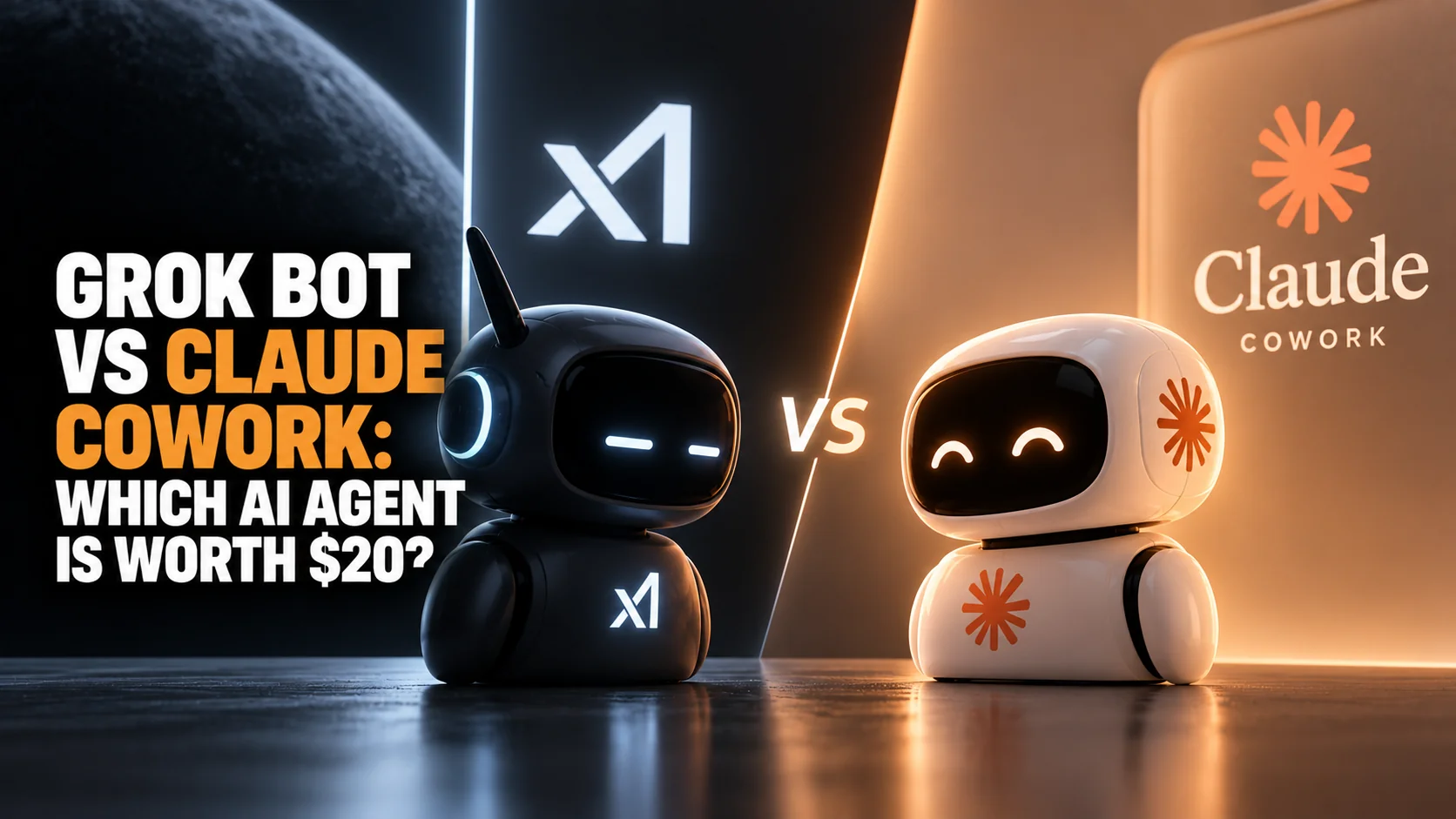
On 11 August 2026, the day xAI launched it, Grok Bot cost $200 a month. Fifteen days later it cost $20. On 26 August the company announced that “Grok Bot is now included with all SuperGrok, Cursor Pro, and Cursor Teams plans”, and Cursor Pro sells for $20 a month. That is the same price as Claude Cowork on Claude Pro. A comparison that started as a question about budget stopped being one in under three weeks. Since 12 October new buyers get Grok Bot through The X Subscription from Premium at $30 a month, $10 more than Cowork; existing Cursor Pro subscribers keep it at $20.
So Grok Bot vs Claude Cowork now turns on what the two agents actually do rather than what they cost. Both run in the cloud. Both keep working after you close the lid. Both ask for access to accounts and files you care about. They differ in one design decision that almost no coverage mentions, and it decides which of them belongs on your Mac. This guide covers the real prices, where each one runs, how each handles your logins, and who should buy which.
The Key Takeaways
- Close entry prices. For new buyers Grok Bot comes with X Subscription Premium at $30/month (existing Cursor Pro subscribers keep it at $20); Claude Cowork comes with Claude Pro at $20/month. Neither is on a free plan.
- Grok Bot got cheap fast. The floor fell from $200 on 11 August to $60 on 21 August to $20 on 26 August 2026. Most comparison articles still quote the old numbers.
- Opposite designs. Grok Bot gives you one persistent cloud computer that remembers every login. Cowork spins up an isolated sandbox that is destroyed when the session ends.
- Grok Bot usage was separate. On the old Cursor and SuperGrok plans xAI says work you hand a Bot “won’t count against your existing usage”; on The X Subscription it shares one weekly pool with Grok chat. Cowork draws on your normal Claude plan limits.
- Platform split. Grok Bot has Linux packages and Cowork does not. Cowork runs in a browser and Grok Bot is apps only, with no iPad version.
Grok Bot vs Claude Cowork at a Glance
| Grok Bot | Claude Cowork | |
|---|---|---|
| Maker | xAI | Anthropic |
| Launched | 11 August 2026 | 9 April 2026 (general availability) |
| Entry price | $30/month (X Subscription Premium) | $20/month (Claude Pro) |
| On a free plan | No | No |
| Where work runs | One persistent cloud computer per member | Temporary sandbox, new one per session |
| State between sessions | Kept, including logins | Destroyed at session end |
| Local file access | On the agent computer | Folders you connect on the desktop |
| Usage accounting | Separate from your plan | Shares your Claude plan limits |
| Desktop | macOS, Windows, Linux | macOS, Windows |
| Mobile | iPhone, Android | iPhone, Android |
| Browser access | No | Yes, at claude.ai |
| No app for | iPad | Linux desktop |
| Standout integration | X (posts, timeline, mentions) | Excel, PowerPoint, Word, PDF |
What Is Grok Bot?
Grok Bot is xAI’s agent product, and it is not a chatbot. Each account gets a persistent computer in the cloud. The Bots running on it open a browser, sign into your apps with your own credentials, work through multi-step jobs, and report back in chat. Close your MacBook and the job continues. xAI describes Bots as teammates you hand real work to: updating records, processing invoices, onboarding a colleague, debugging code. Our full explainer covers what Grok Bot is and which Apple hardware runs it, and it is a different product from the @grok account people tag under posts on X.
What Is Claude Cowork?
Claude Cowork is Anthropic’s agent for knowledge work, generally available since 9 April 2026. It reads, writes, renames and reorganises files, builds spreadsheets and decks, and runs research jobs that end in a deliverable rather than a chat reply. Since July 2026 it has run on the web and on phones as well as the desktop, and its sessions execute on Anthropic’s servers by default. Our complete guide to Claude Cowork walks through setup, and how Cowork differs from Claude Code covers the split that confuses most people.
Grok Bot vs Claude Cowork: What Each One Costs
This is where nearly every article on the subject is out of date, because Grok Bot’s access terms changed three times in twenty-three days.
The Grok Bot price collapse
At launch on 11 August 2026, Grok Bot sat behind three top-of-line subscriptions, and the cheapest individual route cost $200 a month. On 21 August xAI opened a limited free trial and dropped the individual floor to $60. On 26 August it went further, publishing a note titled Grok Bot is now included with more plans that put the agent on every SuperGrok, Cursor Pro and Cursor Teams subscription. Cursor Pro costs $20 a month and lists Grok Bot access in its feature set, which is how an agent that cost $200 in mid-August cost $20 by the end of it.
One wrinkle worth knowing: xAI’s own FAQ still lists the older 21 August plan set, while the newer announcement and Cursor’s live pricing page both say otherwise. Two current sources beat one lagging help page, and it explains why so much coverage still prints the launch-day gate.
What Claude Cowork costs
Cowork has been steadier. It is included on every paid Claude plan and on none of the free ones. Claude Pro is $20 a month, or $17 a month billed annually. Max starts at $100 and runs to $200 depending on how much capacity you want, and Team seats begin at $25. Our breakdowns of what Claude Cowork costs across every tier and every Grok plan and its usage limits go deeper than the table below.
| Route | Price | Agent included |
|---|---|---|
| X Subscription Premium | $30/month | Grok Bot |
| Cursor Pro (existing subscribers) | $20/month | Grok Bot |
| Claude Pro | $20/month ($17 annual) | Claude Cowork |
| Cursor Teams Standard | $40/seat/month | Grok Bot |
| Claude Team | from $25/seat/month | Claude Cowork |
| Claude Max | $100 to $200/month | Claude Cowork |
| Free tier | $0 | Neither |
The usage difference that matters more than the price
The sticker prices sit close, so the meter is the real difference. xAI states that “Grok Bot comes with its own usage, separate from your Grok and Cursor plans, so anything you hand off to a Bot won’t count against your existing usage.” That separation belongs to the old plans: on The X Subscription, xAI says one weekly pool covers Grok Chat, Imagine, Voice and Bot, so for new buyers a heavy Bot week now eats the same allowance, just as a heavy Cowork week eats the allowance your normal Claude conversations draw on. If you keep an old Cursor or SuperGrok plan and run an agent hard every day, that difference is worth more than any benchmark. On the trial question, xAI has never published a duration for its limited free trial, and the seven-day figure circulating on affiliate sites traces to no company page, so treat it as unconfirmed.
Where the Work Runs: Two Opposite Designs
Both agents run in a vendor’s cloud, which makes them sound alike. They are built on opposite assumptions about memory, and everything else follows from it.
Grok Bot remembers everything
Grok Bot gives each member one persistent computer. Files, browser sessions and command-line credentials survive from job to job, so a Bot that signed into your CRM on Monday is still signed in on Thursday, and a second Bot can pick up where the first left off without repeating the login. xAI is explicit that deleting a Bot “does not remove computer files or browser sessions”. Persistence is the product: it is what lets Bots hand work to each other and what makes a long-running job survive a closed laptop.
Claude Cowork forgets on purpose
Cowork does the reverse. Anthropic’s architecture documentation says the agent loop and code execution run “in an isolated, temporary sandbox on Anthropic-managed infrastructure”, created when a session starts and destroyed when it ends, with no state shared between sessions. Cloud sessions have no network access by default and cannot reach private or internal addresses. When Cowork touches files on your Mac, the request is brokered through the desktop app and limited to folders you connected yourself.
Which design wins
Persistence buys convenience and costs isolation. Ephemerality buys isolation and costs convenience: you reconnect things more often, and Cowork cannot quietly accumulate logins because there is nowhere for them to accumulate. Note that Cowork’s cloud default also removes Grok Bot’s headline advantage. Anthropic’s help pages put it plainly: “Work continues in the background. Close your laptop and Claude keeps going.” Working while you sleep is no longer something only Grok Bot does.
Mac, iPhone and Everything Else
Neither agent covers every device, and the gaps fall in different places.
Grok Bot ships desktop builds for macOS on Apple silicon and Intel, Windows on x64 and Arm64, and Linux on x64 and Arm64 as a .deb package, an .rpm package or an AppImage. On mobile it supports iPhone on iOS 18 or later and Android 9 or later. Its documentation states that iPad is not supported.
Claude Cowork runs in the Claude desktop app for macOS and Windows, in a browser at claude.ai, in the iOS and Android apps, and in a Chrome side panel. There is no Linux desktop client. Anthropic does not name the iPad in its Cowork documentation, but the browser route means a tablet reaches Cowork, and Grok Bot has no browser version at all.
For a Mac owner the practical read is simple. Both cover macOS and iPhone properly. If a Linux box sits alongside your Mac, only Grok Bot has a native package for it. If you want to pick up work in a browser on a borrowed machine or a tablet, only Cowork does that. Our Grok desktop client guide for Mac covers running xAI’s tools natively, and Gemini Spark against Claude Cowork compares the same agent category from a different angle.
The Security Question Nobody Answers
Both agents want your logins. Only one of them publishes a blunt warning about what that means, and it is the more permissive of the two.
What xAI tells you in its own documentation
xAI’s approvals, security and privacy documentation states that “Files, browser sessions, and command line credentials on that computer are available across your Bot roster.” Twice on the same page it warns against treating Bots as isolation: “Do not use separate Bots as a security boundary”, and “Sharing a Bot is not a security boundary”. It is equally clear that approvals are not an undo button, because “an approval controls the proposed action. It does not reverse work already completed.” For passwords and one-time codes, xAI tells you to take the keyboard yourself: open the agent computer, take control, complete the sensitive step, hand control back. Do not paste a password into ordinary chat.
How Anthropic handles the same problem
Cowork answers with architecture instead of advice. Because each session gets a sandbox that is destroyed at the end, a compromised session has nothing durable to leak, and Anthropic’s architecture overview confirms cloud sessions start with no network access at all. File reach is limited to folders you explicitly connect.
Read this before you hand over an account
Give credit where it is due: xAI documents its risks honestly, and its prompt-injection controls “reduce, but do not eliminate, risk from malicious content”, which is a more candid line than most vendors write. The conclusion still stands. If you put a banking login or a production admin account on a Grok Bot computer, every Bot on that account reaches it, and deleting the Bot does not clean it up. Cowork asks for less and forgets faster. For a wider look at the category, see our roundup of the best AI agents we have tested.
Which Should You Pick? The Honest Verdict
Buy Claude Cowork if your work ends in a file. Spreadsheets, decks, documents, research write-ups and anything that has to land on your Mac in a folder you control. The sandbox model suits people who want an agent for a task rather than a permanent employee with keys to everything, and the $20 Pro plan covers the same Claude subscription you probably already use.
Buy Grok Bot if your work is a process that repeats. Signing into the same five web tools, moving records between them, running a routine nobody wants to do by hand. Persistence is a real advantage for that shape of job, on the older Cursor plans a separate usage meter means a heavy agent week does not eat your chat limits (on The X Subscription it shares one pool with Grok chat), and the X integration added on 29 August is the only one of its kind: a Bot can search posts, read your timeline and check mentions. If you also live in Cursor, the $20 Pro seat you already pay for now includes it, which our breakdown of Cursor pricing covers tier by tier.
Pick Cowork if you are undecided. It costs the same, asks for less access, reaches more devices, and the work it produces is easier to inspect. Grok Bot is the more powerful tool and the more demanding one, and it is still early beta. If you already pay for ChatGPT Pro, OpenAI added a third option on 29 September 2026: dots, OpenAI’s always-on agents, included from $100 a month.
The Bottom Line on Grok Bot vs Claude Cowork
The $20 tie was the headline until October, when Grok Bot moved to $30 for new buyers, and the design split is the answer. Grok Bot hands you a machine that never forgets, which is exactly why it is the riskier place to store a login. Claude Cowork hands you a machine that forgets by default, which is why it is the safer place to start and the weaker one for long-running routines. Neither is a chatbot, and neither should be judged as one.
Both also tie you to one vendor’s model at one vendor’s price. If you would rather keep several models in one native Mac app and choose per task, that is the gap the wider agent category still leaves open, and it is the problem Fello AI was built to solve.
FAQ
Is Grok Bot cheaper than Claude Cowork?
For new buyers, Claude Cowork is. Since 12 October 2026 Grok Bot comes with The X Subscription from Premium at $30 a month, while Claude Cowork is included with Claude Pro at $20 a month. Existing Cursor Pro subscribers still get Grok Bot at $20. Grok Bot’s entry price fell from $200 at launch on 11 August to $60 on 21 August and to $20 on 26 August. Neither agent is available on a free plan.
Does Grok Bot work on a Mac and iPhone?
Yes. Grok Bot runs on macOS on both Apple silicon and Intel, and on iPhone with iOS 18 or later. It also has Windows and Linux desktop builds and an Android app. Its documentation says the iPad is not supported. Claude Cowork covers macOS, Windows, the web, iPhone and Android, but has no Linux desktop client.
Is it safe to give Grok Bot my logins?
Treat it carefully. xAI’s documentation says files, browser sessions and command-line credentials are available across your whole Bot roster, and warns directly: “Do not use separate Bots as a security boundary.” Deleting a Bot does not remove its files or signed-in sessions. For passwords and one-time codes, take control of the agent computer and type them yourself.
Does Claude Cowork keep working when I close my laptop?
Yes. Cowork sessions run in the cloud by default, and Anthropic states that work continues in the background when you close your laptop, with scheduled tasks running when no device is online. This removes what was Grok Bot’s clearest advantage at launch. Cowork still needs your desktop app online to reach local files.
Is Grok Bot the same as the @grok account on X?
No. The @grok account is the reply bot people tag under posts on X. Grok Bot is a separate desktop and mobile agent app that drives a cloud computer. Since 29 August 2026 the two connect: a Bot can link your X account to search posts, read your timeline and check mentions, and paid users get free X API credits.