Almost every guide to AI for seniors is written for the senior. That is the wrong reader. The person actually searching this is usually the adult child or grandchild who has decided a parent might get something out of a chatbot. They also know perfectly well who will answer the phone when it stops working.
So this is written for you, not for them. It covers which assistant to put on the device and the exact settings that decide whether your parent uses it twice or forever. It also covers the one safety conversation to have before you hand it over, and the honest limits of what any of this does. Prices and settings paths here were checked against vendor and Apple pages in September 2026, because most of what is published on this topic is two years stale.
The Key Takeaways
- Pick one and only one. The failure mode is not choosing wrong, it is installing three apps and leaving someone to work out which is which.
- Voice is the entry point, and the free plans differ. ChatGPT's own pricing page lists “Limited voice chats” on Free; Gemini's free tier is $0 with a Google Account.
- iOS 27 moved the text size control. Apple's iOS 27 guide puts it at Settings, Appearance, Text Size. Most guides online, and one older Apple article, still send you to Display & Brightness.
- Have the scam conversation first. The FTC's advice is blunt: “Don’t trust the voice.” Call back on a number you already have.
- Budget nothing to start. If the free voice limit does bite, the fix is ChatGPT Go at $8 a month, not Plus at $20. Go is the tier that adds more voice chats.
What AI for Seniors Actually Means in 2026
Search this topic and you get two kinds of page. The first is written by senior-living operators, and it is really about fall detection sensors and telehealth inside a care community. The second is written by digital-literacy nonprofits, and it explains what artificial intelligence is at a level a curious adult does not need. AARP's Senior Planet has an AI landing page that lists classes and articles but names no tool at all. The widely cited OATS guide is a 2024 PDF, organised into health, finance and lifestyle, that never mentions a single product.
Neither answers the practical question. If your mother has an iPhone and you have forty minutes on a Sunday, what do you actually install, what do you switch on, and what do you tell her?
This Is Not a Beginner's Guide, and That Matters
We have separate pieces for learning the tools yourself. If you want the concepts, read our guide to AI for absolute beginners. If you want to learn the product properly, our ChatGPT beginners guide covers signup, plans and prompting.
This page assumes you already know what a chatbot is. Your job is different: you are configuring software for somebody who will not read a help article, will not experiment, and will abandon the whole thing silently if the first session goes badly. That is much closer to the problem we describe in our guide to ChatGPT for kids, at the other end of the age range. Same structure, opposite risks.
What They Will Actually Use It For
Set expectations low and specific. In practice the uses that stick are the conversational ones. Asking a question out loud and getting a plain answer. Having a letter or an email drafted. Translating a menu or a label. Getting a long leaflet or a council form explained in ordinary words, and settling arguments about facts. The uses that do not stick are anything requiring a multi-step workflow, anything with file management in it, and anything where the reward arrives more than one screen away.
Which AI for Seniors Is Actually Best
There is no assistant built for older users, and the ones marketed that way tend to be expensive companion robots rather than general tools. What you are really choosing between is the three mainstream chatbots and the assistant already on the phone. The figures below are the consumer rates published on Google's own Gemini subscriptions page and Anthropic's pricing page, checked in September 2026.
| Assistant | Free tier | Paid tier | Voice on the free plan | Best for |
|---|---|---|---|---|
| ChatGPT | Yes, unlimited text chats | Go $8/month, Plus $20/month | Listed as “Limited voice chats” | The default pick. Best-known name, strongest voice mode |
| Google Gemini | $0/month with a Google Account | AI Plus $4.99, AI Pro $19.99 | Included | Someone already living in Gmail, Photos and Android |
| Claude | Yes, free for everyone | Pro $17/month annual, $20 monthly | Available | Long, patient conversations. Weakest name recognition |
| Siri | Built in, no account | Not applicable | Always on | Zero setup, narrowest range of tasks |
Why ChatGPT Is Usually the Answer
Name recognition is not a trivial factor here. Your parent has heard of ChatGPT, has probably seen it on the news, and will not feel they are being made into a test subject for something obscure. That matters more than any benchmark.
The caveat is on the free plan. OpenAI's own pricing page lists unlimited text chats on Free but describes voice as “Limited voice chats”, and voice is precisely what a non-typist will use most. Their cheaper Go tier, at $8 a month, is the one that lists “More voice chats” and “Longer memory”. That matters more than it looks. The obvious upgrade path for a heavy talker is not Plus at $20 a month, it is the $8 tier, because the thing your parent will run out of is voice rather than reasoning. One caveat before you pick it: the pricing page states the Go plan “may include ads”.
When to Pick Gemini or Siri Instead
Choose Gemini if the person already uses a Google account for mail and photos. It reaches into things they already recognise, and there is no new login to remember. Its free tier is straightforwardly $0 with a Google Account, and the first paid step is $4.99 rather than $20.
Choose Siri, or rather choose nothing, if the honest answer is that your parent wants to set a timer and ask about the weather. Siri is already there, needs no account and no app, and our guide to using Siri covers the commands worth teaching. Installing a chatbot for someone who wanted a timer is how you end up with an unused icon and a slightly embarrassed parent.
Set It Up in Twenty Minutes
Do this on one device only. Picking the phone and ignoring the iPad and the laptop is not laziness, it is the whole method. Two devices means two places where it might be signed out.
- Choose the device they already carry. Almost always the phone.
- Create the account on their own email address, not yours. Write the password on paper and leave it somewhere they will find it. A password they cannot retrieve is a dead app in three weeks.
- Do the display settings before the app, using the paths in the next section. Nothing else matters if they cannot read it.
- Put the icon on the first home screen, in the dock if there is room, next to something they already open daily.
- Turn on voice and do the first conversation out loud, together. Let them hold the phone and press the button. You are coaching, not demonstrating.
- Ask it one question that matters to them. Not a party trick. Something real: a recipe substitution, a letter to the council, what a word on a form means.
- Write the steps down on paper in large handwriting, and leave the note by the chair where they actually sit with the phone.
The paper note is the step people skip and the one that decides the outcome. Nobody in this age group is going to search a menu for a feature they used once.
The Note to Leave Behind
Copy this onto a card in handwriting they can read, fill in the two blanks, and leave it wherever they actually sit with the phone. Keep it to one side of one card.
| Write this line | Why it is on the card |
|---|---|
| The app is the one called ______ . It lives at the bottom of the first screen. | Naming the icon and its position beats any instruction about menus |
| To talk instead of typing, tap the microphone and just speak. | Voice is the feature they will use and the one they forget exists |
| If it asks you to sign in, the email is ______ and the password is on this card. | A forgotten password is the single most common reason a setup dies |
| It sounds sure of itself even when it is wrong. If it matters, check it. | The one concept worth keeping in front of them permanently |
| Nobody from any company will ever phone and ask for money or codes. | Ties the scam rule to the device, where it will be read again |
The Settings That Decide Whether They Keep Using It
This is where almost every guide online is now wrong, because Apple moved the controls.
Text Size on iOS 27 Is Not Where You Remember
On iOS 27, Apple's own iPhone guide gives the path as: open Settings, tap Appearance, then tap Text Size, and drag the slider. Bold Text sits in the same menu: Settings, Appearance, Bold Text.
Expect to be told otherwise. Apple still publishes an older support article, not tied to any iOS version, that sends you to Settings, Display & Brightness, Text Size, and most third-party guides copy that one. If Appearance is not on the phone in front of you, it is running an earlier iOS and the Display & Brightness route is the right one.
If the largest slider setting still is not enough, there are two more levers. Display Zoom enlarges the whole interface rather than just the type, under Settings, Appearance, Display Zoom, Larger Text. And Apple's accessibility guide points to Settings, Accessibility, Display & Text Size, where Larger Text has its own slider and a Larger Accessibility Sizes switch that goes beyond the standard range. Turn Bold Text on by default. It costs nothing and it helps everyone.
The setting worth knowing about, and the one nobody mentions, is the Text Size control in Control Center. Apple's guide describes adding it through Add a Control, after which your parent can change text size inside whichever app they are in, without going near Settings. That single control has rescued more setups than any other thing on this page, because it turns a buried preference into one swipe.
Voice Is the Real Accessibility Setting
Typing is the barrier, not comprehension. Somebody who is slow on a keyboard, or whose hands are not steady, will use an assistant they can talk to and abandon one they have to type into. Turn voice mode on during setup and make the first three conversations spoken ones. Our breakdown of ChatGPT's voice modes explains which is which, and Claude's voice mode works similarly if you went that way.
On a Mac, the same logic applies through dictation rather than a chat window, and our comparison of Mac dictation apps covers the options if the desktop is where they actually work.
What AI for Seniors Cannot Do
Be straight about this at setup, because the alternative is that they find out from a wrong answer they acted on.
The Health Question, Answered Honestly
A lot of the search demand around this topic is medical: medication, memory, staying independent. A general chatbot will put a hospital letter or a leaflet into plain English, and that is worth having. It cannot be relied on to manage medication, interpret symptoms, or replace a conversation with a doctor or pharmacist, and it will state wrong things with total confidence. Nothing on this page should be treated as medical advice. The correct use is translation of jargon, and the correct next step is always the person who prescribed the thing.
It Is Confident Exactly When It Is Wrong
The one concept worth teaching is that the assistant does not signal uncertainty the way a person does. It uses the same calm, fluent tone for a fact and for an invention. The practical rule to leave them with is short enough to remember: if it matters, check it somewhere else. Free plans are perfectly capable for this kind of use, and our test of the free chatbots against real message limits shows where they actually run out.
AI Voice Scams: The Conversation to Have First
Have this one before you hand the phone back, and have it even if you decide against installing anything at all.
How the Call Actually Works
The US Federal Trade Commission describes the scenario plainly: a panicked voice on the phone claiming to be a grandchild in trouble and needing money. What has changed is that it now sounds right. In the FTC's own words, a scammer needs “a short audio clip of your family member's voice”, which a scammer can lift from anything posted online, plus a voice-cloning program.
You will see a specific number of seconds quoted all over the internet for how much audio is needed. The figure most often cited, three seconds, comes from a McAfee lab test in April 2023, in which three to four seconds of speech gave a clone its researchers rated an estimated 85% match. Treat it as old rather than exact, and see where the AI voice scam numbers really come from for the rest. The defence does not depend on it either way.
The Rule That Actually Works
The FTC's guidance is two words long: “Don’t trust the voice.” Call the person back on a number you already have saved, not the one that rang. If you cannot reach them, try another family member. The agency also lists the payment methods that give the game away, namely a caller asking you to wire money, send cryptocurrency, or buy gift cards and read out the numbers and PINs.
The FBI goes one step further and tells families to create a secret word or phrase to verify each other's identity. Agree it in person and never send it in a message. For the wider picture on synthetic media, our guide to spotting AI deepfakes covers the visual side of the same problem.
When They Call You Because It Broke
They will, and it is almost never the AI. Work down this list before you touch a setting, because the order reflects how often each one is actually the culprit.
| What they tell you | Usually means | What to do first |
|---|---|---|
| It stopped working | Signed out after an update | Sign back in, then write the password on the card again |
| The button has gone | App update moved the interface | Open it yourself once, find the button, update the paper note |
| It does not understand me | They are in a different app, often the browser or Siri | Check which icon they tapped before debugging anything |
| It says it cannot connect | The phone is offline | Check Wi-Fi, then mobile data |
| It has gone small again | Display Zoom or text size reset by an update | Redo Settings, Appearance, Text Size, and add the Control Center slider |
Two things reduce the call volume more than anything else. Keep the icon in a fixed position, because muscle memory is doing most of the work. And leave the written note where they sit, updated whenever an app update moves a button. If you want an easier device to support from a distance, our ranked list of iPhone AI apps is a reasonable place to compare what is simplest to explain over the phone.
One privacy setting is worth doing once, on their behalf, at setup rather than later. Turning off model training on the account takes a minute, and spares a conversation you do not want to have twice.
One App Instead of Four Accounts
Everything above assumes you picked one assistant and stuck to it, and the reason that rule exists is worth saying plainly. Trying two means two apps, two logins and two subscriptions, and the person you are setting this up for will not manage any of that. Every extra icon is one more thing to tap by mistake, one more password to lose, and one more support call for you.
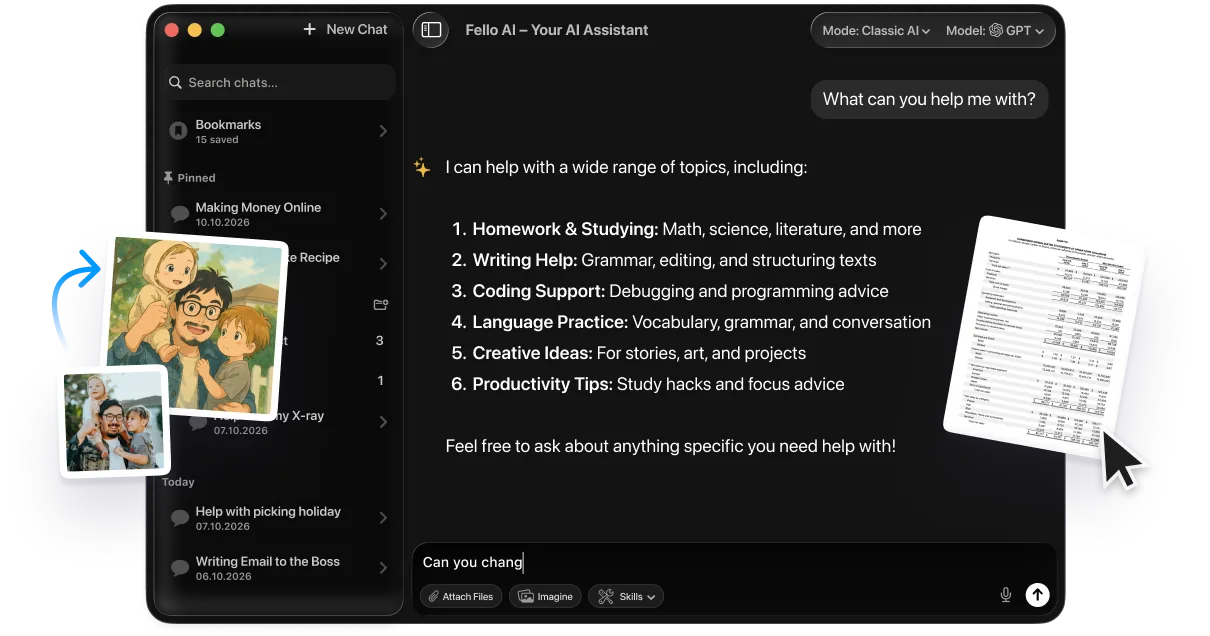
That is the exact problem Fello AI was built to remove on Mac, iPhone and iPad. One app and one subscription put GPT, Claude, Gemini, Perplexity, Grok, Kimi, DeepSeek and others behind a single familiar window. Switching model never means switching app, signing in again, or asking somebody to remember a second password, because from your parent's side nothing changes at all. There is one icon, and it always does the same thing.
It costs $9.99 a month or $79.99 a year, with a free tier to try first, and holds a 4.7-star rating across more than 27,000 reviews. For this particular job the model roster is not really the selling point. The point is narrower. When you sit down to write the note we described earlier, you name one app on it. When they call you in three weeks, there is one place to look.
The Verdict
The published advice on AI for seniors is unusually poor, and it is poor in a specific way. It is written either to sell a care community or to teach a concept, and almost never to get one person set up on one device. The gap is not knowledge, it is that nobody writes for the person doing the work.
So the answer is narrow on purpose. Install ChatGPT unless they live in Google's world, in which case install Gemini. Do the display settings before the app. Make the first three conversations spoken. Write it on paper. Have the scam talk. Expect to pay nothing for months, and treat a paid upgrade as a decision you make later, when a real limit gets hit, rather than a thing you buy on day one. That is the entire job, and it fits in a Sunday afternoon.
Frequently Asked Questions
What is the best AI for seniors?
ChatGPT for most people, because the name is familiar and the voice mode is strong. Choose Google Gemini instead if the person already uses Gmail and Google Photos daily, since there is no new account to remember and the first paid tier is $4.99 rather than $20. If they only want timers and weather, Siri is already on the phone and needs no setup at all.
Is AI free for seniors?
Yes. ChatGPT, Gemini and Claude all have free tiers, and a light voice user will rarely exhaust one. The catch is voice specifically: OpenAI's pricing page lists “Limited voice chats” on the free plan. If that limit starts biting, paid plans run from $4.99 a month for Google AI Plus to $20 a month for ChatGPT Plus.
How do I make the text bigger on my parent's iPhone?
On iOS 27 the control moved. Open Settings, tap Appearance, then tap Text Size, and drag the slider. Bold Text is in the same Appearance menu. If the largest setting still is not enough, Apple's guide points you to Settings, Accessibility, Display & Text Size for further increases and contrast options.
Is ChatGPT safe for an older person to use?
The chatbot itself is not the risk. Two things are. It states wrong answers in a confident tone, so the rule to teach is that anything important gets checked elsewhere. And AI voice cloning is being used in family emergency scams, which is a separate conversation worth having whether or not you install anything.
Can AI help someone with memory problems?
Not as a medical tool, and it should never be relied on for medication or symptoms. What it does well is explain a hospital letter, a leaflet or a form in plain language. Treat it as a translator of jargon, and take anything clinical back to the doctor or pharmacist.