The honest answer to Apple Intelligence vs ChatGPT is that most people are comparing two things that were never built to do the same job. Apple Intelligence is not a chatbot. It is a layer of AI features stitched into macOS and iOS that rewrites the sentence you just typed, summarises the thread you do not want to read, and tidies up a photo. ChatGPT is a general assistant you open and talk to. On a Mac the two behave so differently that “which is better” turns out to be the wrong question.
There is a second complication that almost no comparison mentions. ChatGPT is already inside Apple Intelligence, as an optional extension you switch on in System Settings, and Apple has separately signed Google to supply the foundation models under its rebuilt Siri. So you are not picking a side in a two-horse race. You are deciding how much of a stack you want, and how much of it you want to control. This guide covers what each one really does on your Mac, what Apple sends to OpenAI, where accuracy breaks down on both sides, and who still needs a paid subscription.
The Key Takeaways
- They do different jobs. Apple Intelligence edits and summarises what is already on your screen. ChatGPT thinks, reasons and writes from scratch. Most people end up using both.
- ChatGPT is already built in. Apple lists ChatGPT integration as part of Apple Intelligence, switched on under System Settings, Apple Intelligence & Siri, Extensions. You do not need an OpenAI account, and staying signed out keeps OpenAI from training on what you send.
- Google is now underneath Apple's AI. On 12 January 2026 Apple and Google confirmed a multi-year deal putting Gemini models behind Apple Foundation Models and the next Siri.
- The Mac difference is inline versus window. Writing Tools work in any text field in any app. ChatGPT sits in its own window and you copy text in and out.
- Apple Intelligence is free, and limited on purpose. It costs nothing on an Apple silicon Mac, and it will not write you a long document or let you choose a different model. The conversational Siri AI ships with iOS 27 on 14 September 2026, but Apple has given macOS 27 no release date.
Apple Intelligence vs ChatGPT at a Glance
Before the detail, here is the split by task. Read it as a division of labour rather than a scoreboard, because almost every row that Apple wins is a row ChatGPT never tried to compete in.
| What you want to do | Apple Intelligence | ChatGPT |
|---|---|---|
| Rewrite or proofread text as you type | Yes, inline in any app | Yes, but you copy in and out |
| Summarise a long email or thread | Yes, automatically | Yes, if you paste it |
| Answer a hard question | Hands it to ChatGPT | Its core strength |
| Write something long | No | Yes |
| Hold a back and forth conversation | No | Yes |
| Write or debug code | No | Yes |
| Generate an image | Image Playground, cartoon-leaning styles | Yes, broader range |
| Edit a photo you already have | Clean Up, Extend, Spatial Reframing | Limited |
| Control your Mac and apps | Yes, through Siri and Shortcuts | No |
| Work with no internet | Partly, on-device features | No |
| Cost | Free with the hardware | Free tier, paid tiers from about $20 a month |
| Hardware needed | A Mac with Apple silicon | Any Mac |
Is Apple Intelligence Powered by ChatGPT?
No. Apple Intelligence runs on Apple's own foundation models, some on your device and some on Private Cloud Compute. ChatGPT is an optional hand-off you switch on, so that Siri and Writing Tools pass a request to OpenAI when Apple's models cannot answer it. Separately, Apple announced in January 2026 that its next generation of foundation models, the ones behind the rebuilt Siri, would be based on Google's Gemini. Three different things, and the confusion between them is why this question keeps getting asked.
What Apple's own models do
The everyday features are Apple's. Writing Tools proofreads, rewrites in a friendlier or more professional tone, summarises, and turns prose into lists or tables. Mail sorts by priority and puts a summary at the top of a long thread. Notifications get stacked and condensed. Image Playground and Genmoji make pictures and custom emoji. Visual Intelligence reads what is on your screen or in front of your camera. None of that touches OpenAI. For the full feature inventory, we keep a running explainer of what Apple Intelligence includes and which devices support it.
What the ChatGPT extension adds
Apple's support documentation lists “ChatGPT integration within experiences like Siri, Writing Tools, and Image Playground” as part of Apple Intelligence. You turn it on in System Settings, under Apple Intelligence & Siri, below Extensions. Apple is explicit that an account is optional: “You don't need a ChatGPT account, but if you have one, free or paid, you can connect to your account.” If you connect a paid account, Apple says your Mac “can use advanced ChatGPT capabilities more often.” Apple's own page on how to get Apple Intelligence is the reference here.
Two details are worth knowing before you enable it. The first is what leaves your Mac: your request and any attachments, plus your current time zone, country, device type, language, and the feature you were using. Your IP address is obscured from ChatGPT, though your general location is passed along for fraud prevention and legal compliance.
The second is the one that surprises people, and it runs against instinct. If you use the extension without signing in, Apple says OpenAI must not use your information to train or improve its models. Connect your ChatGPT account and OpenAI's own policies take over instead, which means OpenAI can retain your data and use it to train its models. Apple sets this out in its ChatGPT Extension privacy notice. Signing in buys you more capability and costs you the stricter privacy default.
Where Google Gemini fits in
On 12 January 2026 Apple and Google confirmed a multi-year partnership. In a joint statement the two companies said that, after careful evaluation, Apple had judged Google's technology “the most capable foundation for Apple Foundation Models.” Gemini models and Google cloud technology now sit behind Apple's foundation models and the next generation of Siri. Reports put the deal at roughly a billion dollars a year, a figure neither company has confirmed. Apple tested OpenAI and Anthropic before choosing Google.
For a reader this matters less than it sounds. Gemini is a supplier, not a product you interact with, and Apple still runs the privacy layer. What it does mean is that the tidy story of Apple versus OpenAI is over. If you want the assistant-level comparison rather than the feature-layer one, we cover Siri against ChatGPT separately, and the arrival of the rebuilt Siri in macOS 27 Golden Gate will move that comparison again once it ships on 14 September 2026.
Apple Intelligence vs ChatGPT on Your Mac
This is where the comparison stops being abstract. The difference is not really about model quality. It is about where the AI lives.
Writing Tools work where you already type
Select a paragraph anywhere on your Mac, in Mail, Notes, Pages or a third-party editor, and Writing Tools rewrites it in place. No window switch, no copying, no losing your formatting. For fixing a clumsy sentence in an email you are already halfway through, nothing else on the Mac is close. The cost of that convenience is that you get fixed options rather than instructions. You choose friendly, professional or concise. You do not get to say what you actually want.
ChatGPT lives in its own window
ChatGPT gives you the opposite trade. You get an open-ended instruction box and a model that will follow a complicated request, hold context across a long exchange, and produce something substantial. You pay for it in friction: copy the text out, paste it in, read the answer, paste it back. For a two-word proofread that friction swamps the benefit. For anything you actually have to think about, it disappears.
The Shortcuts Use Model action
The clearest illustration of the whole relationship sits in the Shortcuts app. Apple's Intelligent Actions include a Use Model step, and it offers exactly three choices for where your request goes: the on-device model, Private Cloud Compute, or ChatGPT as an Extension Model. That is the entire menu. Apple built a model picker into automation and then filled it with Apple, Apple, and one outside option. There is no way to point it at Gemini, Claude or anything else.
Accuracy: Where Each One Falls Down
Both systems get things wrong, in different and fairly predictable ways.
Apple ships a warning label on its own summaries
In December 2024 the BBC complained to Apple after notification summaries generated false headlines under the BBC's logo, including a summary claiming the suspect in a New York shooting had shot himself, and another announcing the winner of a darts final hours before it was played. Apple suspended the feature for news and entertainment apps. It returned in iOS 26, with an on-screen warning that summaries may contain errors the first time you enable the category, and every summary shown in italics so you know what you are reading. Apple putting a caution label on its own AI is the most useful accuracy signal available, and we walk through how to turn those summaries off if you would rather not have them.
Where ChatGPT gets it wrong
ChatGPT fails differently. It rarely mangles a summary of text you gave it, because the source is right there. It invents things when asked for facts it does not hold: citations, figures, quotes, product details. The practical rule is that Apple Intelligence is safest when it is working on your own content and least safe when it is compressing news, while ChatGPT is strongest when you supply the material and weakest when you ask it to recall something.
Privacy: Three Tiers, Not Two
Most comparisons flatten this to “Apple is private, OpenAI is not”, which is not accurate. There are three tiers, and knowing which one you are in matters more than the slogan.
The first is on-device. Plenty of Writing Tools work and notification summarising happen on your Mac and nothing leaves it. The second is Private Cloud Compute, where heavier requests go to Apple silicon servers under Apple's own privacy guarantees. The third is the ChatGPT extension, where your request goes to OpenAI along with the metadata listed earlier. Tiers one and two are Apple's to stand behind. Tier three is a different company's, which is why Apple gates it behind a setting and a prompt, and why signing into an account there quietly changes the terms. If you leave the extension switched off, nothing goes to OpenAI at all.
Cost and Hardware: What You Actually Need
Apple Intelligence is free, but it is not free of requirements. Apple lists it for “Mac computers with Apple silicon”, which rules out every Intel Mac, on macOS Sequoia 15.1 or later, with 7 GB of storage set aside. If you are unsure, we maintain a current list of which iPhones, iPads and Macs support Apple Intelligence and a breakdown of the AI features exclusive to the iPhone 18 Pro, and a walkthrough of how to switch it on. On an Intel Mac the question answers itself, and the practical route is one of the Apple Intelligence alternatives that run on older hardware. Newer hardware does not settle it either: the iPhone Duo runs the same chip as the iPhone 18 Pro and still gets a different set of AI features.
ChatGPT has a usable free tier and paid plans starting at around $20 a month for Plus, with higher tiers above it. The honest framing is that you are not choosing between free and paid. Apple Intelligence does not become a chatbot if you wait, and a ChatGPT subscription does not give you inline rewriting across macOS. They are separate purchases solving separate problems.
Which One Should You Use?
The split is cleaner than the marketing on either side suggests.
Use Apple Intelligence on its own if your AI use is editing text you have already written, skimming long email threads, cleaning up photos, and asking your Mac to do things. It is free, it is fast because it is local, and it never interrupts what you are doing. A large number of people need nothing else.
Add ChatGPT if you write anything long, code, research, or plan. Writing Tools and summaries stop at short drafts, and no setting changes which model sits behind them. Siri AI adds a real back-and-forth thread on iOS 27 and macOS 27 from 14 September 2026.
Switch on the built-in extension either way. It is free, it needs no account, and it means Siri and Writing Tools stop failing silently on questions Apple's models cannot handle. If the data handling described above bothers you, leave it off and open ChatGPT deliberately instead. When the Apple half is the part that breaks, our guide to Apple Intelligence not working works through the five causes in the order that costs you the least time.
Run Every AI Model on Your Mac With Fello AI
The Shortcuts menu gives the game away. Apple built a model picker with three entries, two of them Apple's and one of them ChatGPT, and that is the ceiling of your choice inside macOS. If the model you want is Claude for careful writing, Gemini for long documents, or something open-weight for anything you would rather not send anywhere, the operating system has no answer for you.
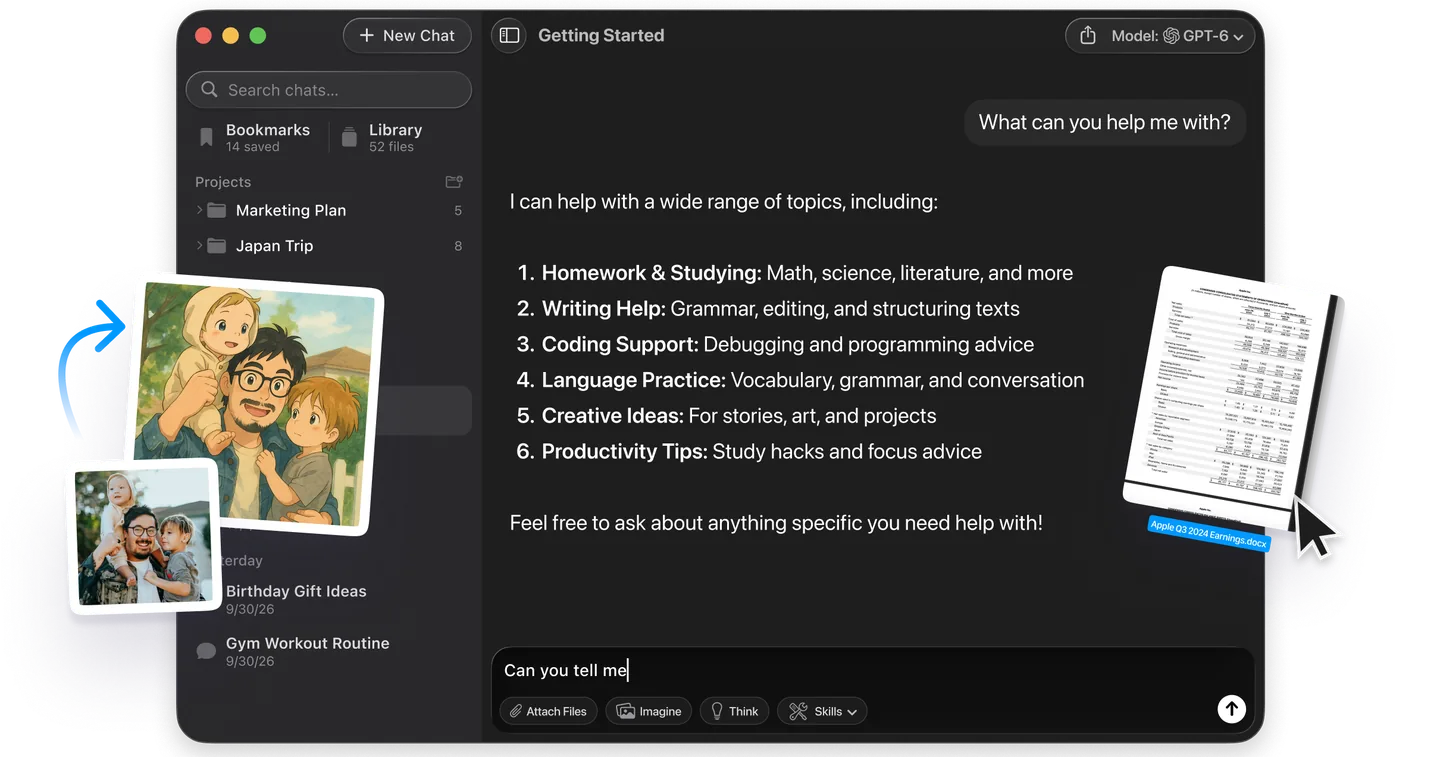
Fello AI is the missing layer. One keystroke opens a native Mac window with several frontier models behind it, so you can run the same prompt through more than one and keep the answer that is actually right, without a browser tab or a second subscription per model. It sits alongside Apple Intelligence rather than replacing it: keep Writing Tools for the inline edits it does better than anything, and reach for Fello AI when the job needs a real model. Our guide to the best AI models covers which one to pick for which task.
Conclusion
Apple Intelligence vs ChatGPT was never a fair fight, because they were built for different halves of the same day. Apple wins the small stuff you do constantly: the rewrite, the summary, the tidy-up, all free and all in place. ChatGPT wins everything that requires thinking, and nothing in macOS competes with it. The one thing worth changing today is the setting almost nobody opens: go to System Settings, Apple Intelligence & Siri, Extensions, and switch ChatGPT on. It costs nothing, it needs no account, and it removes the most common way Apple Intelligence lets people down.
FAQ
Is Apple Intelligence powered by ChatGPT?
No. Apple Intelligence runs on Apple's own foundation models, on your device and on Private Cloud Compute. ChatGPT is an optional extension that Apple Intelligence hands requests to when you have switched it on. Apple also announced in January 2026 that its next generation of foundation models, the ones behind the rebuilt Siri, would be based on Google's Gemini. Gemini shaped those models; it does not answer for them.
Do I still need ChatGPT Plus if I have Apple Intelligence?
Only if you want what Apple Intelligence does not do: long-form writing, coding, research and open-ended conversation. Apple Intelligence never gains those features, so a subscription is a separate decision rather than an upgrade. The free ChatGPT extension inside Apple Intelligence is enough for occasional hard questions.
What does Apple send to OpenAI?
Apple documents it precisely: your request and attachments, plus your time zone, country, device type, language and the feature you were using. Your IP address is obscured, though your general location is provided. Stay signed out and OpenAI must not train on it. Sign in and OpenAI's own policies apply instead. If the extension is switched off, nothing is sent at all.
Which Macs support Apple Intelligence?
Apple lists Mac computers with Apple silicon, running macOS Sequoia 15.1 or later, with 7 GB of free storage. No Intel Mac qualifies, and no software update changes that. Owners of older Macs need a third-party app instead.
Can I use Gemini or Claude instead of ChatGPT with Apple Intelligence?
Not today. ChatGPT is the only outside model listed under Extensions, and the Shortcuts Use Model action offers only the on-device model, Private Cloud Compute or ChatGPT. Apple has never announced a user-facing picker for other models, despite frequent claims otherwise. Running a different model on a Mac means using a separate app.