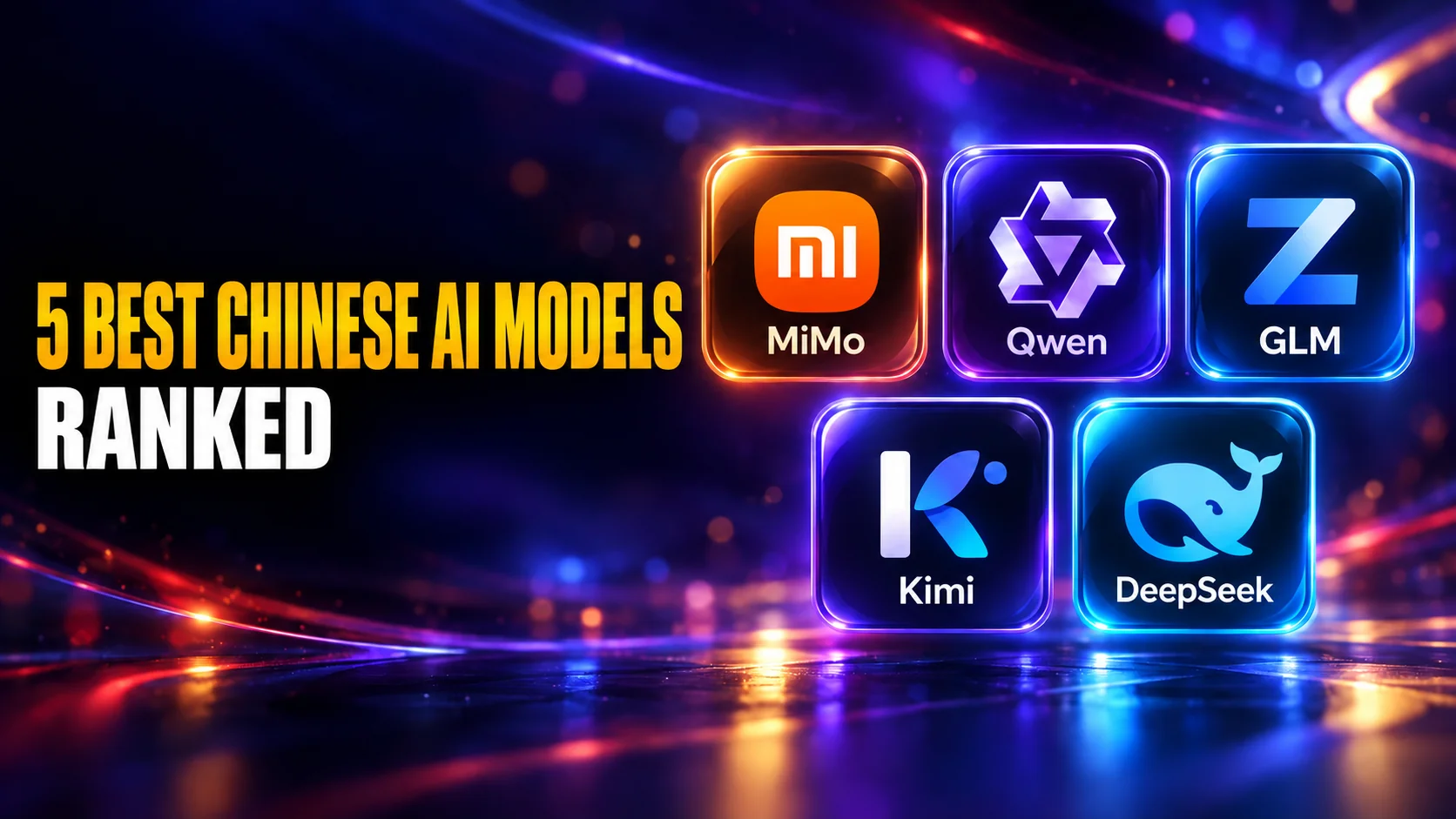
The best Chinese AI model in October 2026 is not DeepSeek. Xiaomi’s MiMo-V2.6-Pro scores 46.3 on the Artificial Analysis Intelligence Index v4.3.2, the highest of any model from a Chinese lab, and it costs $0.13 to run one index task. Alibaba’s Qwen3.8-Max and Z.ai’s GLM-5.3 sit within two points of it. DeepSeek’s newest model, V4.1-Flash, is seven points back.
This guide ranks the best Chinese AI models on one independent board, so the numbers compare like for like. For each model you get the score, the price, the licence and the way an ordinary person can actually use it on a Mac or an iPhone. Then come the three questions people search next: why these models are so cheap, how far behind the US labs they really are, and whether they are safe to use.
The Key Takeaways
- Best overall: Xiaomi’s MiMo-V2.6-Pro leads Chinese models at 46.3 on Artificial Analysis, under a plain MIT licence, at $0.435 / $0.87 per million tokens.
- Best for coding agents: Z.ai’s GLM-5.3 scores 41.9% on Terminal-Bench 4.0, the highest of any Chinese model in Artificial Analysis’s run.
- Best free apps: DeepSeek and Kimi both have free iPhone apps in the US App Store, rated 3.9 and 4.7 stars.
- The gap: the best Chinese score is 11.3 points below Claude Opus 5.5, and the US government’s CAISI put DeepSeek V4 Pro about 8 months behind the frontier.
- The cost: one index task costs $0.13 on MiMo-V2.6-Pro against $5.98 on Claude Opus 5.5, roughly 45 times less.
Best Chinese AI Models at a Glance
The table ranks the strongest Chinese AI models by their score on the Artificial Analysis Intelligence Index, version 4.3.2, read on 13 October 2026. Artificial Analysis runs every model through the same ten tests itself, so a vendor’s own benchmark chart cannot inflate the result. Where Artificial Analysis tests several reasoning settings, the score is the model’s highest setting. Prices are the vendor’s list price per million input and output tokens.
| Model | Lab | Index v4.3.2 | Open weights | API price (in / out) | How to use it |
|---|---|---|---|---|---|
| MiMo-V2.6-Pro | Xiaomi | 46.3 | Yes, MIT | $0.435 / $0.87 | API, MiMo Desktop |
| Qwen3.8-Max (0902) | Alibaba | 45.4 | Text-only version, custom licence | $2 / $6 | Qwen Chat in a browser, API |
| GLM-5.3 | Z.ai (Zhipu) | 44.8 | Yes, custom licence | $1.40 / $4.40 | API |
| Step 5 Preview | StepFun | 43.7 | Promised, not yet published | $1.00 / $2.70 | API |
| Kimi K3 | Moonshot AI | 43.6 | Yes, custom licence | $3 / $15 | Free Kimi app, API |
| GLM-5.3-Flash | Z.ai (Zhipu) | 41.8 | Yes, MIT | $0.15 / $0.50 | API |
| DeepSeek V4.1-Flash | DeepSeek | 39.5 | Yes, MIT | $0.15 / $0.60 off-peak | Free DeepSeek app, API |
| MiniMax-M3 | MiniMax | 29.2 | Yes, community licence | $0.30 / $1.20 (up to 512K input) | API |
Three big names are missing from the table because Artificial Analysis has not scored them. Tencent’s Hy4 Preview is a 770-billion-parameter model under the permissive Apache 2.0 licence. ByteDance’s Seed 2.1, the model family behind the Doubao chatbot, has no weights on Hugging Face. Baidu’s ERNIE 5.1 has no Artificial Analysis entry either. Without an independent score, any ranking of those three would be a guess.
The Best Chinese AI Model Overall: Xiaomi MiMo
MiMo-V2.6-Pro from Xiaomi is the best Chinese AI model overall in October 2026. Xiaomi released it on 21 September 2026, and Artificial Analysis scores it 46.3, the top Chinese result on the board. It is a sparse mixture-of-experts model with 1.02 trillion total parameters, of which 42 billion are active for each token, and it reads text, images, audio and video.
The price is what makes MiMo-V2.6-Pro stand out. Xiaomi charges $0.435 per million input tokens and $0.87 per million output tokens outside China. Artificial Analysis measures the cost of one index task at $0.13, against $2.01 for GLM-5.3 and $2.00 for Kimi K3, the next two open-weight models on the board. The weights are on Hugging Face under the MIT licence, one of the most permissive licences in common use.
The catch with MiMo-V2.6-Pro is access for ordinary users. Xiaomi sells it mainly as an API. Its own agent app, MiMo Desktop, rules out much of Europe. The download page says: “Not yet available in South Korea, the UK or EU member states.”
Our full guide to Xiaomi MiMo covers the four V2.6 models and where each one runs.
The Best Chinese AI Models by Job
The best Chinese AI model depends on the job, because the overall score hides large differences on specific tasks. MiMo-V2.6-Pro wins on the overall index and on cost. GLM-5.3 wins on coding agents, DeepSeek and Kimi win on free consumer apps, and Qwen wins on range of sizes.
| Your job | Pick | Why |
|---|---|---|
| Best overall | MiMo-V2.6-Pro | 46.3 on Artificial Analysis, $0.13 per index task |
| Coding agents | GLM-5.3 | 41.9% on Terminal-Bench 4.0, top Chinese score |
| Free chatbot on your phone | DeepSeek or Kimi | Free iPhone apps, 3.9 and 4.7 stars |
| Run it on your own Mac | Qwen3.8-27B | Apache 2.0, 4-bit build fits a 24GB Mac |
| Lowest token price | GLM-5.3-Flash or DeepSeek V4.1-Flash | $0.15 per million input tokens |
Best for Coding Agents: Z.ai GLM
GLM-5.3 from Z.ai is the best Chinese model for coding agents. On Terminal-Bench 4.0, the agentic coding test inside the Artificial Analysis index, GLM-5.3 solves 41.9% of tasks at its maximum reasoning setting. Qwen3.8-Max (0902) reaches 38.9%, MiMo-V2.6-Pro 34.8% and Kimi K3 only 12.6%. For scale, Claude Sonnet 5.5 leads the whole board at 63.6%.
GLM-5.3 costs $1.40 / $4.40 per million tokens. Its weights are public, but under Z.ai’s own GLM-5.3 licence rather than MIT. Teams that want MIT terms and lower cost should look at GLM-5.3-Flash: 320 billion parameters with 18 billion active, $0.15 / $0.50, and 32.8% on the same Terminal-Bench run.
Best Free Chinese AI Apps: DeepSeek and Kimi
DeepSeek and Kimi are the best Chinese AI models for people who just want a free chatbot on their phone. Both publish a free iPhone and iPad app in the US App Store. On 13 October 2026, the DeepSeek app held 3.9 stars from about 12,200 ratings, and the Kimi app held 4.7 stars from about 5,300. Both also work in a browser.
The models behind the two apps differ. DeepSeek’s current API models are V4.1-Flash, which scores 39.5 and reads images, and V4-Pro, which scores 36.0 and handles text only. Kimi’s app advertises Kimi K3, a 2.8-trillion-parameter model with a 1-million-token context window, the largest open-weight model on this list. Our Kimi K3 explainer covers its licence and the hardware it needs.
Best Range of Sizes: Qwen
Qwen from Alibaba is the best Chinese model family if you need more than one size. The flagship, Qwen3.8-Max (0902), scores 45.4 and costs $2 / $6. In August 2026 Alibaba also published the text-only model that flagship is built on, Qwen3.8-2.4T-A95B, which its model card calls the first Qwen-Max-class model in an open release.
At the small end, Qwen3.8-27B is a dense 27-billion-parameter model under Apache 2.0. Its 4-bit version runs on a Mac with 24GB of memory, according to Unsloth, which publishes compressed builds of the model.
For chatting with Qwen, Alibaba runs Qwen Chat in the browser at chat.qwen.ai. Developers reach the larger models through Alibaba Cloud’s API or third-party hosts.
Cheapest Chinese AI Models
The cheapest capable Chinese AI models are GLM-5.3-Flash and DeepSeek V4.1-Flash, both at $0.15 per million input tokens. GLM-5.3-Flash charges $0.50 for output. DeepSeek charges $0.60 off-peak and $1.20 at peak, which DeepSeek defines as 01:00 to 04:00 and 06:00 to 10:00 UTC on weekdays, outside Chinese public holidays. Measured per index task, MiMo-V2.6-Pro is still the best value. It costs $0.13 a task, against $0.27 for DeepSeek V4.1-Flash and $0.28 for GLM-5.3-Flash, despite its higher token price. Our DeepSeek pricing guide breaks down the peak and off-peak tiers.
Why Are Chinese AI Models So Cheap?
Chinese AI models are cheap because most of them ship as open weights, which lets many companies host the same model and compete on price. That is the first of three reasons given by the Center for Strategic and International Studies (CSIS), a Washington think tank, in a July 2026 analysis. A closed US model has one seller, who sets the price. An open Chinese model has dozens of hosts undercutting each other.
The second reason CSIS gives is efficiency under pressure. US export controls limit Chinese labs’ access to the best AI chips. So the labs lean on cheaper training methods, including learning from the outputs of stronger models, and on efficient inference. Almost every model in the table is a sparse mixture of experts, which activates only a small slice of its parameters per token. MiMo-V2.6-Pro uses 42 billion of 1.02 trillion.
The third reason is strategy. CSIS argues that Chinese labs use cheap, open releases to win developers and become the default choice for anyone who does not need the very best model. The US government’s own testing backs up the value claim. The Center for AI Standards and Innovation (CAISI) found DeepSeek V4 Pro more cost-efficient than GPT-5.4 mini, the cheapest comparable US model, on 5 of 7 benchmarks.
How Far Behind Are Chinese AI Models?
The best Chinese AI model is about 11 points behind the best US model on the Artificial Analysis index. MiMo-V2.6-Pro scores 46.3, and Claude Opus 5.5 scores 57.6. Several US models sit in between at their highest settings, including Claude Sonnet 5.5, Claude Fable 5.1, GPT-6 Astra and GPT-6.1 Sol.
In time, the gap is measured in months, not years. In its evaluation of DeepSeek V4 Pro, CAISI concluded that the model’s capabilities “lag behind the frontier by about 8 months”. CAISI also found that DeepSeek’s own benchmarks flattered the model. On DeepSeek’s numbers, V4 Pro looked level with models released two months earlier. On CAISI’s tests, which include unpublished benchmarks, it performed like GPT-5.
The CAISI result is the reason this guide uses one independent board. A Chinese model’s launch chart often shows it beating Claude or GPT, and DeepSeek V4 Pro shows how far a vendor’s own chart and an outside test can drift apart.
Are Chinese AI Models Safe to Use?
Chinese AI models are safe enough for everyday work when you control where your prompts go. The same model carries very different risks depending on whether you use the Chinese company’s own app, run the open weights yourself, or reach the model through a third-party host.
The Official Apps Send Your Data to China
The official Chinese apps process your data in China. DeepSeek’s privacy policy states that “we directly collect, process and store your Personal Data in People’s Republic of China.”
Treat anything you type into a Chinese company’s own app or API as stored under Chinese law, and keep confidential work, health details and client data out of it. Our guide on whether DeepSeek is safe for US and EU users covers the government bans and the specific risks.
Open Weights Change the Picture
Open weights take the Chinese lab out of the data path, because the model runs on hardware you or your host control. CSIS makes the point directly: when a Chinese model runs through a third-party host or a local deployment, “the original Chinese developer cannot see the prompts”. Licence matters here too. MiMo-V2.6-Pro, GLM-5.3-Flash and DeepSeek V4.1-Flash use MIT, and Tencent Hy4 Preview uses Apache 2.0. Kimi K3, GLM-5.3 and Qwen3.8’s open flagship carry their own licences with extra conditions.
Censorship Is Built Into the Models
Censorship is the one risk that open weights do not remove, because it lives in the model itself. CAISI tested DeepSeek models on politically sensitive questions in 2025. It found they “echoed four times as many inaccurate and misleading CCP narratives as U.S. reference models did.”
For coding, maths or summarising a contract, this rarely matters. For anything touching Chinese politics, history or Taiwan, check the answer against a Western model.
How to Use Chinese AI Models on a Mac or iPhone
The easiest way to use Chinese AI models on a Mac or iPhone is through the free DeepSeek and Kimi apps, or through Qwen Chat in a browser. All three need an account with the Chinese company, and all three process your prompts on that company’s servers.
Running a model locally on a Mac is realistic only at the small end. Qwen3.8-27B in 4-bit form needs a Mac with 24GB of memory. The flagships are out of reach: Kimi K3’s 2.8 trillion parameters and MiMo-V2.6-Pro’s 1.02 trillion need a multi-GPU server. Our ranking of the best open source AI models lists which open models a laptop can handle.
Compare Them Without Four New Accounts
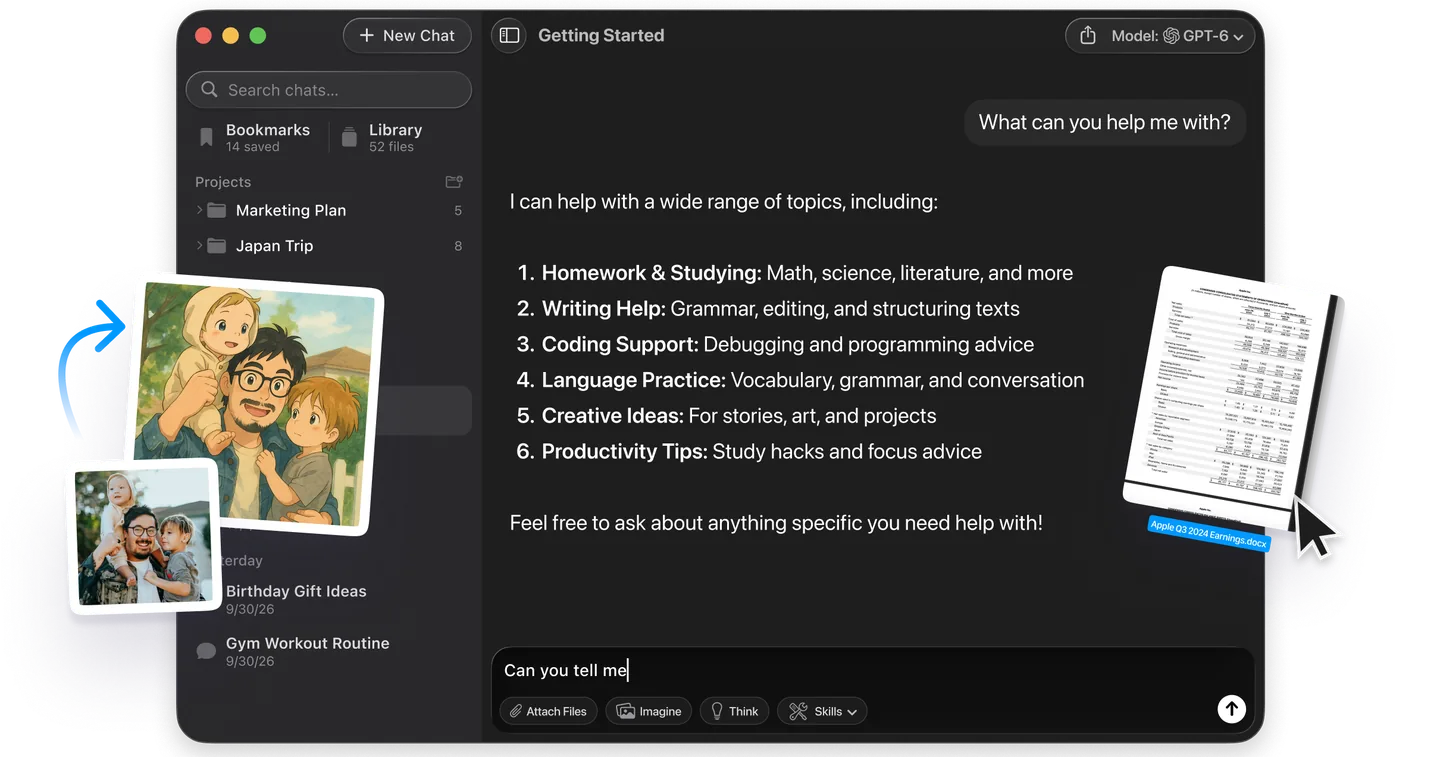
Choosing between DeepSeek, Kimi, GLM and Qwen does not have to mean four sign-ups, four apps and four sets of terms. Fello AI puts all four in one app on Mac, iPhone and iPad, next to ChatGPT, Claude and Gemini. Ask a Chinese model and a US model the same question in the same window, and see for yourself whether the cheaper answer is good enough.
The Verdict
DeepSeek started the Chinese AI story, but it no longer leads it. On independent testing, Xiaomi’s MiMo-V2.6-Pro is the best Chinese AI model, and it is also the cheapest per finished task. GLM-5.3 is the pick for coding agents. DeepSeek and Kimi remain the easiest way in, with free apps. Every one of them still trails the best US models by about 11 index points. For most everyday work, that gap matters less than a price gap of up to 45 times. For confidential work, run open weights on infrastructure you trust, or stay with a US model. For a wider view that includes the US labs, see our monthly ranking of the best AI models.
FAQ
What is the best Chinese AI model right now?
Xiaomi’s MiMo-V2.6-Pro is the best Chinese AI model in October 2026. It scores 46.3 on the Artificial Analysis Intelligence Index v4.3.2, ahead of Alibaba’s Qwen3.8-Max at 45.4 and Z.ai’s GLM-5.3 at 44.8. For coding agents, GLM-5.3 is stronger.
Is DeepSeek still the best Chinese AI?
No. DeepSeek’s strongest current model, V4.1-Flash, scores 39.5 on Artificial Analysis, behind MiMo, Qwen, GLM, StepFun and Kimi. DeepSeek is still one of the cheapest options and has one of the two best free Chinese chatbot apps.
Are Chinese AI models free?
The consumer apps are free. DeepSeek and Kimi both offer free iPhone apps, and Qwen Chat is free in a browser. The APIs are paid, from $0.15 per million input tokens for GLM-5.3-Flash and DeepSeek V4.1-Flash. The open-weight models cost nothing to download, but you pay for the hardware to run them.
Does my data go to China if I use a Chinese AI model?
It does if you use the Chinese company’s own app or API. DeepSeek’s privacy policy says it collects, processes and stores personal data in China. If you run open weights yourself or through a non-Chinese host, the original lab cannot see your prompts.
Can I run Chinese AI models on a Mac?
Only the small ones. Qwen3.8-27B, a dense 27-billion-parameter model under Apache 2.0, runs in 4-bit form on a Mac with 24GB of memory. The flagships, such as Kimi K3 and MiMo-V2.6-Pro, need multi-GPU servers, so on a Mac you use them through an app or an API instead.