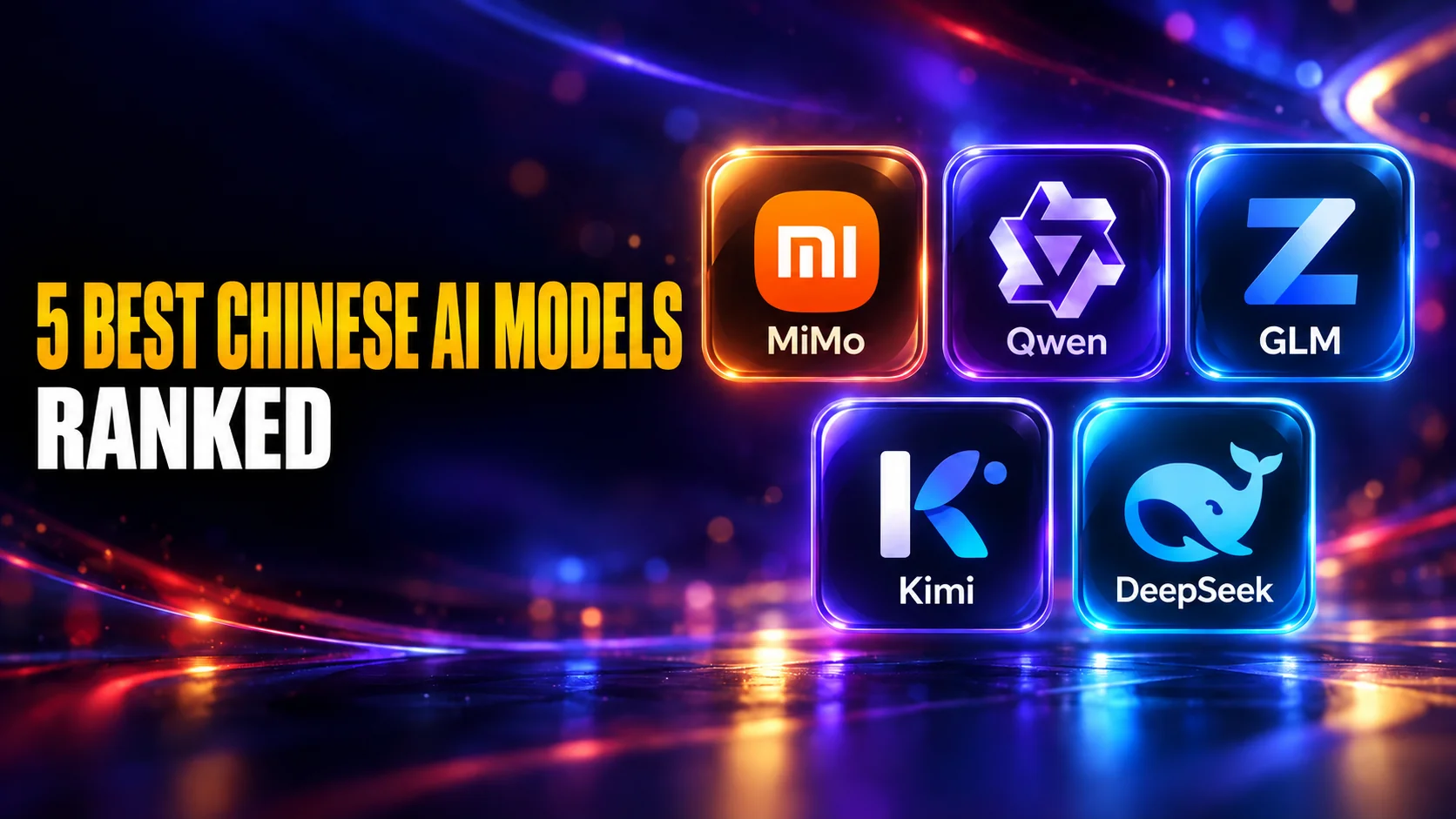
The best Chinese AI model in November 2026 is not DeepSeek. Moonshot AI’s Kimi K3.1 Pro, released on 23 October, scores 46.5 on the Artificial Analysis Intelligence Index v5.0.1, twelfth among the models the index lists as current and 18.1 points behind the leader, Claude Fable 5.2. Alibaba’s Qwen4-Max, generally available since 16 November, is the new runner-up at 42.9, but its weights are closed. Moonshot published the Kimi weights on 2 November, so Kimi K3.1 Pro is also the best Chinese model you can download. The open pick most teams can afford to run is DeepSeek’s V4.1-Flash-1017 at 32.6, just ahead of Z.ai’s GLM-5.3 at 31.7. Xiaomi’s MiMo-V2.6-Pro scores 29.9 but finishes an index task for just $0.26, the lowest cost of the top downloadable models.
This guide ranks the best Chinese AI models on one independent board, so the numbers compare like for like. Artificial Analysis rebuilt that board on 27 October as version 5, which moved every score, so do not compare these numbers with older rankings. The scores here are from version 5.0.1, re-read on 18 November 2026. For each model you get the score, the price, the licence and the way an ordinary person can actually use it on a Mac or an iPhone. Then come the three questions people search next: why these models are so cheap, how far behind the US labs they really are, and whether they are safe to use.
The Key Takeaways
- Best overall: Moonshot’s Kimi K3.1 Pro leads Chinese models at 46.5 on the Artificial Analysis index v5.0.1, at $2 / $10 per million tokens, with open weights on Hugging Face since 2 November.
- Runner-up: Alibaba’s Qwen4-Max, generally available since 16 November, scores 42.9 at $1.50 / $4.50 per million tokens. It replaces Qwen3.8-Max as Alibaba’s flagship, but its weights are not public.
- Best open weights: Kimi K3.1 Pro as well, since its weights went public on 2 November. DeepSeek V4.1-Flash-1017 scores 32.6 under MIT and is the open pick at a fraction of the price. Best value: Xiaomi’s MiMo-V2.6-Pro scores 29.9, also MIT, at $0.26 per index task.
- Best for coding agents: Kimi K3.1 Pro scores 67.2% on Terminal-Bench 4.0, the highest of any model in Artificial Analysis’s run. Qwen4-Max is the next Chinese model at 48.5%, and among the smaller open models Z.ai’s GLM-5.3 leads at 41.9%.
- Best free apps: DeepSeek and Kimi both have free iPhone apps in the US App Store, rated 3.9 and 4.7 stars on 18 November.
- The gap: the best Chinese score is 18.1 points below Claude Fable 5.2, the top model, and 12.7 below Claude Opus 5.5. The US government’s CAISI put DeepSeek V4 Pro about 8 months behind the frontier.
- The cost: one index task costs $0.26 on MiMo-V2.6-Pro against $10.04 on Claude Opus 5.5, roughly 39 times less.
Best Chinese AI Models at a Glance
The table ranks the strongest Chinese AI models by their score on the Artificial Analysis Intelligence Index, version 5.0.1, re-read on 18 November 2026. Artificial Analysis runs every model through the same nine tests itself, most of them on private question sets, so a vendor’s own benchmark chart cannot inflate the result. Where Artificial Analysis tests several reasoning settings, the score is the model’s highest setting. Prices are the vendor’s list price per million input and output tokens.
| Model | Lab | Index v5.0.1 | Open weights | API price (in / out) | How to use it |
|---|---|---|---|---|---|
| Kimi K3.1 Pro | Moonshot AI | 46.5 | Yes since 2 November, custom licence | $2 / $10 | Kimi app and web, API |
| Qwen4-Max | Alibaba | 42.9 | No, smaller Qwen 4 models promised as open source | $1.50 / $4.50 | API, including OpenRouter |
| Hy4 | Tencent | 34.6 | No, not published (the Hy4 Preview is Apache 2.0) | $0.83 / $2.50 | API, including OpenRouter |
| DeepSeek V4.1-Flash-1017 | DeepSeek | 32.6 | Yes, MIT | $0.15 / $0.60 off-peak | Free DeepSeek app, API |
| GLM-5.3 | Z.ai (Zhipu) | 31.7 | Yes, custom licence | $1.40 / $4.40 | API |
| MiMo-V2.6-Pro | Xiaomi | 29.9 | Yes, MIT | $0.435 / $0.87 | API, MiMo Desktop |
| MiniMax-M3.1-Flash | MiniMax | 29.1 | Yes, community licence | $0.15 / $0.60 | API |
| Step 5 Preview | StepFun | 28.5 | Promised, not yet published | $1.00 / $2.70 | API |
| GLM-5.3-Flash | Z.ai (Zhipu) | 27.8 | Yes, MIT | $0.15 / $0.50 | API |
| MiniMax-M3 | MiniMax | 18.9 | Yes, community licence | $0.30 / $1.20 (up to 512K input) | API |
| Kimi K3 | Moonshot AI | No v5 score at max setting | Yes, custom licence | $3 / $15 | Kimi app, API |
Kimi K3 has no v5 score at its highest reasoning setting, the one this table uses, and Artificial Analysis now marks it deprecated. Qwen3.8-Max (0902), Alibaba’s previous flagship, has left the table: Artificial Analysis marks it deprecated too, and Qwen4-Max beats it on both score (42.9 against 33.7) and price ($1.50 / $4.50 against $2 / $6). Tencent’s Hy4, released on 4 November 2026, drops to third among Chinese models. Unlike the 770-billion-parameter Hy4 Preview, which ships under the permissive Apache 2.0 licence, Hy4’s weights are not public. Tencent has since published the weights of a smaller sibling, Hy4 Flash, with 220 billion parameters and 12 billion active, under its own Tencent Hy License, but Artificial Analysis has not scored it yet. Ant Group’s Ling 3.1 Flash 1019 is an open MIT model that scores 29.6, just behind MiMo-V2.6-Pro at 29.9, but Artificial Analysis puts one index task at $3.19 against MiMo’s $0.26. Two big names are missing altogether because Artificial Analysis has not scored them. ByteDance’s Seed 2.1, the model family behind the Doubao chatbot, has no weights on Hugging Face. Baidu’s ERNIE 5.1 has no Artificial Analysis entry either. Without an independent score, any ranking of those two would be a guess.
The Best Chinese AI Model Overall: Kimi K3.1 Pro
Kimi K3.1 Pro from Moonshot AI is the best Chinese AI model overall in November 2026. Moonshot released it on 23 October 2026 as a post-trained version of Kimi K3. Artificial Analysis scores it 46.5 on index v5.0.1, 3.6 points clear of the next Chinese model, Alibaba’s Qwen4-Max at 42.9. That lead shrank from nearly 12 points when Qwen4-Max arrived on 16 November. Eleven models from US labs score higher, led by Claude Fable 5.2 (64.6), OpenAI’s GPT-6.2 Astra (62.1), released on 17 November, and Google’s Gemini 4 Neon (61.4), released on 18 November. Kimi K3.1 Pro keeps K3’s 2.8 trillion parameters, 104 billion of them active per token, and its 1-million-token context window. It costs $2 per million input tokens and $10 per million output, a third less than K3. Our Kimi K3.1 Pro explainer covers where Moonshot’s own benchmarks and the independent ones disagree.
Moonshot published the Kimi K3.1 Pro weights on Hugging Face on 2 November 2026, under its own licence: free to use and sell, but a business that runs the model as a hosted service with more than $20 million in revenue needs a separate agreement with Moonshot. The catch is cost per job. Artificial Analysis puts one index task at $3.68, because the model writes long answers, against $0.26 for MiMo-V2.6-Pro. Moonshot has not announced the next generation yet. Our page on what we know about Kimi K4 covers the Nvidia chip reports and why a 2027 release is likelier.
Runner-Up: Alibaba Qwen4-Max
Qwen4-Max from Alibaba is the second-best Chinese AI model and the strongest one with closed weights. Alibaba made it generally available on 16 November 2026 as the first model of the Qwen 4 family. Artificial Analysis scores it 42.9 on index v5.0.1, up from 33.7 for Qwen3.8-Max (0902), the flagship it replaces. On Terminal-Bench 4.0 it solves 48.5% of tasks, second among Chinese models after Kimi K3.1 Pro.
Qwen4-Max costs less than Kimi K3.1 Pro to run. Alibaba charges $1.50 per million input tokens and $4.50 per million output on its QwenCloud API, and Artificial Analysis measures one index task at $3.27, against $3.68 for Kimi K3.1 Pro. It reads text, images and video and has a 1-million-token context window. The catch is speed: Artificial Analysis calls it “notably slow per task and very verbose”. The weights are not public either. Alibaba says smaller models in the Qwen 4 family are coming to open source but gives no date.
Best Open-Weight Chinese Models: Kimi K3.1 Pro, DeepSeek on Price, Xiaomi MiMo for Value
Kimi K3.1 Pro is also the best Chinese AI model you can download, since Moonshot published its weights on 2 November 2026: at 46.5 on index v5.0.1 it is 13.9 points ahead of the next open model. At 2.8 trillion parameters and a 1.56 TB download it is a data-centre model, though, so DeepSeek V4.1-Flash-1017 is the open pick most teams can actually afford to run. Artificial Analysis scores it 32.6 on index v5.0.1, with Z.ai’s GLM-5.3 just behind at 31.7. Its weights are on Hugging Face under the MIT licence, one of the most permissive licences in common use. The catch for every other open model on the board is that it still scores below Claude Haiku 5.5, Anthropic’s smallest model, at 36.5.
MiMo-V2.6-Pro from Xiaomi is the best value. Xiaomi released it on 21 September 2026, and Artificial Analysis scores it 29.9. It is a sparse mixture-of-experts model with 1.02 trillion total parameters, of which 42 billion are active for each token, and it reads text, images, audio and video.
The price is what makes MiMo-V2.6-Pro stand out. Xiaomi charges $0.435 per million input tokens and $0.87 per million output tokens outside China. Artificial Analysis measures the cost of one index task at $0.26, against $0.60 for DeepSeek V4.1-Flash-1017 at DeepSeek’s peak rate and $5.01 for GLM-5.3, the open-weight models closest to it on the board. MiMo’s weights are on Hugging Face under the MIT licence too.
The catch with MiMo-V2.6-Pro is access for ordinary users. Xiaomi sells it mainly as an API. Its own agent app, MiMo Desktop, rules out much of Europe. The download page says: “Not yet available in South Korea, the UK or EU member states.”
Our full guide to Xiaomi MiMo covers the four V2.6 models and where each one runs.
The Best Chinese AI Models by Job
The best Chinese AI model depends on the job, because the overall score hides large differences on specific tasks. Kimi K3.1 Pro wins on the overall index, on coding agents and, since 2 November, on open weights. Qwen4-Max is the runner-up at a lower token price. DeepSeek wins on open weights per dollar, MiMo-V2.6-Pro on cost, GLM-5.3 on open coding agents, DeepSeek and Kimi on free consumer apps, and Qwen on range of sizes.
| Your job | Pick | Why |
|---|---|---|
| Best overall | Kimi K3.1 Pro | 46.5 on Artificial Analysis v5.0.1, best Chinese model by 3.6 points |
| Runner-up, cheaper tokens | Qwen4-Max | 42.9 on Artificial Analysis v5.0.1, $1.50 / $4.50, closed weights |
| Best open weights | Kimi K3.1 Pro, or DeepSeek V4.1-Flash-1017 to run cheaply | 46.5 and 32.6 on Artificial Analysis v5.0.1; DeepSeek is MIT |
| Best value | MiMo-V2.6-Pro | 29.9 on Artificial Analysis v5.0.1, MIT licence, $0.26 per index task |
| Coding agents | Kimi K3.1 Pro, or GLM-5.3 for a smaller open model | 67.2% and 41.9% on Terminal-Bench 4.0 |
| Free chatbot on your phone | DeepSeek or Kimi | Free iPhone apps, 3.9 and 4.7 stars |
| Run it on your own Mac | Qwen3.8-27B | Apache 2.0, 4-bit build fits a 24GB Mac |
| Lowest token price | GLM-5.3-Flash or DeepSeek V4.1-Flash | $0.15 per million input tokens |
Best for Coding Agents: Kimi K3.1 Pro, or Z.ai GLM for Open Weights
Kimi K3.1 Pro is the best Chinese model for coding agents, and on one test the best model of any kind. On Terminal-Bench 4.0, the agentic coding test inside the Artificial Analysis index, it solves 67.2% of tasks, ahead of Gemini 4 Carbon at 65.2% and GPT-6.2 Astra at 64.1%. The next Chinese model is Alibaba’s Qwen4-Max at 48.5%, but its weights are closed. Among the smaller open models, GLM-5.3 from Z.ai leads at 41.9% at its maximum reasoning setting. MiMo-V2.6-Pro reaches 34.8% and DeepSeek V4.1-Flash-1017 33.8%.
GLM-5.3 costs $1.40 / $4.40 per million tokens. Its weights are public, but under Z.ai’s own GLM-5.3 licence rather than MIT. Teams that want MIT terms and lower cost should look at GLM-5.3-Flash: 320 billion parameters with 18 billion active, $0.15 / $0.50, and 32.8% on the same Terminal-Bench run.
Best Free Chinese AI Apps: DeepSeek and Kimi
DeepSeek and Kimi are the best Chinese AI models for people who just want a free chatbot on their phone. Both publish a free iPhone and iPad app in the US App Store. On 18 November 2026, the DeepSeek app held 3.9 stars from about 12,800 ratings, and the Kimi app held 4.7 stars from about 5,400. Both also work in a browser. Our Kimi vs DeepSeek comparison puts the two apps head to head, from the models they run to where they store your chats.
The models behind the two apps differ. DeepSeek’s current API models are V4.1-Flash, served as the V4.1-Flash-1017 build since 17 October, which scores 32.6 on index v5.0.1 and reads images, and V4-Pro, which scores 23.1 and handles text only. DeepSeek has named V4.1-Pro as its next model, and our DeepSeek V5 release date guide covers what comes after it. Kimi’s app is moving from Kimi K3 to Kimi K3.1 Pro, which Moonshot says is rolling out on Kimi.com and the mobile apps from 23 October. Moonshot has not said whether the free plan gets it, so check the model picker in the app. K3 and K3.1 Pro, at 2.8 trillion parameters each, are the largest open-weight models on this list. Our Kimi K3 explainer covers its licence and the hardware it needs.
Best Range of Sizes: Qwen
Qwen from Alibaba is the best Chinese model family if you need more than one size. At the top sits Qwen4-Max, the closed flagship Alibaba launched on 16 November 2026. Below it, Alibaba’s open models are still Qwen3.8 releases. In August 2026 Alibaba published Qwen3.8-2.4T-A95B, the text-only model its previous flagship, Qwen3.8-Max, is built on, which its model card calls the first Qwen-Max-class model in an open release. Alibaba says smaller Qwen 4 models are coming to open source but gives no date, and our Qwen 4 release date tracker follows them.
At the small end, Qwen3.8-27B is a dense 27-billion-parameter model under Apache 2.0. Its 4-bit version runs on a Mac with 24GB of memory, according to Unsloth, which publishes compressed builds of the model.
For chatting with Qwen, Alibaba runs Qwen Studio at chat.qwen.ai, formerly Qwen Chat, plus desktop apps for Mac and Windows. Its iPhone apps are not in the US or EU App Stores. Our Qwen vs ChatGPT comparison covers what the free tier gets you against OpenAI’s chatbot. Developers reach the larger models through Alibaba Cloud’s API or third-party hosts.
Cheapest Chinese AI Models
The cheapest capable Chinese AI models are GLM-5.3-Flash and DeepSeek V4.1-Flash, both at $0.15 per million input tokens. GLM-5.3-Flash charges $0.50 for output. DeepSeek charges $0.60 off-peak and $1.20 at peak, which DeepSeek defines as 01:00 to 04:00 and 06:00 to 10:00 UTC on weekdays, outside Chinese public holidays. Measured per index task, MiMo-V2.6-Pro is the best value of the top downloadable models. It costs $0.26 a task, against $0.60 for DeepSeek V4.1-Flash-1017 at peak, despite its higher token price. Xiaomi’s smaller MiMo-V2.6-Flash is cheaper still at $0.13 a task, for a score of 26.7. Our DeepSeek pricing guide breaks down the peak and off-peak tiers.
Why Are Chinese AI Models So Cheap?
Chinese AI models are cheap because most of them ship as open weights, which lets many companies host the same model and compete on price. That is the first of three reasons given by the Center for Strategic and International Studies (CSIS), a Washington think tank, in a July 2026 analysis. A closed US model has one seller, who sets the price. An open Chinese model has dozens of hosts undercutting each other.
The second reason CSIS gives is efficiency under pressure. US export controls limit Chinese labs’ access to the best AI chips. So the labs lean on cheaper training methods, including learning from the outputs of stronger models, and on efficient inference. Almost every model in the table is a sparse mixture of experts, which activates only a small slice of its parameters per token. MiMo-V2.6-Pro uses 42 billion of 1.02 trillion.
The third reason is strategy. CSIS argues that Chinese labs use cheap, open releases to win developers and become the default choice for anyone who does not need the very best model. The US government’s own testing backs up the value claim. The Center for AI Standards and Innovation (CAISI) found DeepSeek V4 Pro more cost-efficient than GPT-5.4 mini, the cheapest comparable US model, on 5 of 7 benchmarks.
How Far Behind Are Chinese AI Models?
The best Chinese AI model is 18.1 points behind the best US model on the Artificial Analysis index v5.0.1. Kimi K3.1 Pro scores 46.5, and Claude Fable 5.2 scores 64.6. Ten more models from Anthropic, OpenAI, Google and Meta sit in between, among them OpenAI’s GPT-6.2 Astra at 62.1, Google’s Gemini 4 Neon at 61.4 and Claude Opus 5.5 at 59.1. The second-best Chinese model, Alibaba’s Qwen4-Max at 42.9, is 21.7 points behind the leader. Since Moonshot published the K3.1 Pro weights on 2 November, 18.1 points is also the gap for models you can download. The next open model, DeepSeek V4.1-Flash-1017 at 32.6, is 32 points behind. Artificial Analysis said v5 widened the gap between the top open-weights model and the leader from 3 points to 12. It now builds 60% of the index on private test sets or held-out answers, which labs cannot train on.
In time, the gap is measured in months, not years. In its evaluation of DeepSeek V4 Pro, CAISI concluded that the model’s capabilities “lag behind the frontier by about 8 months”. CAISI also found that DeepSeek’s own benchmarks flattered the model. On DeepSeek’s numbers, V4 Pro looked level with models released two months earlier. On CAISI’s tests, which include unpublished benchmarks, it performed like GPT-5.
The CAISI result is the reason this guide uses one independent board. A Chinese model’s launch chart often shows it beating Claude or GPT, and DeepSeek V4 Pro shows how far a vendor’s own chart and an outside test can drift apart.
Are Chinese AI Models Safe to Use?
Chinese AI models are safe enough for everyday work when you control where your prompts go. The same model carries very different risks depending on whether you use the Chinese company’s own app, run the open weights yourself, or reach the model through a third-party host.
The Official Apps Send Your Data to China
The official Chinese apps process your data in China. DeepSeek’s privacy policy states that “we directly collect, process and store your Personal Data in People’s Republic of China.”
Treat anything you type into a Chinese company’s own app or API as stored under Chinese law, and keep confidential work, health details and client data out of it. Our guide on whether DeepSeek is safe for US and EU users covers the government bans and the specific risks.
Open Weights Change the Picture
Open weights take the Chinese lab out of the data path, because the model runs on hardware you or your host control. CSIS makes the point directly: when a Chinese model runs through a third-party host or a local deployment, “the original Chinese developer cannot see the prompts”. Licence matters here too. MiMo-V2.6-Pro, GLM-5.3-Flash and DeepSeek V4.1-Flash use MIT, and Tencent Hy4 Preview uses Apache 2.0. Kimi K3, Kimi K3.1 Pro, GLM-5.3, MiniMax’s M3 models and Qwen3.8’s open flagship carry their own licences with extra conditions.
Censorship Is Built Into the Models
Censorship is the one risk that open weights do not remove, because it lives in the model itself. CAISI tested DeepSeek models on politically sensitive questions in 2025. It found they “echoed four times as many inaccurate and misleading CCP narratives as U.S. reference models did.”
For coding, maths or summarising a contract, this rarely matters. For anything touching Chinese politics, history or Taiwan, check the answer against a Western model.
How to Use Chinese AI Models on a Mac or iPhone
The easiest way to use Chinese AI models on a Mac or iPhone is through the free DeepSeek and Kimi apps, or through Qwen Studio at chat.qwen.ai. All three need an account and process your prompts in the cloud. DeepSeek and Kimi run on their makers’ servers, and Qwen’s privacy policy says its data is stored and processed in Singapore.
Running a model locally on a Mac is realistic only at the small end. Qwen3.8-27B in 4-bit form needs a Mac with 24GB of memory. The flagships are out of reach: Kimi K3’s 2.8 trillion parameters and MiMo-V2.6-Pro’s 1.02 trillion need a multi-GPU server. Our ranking of the best open source AI models lists which open models a laptop can handle.
Compare Them Without Four New Accounts
Choosing between DeepSeek, Kimi, GLM and Qwen does not have to mean four sign-ups, four apps and four sets of terms. Fello AI puts all four in one app on Mac, iPhone and iPad, next to ChatGPT, Claude and Gemini. Ask a Chinese model and a US model the same question in the same window, and see for yourself whether the cheaper answer is good enough.
The Verdict
DeepSeek started the Chinese AI story, but it no longer leads it. On independent testing, Moonshot’s Kimi K3.1 Pro is the best Chinese AI model, 18.1 index points behind Claude Fable 5.2 and the top scorer of any model on Terminal-Bench 4.0. Alibaba’s Qwen4-Max now runs close behind, 3.6 points back at a lower token price, but its weights are closed, so you can only reach it through an API. Since 2 November Kimi K3.1 Pro is also the best model you can download, though at 2.8 trillion parameters it is a data-centre model: DeepSeek V4.1-Flash-1017 is the open pick at a fraction of the price, Xiaomi’s MiMo-V2.6-Pro is the cheapest per finished task, and GLM-5.3 is the smaller open pick for coding agents. DeepSeek and Kimi remain the easiest way in, with free apps. For most everyday work, the remaining gap to the US labs matters less than a price gap of up to 39 times. For confidential work, run open weights on infrastructure you trust, or stay with a US model. For a wider view that includes the US labs, see our monthly ranking of the best AI models.
FAQ
What is the best Chinese AI model right now?
Moonshot AI’s Kimi K3.1 Pro is the best Chinese AI model in November 2026. It scores 46.5 on the Artificial Analysis Intelligence Index v5.0.1, ahead of Alibaba’s Qwen4-Max at 42.9, Tencent’s Hy4 at 34.6, DeepSeek’s V4.1-Flash-1017 at 32.6 and Z.ai’s GLM-5.3 at 31.7. Moonshot published its weights on 2 November 2026, so it is also the best Chinese model you can download, while DeepSeek V4.1-Flash-1017 is the cheaper open pick.
Is DeepSeek still the best Chinese AI?
No. It has not led overall since Kimi K3.1 Pro launched, and since Moonshot published the K3.1 Pro weights on 2 November it no longer leads the models you can download either. DeepSeek’s strongest current model, V4.1-Flash-1017, scores 32.6 on the Artificial Analysis Intelligence Index v5.0.1, behind Kimi K3.1 Pro (46.5), Qwen4-Max (42.9) and Tencent Hy4 (34.6), and ahead of GLM-5.3 (31.7) and MiMo-V2.6-Pro (29.9). DeepSeek is also one of the cheapest options and has one of the two best free Chinese chatbot apps.
Are Chinese AI models free?
The consumer apps are free. DeepSeek and Kimi both offer free iPhone apps, and Qwen Studio is free in a browser and in Qwen’s own apps. The APIs are paid, from $0.15 per million input tokens for GLM-5.3-Flash and DeepSeek V4.1-Flash. The open-weight models cost nothing to download, but you pay for the hardware to run them.
Does my data go to China if I use a Chinese AI model?
It does if you use the Chinese company’s own app or API. DeepSeek’s privacy policy says it collects, processes and stores personal data in China. If you run open weights yourself or through a non-Chinese host, the original lab cannot see your prompts.
Can I run Chinese AI models on a Mac?
Only the small ones. Qwen3.8-27B, a dense 27-billion-parameter model under Apache 2.0, runs in 4-bit form on a Mac with 24GB of memory. The flagships, such as Kimi K3 and MiMo-V2.6-Pro, need multi-GPU servers, so on a Mac you use them through an app or an API instead.
Úvodní obrázek k tomuto článku vznikl s pomocí AI.