Kimi vs Claude looks lopsided on paper. On the Artificial Analysis Intelligence Index, Anthropic's Claude Opus 5.5 scores 57.6 and Moonshot AI's Kimi K3 scores 43.6, both at their maximum reasoning setting. But the Claude app does not open on Opus at maximum. Free and Pro both default to Claude Sonnet 5.5 at Medium effort, which scores 40.7, a few points below K3.
So the useful question is not which lab has the stronger flagship. It is what you get on the plan you would actually pay for, at the settings you would actually use. This guide maps that, then compares price, how each company limits your usage, files and agents, privacy and the Mac apps. Every price and plan detail comes from Moonshot's and Anthropic's own pages, and every score from Artificial Analysis, all checked on 2 October 2026.
The Key Takeaways
- Default chat: Claude Free and Pro open on Sonnet 5.5 at Medium effort, 40.7 on the Intelligence Index, just below Kimi K3 at its maximum of 43.6.
- One click up: Pro lets you switch to Opus 5.5, which scores 51.2 at Medium and 57.6 at max, above anything Kimi runs.
- Price: Kimi's paid plans run $19, $39, $99 and $199 a month. Claude's run $20 (or $17 billed yearly), $100 and $200.
- Privacy: Claude lets you choose whether your chats train its models. Kimi's international privacy policy says your content is used for training and describes no switch to turn that off.
- Mac: Claude's desktop app runs on Intel and Apple silicon Macs from macOS 11. Kimi's needs Apple silicon and macOS 12, and its Work agent is still in beta.
Kimi vs Claude: The Short Answer
For most people, Claude is the better choice. At around $20 a month, Claude Pro gives you Opus 5.5, a stronger model than any Kimi plan runs. You can keep your chats out of training, and the app runs on more Macs. The catch is that Claude opens on Sonnet 5.5, so switch to Opus for anything hard.
Kimi is the better choice for a narrower group. Pick it for two things. Open weights you can download and run yourself. Or an agent that splits one big research job across up to 300 sub-agents. Kimi is also the one to watch for new open models.
What Kimi and Claude Actually Are
Kimi is Moonshot AI's assistant, with open weights
Kimi is the chat app and agent platform from Moonshot AI, one of China's leading AI labs. Its flagship, Kimi K3, is a mixture-of-experts model with 2.8 trillion parameters, 104 billion of them active per token. Its context window is 1,048,576 tokens, according to its Hugging Face model card. Moonshot publishes the full weights under its own Kimi K3 license. Our Kimi K3 deep dive covers the model itself.
In the Kimi app, a switch above the message box offers three choices. K2.6 is the fast model for quick questions. K3 is the most capable, with Low, High and Max thinking settings. K3 Swarm spreads large search and batch jobs across many agents at once. Web search, a URL fetch tool, image search, a Python sandbox and memory are built in.
Claude is Anthropic's assistant, with a model per plan
Claude is Anthropic's closed assistant, and the plan you pay for decides which models you can pick. Free gets Anthropic's Sonnet and Haiku models but not Opus. Pro and Max add Opus. Sonnet 5.5 is the default model on Free and Pro, according to Tom's Guide. It replaced Sonnet 5, which Anthropic had made the default on both plans in June. The top model, Claude Fable 5.1, costs extra usage credits on Pro and is included on Max up to half of the weekly limit.
Anthropic's current models are new. Claude Opus 5.5 launched on 22 September 2026 and Claude Sonnet 5.5 on 28 September. In the Claude apps you also choose an effort level, from Low to Max, and Anthropic sets Medium as the default in its apps and in Claude Code.
Which Model You Actually Get on Each Plan
Claude Free and Pro answer with Sonnet 5.5 by default, Pro and Max can switch to Opus 5.5, and every Kimi plan picks between K2.6 and K3. The effort setting moves the scores as much as the plan does. The table uses the Artificial Analysis Intelligence Index v4.3.2, which combines ten evaluations of reasoning, knowledge, coding and long-document work. We read it on 2 October 2026.
| Where you are | Model answering you | At default or low setting | At max setting |
|---|---|---|---|
| Claude Free or Pro, default | Sonnet 5.5 | 40.7 (Medium, the app default) | 56.0 |
| Claude Pro or Max, Opus selected | Opus 5.5 | 51.2 (Medium) | 57.6 |
| Claude Max, Fable selected | Fable 5.1 | 48.9 (Medium) | 53.4 |
| Kimi, K3 selected | Kimi K3 | 30.1 (Low) | 43.6 |
| Kimi, K2.6 selected | Kimi K2.6 | 27.0 | |
The default-setting catch
On default settings, Claude and Kimi are close. Out of the box, Claude Free and Pro both answer with Sonnet 5.5 at Medium, which scores 40.7. That is a little under K3 at Max and well above K3 at Low.
The gap opens when you change one setting.
On Pro, picking Opus 5.5 lifts the score to 51.2 at the same Medium effort, higher than anything Kimi offers at any setting. Raising the effort lifts both Claude models further, but higher effort uses your limit faster. On Kimi, K3 at Max spends credits faster too.
To switch in the Claude app, click the model name next to the send button and pick Opus 5.5. The Effort setting sits in the same menu.
One caveat keeps this honest. A single index is one view, and Artificial Analysis rescales it every few weeks, so treat these as a dated snapshot. Our best AI models hub tracks the current leaders across several boards.
Kimi vs Claude: Prices and Plans
On price, the two line up almost tier for tier, with Kimi adding a $39 step that Claude does not have. Kimi's prices come from Moonshot's membership pricing page and Claude's from Anthropic's pricing page and help centre, all in US dollars before tax.
| Tier | Kimi | Claude |
|---|---|---|
| Free | Adagio, $0, small credit allowance | Free, $0, five-hour session limit |
| Entry paid | Plus, $19/mo ($180/yr) | Pro, $20/mo ($200/yr, about $17/mo) |
| Step up | Pro, $39/mo ($372/yr) | No equivalent |
| Heavy use | Max, $99/mo ($948/yr) | Max 5x, $100/mo |
| Top tier | Ultra, $199/mo ($1,908/yr) | Max 20x, $200/mo |
Two plan details change the value. Kimi's 1 million token chat window is limited to Max and Ultra. Claude's Max plans are monthly only, while Pro also comes yearly. Our Kimi pricing guide has the full Kimi rate card, and our Claude Pro vs Max comparison covers when Max is worth it.
How Kimi's credits work
Kimi meters everything through one shared pool of credits. Chats with K2.6 and K3, Agent Swarm, Slides, Kimi Code and the desktop agent all draw on it, billed by the tokens each task uses. Moonshot's help centre says plainly that K2.6 in chat consumes credits too.
The free pool is small. Moonshot's own rough guide for free users puts one deep research report at 5 to 10 percent of the allowance and a simple slide deck at 1 to 2 percent. Credits refresh monthly on your subscription date, and unused ones expire. Kimi Code also has its own rate limits, one per five-hour window and one per week.
How Claude's limits work
Claude does not use credits for ordinary chat. Each plan has a usage limit that resets every five hours, and paid plans add a weekly limit across all models. Anthropic does not publish a message count, because long chats, big files and higher effort all use more of the allowance. Our guide to whether Claude is free covers what the Free plan includes.
Max 5x and Max 20x give five and twenty times Pro's per-session usage. On paid plans you can also switch on usage credits, which let you keep working past the limit at API rates. Our guide to Claude usage limits explains how the windows interact.
Files, Documents and Agents
Claude folds file work into the chat window, while Kimi splits it across separate tools. Every Claude plan, Free included, can create and edit files with code execution. Anthropic contradicts itself on Claude Slides, Claude Docs and Claude Design. Its pricing page lists them from Pro up, while its 16 September release notes say they are available on every plan, including Free. Since 16 September 2026, the old Cowork agent mode has been merging into ordinary Claude chat on Pro and Max. You can now hand over a report or a deck from any conversation.
Moonshot is candid that the Kimi chat window does not produce downloadable Office files. For slides you go to Kimi Slides, and for Word and Excel files you switch to Agent mode. When K3 runs as an agent, it produces editable .pptx, .docx, .xlsx and .pdf files end to end. K2.6 only returns text. Kimi accepts up to 50 files at a time, each up to 100 MB.
Context is the other split. A K2.6 conversation holds about 128,000 tokens before it stops reading new content. Claude's pricing page lists a context window of up to 1 million tokens on every plan, varying by model.
For big parallel jobs, Kimi is the more ambitious tool. Its Agent Swarm can assemble up to 300 sub-agents for one research or batch task. For a finished document from an ordinary chat, Claude is the smoother path.
Coding: Kimi Code vs Claude Code
Both companies bundle a coding agent with their paid plans. Kimi Code is available on every paid Kimi tier, draws on the shared credit pool and has its own five-hour and weekly rate limits. Moonshot says it will soon split Kimi Code benefits from membership, so you can buy each separately. Claude Code comes with Pro and Max, runs on the same session and weekly limits as chat, and uses Opus 5.5 by default.
For developers paying per token, K3 is not the cheap option it looks like. These are the list prices per million tokens from each company's API documentation.
| Model | Input | Output | Intelligence Index (max) |
|---|---|---|---|
| Kimi K2.6 | $0.95 | $4.00 | 27.0 |
| Kimi K3 | $3.00 | $15.00 | 43.6 |
| Claude Haiku 5.5 | $0.10 | $0.50 | 43.4 |
| Claude Sonnet 5.5 | $2.00 | $10.00 | 56.0 |
| Claude Opus 5.5 | $4.00 | $20.00 | 57.6 |
| Claude Fable 5.1 | $10.00 | $50.00 | 53.4 |
Sonnet 5.5 costs a third less per token than K3 on Moonshot's own API, and scores higher. Because K3's weights are open, other hosts sell it too. On OpenRouter, the cheapest listed host charges $1.39 per million input tokens, but none charges less than $11.20 for output, still above Sonnet 5.5's $10. Artificial Analysis also measures what a full run of its index costs. K3 at Max costs $2.00 for its 43.6. Sonnet 5.5 at Medium reaches 40.7 for $0.59, and Opus 5.5 at Low reaches 42.3 for $0.55. For roughly the same score, Claude costs under a third as much. At the low end the gap is wider. Claude Haiku 5.5, released on 7 October, costs $0.10 per million input tokens and $0.50 per million output tokens for prompts up to 100,000 tokens, an eighth or less of K2.6's rate, and scores 43.4, within a fifth of a point of K3 (read 8 October).
K3's case for builders now rests on openness. You can run the same weights on your own hardware, keep a 1 million token context, and pay $0.30 per million tokens for cached input on Moonshot's API. K2.6 is no longer the cheap end for bulk jobs, since Haiku 5.5 undercuts it on price and outscores it by 16 points.
Privacy and Where Your Data Goes
Claude gives you a training choice, and Kimi does not describe one. Anthropic's privacy centre says it uses consumer chats from Free, Pro and Max to improve its models only if you choose to allow it. The one exception is a chat flagged for safety review. Incognito chats are never used. If you do allow training, Anthropic keeps that data for up to five years.
Kimi's international service is run by Novascent Private Limited, according to Moonshot's privacy policy, last updated 13 August 2026. The policy says it processes your prompts, files and other content to provide the service and to train and optimise its models. It also allows for storing your data on servers outside your country. It describes no settings switch for opting out of training. Moonshot's separate policy for its China service, run by Beijing Moonshot Technology, does let users ask customer service to stop training on their content.
For anything sensitive, use Claude with training switched off, or an Incognito chat. With Kimi, the private route is to run the open weights on hardware you control, so nothing leaves your building.
Kimi and Claude on a Mac
Both companies ship real desktop apps, and Claude's runs on more Macs. Anthropic's Claude desktop app needs macOS 11 Big Sur or later, and its macOS download is a universal build, so it runs on Intel and Apple silicon. Agent work in the desktop app, formerly Cowork, needs a paid plan.
Kimi's desktop client runs on Mac and Windows, and on a Mac it needs Apple silicon and macOS 12 or later, according to Moonshot's help centre. It has two modes. Chat is the normal assistant. Work is a local agent, launched on 3 June 2026 and still labelled beta, that can use your browser, organise files and produce documents on your machine. By default it asks before modifying files or running code, and you can loosen that to fully automatic.
Neither official app is in the Mac App Store, so download them from claude.com and kimi.com. A Mac App Store search for either name turns up third-party apps from other developers, so do not install the first result.
Which One Should You Pick
Pick Claude if you want one assistant for writing, questions, documents and long files. Pro at $20 is the best value in this comparison. One switch to Opus 5.5 beats anything Kimi runs, your chats stay out of training if you say so, and the app works on Intel Macs.
Pick Kimi if you want open weights or an agent that fans a big research task out across hundreds of sub-agents. If you are weighing a third option, we compare Moonshot's assistant with OpenAI's in Kimi vs ChatGPT, and Anthropic's with its other Chinese rival in DeepSeek vs Claude.
Or use Kimi and Claude without choosing
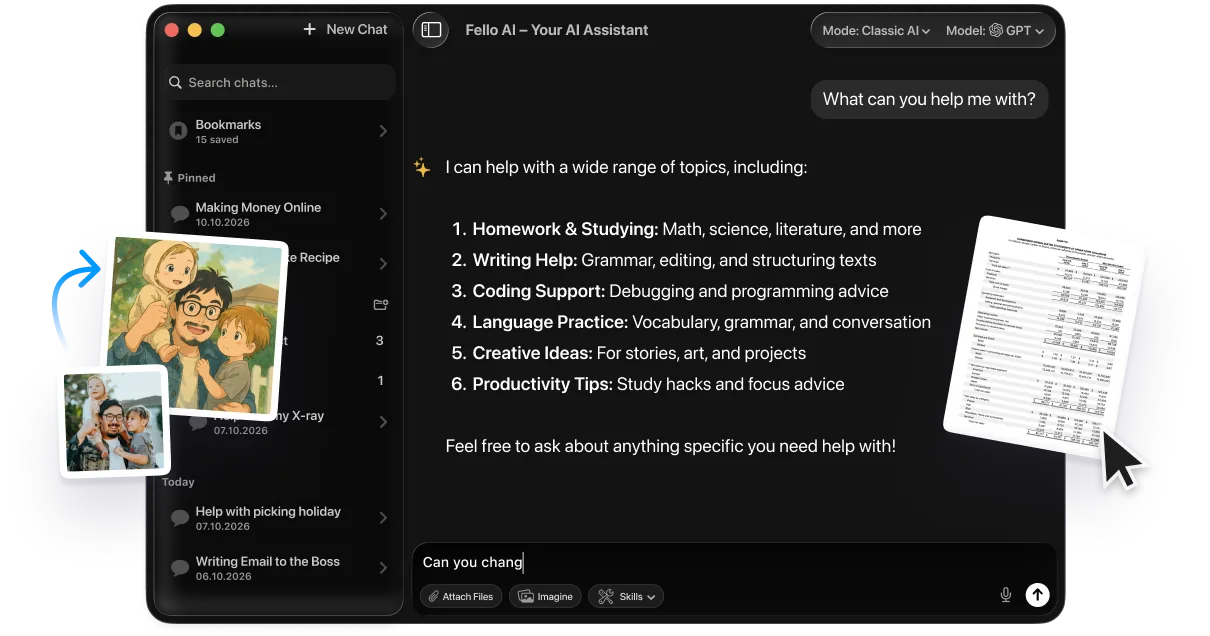
Fello AI puts Kimi and Claude side by side in one native app, next to GPT, Gemini, Grok and DeepSeek. Send the same question to both and keep the better answer. It runs on Mac, iPhone and iPad, has a free tier, and its paid plan is $9.99 a month, less than either company's entry plan.
The Verdict
Claude wins for most people.
The deciding fact is what each $20 plan can put in the chat window. On Claude Pro, Opus 5.5 at its default Medium effort scores higher than Kimi K3 at its maximum. Claude opens on Sonnet 5.5, so make the switch for hard questions. Claude also lets you keep your chats out of training, and its Mac app runs on Intel.
Kimi wins on openness. Its weights are downloadable and its swarm agent takes on bigger parallel jobs. What Kimi no longer wins is price for performance, because Claude Sonnet 5.5 costs less than K3 per token on Moonshot's own API and scores higher, and Claude Haiku 5.5 undercuts even K2.6 for bulk work. If you chat, get Claude Pro. If you build and want to own the model, start with Kimi K3's open weights.
Frequently Asked Questions
Is Kimi better than Claude?
Not for most people. On the Artificial Analysis Intelligence Index v4.3.2, Kimi K3 scores 43.6 at its maximum setting. Claude's default chat model, Sonnet 5.5 at Medium, scores a little lower at 40.7. But Claude Pro lets you switch to Opus 5.5, which scores 51.2 at Medium and 57.6 at max. Kimi is the better pick if you need open weights or a large agent swarm.
Is Kimi free to use?
Kimi has a free plan, Adagio, but every chat spends credits from a small monthly pool, including chats with the fast K2.6 model. Paid plans start at $19 a month. Claude Free works differently: no credits, just a usage limit that resets every five hours.
Is Kimi or Claude better for coding?
Claude, on both plans and price. Claude Code comes with Pro and runs Opus 5.5 by default, while Kimi Code spends shared credits under its own five-hour and weekly limits. On the API, Claude Sonnet 5.5 costs $2 and $10 per million tokens against $3 and $15 for Kimi K3, and scores higher.
Does Kimi or Claude train on my chats?
Claude uses your consumer chats for training only if you allow it, and never uses Incognito chats. Kimi's international privacy policy says it processes your content to train its models and describes no opt-out switch, so avoid sharing anything sensitive with the hosted Kimi app.
Do Kimi and Claude have Mac apps?
Yes, both do. Claude's desktop app needs macOS 11 or later and runs on Intel and Apple silicon Macs. Kimi's needs Apple silicon and macOS 12 or later, and its Work agent mode is in beta. Neither official app is in the Mac App Store.