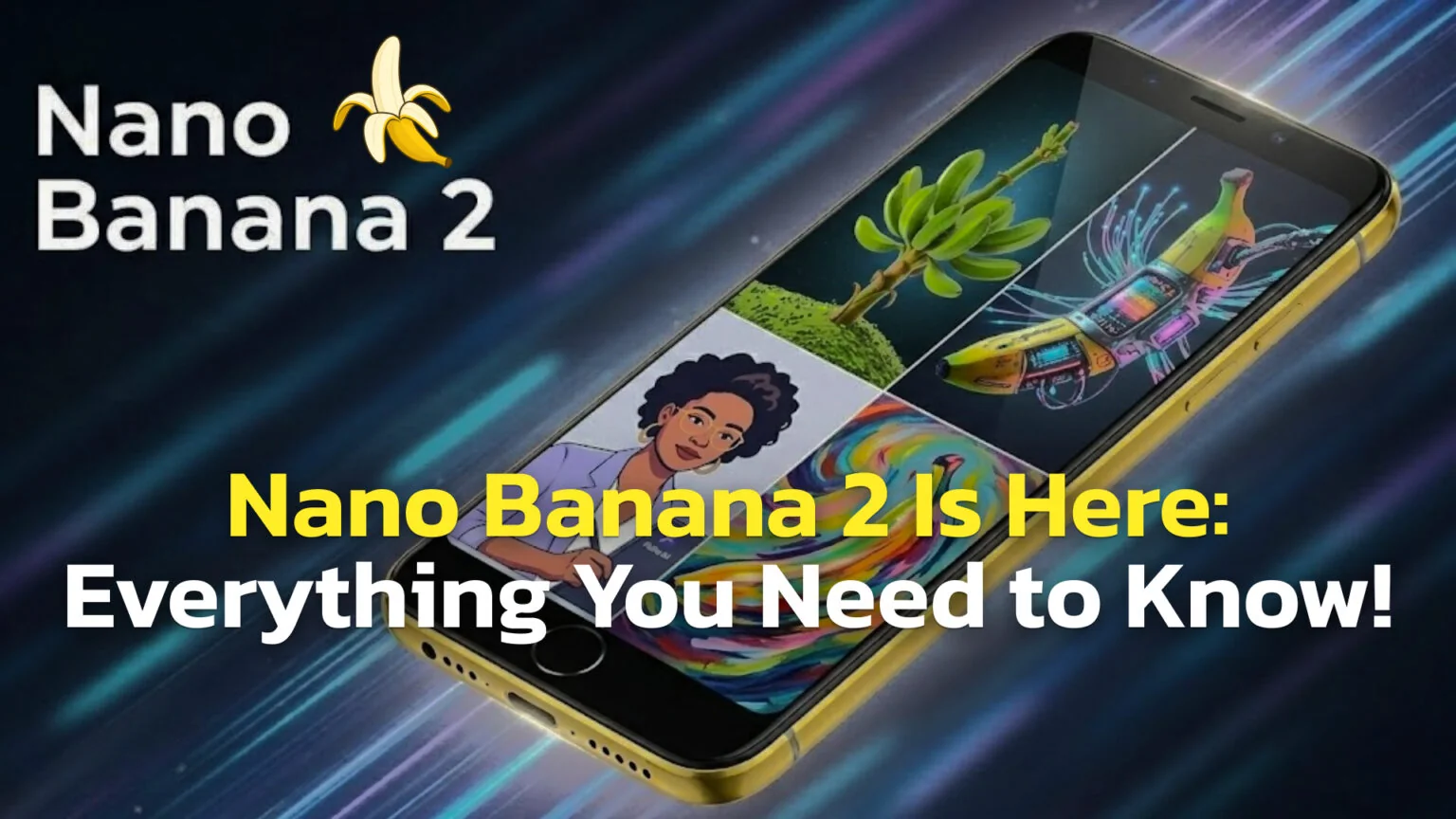
Google launched Nano Banana 2 on February 26, 2026, and it immediately replaced Nano Banana Pro as the default image generation model across the Gemini app, Google AI Mode, and Google Lens. The headline number: ~$0.067 per image, roughly 50% less than Nano Banana Pro’s $0.134 per image, at Flash-tier speed instead of the Pro model’s 20 to 60 second wait times.
Update, October 6, 2026: Google has released Nano Banana 2.1, an update to Nano Banana 2 that halves the API price per image. Google deprecated Nano Banana 2 the same day and shuts it down in the Gemini API on October 29, 2026. This review covers the February 2026 release.
If you have been searching for “Nano Banana Pro 2,” this Nano Banana 2 review has the answers. Google officially calls the new model Nano Banana 2 (technically Gemini 3.1 Flash Image), not Pro 2, but the naming confusion is understandable. Here we cover what has actually changed, how it stacks up against Nano Banana Pro and the competition, what it costs, and whether it is worth switching to. We have also folded in Nano Banana 2 Lite, the cheaper, faster, 1K-only tier Google added on June 30, 2026, so you can see exactly where each model in the family fits. If the family itself is new to you, our explainer on what Nano Banana is covers all four versions from the start. For the ByteDance side of this race, see our breakdown of Seedream 5.0 Pro.
The Key Takeaways
- Nano Banana 2 costs ~$0.067 per image, around 50% cheaper than Nano Banana Pro at $0.134
- Generation speed is 4 to 6 seconds, compared to 20 to 60 seconds for Nano Banana Pro
- Resolution support now runs from 512px to 4K, matching Nano Banana Pro’s 4K ceiling
- The model tracks up to 5 characters and 14 objects consistently across workflows
- Nano Banana 2 is the new default in the Gemini app, Google AI Mode, and Flow across 141 countries
- Google added Nano Banana 2 Lite on June 30, 2026 at ~$0.034 per image, about half the cost of Nano Banana 2, with ~4-second 1K generation built for high-volume work
What Is Nano Banana 2? (And Is It “Nano Banana Pro 2”?)
Nano Banana 2 is Google’s AI image generation and editing model officially named Gemini 3.1 Flash Image. It launched on February 26, 2026, and became the default image model across Google’s consumer and developer products. Google replaced it with Nano Banana 2.1 on October 6, 2026.
“Nano Banana Pro 2” is not the official name. Google named this model Nano Banana 2 to signal it builds on the original Nano Banana foundation at Flash speed, not as a direct sequel to the Pro tier. The core claim is that it delivers Pro-quality output at a fraction of the cost and a fraction of the wait, and the gap is real once you compare how much Nano Banana 2 costs per image.
Nano Banana Pro (Gemini 3 Pro Image), launched in November 2025, remains available for Gemini Pro and Ultra subscribers who need maximum creative precision. The two models now serve distinct use cases within Google’s image generation lineup.
Nano Banana 2 vs Nano Banana Pro: What Actually Changed?
The clearest way to understand the Nano Banana 2 upgrade is side by side with the model it largely replaces.
Want to test the upgrade on your own shots? Run our Gemini AI photo prompt collection through Nano Banana 2 and compare the results side by side.
| Feature | Nano Banana 2 Lite | Nano Banana 2 | Nano Banana Pro |
|---|---|---|---|
| Official model name | Gemini 3.1 Flash-Lite Image | Gemini 3.1 Flash Image | Gemini 3 Pro Image |
| Launch date | June 2026 | February 2026 | November 2025 |
| Max resolution | 1K | 4K | 4K |
| Price per image | ~$0.034 | ~$0.067 | ~$0.134 |
| Price per 1M tokens | ~$30 | $60 | $120 |
| Generation speed | ~4 seconds (1K) | 4–6 seconds (1K), ~20 seconds (4K) | 20–60 seconds |
| Search grounding | No | Yes | Yes |
| Character consistency | Up to 5 | Up to 5 | Up to 5 |
| Object fidelity | Up to 14 objects | Up to 14 objects | Up to 14 objects |
| Default in Gemini app | No (high-volume tier) | Yes | No (legacy access) |
| Free tier | Yes (Gemini app) | Yes (Gemini app) | Legacy (Gemini Pro+) |
| Availability | Consumer + API | 141 countries | 141 countries |
The most significant change is speed at half the cost: Nano Banana 2 reaches the same 4K ceiling as Nano Banana Pro at Flash-tier speed and $0.067 per 1K image against $0.134. That makes Nano Banana 2 the better fit for most workflows. For zero-cost picks across generating and editing, see the best free AI image generators and editors.
Where Nano Banana Pro retains its edge is fine creative control for complex, highly detailed studio prompts. Google describes Pro as the better choice for “specialised tasks” and keeps it accessible via the three-dot regeneration menu for Gemini Pro and Ultra subscribers.
How Much Does Nano Banana 2 Cost?
Nano Banana 2 costs approximately $0.067 per image at Flash tier, priced at $60 per million tokens via the Gemini API. That is roughly 50% cheaper than Nano Banana Pro at $0.134 per image ($120 per million tokens). The original base Nano Banana model sat at around $0.039 per image, placing Nano Banana 2 as a middle-tier option on price while claiming Pro-tier output quality.
For enterprise teams, the savings compound quickly. Running 1,000 images per month at Nano Banana Pro rates costs approximately $134. At Nano Banana 2 rates, the same volume costs around $67, saving $804 per year at equivalent quality. At 10,000 images per month, that gap reaches $8,040 annually.
For consumer users, Nano Banana 2 is available free within the Gemini app as the default model. Google AI Pro and Ultra subscribers retain access to Nano Banana Pro for specialised workflows on demand. For the exact daily limits and the point where paying starts to make sense, see Is Nano Banana free?, and for the consumer walkthrough see how to use Nano Banana 2.
What Is Nano Banana 2 Lite?
On June 30, 2026, Google added a third tier to the family: Nano Banana 2 Lite, officially Gemini 3.1 Flash-Lite Image. It is the fastest and cheapest model Google has shipped in this lineup, generating a 1K image in about 4 seconds for roughly $0.034 per image, around half the cost of standard Nano Banana 2. Lite does not replace the model reviewed here. It sits below it and retires the original Nano Banana (Gemini 2.5 Flash Image) as the new entry point.
Lite is built for volume. Google positions it for high-velocity workflows like rapid ideation, bulk product shots, and developer pipelines where cost and throughput matter more than a 4K ceiling. The trade-offs are clear. Lite tops out at 1K resolution across 14 aspect ratios, and it does not support Google Search or Image grounding, so it cannot pull live web data into a generation the way standard Nano Banana 2 can. Every Lite image still carries an invisible SynthID watermark.
Google shipped Lite alongside Gemini Omni Flash, a new video model priced at $0.10 per second of output, per Google’s launch announcement. Both are available now in Google AI Studio, the Gemini API, and the Gemini Enterprise Agent Platform, and Lite is rolling out across consumer surfaces including AI Mode in Search, the Gemini app, NotebookLM, and Google Photos.
The rule of thumb is simple. Choose Nano Banana 2 Lite for cheap, fast, high-volume 1K generation where you do not need real-world grounding. Stick with Nano Banana 2 when you want 4K output, live search grounding, or the strongest all-round quality, and step up to Nano Banana Pro only for complex, studio-grade prompts that justify the higher price and longer wait.
Nano Banana 2 vs the Competition
How does Nano Banana 2 compare to the other major AI image generators?
| Model | Price per image | Max resolution | Speed | Free tier | Best for |
|---|---|---|---|---|---|
| Nano Banana 2 | ~$0.067 | 4K | 4–6 sec | Yes | Speed, quality, and cost |
| Nano Banana Pro | ~$0.134 | 4K | 20–60 sec | Legacy | Max creative precision |
| Nano Banana 2 Lite | ~$0.034 | 1K | ~4 sec | Yes | High-volume, low-cost |
| DALL-E 3 | ~$0.04–0.08 | 1024×1024 | ~10 sec | No | Prompt adherence |
| Flux Kontext | Varies | N/A | Fast | No | Open-source workflows |
| Midjourney | Subscription | ~2K | ~30 sec | No | Artistic style |
Nano Banana 2’s strongest competitive position is the combination of 4K output, sub-10-second generation speed, and free consumer access in a single package. DALL-E 3 and Flux Kontext lack 4K support; Midjourney requires a paid subscription with no free tier. According to Google’s benchmarks, Nano Banana 2 outperforms Flux Kontext on text rendering and complex instruction following, though independent third-party benchmark results are still emerging as of launch day.
In our Nano Banana Pro vs GPT-Image-1.5 comparison, Nano Banana Pro came out ahead on output precision. Nano Banana 2 now makes that performance level available at Flash pricing.
Key Features of Nano Banana 2

Resolution and Image Quality
Nano Banana 2 supports image generation from 512px up to 4K, across multiple aspect ratios. This matches Nano Banana Pro’s 4K ceiling, adds a smaller 512px size that Pro lacks, and is a significant upgrade over the original model’s 1K limit. Google describes the quality as offering “vibrant lighting, richer textures and sharper details” at Flash speed. Images are grounded in Gemini’s real-world knowledge base, drawing on Google Search data for prompts referencing specific products, brands, or locations.
Character and Object Consistency
Nano Banana 2 tracks up to 5 characters and maintains the fidelity of up to 14 reference objects within a single generation sequence. This makes it practical for storyboarding, product mockups, and brand asset workflows where consistent character appearance across scenes matters. In our hands-on testing of the original Nano Banana, consistency was already a standout strength. Nano Banana 2 preserves that capability while adding resolution and speed improvements.
Text Rendering and Real-Time Grounding
Nano Banana 2 includes precision text rendering, generating accurate, legible text within images for marketing mockups, infographics, and data visualisations. It also supports in-image text translation for multilingual assets. The model pulls from real-time web search data during generation, meaning prompts for current products, events, or specific real-world subjects produce more accurate visual results than models working from static training data alone.
How to Access Nano Banana 2
For Gemini app users: Nano Banana 2 became the default in February 2026, and Google began upgrading the Gemini app and AI Mode to Nano Banana 2.1 on October 6, 2026. No settings change is needed.
For developers, access Nano Banana 2 via the Gemini API in these steps:
- Go to Google AI Studio and sign in with your Google account
- Generate a Gemini API key from the API keys section
- In your API request, set the model to
gemini-3.1-flash-image-preview - Send your image generation prompt in the request body
- The model is also available via Vertex AI, Gemini CLI, and Antigravity
Nano Banana 2 launched in preview through developer APIs in 141 countries and reached general availability as gemini-3.1-flash-image on May 28, 2026. Google deprecated it on October 6, 2026 and shuts it down on October 29, 2026, with Nano Banana 2.1 as the replacement.
Who Should Use Nano Banana 2?
For most users and teams, Nano Banana 2 was the clear default until October 2026, when Google started recommending Nano Banana 2.1 for all new projects. Against Nano Banana Pro, Nano Banana 2 is faster and cheaper at the same 4K ceiling. Choose Nano Banana 2 if you need fast image generation at scale, are running high-volume production workflows where cost matters, or want 4K output with solid character and object consistency. For anyone already generating images in the Gemini app, the switch has already happened automatically. On desktop, our Nano Banana Mac client guide shows how to reach the same model without a browser tab.
Stick with Nano Banana Pro if your work demands maximum creative precision on complex studio-level prompts and you are prepared to pay more and wait longer per image. Google keeps Pro available specifically for Gemini Pro and Ultra subscribers who need that higher ceiling.
Nano Banana earned a huge following for making high-quality AI image generation fast and accessible. Nano Banana 2 continues that direction with better specs at a lower price point.
Conclusion
Nano Banana 2 is a strong step forward for Google’s image generation lineup: faster and cheaper than Nano Banana Pro at the same 4K ceiling. The 50% price reduction made it the most compelling option in Google’s lineup for high-volume production use until Nano Banana 2.1 halved the per-image price again in October 2026.
The main open question is whether the output quality truly matches Nano Banana Pro in independent real-world tests. Those results are still emerging as of launch day. We will update this review as hands-on comparisons come in, so bookmark felloai.com for the latest.
FAQ
Is Nano Banana Pro 2 the same as Nano Banana 2?
Yes. “Nano Banana Pro 2” is a common naming misconception. The actual model is called Nano Banana 2 (officially Gemini 3.1 Flash Image). It is not a direct sequel to Nano Banana Pro but a new model targeting Pro-quality output at Flash speed and lower cost.
How much does Nano Banana 2 cost per image?
Nano Banana 2 costs approximately $0.067 per image at Flash tier ($60 per million tokens via the Gemini API). This is roughly 50% cheaper than Nano Banana Pro at ~$0.134 per image ($120 per million tokens).
Does Nano Banana 2 replace Nano Banana Pro?
Nano Banana 2 became the default model across Gemini apps and Google AI Mode in February 2026, and Google began upgrading both to Nano Banana 2.1 on October 6, 2026. Nano Banana Pro remains available for Gemini Pro and Ultra subscribers for specialised tasks via the three-dot regeneration menu in the Gemini app.
Is Nano Banana 2 free?
Yes, for Gemini app users, within the daily image limits. API access is paid at $60 per million output tokens until Google shuts Nano Banana 2 down on October 29, 2026.
Can Nano Banana 2 generate 4K images?
Yes. Nano Banana 2 supports resolutions from 512px up to 4K across multiple aspect ratios. That matches Nano Banana Pro’s 4K maximum, and the 512px size is one Pro does not offer.
What is Nano Banana 2 Lite?
Nano Banana 2 Lite (officially Gemini 3.1 Flash-Lite Image) is Google’s fastest and cheapest image model, launched on June 30, 2026. It generates 1K images in about 4 seconds for roughly $0.034 each, about half the cost of Nano Banana 2, and sits below it in the family. Lite has no 4K output and no search grounding.
Nano Banana 2 vs Nano Banana 2 Lite: which should you use?
Use Nano Banana 2 Lite for cheap, high-volume 1K generation where speed and cost matter most. Use Nano Banana 2 when you need 4K resolution, live search grounding, or the best overall quality. Lite trades those features for lower cost and consistent 4-second output.