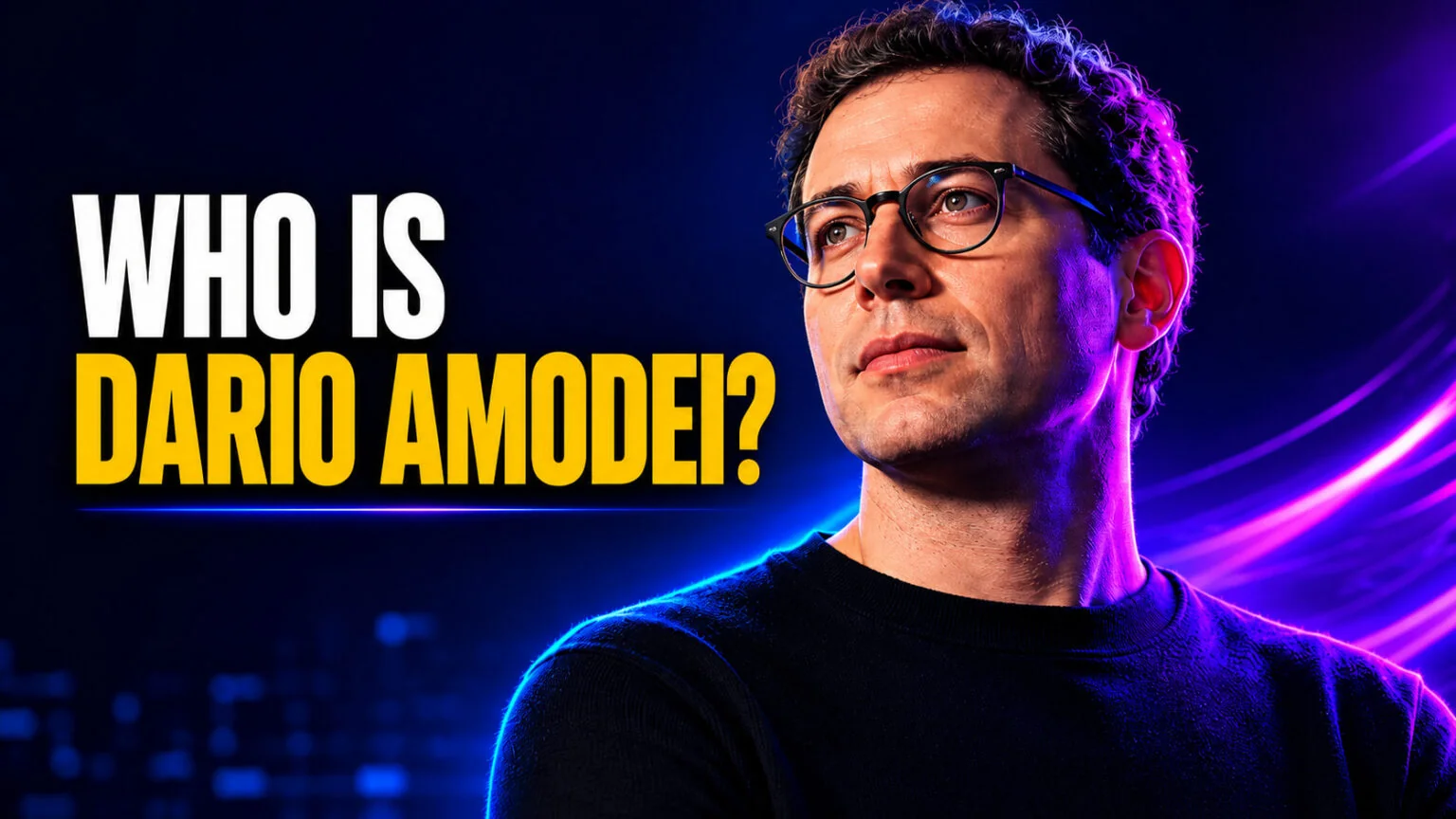
Dario Amodei is the CEO and co-founder of Anthropic, the company behind Claude. He is 43 years old, was born in San Francisco in 1983, and Forbes puts his net worth at $15.5 billion as of October 2026. He has been married to Camilla “Cami” Clark since 2022. Before Anthropic he was Vice President of Research at OpenAI, where he led the work on GPT-2 and GPT-3.
This guide answers the questions people search most: his wife, net worth, religion and origin, age and education. It also covers why he left OpenAI in December 2020, how Anthropic reached a $965 billion valuation, his fight with the Pentagon, the planned IPO, and his prediction that powerful AI could arrive in 2026 or 2027. Every figure is dated and sourced, because most of them have changed in 2026.
The Key Takeaways
- Dario Amodei has been CEO of Anthropic since 2021. He co-founded it with his sister Daniela Amodei and a group of former OpenAI researchers.
- His net worth is $15.5 billion per Forbes’ real-time estimate on October 6, 2026, up from $7 billion on the 2026 Billionaires list.
- He is married to Camilla “Cami” Clark. They married in 2022, and she has no formal role at Anthropic.
- He left OpenAI in December 2020 after leading GPT-2 and GPT-3, because he wanted scaling and safety built together.
- Anthropic is valued at $965 billion after its May 2026 Series H, filed a confidential draft S-1 on June 1, 2026, and is reported to be preparing an IPO for mid-November 2026.
Dario Amodei Quick Facts: Age, Religion, Hometown, Education
Dario Amodei is a 43-year-old American AI researcher and CEO, born in 1983 in San Francisco, California. His mother, Elena Engel, is Jewish-American. His father, Riccardo Amodei, was an Italian leather craftsman. That gives him Jewish heritage through his mother and Italian roots through his father. His sister, Daniela Amodei, is four years younger and serves as president of Anthropic.
He graduated from Lowell High School in San Francisco, started college at Caltech, and finished a bachelor’s degree in physics at Stanford University. He earned his PhD at Princeton University in 2011, in physics with a focus on biophysics, and then worked as a postdoctoral scholar at Stanford School of Medicine. He has run Anthropic as Chief Executive Officer since its founding in 2021.
| Detail | Value |
|---|---|
| Full name | Dario Amodei |
| Born | 1983, San Francisco, California |
| Age | 43 (Forbes, October 2026) |
| Religion | Jewish heritage (through his mother) |
| Origin | Italian-American father, Jewish-American mother |
| Hometown | San Francisco, California |
| Education | Caltech (attended), Stanford (BS Physics), Princeton (PhD, 2011), Stanford School of Medicine (postdoc) |
| Current role | CEO and co-founder, Anthropic (since 2021) |
| Sister | Daniela Amodei (Anthropic president) |
| Wife | Camilla “Cami” Clark (married 2022) |
| Net worth | $15.5 billion (Forbes real-time, October 6, 2026) |
| Anthropic valuation | $965 billion post-money (Series H, May 2026) |
Dario Amodei’s Family and Early Life
Dario Amodei grew up in San Francisco in a close family that he says shaped his sense of duty. His mother, Elena Engel, ran renovation and construction projects for libraries in Berkeley and San Francisco. His father, Riccardo Amodei, was a trained leathersmith from the Tuscan town of Massa Marittima. Amodei has said his parents gave him “a sense of right and wrong and what was important in the world.”
His father died in 2006, when Dario was 23, after a long illness. Within a few years a new treatment made that illness largely curable. Amodei has called this one of his main reasons for wanting AI to speed up medical research, and the loss pushed his Princeton work from theoretical physics toward biology.
Dario’s sister Daniela Amodei was born in 1987. The siblings co-founded Anthropic together, and they made the Time 100 most influential people list jointly in 2026, after Dario was named alone in 2025.
Is Dario Amodei Jewish?
Yes. Dario Amodei has Jewish heritage through his mother, Elena Engel, and Italian ancestry through his father, Riccardo. Both siblings are commonly described as Jewish-American, and Jewish Insider profiled them in March 2026 during Anthropic’s lawsuit against the Department of Defense. Neither Dario nor Daniela has spoken at length in public about personal religious practice.
Daniela Amodei: The Sister Co-Founder
Daniela Amodei is Dario’s only sister and the president of Anthropic, a role she has held since the company’s founding in 2021. She married Holden Karnofsky in August 2017. Karnofsky co-founded Open Philanthropy, which renamed itself Coefficient Giving in November 2025. Anthropic hired Karnofsky in early 2025 to work on its responsible-scaling and safety planning, a hire Fortune reported in February 2025. Daniela and Holden have one son.
Dario Amodei’s Wife: Cami Clark
Dario Amodei is married to Camilla “Cami” Clark. The couple married in 2022, as The Information reported in August 2026. Clark has no formal job at Anthropic, but people close to the couple describe her as one of Amodei’s most trusted advisers. Former Google CEO Eric Schmidt, one of Anthropic’s first investors, met Amodei through her.
Amodei kept his private life out of public view for years, and earlier versions of many bios, this one included, said his marital status was undisclosed. That changed with the August 2026 reporting. For a CEO whose personal life plays out in public, compare Sam Altman’s biography: his 2024 marriage, 2025 fatherhood and 2023 firing all made front pages.
Education: From Stanford Physics to Princeton Biophysics
Dario Amodei studied physics at Stanford and earned a PhD in physics, focused on biophysics, at Princeton in 2011. He graduated from Lowell High School in San Francisco and started at the California Institute of Technology. He then transferred to Stanford University for his bachelor’s degree in physics.
At Princeton University he worked under Michael Berry and William Bialek. His thesis, “Network-Scale Electrophysiology: Measuring and Understanding the Collective Behavior of Neural Circuits,” studied how whole populations of retinal neurons fire together, and he co-invented a sensor to record them. He was a Hertz Fellow and won the Hertz Thesis Prize. He then joined Stanford School of Medicine as a postdoctoral scholar, studying proteins linked to cancer, before moving into AI.
Career: From Baidu to Google Brain to OpenAI
Dario Amodei’s AI career started at Baidu in November 2014, on Andrew Ng’s research team. He worked on speech recognition and was the first author of Baidu’s Deep Speech 2 paper in 2015, research that showed him how reliably models improve with more data and compute. He then joined Google Brain as a senior research scientist, where he co-wrote the 2016 paper “Concrete Problems in AI Safety.”
He joined OpenAI in 2016 and rose to Vice President of Research. He set the lab’s research direction, led the efforts to build GPT-2 in 2019 and GPT-3 in 2020, and helped pioneer reinforcement learning from human feedback, the training method behind modern chatbots. Forbes credits him as its co-inventor.
Why Dario Amodei Left OpenAI
Amodei left OpenAI in December 2020 with his sister Daniela, Jack Clark, Chris Olah and a handful of other researchers. He has described the reason this way: “There was a group of us within OpenAI, that in the wake of making GPT-2 and GPT-3, had a kind of very strong focus belief in two things. … One was the idea that if you pour more compute into these models, they’ll get better and better and that there’s almost no end to this. … And the second was the idea that you needed something in addition to just scaling the models up, which is alignment or safety.”
He has also said “it is incredibly unproductive to try and argue with someone else’s vision,” so he chose to “take some people you trust and go make your vision happen.” For how the two companies have diverged since, see Anthropic vs OpenAI: Who’s Winning the AI Race in 2026. The OpenAI side of the story, including the November 2023 firing of CEO Sam Altman, is in Who Is Sam Altman?. Mira Murati, the CTO who was briefly interim CEO during that crisis, has since founded her own lab, Thinking Machines.
Anthropic: Co-Founding the Maker of Claude
Amodei co-founded Anthropic in 2021 with his sister Daniela and former OpenAI colleagues including Tom Brown, Sam McCandlish, Jack Clark, Jared Kaplan, Chris Olah and Ben Mann. The company is a public benefit corporation with an explicit safety mandate. It builds frontier models and publishes research on alignment, interpretability and constitutional AI.
Anthropic introduced Claude in March 2023, first to customers who requested access, and launched the consumer chatbot in July 2023. Its current flagship is Claude Opus 5.5, released on September 22, 2026. Above Opus sits the Mythos class: Claude Fable 5 is the safeguarded public version, while Claude Mythos stays limited to approved organizations. Researchers at the security startup Calif used Mythos Preview to help build a working exploit against Apple’s M5 memory protection in about five days, covered in our piece on the Apple M5 exploit. Anthropic’s agent product, Claude Cowork, competes with Google’s Gemini Spark, broken down in Gemini Spark vs Claude Cowork.
The 80-Fold Q1 2026 Growth Surge
Anthropic grew 80-fold in the first quarter of 2026 on an annualized basis, against an internal plan for 10-fold growth. Amodei said so at Anthropic’s developer conference on May 6, 2026, and called it the reason Claude users had hit compute shortages. Anthropic’s annualized revenue run rate passed $30 billion in April and $47 billion in May, by the company’s own count. On May 6, Anthropic also doubled Claude Code’s five-hour rate limits on paid plans, removed peak-hour limit cuts for Pro and Max, and raised API limits for Opus models.
The $1.25 Billion-a-Month SpaceX Colossus Deal
Anthropic agreed in May 2026 to pay SpaceX $1.25 billion per month through May 2029 for compute on the Colossus and Colossus II clusters in Memphis, Tennessee, built by Elon Musk’s xAI. The terms were disclosed in SpaceX’s S-1 IPO filing, which counts about 325,000 Nvidia GPUs across the two sites. Anthropic’s own announcement covered all of Colossus 1: more than 300 megawatts and over 220,000 GPUs. At full rate the contract would exceed $40 billion, and either side can end it with 90 days’ notice. Anthropic has also said it wants to work with SpaceX on orbital AI data centers, after SpaceX applied to the FCC in January 2026 for a constellation built for orbital compute.
The June 2026 Export-Control Shutdown
On June 12, 2026, a US government export-control directive forced Anthropic to switch off Claude Fable 5 and Claude Mythos 5 for every customer. The order barred access by foreign nationals, and Anthropic had no way to check nationality in real time. The controls were lifted on June 30, Fable 5 returned globally on July 1, and Mythos 5 came back only for approved US organizations. The full timeline is in Claude Fable 5 Just Got Pulled by the US Government.
The Pentagon Dispute: From Blacklist to Appeals Court
In February 2026, Amodei refused a Department of Defense demand to drop Anthropic’s contract ban on using Claude for mass domestic surveillance or fully autonomous weapons. In March, Defense Secretary Pete Hegseth labeled Anthropic a “supply-chain risk,” blocking the military and its contractors from using Claude, and Anthropic sued in two courts. A San Francisco federal judge ruled one designation unlawful in August 2026. On September 25, 2026, the D.C. Circuit Court of Appeals upheld the other designation 2-1. Anthropic said it respectfully disagrees and is considering all options, including further review.
Dario Amodei’s Net Worth in 2026 ($15.5 Billion)
Dario Amodei’s net worth is $15.5 billion, according to Forbes’ real-time estimate on October 6, 2026, which ranks him #187 in the world. Forbes had him at $1.2 billion in April 2025 and $7 billion on its 2026 Billionaires list. Almost all of it is Anthropic equity, so his fortune tracks the company’s valuation.
That valuation moved fast in 2026. Anthropic raised a $30 billion Series G at $380 billion in February, led by GIC and Coatue. In May it raised a $65 billion Series H at $965 billion, led by Altimeter Capital, Dragoneer, Greenoaks and Sequoia Capital. That made Anthropic more valuable than OpenAI, last priced at $852 billion in March.
| Source / Asset | Estimate | Date | Basis | Status |
|---|---|---|---|---|
| Forbes real-time | $15.5 billion | October 6, 2026 | Anthropic equity | Current |
| Forbes 2026 Billionaires list | $7 billion | March 2026 | Anthropic equity at $380 billion | Superseded |
| Anthropic valuation | $965 billion post-money | May 28, 2026 | Series H close | Confirmed by Anthropic |
| Anthropic run-rate revenue | Over $47 billion annualized | May 2026 | Anthropic Series H announcement | Confirmed by Anthropic |
| IPO | Confidential draft S-1 submitted | June 1, 2026 | Anthropic announcement | Listing date not set |
The Anthropic IPO
Anthropic confidentially submitted a draft S-1 to the SEC on June 1, 2026, the first formal step toward going public. A confidential draft is not published, and no public prospectus was on file as of October 6, 2026. Bloomberg reported on October 1 that Anthropic could start marketing the offering the week of November 9 and list as soon as mid-November. Anthropic has not confirmed a date, so treat any listing date as reported, not official. The full timeline, the reported valuation and how to buy the stock are in our Anthropic IPO guide.
How Dario Amodei Made His Money
Amodei’s wealth comes from one asset: his Anthropic shares. He is a researcher who became a founder, not a serial investor, and he does not run a personal venture fund. That sets him apart from Sam Altman, whose fortune rests on years of startup investing. Amodei’s net worth has risen with each Anthropic round, from a small founding round in 2021 to the $965 billion Series H in 2026.
Who Owns Anthropic?
No single person or company owns Anthropic. It is a privately held public benefit corporation owned by its founders, employees and investors. Its largest strategic backers are Amazon, which had invested $8 billion by mid-2025, and Google, which had invested $3 billion. Microsoft and Nvidia invested through a 2025 partnership, and the 2026 rounds added funds such as GIC, Coatue, Altimeter, Dragoneer, Greenoaks and Sequoia. Dario Amodei is CEO but does not hold a majority stake; his shares are worth about $15.5 billion of a $965 billion company.
Machines of Loving Grace and Dario Amodei’s AGI Prediction
“Machines of Loving Grace” is an essay of about 14,000 words that Dario Amodei published in October 2024. It describes what “powerful AI” could do for the world if things go right. He defines powerful AI as a system “smarter than a Nobel Prize winner across most relevant fields”, from biology and programming to math, engineering and writing, able to prove unsolved theorems, write difficult codebases from scratch and run as millions of instances at once. The title comes from Richard Brautigan’s poem “All Watched Over by Machines of Loving Grace,” which the essay links in its first footnote.
In the essay he wrote that powerful AI “could come as early as 2026, though there are also ways it could take much longer.” He repeated the forecast to Dwarkesh Patel on February 13, 2026: “I said we’ll get that in 2026, maybe 2027. Again, that is my hunch.” He added that he would not be surprised to be off by a year or two. For how that forecast compares with other lab leaders’, see When Will AGI Happen?.
Amodei followed up in January 2026 with “The Adolescence of Technology,” an essay of roughly 20,000 words that maps the risks of powerful AI and warns of a rite of passage that “will test who we are as a species.” In September 2026 he published “We Must Pace the Frontier,” which asks AI labs to deliberately slow capability gains and commits Anthropic to permanent outside evaluators. Its argument and the industry’s reaction are covered in Pace the Frontier: What AI Labs Actually Committed To.
Controversies and Public Friction
Amodei’s public profile rests more on his arguments than on scandal, but he has drawn fire from several directions. Four moments stand out.
The Pentagon blacklisting followed his refusal to let Claude be used for autonomous weapons or mass domestic surveillance. It has become the most public clash between an AI lab and the US military, and President Donald Trump has repeatedly attacked Amodei on social media.
The tension between safety and growth is one he admits. “We’re under an incredible amount of commercial pressure and make it even harder for ourselves because we have all this safety stuff we do that I think we do more than other companies,” he told Dwarkesh Patel in February 2026.
His discomfort with his own power came out on CBS’s 60 Minutes in November 2025. He said he is “deeply uncomfortable with these decisions being made by a few companies, by a few people,” and, asked who elected him and Sam Altman, answered: “No one, no one. Honestly, no one.”
His call to slow down in September 2026 drew public agreement from Sam Altman, Elon Musk and Demis Hassabis. Altman went further and said OpenAI would also give independent evaluators employee-like access, though a post on X is not a binding commitment.
What Dario Amodei’s Story Means for AI Users
Dario Amodei’s decisions shape the Claude models people use every day. His bets on scaling and safety explain why Anthropic ships models like Opus 5.5 while keeping Mythos restricted, and why the company fights in court over what Claude is allowed to do. Knowing his record is useful context whenever Anthropic announces a new model, a price change or a policy fight.
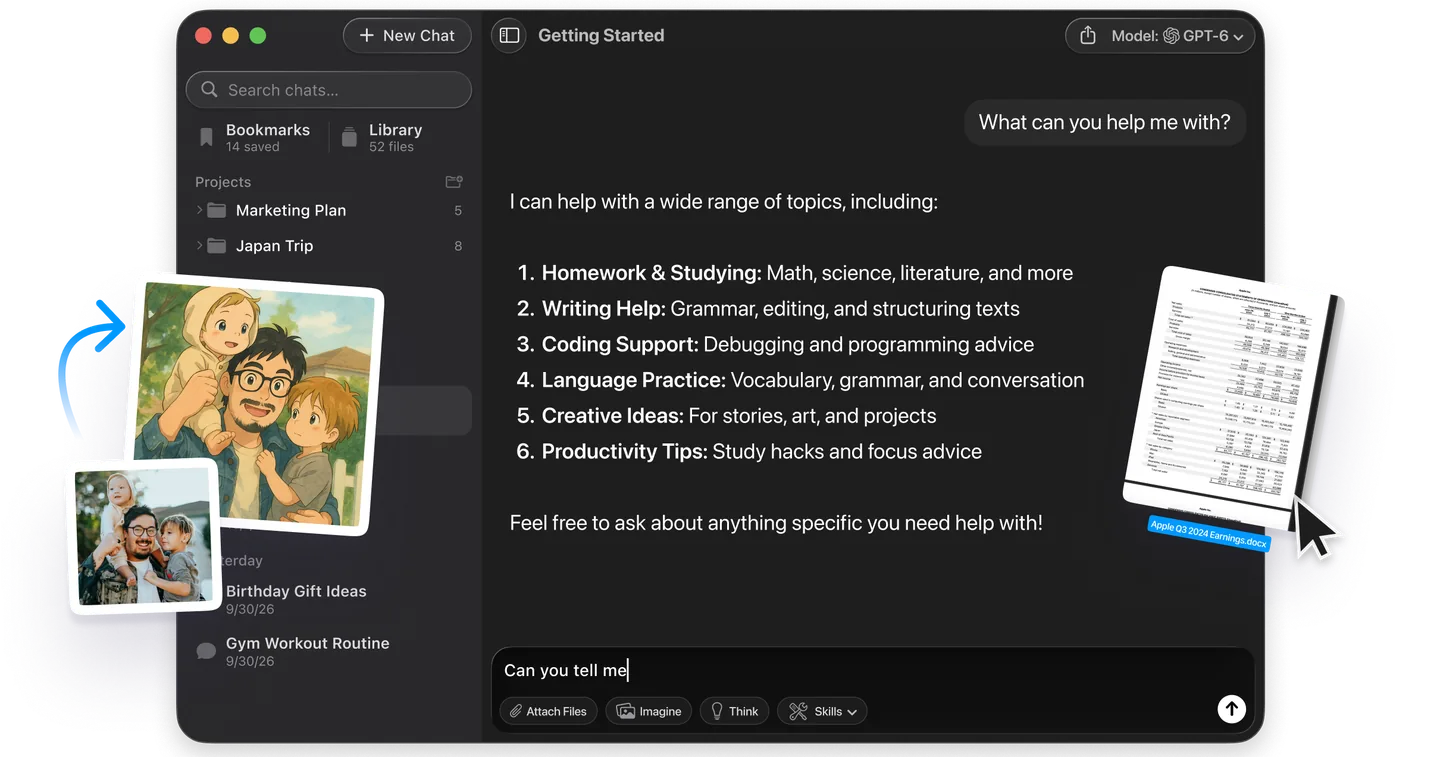
The easiest way to judge Claude against its rivals is to use them side by side. Fello AI gives you Claude, ChatGPT, Gemini, Grok and DeepSeek in one app for Mac, iPhone and iPad for $9.99 per month, so you can compare their answers without juggling five subscriptions. For the wider landscape, see our hub on Best AI Models in 2026.
Anthropic’s pull on talent is part of the same story. On May 19, 2026, OpenAI co-founder Andrej Karpathy joined Anthropic to build a team that uses Claude to speed up pretraining research. The rival frontier at Google is led by DeepMind’s Demis Hassabis, and Microsoft AI by Mustafa Suleyman.
FAQ
Who is Dario Amodei?
Dario Amodei is the CEO and co-founder of Anthropic, the company behind Claude. He founded Anthropic in 2021 with his sister Daniela and other former OpenAI researchers, after serving as OpenAI’s Vice President of Research, where he led the work on GPT-2 and GPT-3. He is 43 and was born in San Francisco in 1983.
What is Dario Amodei’s net worth?
Dario Amodei’s net worth is $15.5 billion, per Forbes’ real-time estimate on October 6, 2026. Nearly all of it is Anthropic equity. Anthropic was valued at $965 billion in its May 2026 Series H.
Who is Dario Amodei’s wife?
Dario Amodei is married to Camilla “Cami” Clark. They married in 2022. She has no formal role at Anthropic but is described as one of his closest advisers.
Why did Dario Amodei leave OpenAI?
Amodei left OpenAI in December 2020 with his sister Daniela and several senior researchers. He has said the group believed in both scaling models with more compute and building alignment and safety into them, and that it was more productive to build that vision themselves than to argue for it inside OpenAI.
What is Dario Amodei’s AGI prediction?
Amodei predicts that “powerful AI,” a system smarter than a Nobel Prize winner across most fields, could arrive as early as 2026. In February 2026 he told Dwarkesh Patel his hunch is “2026, maybe 2027,” and that he would not be surprised to be off by a year or two.