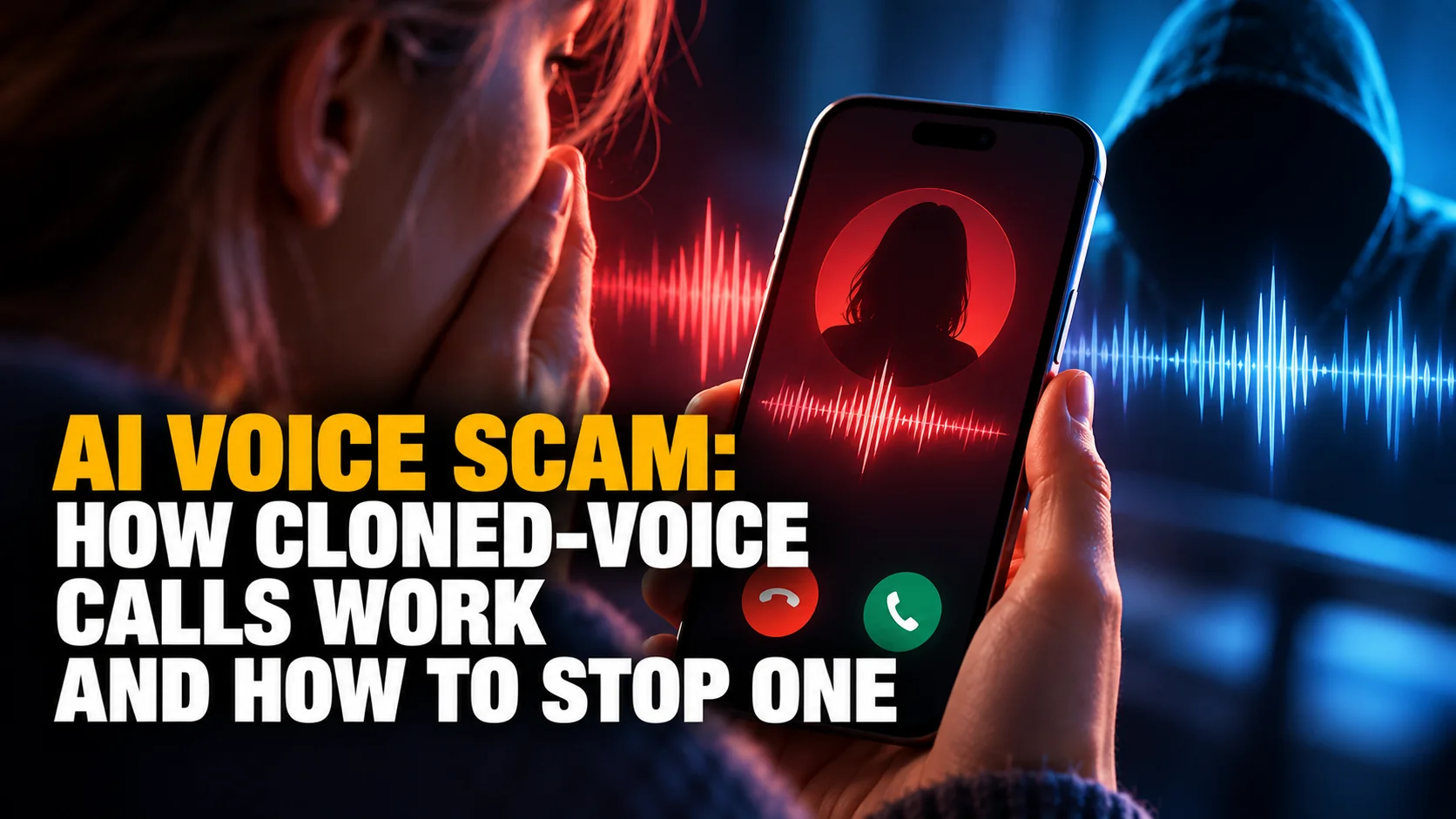
A caller told a California mother that a drug cartel had kidnapped her daughter, then put on what sounded exactly like her daughter, sobbing and saying she was scared. Over five hours of instructions, she wired $5,400 to Mexico. When she finally called her daughter directly, her daughter picked up. She was at work. That is an AI voice scam: a phone call built on a cloned copy of a real person's voice, made from a few seconds of audio, and designed to make you pay before you think.
The advice to stop it has not changed in three years, and it works whatever the voice sounds like.
What has changed is how much nonsense surrounds it. Most pages on this topic quote the same handful of statistics, and none of them says where those numbers came from or what they measure. This guide does both, then gives you the exact habit, script and card that defeat the call.
The Key Takeaways
- Stop judging the voice. The FTC's advice is “Don’t trust the voice.” Hang up and call back on a number you already have saved.
- The famous $893 million is mostly not voice calls. The FBI's own report puts family-distress voice-cloning losses in 2025 at over $5 million. $632 million of the AI total was investment fraud.
- “Three seconds of audio” is a 2023 lab test. McAfee got an estimated 85% match from three to four seconds with a free tool. It is not a 2026 measurement.
- A family safe phrase is official advice. The FBI tells families to create a secret word or phrase, agreed in person and never posted.
- Speed decides recovery. One fraud-recovery firm says diverted funds are nearly impossible to recover after 48 hours. Call your bank before anything else.
What Is an AI Voice Scam?
An AI voice scam is a phone call or voice message that uses a cloned copy of someone's voice to ask, urgently, for money or information. The voice usually belongs to a family member, a boss or an official. The clone is built from a short clip of real speech, often taken from social media, and the call relies on panic so you act before you check.
It is the old grandparent scam with a better costume. The FTC's March 2023 alert sets out the whole mechanism in one line: a scammer needs “a short audio clip of your family member's voice” and a voice-cloning program. The story is the same one scammers told for years with a bad line and a stranger's voice.
The difference is that now it sounds like the person.
Two newer tricks make it harder to catch. AI-media expert Henry Ajder told CNN that some attackers use text-to-speech or “voice skinning”, which changes a scammer's live voice into the target's in real time. That turns the call into a conversation rather than a recording. And caller ID is easy to spoof, so the call may appear to come from your mother's number when it is not her.
How AI Voice Scams Work, Step by Step
Every version of the scam runs through the same four steps. The voice clone is the third one, not the first.
- Pick a target and a voice. The scammer needs two people: someone who will pay, and someone whose voice will make them. Social media shows who is related to whom.
- Collect the audio. A few seconds of clear speech from a public video, a voice note or a voicemail greeting. CNN notes it can also come from an earlier scam call that was secretly recorded.
- Clone the voice. The clip goes into a voice-cloning tool. ElevenLabs' own pricing page, for example, lists Instant Voice Cloning from the $6-a-month Starter plan, and our breakdown of ElevenLabs' plans and credits shows what else that buys.
- Call with a crisis and a deadline. An arrest, a crash, a kidnapping. A second voice, a “police officer” or “lawyer”, often takes over to explain the payment. You are told not to tell anyone.
How Scammers Get Your Voice
You do not have to post anything yourself. The clip usually comes from whoever in the family is most visible online: a grandchild's public TikTok, a birthday video on Facebook, a podcast appearance, a voicemail greeting that says your full name. In its investigation of a near-miss in Ontario, the CBC reported that personal video posts, even years-old ones, are being harvested for exactly this.
The tools are not hard to reach either. Consumer Reports tested six voice-cloning products in March 2025, from Descript, ElevenLabs, Lovo, PlayHT, Resemble AI and Speechify. It found that four of the six failed to take basic steps to stop someone cloning a voice without permission. If you want to hear how good consumer voices have become, our test of the free AI voice generators is a fair sample of what anyone can use today.
Are AI Voice Scams Real? What the Numbers Actually Say
Yes, they are real, and the FBI now tracks them. But almost every figure quoted about them is either the wrong number or an old one, and the honest version is more useful to you.
| The figure you will see | Who published it | What it actually measures | Date |
|---|---|---|---|
| $893 million lost to AI scams | FBI IC3 annual report | All 22,364 US complaints that mention AI, of every type | 2025 data |
| Over $5 million | FBI IC3 annual report | Reported losses to distress scams using voice cloning | 2025 data |
| AI scams up 1,210% | Pindrop | AI fraud in a deepfake-detection vendor's own analysis of its fraud data | 2025 |
| 3 seconds of audio | McAfee Labs | A free tool's clone from three to four seconds, rated an estimated 85% match | April 2023 |
| 1 in 4 adults hit | McAfee survey, 7,054 people | Had any experience of one: 1 in 10 personally, 15% knew someone | April 2023 |
| 28% of UK adults targeted | Starling Bank survey | People who think they were targeted in the past year | September 2024 |
The $893 Million Is Mostly Not Voice Calls
The FBI's 2025 Internet Crime Report is the first to break out AI as its own category, and the headline number is real: $893,346,472 in losses across 22,364 complaints. But $632 million of that was investment fraud with an AI connection, the fake-celebrity trading clubs. The report's own line on the voice scam is far smaller: victims of grandparent or distress scams, where cloning mimics a loved one, “claimed losses over $5 million in 2025”.
That is a reported figure, and most families who lose money this way never file with the FBI, so the real total is higher. It still matters, because a page that tells you the voice scam costs $893 million a year is selling fear with someone else's number.
Where “Three Seconds” and “1 in 4” Came From
Both come from one McAfee report, Beware the Artificial Impostor, surveyed in April 2023. McAfee's researchers wrote that with “just three to four seconds of voice recording” a free tool made a convincing clone at an estimated 85% match, by their own rating scale. With paid tiers and more audio they reached an estimated 95%. The survey's “quarter of adults” counts people who had any experience of an AI voice scam, including the 15% who only knew someone who was targeted.
The tools have improved since 2023, so the number is not too high. It is simply old. The 1,210% surge you will see on news sites is a different thing again. It is Pindrop's analysis of its own fraud data, from a company that sells voice-deepfake detection to businesses, and it does not measure calls to families.
The Versions You Will Actually Get
The grandparent call is the famous one, but the FBI's 2025 report says the distress scam is already evolving to imitate other family members and close friends in different kinds of emergency. These are the four versions you are most likely to meet.
The Family Emergency Call
A grandchild or adult child has crashed a car, been arrested or hurt someone, and needs bail or a lawyer now. In a 2021 call that CBC Marketplace investigated in 2025, Ontario grandmother Marilyn Crawford was told her grandson needed $9,000 to get out of jail. Within 30 minutes a taxi sent by the scammers arrived. It took her to her bank, where a staff member flagged the withdrawal. Her family suspects the voice was cloned.
The Fake Kidnapping
Deborah Del Mastro got this version in May 2026, she told ABC7 News. A man said a cartel held her 37-year-old daughter, and a voice like her daughter's came on the line in a panic attack. Five hours of instructions later, she had wired $5,400 to Mexico. In December 2025 the FBI warned that the same scheme is now arriving by text, with doctored photos of the “kidnapped” person as proof of life. They are sometimes sent on timers so you cannot study them.
The Professional You Trust
On 15 September 2026, CNN reported that a Michigan couple wired $66,026.92 days before closing on a condo. It followed a fake email and a confirming phone call from a voice that “sounded just like” their loan officer, a clone their recovery firm suspects was built from his social media posts. The email gave a phone number that differed from his real one only in the last two digits. The FBI counted $275 million in real-estate scam losses in 2025, up 58.5% on the year before.
The Official or the Boss
The same trick scales up. Since April 2025, the FBI has warned of AI-generated voice messages impersonating senior US officials, aimed at current and former officials and their contacts to build rapport before sending a malicious link. At work, the version is a boss asking for an urgent transfer. The FBI notes that voice cloning can back up those payment requests, and businesses reported over $30 million in 2025 losses to email-compromise scams involving AI.
Can You Tell a Cloned Voice by Listening?
Not reliably, and you should stop trying.
The FBI still tells people to listen closely to tone and word choice, but in the same May 2025 warning it concedes that a cloned voice and the real one “can sound nearly identical”. Word choice is the part worth your attention. Ajder was blunter to CNN: “For the everyday person, it is just not fair to expect them to be able to spot this stuff.”
The old tells, strange pauses or a wavering tone, may simply not be there any more, CNN notes, now that the technology has advanced. UC Berkeley's Hany Farid, as CNN reported, advises listening to the script instead of the voice. Three questions do the work.
| Ask yourself | What it sounds like on the call |
|---|---|
| Is there a deadline? | Tonight, within the hour, before the hearing, before they move him |
| Is there a secret? | Don't tell Mum, don't call anyone, stay on the line with me |
| Is the payment strange? | Wire transfer, gift cards, cryptocurrency, cash handed to a courier, a taxi to the bank |
Any one of them is enough to hang up. Detection software exists, and our look at how accurate AI voice detectors really are explains why its lab scores fall apart on compressed phone audio. For fake video and photos, our guide to spotting AI deepfakes covers the visual side.
What to Do During an AI Voice Scam Call
- Say as little as possible and hang up. Staying on the line gives the caller time to adapt the story and more of your voice.
- Call the person back on a number you already have. Not the number that rang, and not a number the caller gives you.
- If they do not answer, try someone who knows where they are. A partner, a parent, a flatmate, their workplace. Text them too.
- Ask for the safe phrase if you get back through to “them” and still have doubts.
- Do not pay anything while you are unsure. A real emergency survives a ten-minute check. A scam does not.
Ajder put the right attitude to CNN. Better that your mum or your brother laughs at you for thinking they are a robot “than it is to potentially be running to an ATM.”
How to Protect Your Family From an AI Voice Scam
The protection that works is a habit agreed in advance, not an app. The FBI's December 2024 alert tells families to “Create a secret word or phrase with your family to verify their identity.” Starling Bank ran a national Safe Phrases campaign in the UK on the same idea, after its survey found 46% of UK adults had never heard of these scams.
Set Up a Family Safe Phrase
Make it random. A pet's name or a street is findable, while two unrelated words, such as a colour and a kitchen object, are not. Agree it in person, and never text it, email it or drop it into a family group chat, because a phrase that exists in writing can leak.
Then settle who says it. The person asking for help gives the phrase; the person being asked never offers a hint, such as whether it is the dog's name, because a hint hands over the answer.
If the phrase is ever used on a real call, pick a new one.
The Copy-Paste Family Message
Send this to the family chat, then agree the phrase itself face to face:
Scammers can now copy our voices from a few seconds of video. So here is our rule. If any of us ever calls asking for money or help in an emergency, the other person hangs up and calls straight back on the saved number. If that fails, ask for our safe phrase. I will tell you the phrase in person, not here. If you ever get a call like this, it is never rude to hang up on me. I would much rather you did.
The Card by the Phone
For an older parent, put the rule on paper where the phone lives. If they would read it more easily in another language or in plainer words, any AI chat app, Fello AI included, will rewrite the card in a few seconds. Our guide to setting up AI for an older parent uses the same printed-card approach for the rest of the phone.
| Write on the card | Why |
|---|---|
| If someone calls needing money, hang up and call them back on the saved number. | The one rule that beats every version of the scam |
| Our safe phrase is the one we agreed. Ask for it. | Never write the phrase itself on the card |
| Police, lawyers and banks never want gift cards, crypto or a courier. | The payment method is the giveaway |
| Being told to keep it secret means it is a scam. | Secrecy is how the scammer stops the call-back |
| Then call: ______ (a name you trust) | A second person breaks the panic |
Shrink the Supply of Audio
The FBI also advises limiting public video and audio of yourself and making social accounts private. You will not remove every clip, and you do not need to, because the call-back rule works regardless. But a voicemail greeting in the default robot voice instead of your own, and family videos shared to a private album rather than a public profile, cost nothing.
If You Already Sent Money
Move fast. Tyler Adams of the fraud-recovery firm CertifID told CNN that “Most funds that are diverted by criminals are nearly impossible to recover after 48 hours.”
- Call your bank or payment app now, using the number on your card, and ask them to stop or recall the transfer.
- Write down everything while it is fresh: numbers, times, names used, where the money went.
- Report it. In the US, to the FBI at ic3.gov and the FTC at ReportFraud.ftc.gov. In England, Wales and Northern Ireland, to Report Fraud on 0300 123 2040 or reportfraud.police.uk, and in Scotland to Police Scotland on 101. In Canada, to local police and the Canadian Anti-Fraud Centre on 1-888-495-8501.
- Warn the family. A scammer who got paid once may call again with a bigger ask.
What the Law Says About AI Voice Cloning
Cloning a voice is not illegal in itself. The FBI's December 2024 alert says plainly that creating synthetic content is not inherently illegal, while using it for fraud is. What has changed in the US is what regulators can go after.
The biggest step came from the FCC, which announced on 8 February 2024 that it had ruled unanimously that AI-generated voices count as “artificial” under the Telephone Consumer Protection Act. That puts voice-cloned robocalls under the same consent rules as any prerecorded call, and it gave state attorneys general a new legal route against the people making them.
| When | Who | What changed |
|---|---|---|
| 8 Feb 2024 | FCC | Announced that AI voices in robocalls are “artificial” under the TCPA, effective immediately |
| Feb 2024 | FTC | Proposed extending its impersonation rule to cover impersonating individuals, the category a cloned grandchild falls into. Still not finalised as of September 2026 |
| 1 Apr 2024 | FTC | Rule against impersonating government agencies and businesses took effect |
| Apr 2024 | FTC | Named four Voice Cloning Challenge winners, including real-time detection of cloned voices in calls, in two-second chunks |
None of that stops a call from reaching you. It makes the people behind it easier to prosecute after the money has gone, which is why the protection that counts is still the one you set up at home.
The Verdict
An AI voice scam is real, it is getting easier to run, and the voice will only get better. That is exactly why listening harder is the wrong defence. The scam has one weak point that no amount of AI fixes: it needs you to act before you check. A call-back on a saved number and a phrase nobody wrote down beat the best clone ever made. Set both up this week, with the parent most likely to pick up.
Frequently Asked Questions
How much audio do scammers need to clone a voice?
Very little. In McAfee's April 2023 test, three to four seconds gave an estimated 85% match with a free tool, and more audio gave better results. Tools have improved since, so assume any public clip of clear speech is enough.
Can a scammer clone my voice if I answer the phone?
It is possible. CNN reports that clips can come from an earlier scam call that was secretly recorded. Letting unknown numbers go to voicemail and hanging up quickly on anything odd keeps the sample short.
What should our family safe word be?
Something random that cannot be found online, such as two unrelated words. Agree it in person, never write it in a message, and have the caller say it rather than asking a question that hints at the answer.
Can an app detect an AI voice scam call?
Spam filters block some known scam numbers, and detection tools exist, but none is reliable on a live, compressed phone call from a new number. Treat software as a backup, not a replacement for calling back.
Where do I report an AI voice scam?
In the US, to ic3.gov and ReportFraud.ftc.gov. In the UK, to Report Fraud, or Police Scotland on 101. In Canada, to local police and the Canadian Anti-Fraud Centre. Report even if you did not lose money.