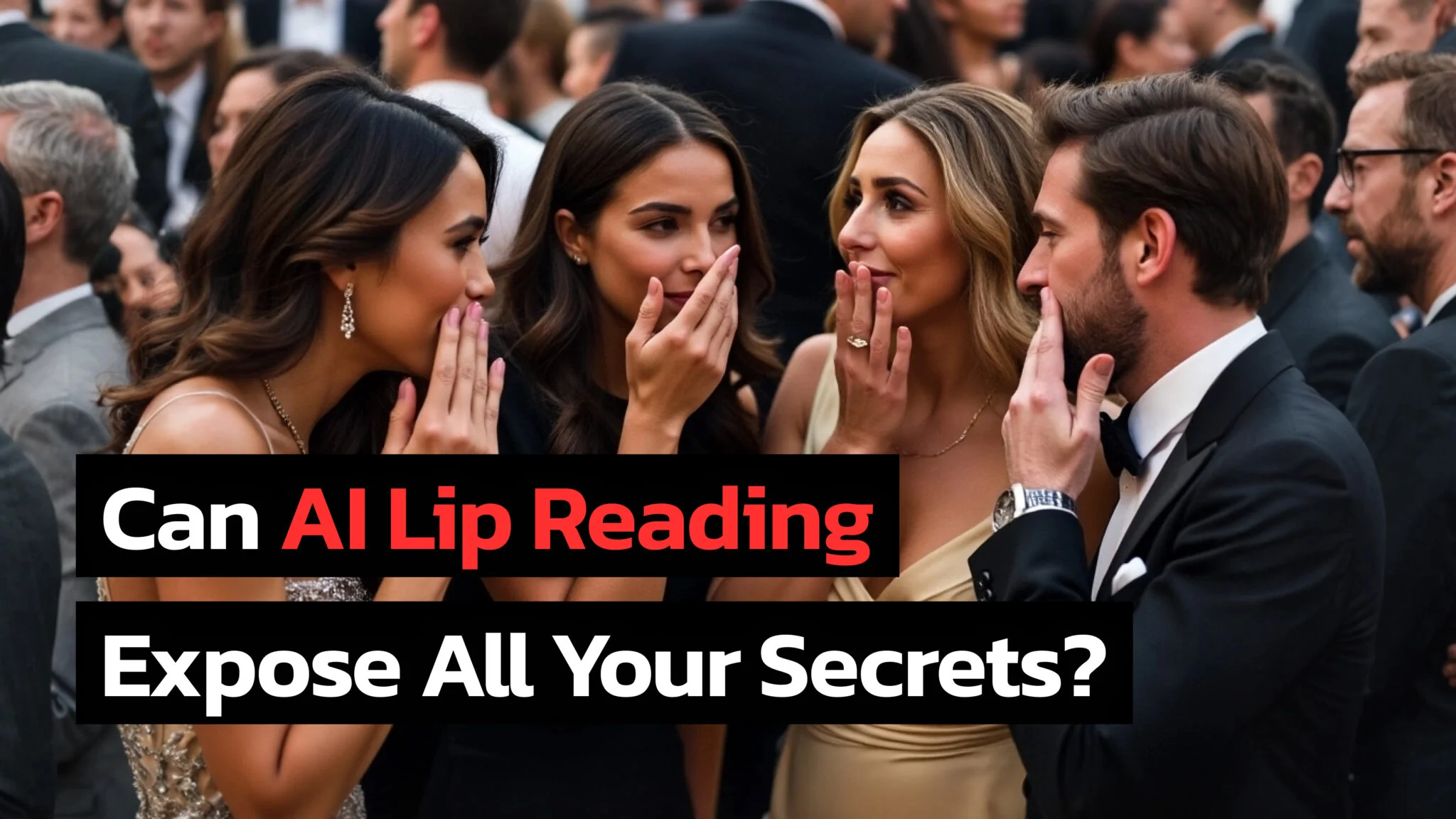
“Read Their Lips” by Symphonic Labs is a lip reading AI that was built to turn the lip movements in a silent video into text. It went viral in September 2024, when the service at readtheirlips.com let anyone upload a clip where the audio was missing or unclear. People on Reddit tested it on famous clips and argued about both its possibilities and its limits. As of 25 November 2026, the site shows a “Temporarily Under Construction” notice, so you cannot run a new video through it right now.
Key Takeaways
- Offline for now: as of 25 November 2026, readtheirlips.com says the service is “Temporarily Under Construction” and “will be back online soon”. The notice was already there in March 2026.
- Rough results at launch: in the September 2024 Reddit thread, users got some readable lines and some gibberish. Lip shapes alone cannot separate sounds like P, B and M.
- Humans are not better: research cited in Oxford’s LipNet paper puts human lipreading accuracy at around 20%.
- Research has moved: a May 2026 model reached a 19.4% word error rate on LRS3, a benchmark of TED talk clips, but error rates nearly double on harder, real-world video.
When it was online, Read Their Lips used AI to track the speaker’s mouth and convert the lip movements into text. You uploaded a video, set a start and end time, and kept the face inside the selection box. The service has been paused since at least March 2026. When it launched, many results were far from accurate. One Reddit user ran a longer clip and got back the same phrase repeated over and over, and another called the output “mostly inaccurate unless it’s painfully obvious what they are saying”. Human lipreaders face the same problem: research puts their accuracy at around 20%.
Read Their Lips struggles with words that look the same on the lips. “Pat”, “bat” and “mat” start with P, B and M, which share one lip shape, so video alone cannot tell them apart. Despite these shortcomings, people were excited about running the AI on historical footage or clips where the sound is lost, in the hope of recovering conversations nobody could hear.
Is Read Their Lips Still Available?
No, not as of 25 November 2026. The readtheirlips.com home page says: “Temporarily Under Construction. We’re currently working on improvements to serve you better. The service will be back online soon.” It gives an email address for refunds. Wayback Machine captures show the site working without the notice on 29 January 2026 and with it on 8 March 2026, so the service has been paused for at least eight months. The page still lists prepaid packs of $20 for 300 seconds of video, $30 for 600 seconds and $50 for 2,000 seconds. In October 2024 the same packs cost $10, $15 and $25 and unlocked faster processing and videos longer than 30 seconds. The site does not list which languages it supports.
Symphonic Labs is a startup from the University of Waterloo’s Velocity incubator, founded by Avery Chiu and Christopher Samra. Velocity describes it as building wearable silent speech interfaces that turn mouthed words into voice or text, initially for defense. On 25 November 2026 the symphoniclabs.com address no longer showed a company site and forwarded to a parked domain.
How It Works
Symphonic Labs has not published how Read Their Lips works, but research lip reading systems follow the same basic recipe. Oxford’s LipNet (2016), which its authors describe as the first end-to-end model to read whole sentences, feeds the video frames through spatiotemporal convolutions, a type of convolutional neural network (CNN) that looks at mouth shapes across time. A recurrent network then turns that sequence into text. The model learns from thousands of videos paired with what was actually said.
The hard part is that many sounds share one mouth shape, called a viseme. The phoneme-to-viseme map used in the LipNet paper groups “P”, “B” and “M” into one shape and “F” and “V” into another. A model that sees only the lips has to guess between them from context, which lowers accuracy. More training data and stronger language models help with the guessing, but they cannot recover a sound the camera never saw.

Comparison with Human Lip-Reading
Lip reading AI and human lipreaders fail in the same places. Human lipreaders also struggle to tell apart phonemes that look alike. As the image below shows, many sounds are produced with very similar mouth shapes, making it difficult to rely on visual cues alone.

Lipreaders may not be able to distinguish “B”, “M” and “P” without extra context. The numbers are low. A 1982 study cited in the LipNet paper found that hearing-impaired people identified only 17% of single-syllable words (plus or minus 12 points) and 21% of compound words, from sets of 30 words each. The LipNet authors summarise the literature as human lipreading accuracy of around 20%. Experience and the surrounding conversation fill in the gaps.
AI has already beaten humans on narrow tests. On the GRID corpus, which uses short commands from a fixed vocabulary, LipNet reached 95.2% sentence-level accuracy in 2016 on speakers it had seen in training. On a harder split with speakers it had never seen, three hearing-impaired lipreaders averaged a 47.7% word error rate, against 11.4% for LipNet. Where humans rely on context and life experience, AI relies on large datasets. That is why it does so well on fixed vocabularies and much worse on open conversation.
How Accurate Is Lip Reading AI in 2026?
The best research lip readers now get about four in five words right on clean TED talk video, and only about half on harder clips. Researchers measure this with the word error rate (WER), the share of words the model gets wrong. The standard test is LRS3, built from more than 400 hours of TED and TEDx videos.
| Model or study | Published | Test set | Word error rate |
|---|---|---|---|
| DLLM-VSR | May 2026 | LRS3 (TED talks) | 19.4%, best among models trained only on LRS3 labels |
| Llama-2-13B lip reader | September 2025 | LRS3 (TED talks) | 24.7% |
| Llama-2-13B lip reader | September 2025 | WildVSR (harder, real-world clips) | 47.0% |
The gap between those rows is the real story. In 2023 researchers built WildVSR, a new test set that follows the way LRS3 was made, because the LRS3 test set is only one hour long and models risk overfitting to it. The publicly available models they tested all scored significantly worse on WildVSR. The September 2025 study found that bigger language models mostly improve the word guessing, not what the model actually sees on the lips. If you want to read one of these papers yourself, Fello AI lets you drop the PDF in and ask GPT, Claude or Gemini to explain the results in plain English, without a second subscription.
Potential Applications and Concerns
There are many potential uses for AI lip reading. It could help in noisy environments where hearing is difficult, or be applied to old videos where the audio is damaged or missing. It could also give people with hearing impairments another way to follow conversations in real time. When the audio is there, ordinary speech recognition is far more accurate: a 2024 model transcribed LRS3 audio with a 0.68% word error rate. See our guide to AI subtitles on a Mac.
On the flip side, privacy concerns arise. If AI becomes highly accurate, it could be used for surveillance, reading private conversations from security footage without consent. These ethical concerns highlight the need for caution in how this technology is applied. For the steps you can take today, read how to use AI without giving up your privacy.
In 2024, “Read Their Lips” showed promise but had a long way to go before it became a reliable tool. With improvements, lip reading AI could change how we work with silent video and open up new possibilities for communication and accessibility.
Conclusion
The “Read Their Lips” AI tool by Symphonic Labs sparked both curiosity and debate when it launched in September 2024. It showed how far lip reading AI had come, and how far it still had to go with silent or unclear video footage.
Its limits, such as telling apart similar-looking phonemes like “F” and “V”, are the limits of lip reading itself. The same technology could still become useful for accessibility, historical research and, more worryingly, surveillance.
The open questions from 2024 remain. How accurate can this technology become outside the lab? Will it be used responsibly, or will it become a privacy risk? And who will turn the research into a product people can actually use?
Two years on, the research keeps moving: models now score word error rates below 20% on TED talk clips, while harder tests show how much they still miss. Read Their Lips itself, however, has been under construction since at least March 2026, so for now lip reading AI is mostly something you read about in papers, not something you can try.
FAQ
Is Read Their Lips still working?
No. As of 25 November 2026, readtheirlips.com shows a “Temporarily Under Construction” notice and says the service will be back online soon. The notice has been there since at least March 2026.
Is Read Their Lips free?
Not for longer videos. The site sells prepaid packs: $20 for 300 seconds, $30 for 600 seconds and $50 for 2,000 seconds, as listed on 25 November 2026. In October 2024 the paid packs were what unlocked videos longer than 30 seconds.
Does Read Their Lips work in other languages?
The site does not say. Readtheirlips.com lists no supported languages, and we found no language list from Symphonic Labs.
How accurate is lip reading AI?
On clean TED talk clips, the best research models get about four in five words right: a May 2026 model reached a 19.4% word error rate on LRS3. On harder, real-world clips, a September 2025 study measured 47.0%, so about half the words were wrong.
Is AI better at lip reading than humans?
On narrow tests, yes. Oxford’s LipNet reached 95.2% sentence-level accuracy on the fixed-vocabulary GRID corpus in 2016. On a harder split with unseen speakers, LipNet’s word error rate was 11.4%, against an average of 47.7% for three hearing-impaired lipreaders. Research puts general human lipreading accuracy at around 20%.