Update, September 4, 2026: ChatGPT 6 exists. OpenAI launched GPT-6 Astra on September 3, 2026, ending a year of speculation and settling the naming question: Astra shipped as GPT-6, not as a GPT-5 point release such as GPT-5.7. It is the first model OpenAI has ever designated Critical for cyber capability under its Preparedness Framework, which is why the August pause happened and why the rollout looks nothing like a normal flagship launch. Access starts with approved defenders in OpenAI’s Daybreak program, with ChatGPT Plus, Pro, Business and Enterprise, the API, AWS and Azure following over “the coming days”, no date attached. API pricing is $10 per million input tokens and $50 per million output, roughly 2.5 times GPT-5.6 Sol. Note also that there is no product called “ChatGPT 6”; the model is GPT-6 Astra, inside ChatGPT. We take the launch apart number by number in GPT-6 Astra is here: benchmarks, price, and what the numbers don’t say. The sections below are updated to that reality; the pre-launch rumor history is preserved as a record of what the field expected.
Update, September 22, 2026: the GPT-6 family grew. OpenAI added GPT-6 Sol and GPT-6 Luna, the cheaper tiers below Astra, at $2 / $10 and $0.10 / $0.50 per million tokens, half of what the GPT-5.6 models they replace cost. Both reach Plus and above in ChatGPT Work and Codex, Free and Go can use Luna in the desktop app, and neither is in ordinary Chat. Astra itself is settled too: it runs in Chat as GPT-6 Pro on Pro, Business and Enterprise, and in ChatGPT Work and Codex on Plus.
For months, the AI world held its breath for OpenAI’s next frontier model, codenamed “Spud.” That wait ended on April 23, 2026, when OpenAI released it as GPT-5.5, not GPT-6, and the company followed with GPT-5.6 on July 9, 2026. Both were point releases inside the GPT-5 family, not the generational leap the “weeks away” leaks promised. The leap came on September 3, 2026, when OpenAI launched GPT-6 Astra, five weeks after it first put the Astra name in public. The question is no longer whether ChatGPT 6 is coming. It is who can use it, what it costs, and which of the launch numbers survive a close reading.
If you are tired of chasing clickbait and vague roadmaps, you are in the right place. We have tracked every official statement, analyzed OpenAI’s infrastructure build-outs, and filtered out the baseless hype to give you a clear, honest picture of where the technology actually stands. This guide cuts through the confusion to bring you only verified updates, confirmed timelines, and credible expectations.
Here’s what we’ll cover.
- When it could realistically arrive
- What’s confirmed vs rumor
- Whether it’s worth waiting
The Key Takeaways
- GPT-6 shipped as Astra on September 3, 2026. OpenAI named the model on August 1, then launched it five weeks later as GPT-6 Astra, with the API id gpt-6-astra. The GPT-6 versus GPT-5.7 naming question is closed.
- It is the first model OpenAI has designated Critical for cyber. The August 7, 2026 finding that OpenAI could not rule out critical cyber capabilities was not a false alarm. Astra shipped carrying that designation, where every earlier model, GPT-5.6-Sol included, sat at the lower High threshold.
- Who can use it now. Astra is in ChatGPT as GPT-6 Pro, on the Pro $100, Pro $200, Business and Enterprise plans. Plus includes Astra in ChatGPT Work and Codex, not in ordinary Chat, and the Free and Go plans get no Astra at all.
- The April 14 rumor passed quietly. An unverified leak pegged April 14, 2026 as launch day, tied to a “super app” combining ChatGPT, Codex, and the Atlas browser. It came and went without an OpenAI tweet, blog post, or drop. Polymarket traders trimmed “GPT-6 by April 30” from 78% to roughly 72%.
- Astra costs five times GPT-6 Sol. GPT-6 Astra runs $10 per million input tokens and $50 per million output, level with Anthropic’s Fable 5.1. The cheaper tiers below it are GPT-6 Sol and Luna, at $2 / $10 and $0.10 / $0.50 since September 22, half of what the GPT-5.6 models they replace cost. Fast mode doubles those rates, Batch and Flex halve them.
- The headline benchmark is not what it looks like. The 98.6% on ARC-AGI-3 measures action efficiency against a human baseline, not a solve rate, and OpenAI has itself published how enabling two harness settings tripled that score. Read the launch numbers with that in mind.
- Most plans still answer you with GPT-5.6. In ordinary ChatGPT conversations paid plans run GPT-5.6 Sol and the Free and Go plans run GPT-5.6 Luna, so keep your workflow portable instead of rebuilding it around a model your plan may not serve.
ChatGPT 6 Release Date Status
ChatGPT 6 has a release date now: September 3, 2026. What decides whether you can use it is your plan, and for most people that is where the practical answer lives.
Current Status
As of September 4, 2026, GPT-6 exists and is called GPT-6 Astra. Getting there took an unusually crowded road. The “Spud” model everyone was waiting for shipped on April 23, 2026 as GPT-5.5, OpenAI followed with GPT-5.6 on July 9, 2026, and only after seven GPT-5 models, from GPT-5.0 through GPT-5.6, did the numbered jump arrive. The “a few weeks” timeline Sam Altman gave on March 24 resolved into GPT-5.5; the cadence was right, the GPT-6 naming prediction was five months early.
The one thing that did change is the name. On August 1, 2026 OpenAI introduced Astra as its next major model, and it did so through research output rather than a product page. An internal version of Astra solved ten open problems in mathematics and theoretical computer science, every one of them untouched for at least a decade, and OpenAI published a Lean 4 certificate for each result in the public openai/ten-proofs repository under an Apache 2.0 license. The headline result is the first explicit construction of a non-sofic group, a question open since Mikhail Gromov introduced soficity in 1999. OpenAI says the tokens behind all ten solutions would have cost roughly $2,000 at Sol API rates.
Read that carefully, because at the time it was not a launch. Astra had no release date, no pricing, no context window, no model card and no ChatGPT availability, and OpenAI had not said whether it would become GPT-6 or land as another point release inside the GPT-5 line. That gap closed on September 3, 2026. We went through the launch result by result in our full breakdown of what OpenAI actually shipped as GPT-6 Astra.
Then it stalled. On August 7, 2026 OpenAI published a security note saying its latest internal evaluations of Astra showed “significant advancements in agentic coding and cybersecurity”, and that those results meant it could not rule out critical cyber capabilities under its Preparedness Framework. The Critical threshold is defined as a model that can identify and develop working zero-day exploits in hardened real-world systems without human intervention. OpenAI noted that every previous model it had evaluated, GPT-5.6-Sol included, sat at the lower High threshold, and it said Astra was not involved in the Hugging Face incident. Its response was to impose isolated testing environments, restricted network and tool access, stronger model weight protections and sandboxed execution, and to pause internal activities involving Astra that did not yet meet those controls.
Eleven days later the scope became clearer. OpenAI told Axios on August 18, 2026 that it had paused two weeks of deployment-focused reinforcement-learning training, that its largest planned frontier RL run remained on hold, that a significant number of Astra and cyber-related research workloads were still paused, and that it was rewriting the Preparedness Framework itself, most of which dates to 2023. Chief scientist Jakob Pachocki framed the changes as broader than any single incident. At the time that read as a timeline signal pointing later. It was not: Astra launched sixteen days after that briefing, on September 3, carrying the Critical designation that caused the pause in the first place. What the pause bought was security controls, not delay. It also sits beside what OpenAI told TIME the same month, that it expects an internal system it would call AGI before the year is out, a claim we weigh in what Altman actually promised about AGI in 2026.
Against that, an August 25, 2026 post on X from the account @synthwavedd claimed OpenAI had finished a pretrain codenamed “Bel”, successor to “Doug”, at more than 10 trillion total parameters, with Doug the base for Astra and GPT-6 and Bel intended as a post-GPT-6 base. It travelled fast, past 660,000 views and into several tech sites within a day. Treat it as a rumor, and note that the GPT-6 launch did not settle it. Every republication we could find cites that one post, OpenAI has said nothing, and several write-ups garbled it, swapping Bel and Doug so that Bel becomes the GPT-6 base.
An unverified source pegged April 14, 2026 as the launch date, alongside a rumored “super app” combining ChatGPT, Codex, and the Atlas browser. That date came and went without so much as an OpenAI tweet, and the model that did arrive nine days later was GPT-5.5, not GPT-6. The real answer landed four and a half months after that: September 3, 2026. No leaked date got it right.
That rapid release cadence was deliberate. OpenAI spent a year gathering real-world data from each GPT-5 generation to tune the agentic behaviours that now define GPT-6.
So… when could it actually land?
It landed on September 3, 2026, later than the leaks predicted and sooner than the August pause suggested. Altman’s “few weeks” framing from March described GPT-5.5. The April 14 rumor missed by nearly five months. Our own reading in late August put late 2026 at the optimistic end, with 2027 realistic, and that was wrong too, because the pause turned out to be about security controls rather than the schedule: OpenAI halted internal Astra activity that did not meet strengthened controls, built the controls, and shipped. The one question still without a date is availability, which we cover below. Frontier releases are often shaped by safety work like red teaming, and OpenAI describes red teaming as a structured way to probe models for failures before release. In this case that work changed how the model ships, not whether it ships.
What would count as real confirmation?
We treated GPT-6 timing and features as “confirmed” only when at least one of these appeared. All of it now has.
Those bars are cleared. On September 3, 2026 OpenAI announced the launch, published model documentation and pricing under the API id gpt-6-astra, and company president Greg Brockman put the GPT-6 name on the record. The ledger below keeps the pre-launch entries so you can see which claims held.
- An OpenAI blog post or release notes update.
- A published model card or system card.
- Official API docs explicitly mentioning GPT-6.
- A statement attributed to OpenAI in reputable reporting, with clear wording.
Additionally, infrastructure plays a massive role. OpenAI’s Stargate Project signals serious infrastructure investment, but OpenAI hasn’t linked it to a GPT-6 release date. Treat it as context about scale, not a countdown.
What We Know About ChatGPT 6
It is easy to get confused by social media hype, especially when screenshots of “new” models circulate on X (formerly Twitter) or Reddit. Let’s look at the ChatGPT 6 rumors versus what has been officially stated by leadership or confirmed by reliable tech reporting. We call this our Verification Ledger.
Confirmed facts vs rumors
The table below tracks the most popular claims currently circulating. We only mark something as “Confirmed” if it comes directly from an official OpenAI announcement or a primary news source like a verified press release.
| Claim | Status | Why we think this | Last checked |
|---|---|---|---|
| OpenAI’s next major model is named Astra | Confirmed | Announced August 1, 2026 with ten Lean 4 proof certificates published in the public openai/ten-proofs GitHub repository | August 3, 2026 |
| Astra ships as GPT-6 | Confirmed | Launched September 3, 2026 as GPT-6 Astra, API id gpt-6-astra. Not GPT-5.7 | September 4, 2026 |
| OpenAI paused work on Astra over cyber risk | Confirmed | OpenAI’s own August 7, 2026 security note says it cannot rule out critical cyber capabilities. The pause ended with the September 3 launch, and Astra shipped carrying the Critical designation | September 4, 2026 |
| OpenAI’s largest planned frontier RL run is on hold | Confirmed in August | OpenAI told Axios on August 18, 2026. It has not said whether the run resumed; Astra shipped sixteen days later regardless | September 4, 2026 |
| “Bel”, a finished 10T+ parameter pretrain | Rumor, single source | One X post on August 25, 2026 from @synthwavedd. Every republication we found traces to it, no outlet has confirmed it independently, and the GPT-6 launch did not address it | September 4, 2026 |
| Spud pretraining finished March 24, 2026 | Confirmed | Multiple reports citing Sam Altman and OpenAI briefings; Spud shipped April 23 as GPT-5.5 | August 3, 2026 |
| “Spud” ships as a numbered GPT-6 | Resolved / No | Spud launched April 23 as GPT-5.5, then GPT-5.6 followed July 9; neither took GPT-6 branding | August 3, 2026 |
| April 14 launch date | Debunked | The date passed silently with no official OpenAI communication | August 3, 2026 |
| “Super app” combining ChatGPT + Codex + Atlas | Rumor | Tied to the same unverified April 14 leak; no official confirmation | August 3, 2026 |
| 100x More Powerful | Speculation | No official benchmarks or docs support it | August 3, 2026 |
| Agent Capabilities | Confirmed | OpenAI describes GPT-6 Astra as state of the art on computer use and browser use, and leads the launch with long-horizon agentic work | September 4, 2026 |
| Physical Robot Release | Rumor | No credible linkage between hardware launch and GPT-6 | August 3, 2026 |
| Pricing Increase | Confirmed | $10 / $50 per million tokens for Astra, against $2 / $10 for GPT-6 Sol since September 22. Fast mode doubles it | September 23, 2026 |
The verification ledger
Always check the source of ChatGPT 6 leaks. If a screenshot shows a “release date” prompt inside ChatGPT, it is usually a “hallucination” (the AI making things up) rather than a verified leak. Large Language Models (LLMs) are predictive engines; if you ask them “When are you released?”, they often predict a date based on internet text rather than accessing a hidden internal database.
Furthermore, true leaks rarely appear as simple text outputs. Legitimate leaks historically come in the form of API documentation code strings, updated developer terms of service, or reliable reports from journalists who have spoken to insiders. If you see a “GPT-6” dropdown menu in a screenshot, remember that inspecting and editing HTML elements in a browser takes seconds. Mockups are easy to create, so screenshots alone aren’t evidence.
Security Tip: If you see “early access” offers, treat them as suspicious; enable MFA (Settings, then Security) and only use official OpenAI sign-up flows.
Expected ChatGPT 6 Features
We now have specs rather than direction. GPT-6 Astra carries a 1,050,000-token context window, with a maximum input of 922,000 tokens and 128,000 tokens of output, takes text and images in and returns text, and has a knowledge cutoff of April 30, 2026. The sections below keep the pre-launch expectations, with what actually shipped against each one.
Memory and personalization
Sam Altman has described current AI memory as being in the “GPT-2 era” relative to what’s coming, a striking claim that suggests this is the area where GPT-6 will make its biggest leap. Users expect GPT-6 memory to be vastly improved. Currently, most models have a “context window” that limits how much they remember in a single session, and they struggle to remember things between different sessions unless specifically instructed.
- Context. The AI might remember details from a conversation you had months ago without you needing to remind it.
- Adaptability. It could learn your writing style, coding preferences, or business tone without needing new instructions every time.
This “persistent memory” would fundamentally change the user experience. Instead of starting from scratch with every “New Chat,” you would be picking up a relationship where you left off. Imagine an AI that knows you prefer Python over JavaScript, or that you always want your marketing emails to have a professional but friendly tone. This reduces the “prompt engineering” burden on the user significantly.
Agents and autonomy
The buzzword you will hear often is “Agents.” OpenAI is investing heavily in agentic capabilities, as evidenced by the OpenAI Agents SDK. It’s reasonable to expect future frontier models to push this further, but GPT-6 specifics are unconfirmed.
- Example. Instead of just writing an email draft, an agent might draft it, find the recipient’s address in your contacts, and queue it for sending.
- Autonomy. This moves the AI from a tool you talk to, to a tool that works for you.
In an autonomous workflow, the model might break a complex goal, like “Plan a travel itinerary,” into sub-tasks such as checking flights, verifying hotel availability, comparing prices, and presenting a final package. GPT-5.5 already took a significant step here, scoring 78.7% on OSWorld-Verified, narrowly ahead of Claude Opus 4.8, and operating software interfaces directly via native computer use. This is the expectation GPT-6 Astra was built to meet: OpenAI describes it as state of the art on computer use, browser use, software engineering, cybersecurity, science and professional work, and long-horizon agentic work is the capability the launch leads with.
OpenAI hardware and interface redesign
One area that rarely gets covered in GPT-6 speculation is hardware. Altman has confirmed that OpenAI is developing “a small family of devices” optimised for AI-first interactions, a deliberate move away from traditional form factors like the smartphone keyboard. This suggests GPT-6 won’t just be a smarter chatbot; it may debut alongside new hardware designed to take full advantage of its agentic capabilities.
Altman has also said that “bolting AI onto the existing way of doing things” won’t work as well as redesigning products from an “AI-first” perspective. ChatGPT’s interface is expected to change substantially beyond its current chat-based design in the GPT-6 era.
A new training paradigm
GPT-6 won’t just be a bigger version of GPT-5. Altman has indicated that the GPT-5 and GPT-6 generation uses reinforcement learning as its core training approach, rather than the pre-training paradigms used for earlier models. This is significant: reinforcement learning allows the model to discover patterns and solve problems through trial and error, rather than just absorbing existing text. OpenAI describes this as enabling the AI to potentially contribute to “new algorithms, physics, and biology,” meaning early scientific discovery, not just retrieval.
Multimodal improvements
We also expected significant strides in GPT-6 multimodal video and audio capabilities. That is the one prediction the launch did not deliver. GPT-6 Astra takes text and images in and returns text, so real-time video understanding and audio composition are not part of this release. The multimodal leap, if it comes, belongs to a later model.
GPT 6 vs GPT 5 Comparison
The comparison is no longer hypothetical on one side. The table below sets what the field expected of GPT-6 against what GPT-6 Astra actually shipped with on September 3, 2026.
Models in the GPT-5 class are strong at creative writing, coding and general knowledge, and still make logic errors. Astra is OpenAI’s answer to that, though several of its headline scores need reading carefully before you treat them as settled. For a broader look at how this stacks up against the rest of the industry, see our Best AI Models hub, which we update as each new frontier model ships.
| Feature | Current/GPT-5 Class | GPT-6 Astra (shipped September 3, 2026) |
|---|---|---|
| Primary Strength | Text Generation, Coding & Computer Use (GPT-5.6) | Computer use, software engineering and science, per OpenAI |
| Memory | Session-based (currently “GPT-2 era” per Altman) | Not detailed at launch |
| Reasoning | Strong but prone to errors | Headline scores need caveats, see ARC-AGI-3 below |
| Multimodal | Image/Voice analysis | Text and image in, text out. No video or audio |
| Speed | Fast for text | Fast mode available at double the token price |
Reasoning vs Agency
The shift is subtle but important.
- Current Models. Good at writing, coding snippets, and summarizing. They act like a very smart encyclopaedia.
- GPT-6 Astra. Built for multi-step work that runs long, with computer use and software engineering as the headline capabilities. It acts more like a smart intern.
Note: The GPT-6 context window is now a published figure rather than a guess: 1,050,000 tokens, with a maximum input of 922,000 and 128,000 tokens of output. That is the same envelope as the GPT-5.6 family, and well short of the “10 million tokens” charts that circulated before launch. The more important metric is still “effective context,” meaning how accurately the model retrieves a specific fact from a mountain of data, rather than how much data it can hold.
Access and Pricing Availability
How do you actually get your hands on it? This is the part that did not follow OpenAI’s usual pattern, and where your plan decides what you get.
Normally a new flagship goes to paid ChatGPT users first. GPT-6 Astra did not. Because it is the first model OpenAI has designated Critical for cyber capability, access opened with Daybreak, OpenAI’s application-based program for vetted cybersecurity defenders, including a Daybreak Blue track for organisations protecting critical infrastructure. Everything else followed behind it.
- Daybreak first. Approved defenders got GPT-6 Astra ahead of everyone else. This is a vetted, application-based program, not a queue you can join by paying.
- Then Chat, on Pro $100, Pro $200, Business and Enterprise. Astra is served there as GPT-6 Pro, and OpenAI’s help centre has listed it as available rather than rolling out since September 16. It is capped: 200 messages a week on Pro $200, 50 a week on Pro $100, 50 a week on Business Premium and 15 a month on Business Standard.
- Plus gets Astra outside Chat, Free and Go get none. Plus includes Astra in ChatGPT Work and Codex, not in ordinary conversations. ChatGPT Go ($8/mo, localized in some markets) and the free tier have no Astra access at all, though both can use the cheaper GPT-6 Luna in the desktop app since September 22.
For developers, the model id is gpt-6-astra, priced at $10 per million input tokens and $50 per million output, with cached input at $1 and cache writes at $12.50. The cheaper ids are gpt-6-sol at $2 / $10 and gpt-6-luna at $0.10 / $0.50. Batch and Flex run at half price, Fast mode at double. Expect tiering and rate limits: as of today Tier 5 requires $1,000 paid and 30+ days since the first successful payment, and tier rules can change, see platform.openai.com.
Should You Wait For GPT 6
GPT-6 is here and so are its cheap tiers, so the question changes shape. It is no longer whether to wait for the model, it is which one to run. Build on what you can run today: the principles carry across generations, ordinary ChatGPT conversations still answer on GPT-5.6, and at $2 / $10 per million tokens GPT-6 Sol is the right default for plenty of work that does not need Astra.
How to prepare for GPT 6
The best way to prepare for GPT-6 is to build good habits now. If your data is messy or your prompts are vague, a smarter model won’t fix your fundamental problems.
- Clean your data. AI is only as good as the information you give it. Organize your internal documentation; using tools to chat with PDFs and files helps here, so that when the new model arrives, it has a high-quality knowledge base to learn from.
- Refine prompts. Learn how to instruct AI clearly. The skill of breaking complex tasks into clear steps will be even more valuable when directing “agents.”
- Use Multi-Model Tools. Don’t lock yourself into one vendor. The AI landscape is competitive.
The “Use It Now” Strategy
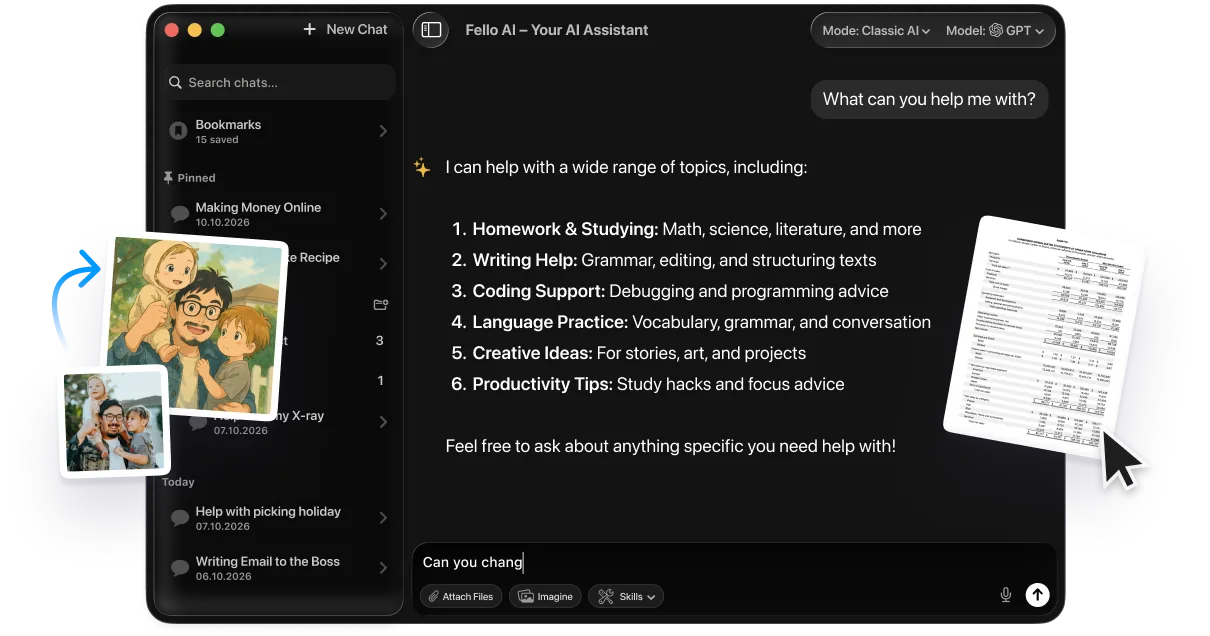
Tip: You can use platforms like Fello AI today to access the best AI model currently available (whether that is GPT, Claude, or Gemini). This keeps your workflow flexible, so you are covered whether or not your plan includes GPT-6 Astra. By building on a platform that aggregates models, you insulate yourself from rollout queues. If your plan does not include Astra but Claude Opus 5.5 or Gemini 3.1 Pro ships a breakthrough feature, you can switch instantly without rebuilding your entire stack.
Conclusion
The ChatGPT 6 release date turned out to be September 3, 2026, and not one leaked date got it right. The April 14 rumor missed by nearly five months, the “Bel” leak still has one source, and the August pause that looked like a delay was a security-controls pause the model shipped through. That is the case for ignoring leaked dates, not for chasing the next one.
What is left to watch is which model your plan serves, not whether GPT-6 exists. The practical advice has not changed: organize your data, keep your prompts sharp, and use tools that let you swap models without rebuilding around any one of them.
Next Step: Check the current top-performing models on Fello AI and keep your workflow portable, so GPT-6 Astra is a switch rather than a migration.
FAQ
Is there a release date for ChatGPT 6?
Yes. GPT-6 launched as GPT-6 Astra on September 3, 2026. The road there ran through two point releases, GPT-5.5 on April 23 and GPT-5.6 on July 9, and a pause over cyber risk in August. Availability settled within weeks: approved Daybreak defenders first, then Chat on Pro $100, Pro $200, Business and Enterprise, where Astra runs as GPT-6 Pro, with Plus limited to ChatGPT Work and Codex and no Astra at all on Free and Go. Note too that there is no product called “ChatGPT 6”; the model is GPT-6 Astra, served inside ChatGPT.
What is OpenAI Astra?
Astra is the name OpenAI gave its next major model on August 1, 2026, and it is now the released GPT-6 Astra. It was introduced through research rather than a product launch, with an internal version solving ten open problems in mathematics and theoretical computer science and a Lean 4 certificate for each published in the openai/ten-proofs GitHub repository. Five weeks later, on September 3, 2026, OpenAI shipped it as GPT-6 with published pricing and the API id gpt-6-astra, and it now runs in ChatGPT as GPT-6 Pro on the Pro, Business and Enterprise plans.
Why did OpenAI pause Astra?
Cybersecurity capability. On August 7, 2026 OpenAI said internal evaluations showed Astra had made significant advances in agentic coding and cybersecurity, and that it could not rule out critical cyber capabilities under its Preparedness Framework, the level at which a model can build working zero-day exploits in hardened real systems without human help. Every earlier model it had evaluated, including GPT-5.6-Sol, sat at the lower High threshold. OpenAI paused internal Astra activities that did not meet tightened security controls, and told Axios on August 18 that it had also paused two weeks of deployment-focused RL training, was holding its largest planned frontier RL run, and was rewriting the Preparedness Framework. The pause ended with the September 3 launch: Astra shipped carrying the Critical designation, and access opens with vetted defenders rather than paying subscribers because of it.
What are “Bel” and “Doug”?
Claimed internal pretraining codenames, and not confirmed by OpenAI. An August 25, 2026 post on X from @synthwavedd said OpenAI had finished a pretrain called Bel with more than 10 trillion total parameters, successor to one called Doug, with Doug the base for Astra and GPT-6 after further reinforcement learning and Bel intended as a post-GPT-6 base. It spread widely, but every republication we found traces back to that single post, and some reversed the two names. The GPT-6 Astra launch did not confirm or deny it. Treat it as an unverified rumor.
Will it be called GPT-5.5 or GPT-6?
Both questions are answered. Spud shipped on April 23, 2026 as GPT-5.5: its SWE-bench Pro score landed at 58.6%, a modest gain over GPT-5.4’s 57.70% and far short of the “high 70s” leaks, so OpenAI kept GPT-5 branding. The next major model, Astra, took the generational number on September 3, 2026 and launched as GPT-6 Astra, not as the GPT-5.7 that reporting had floated.
What is OpenAI Spud?
Spud was the internal codename for OpenAI’s next frontier model. It was trained at the Stargate facility in Abilene, Texas using over 100,000 H100 GPUs, and OpenAI shut down Sora to redirect GPU resources toward the project. Spud shipped publicly on April 23, 2026 as GPT-5.5.
What happened with the April 14, 2026 launch rumor?
An unverified source claimed OpenAI would launch GPT-6 on April 14, 2026 as part of a “super app” combining ChatGPT, Codex, and the Atlas browser. That date passed without a release. OpenAI ultimately launched the model nine days later (April 23, 2026) as GPT-5.5, with no Atlas browser and no unified super app, only the model itself.
Will ChatGPT 6 be free?
No. Astra is a paid model: Pro $100, Pro $200, Business and Enterprise get it in Chat as GPT-6 Pro, Plus gets it in ChatGPT Work and Codex, and the Free and Go plans get no Astra at all. What Free and Go did get on September 22 is GPT-6 Luna, the cheapest model in the family, in the ChatGPT desktop app. In ordinary Free and Go chats, OpenAI’s help centre still names GPT-5.6 Luna as the default.
How much better will GPT-6 be than GPT-5?
OpenAI calls GPT-6 Astra state of the art on computer use, browser use, software engineering, cybersecurity, science and professional work, but the headline numbers need care. Its 98.6% on ARC-AGI-3 measures action efficiency against a human baseline rather than a solve rate, and OpenAI has itself published how enabling two harness settings tripled that score. Its 97.6% on FrontierMath Tier 4 covers 41 of the 43 private problems on a benchmark Epoch AI discloses OpenAI funded and holds part-exclusive access to. And OpenAI did not publish GDPval, its own measure of economically valuable work, in the launch materials. We take each apart in the full breakdown.