Kimi vs ChatGPT is closer than the hype on either side suggests. On the Artificial Analysis Intelligence Index, the model that answers you in ChatGPT Plus, GPT-6 Sol, scores 47.6 at maximum effort. Moonshot AI's flagship, Kimi K3, scores 43.6. But free ChatGPT does not run Sol. It runs Luna, which scores 37.3 as GPT-5.6 Luna and 38.1 as GPT-6 Luna, so a free ChatGPT user is working with a weaker model than a Kimi user who spends credits on K3.
That is the problem with most Kimi vs ChatGPT comparisons: they pit one lab's best model against the other's and ignore which model your plan actually gets. This guide works the other way round. It maps the model you get on each plan, then compares price, coding, files, privacy and the Mac apps, using Moonshot's and OpenAI's own help pages, checked on 27 September 2026.
The Key Takeaways
- Paid chat: since 7 October 2026 ChatGPT Plus runs GPT-6 Sol, at 47.6 on the Intelligence Index at maximum effort, above Kimi K3 at 43.6.
- Free chat: free ChatGPT runs Luna, at 37.3 to 38.1 depending on the version, with unlimited text chats, while Kimi's free tier spends a small, unpublished pool of credits.
- Price: Kimi's paid plans run $19 to $199 a month. ChatGPT runs $8, $20 and from $100, and only the $8 Go plan and the free tier carry ads.
- Builders: K3 is open-weight at 2.8 trillion parameters, but on the API OpenAI's GPT-6.1 Sol costs less ($2 / $10 against $3 / $15) and scores higher.
- Mac: both have desktop apps. ChatGPT's runs on Intel or Apple silicon from macOS 14. Kimi's needs Apple silicon and its Work mode is still in beta.
Kimi vs ChatGPT: The Short Answer
For most people, ChatGPT is the better choice. At $20, Plus puts a stronger model in the chat window than Kimi's $19 plan does, it never makes you watch a credit meter for ordinary chatting, and its Mac app runs on more Macs.
Kimi is the better choice for a narrower group. Kimi gives you more for the money if you want one of three things. Open weights you can download and host yourself. Cheap tokens for bulk work through K2.6. Or a desktop agent that splits big research jobs across parallel sub-agents on a $19 plan.
What Kimi and ChatGPT Actually Are
Kimi is Moonshot AI's assistant, with open weights
Kimi is the chat app and agent platform from Moonshot AI, one of China's leading AI labs. Its flagship model, Kimi K3, has 2.8 trillion parameters with 104 billion active per token and a context window of just over 1 million tokens, according to its Hugging Face model card. The weights are published under Moonshot's own Kimi K3 license, so anyone with enough hardware can run it. Our Kimi K3 deep dive covers the model itself.
In the Kimi app you pick between three options above the message box. K2.6 is the fast one for quick questions. K3 is the most capable. K3 Swarm splits large search and batch jobs across many agents at once. Built in are web search, a fetch tool for reading specific URLs, image search, a Python sandbox and memory.
ChatGPT is OpenAI's assistant, with a model per plan
ChatGPT is OpenAI's closed assistant, and which model answers you depends on what you pay. OpenAI's help centre sets it out. On paid plans, GPT-6 is now the default in the model menu, and GPT-6 Sol runs Instant and every thinking level. Plus gets Medium and High thinking but not Extra High, and GPT-5.6 Sol stays selectable. On Free and Go, the default is Luna, and even the Think option runs on Luna. Which Luna is in flux: OpenAI's 7 October release notes say Free and Go move to GPT-6 Luna from 8 October, while the help centre still lists GPT-5.6 Luna. One more caveat on the scores below: Artificial Analysis tests Sol at maximum effort, a level Plus cannot select, so read Plus's 47.6 as a ceiling.
GPT-6 reached the chat window on 7 October 2026, but not every GPT-6 model came with it. GPT-6.1 Sol is still available only in ChatGPT Work and Codex. GPT-6 Astra reaches the chat window only as GPT-6 Pro, on Pro, Business and Enterprise plans, with weekly caps. Plus subscribers get Astra in Work and Codex, not in Chat. We explain the naming in our guide to GPT-6 Sol and Luna.
Which Model You Actually Get on Each Plan
This is the comparison that matters, and it is the one most pages skip. The scores below are from the Artificial Analysis Intelligence Index v4.3.2, each model at its highest reasoning setting, read on 27 September 2026. A higher score means better results on the index's mix of reasoning, knowledge, coding and long-document tasks.
| Where you are | Model answering you | Intelligence Index |
|---|---|---|
| ChatGPT Free or Go | GPT-5.6 Luna, moving to GPT-6 Luna | 37.3 (GPT-6 Luna 38.1) |
| ChatGPT Plus ($20) | GPT-6 Sol | 47.6 (max effort) |
| ChatGPT Pro (from $100), Pro option | GPT-6 Pro, powered by GPT-6 Astra | 52.7 (Astra) |
| Kimi, K2.6 selected | Kimi K2.6 | 27.0 |
| Kimi, K3 selected | Kimi K3 | 43.6 |
Read it by budget. With nothing to spend, K3 is the stronger model on paper, 43.6 against Luna's 37.3, but Kimi bills every chat against credits, K2.6 included, and the free allowance is small. Free ChatGPT gives you unlimited text chats on Luna. At around $20 a month, the picture flips: Plus runs Sol at 47.0, and Kimi's $19 plan still runs K3 at 43.6.
One caveat keeps this honest. One index is one view, and it changes version every few weeks, which moves every score, so treat these as a snapshot. Our best AI models hub tracks the current leaders across several boards.
Kimi vs ChatGPT: Prices and Plans
On price alone, ChatGPT has the cheaper way in, with an $8 plan to Kimi's $19. Kimi's prices are from Moonshot's membership pricing page and ChatGPT's from OpenAI's pricing page, all in US dollars. Kimi's paid tiers are called Plus, Pro, Max and Ultra on that page, while its help centre still uses the older names Moderato, Allegretto, Allegro and Vivace for the same prices.
| Tier | Kimi | ChatGPT |
|---|---|---|
| Free | Adagio, $0, with a small credit allowance | Unlimited text chats on Luna, with ads |
| Entry paid | Kimi Plus, $19/mo ($180/yr) | Go, $8/mo, with ads |
| Main paid | Kimi Pro, $39/mo ($372/yr) | Plus, $20/mo, no ads |
| Heavy use | Kimi Max, $99/mo ($948/yr) | Pro, from $100/mo |
| Top tier | Kimi Ultra, $199/mo ($1,908/yr) | Pro $200, or Pro $500 for the most usage |
How Kimi's credits work
Kimi does not sell you a fixed number of messages. Every membership feature, from K2.6 chats to K3, Agent Swarm, Slides, Kimi Code and the desktop agent, draws on one shared pool of credits, billed by the tokens each task uses. Moonshot's rough guide for free-tier users puts one deep research report at 5 to 10 percent of the allowance and a simple slide deck at 1 to 2 percent. That tells you how small the free pool is. Unused credits expire each month.
The upside is flexibility: you can spend a whole month's credits on research if that is what you need. The downside is that heavy chatting and heavy agent work compete for the same budget. The full rate card, including the API, is in our Kimi pricing guide.
One more thing to check before you budget.
On 19 July 2026, Moonshot paused new subscriptions because K3 demand had pushed its GPUs close to capacity, and said it would reopen spots in batches. Its pricing page now says the new membership plan is available and asks you to check your purchase eligibility there. Moonshot has not announced a date for the reopening, so look at the page on the day you buy.
ChatGPT's ads and the three Pro tiers
ChatGPT's cheap tiers now carry ads. OpenAI's help centre says ads appear only for Free and Go users, and that Plus, Pro, Business, Enterprise and Edu accounts have none. Separately, OpenAI paused new sign-ups for the $200 Pro plan on 10 September 2026 and reopened them on 29 September, at a lower allowance for new subscribers, the same day it added a $500 Pro tier with the most usage. On the $100 Pro plan, GPT-6 Pro and GPT-5.6 Sol Pro share one weekly allowance in Chat.
Coding: Kimi Code vs Codex
Both companies bundle a coding agent with their consumer plans. Kimi Code is available on every paid Kimi tier and draws on the shared credit pool, with its own separate limit of 5 hours a week. OpenAI's Codex comes with every ChatGPT plan. Free and Go get GPT-6 Luna in the desktop app as it rolls out. Plus gets GPT-6.1 Sol and GPT-6 Luna across the web, the command line and IDE extensions.
On the index, that matters. Codex on Plus runs GPT-6.1 Sol at 51.8, while Moonshot's strongest model, K3, scores 43.6. OpenAI's coding agent on a $20 plan gets the stronger model.
For developers paying per token, the gap is wider than most comparisons admit. The two flagships compare like this, per million tokens, from each company's API price list.
| Model | Input | Output | Intelligence Index |
|---|---|---|---|
| Kimi K2.6 | $0.95 | $4.00 | 27.0 |
| Kimi K3 | $3.00 | $15.00 | 43.6 |
| GPT-6.1 Sol | $2.00 | $10.00 | 51.8 |
| GPT-5.6 Sol | $4.00 | $20.00 | 47.0 |
| GPT-6 Astra | $10.00 | $50.00 | 52.7 |
GPT-6.1 Sol is a third cheaper than K3 and scores higher. GPT-5.6 Sol's rate is a promotion that OpenAI says runs at least through 21 November 2026, and all three OpenAI rates are for standard-length prompts. K3's API case now rests on three things. There is the $0.30 cache-hit rate for workloads that reuse long prompts, and the 1 million token context. And you can run the same weights yourself when you outgrow any API. For bulk jobs where price beats quality, K2.6 is the cheap end of either catalogue.
Files, Documents and Agents
Here the two products feel most different. Moonshot's help centre is candid that the Kimi chat window does not produce downloadable Office files. For slides you go to Kimi Slides, and for Word and Excel files you switch to Agent mode. When K3 runs as an agent, it can produce editable .pptx, .docx, .xlsx and .pdf files end to end. K2.6 only returns text, such as an outline or a draft to paste.
Context is the other split. A K2.6 conversation holds about 128,000 tokens before it stops reading new content. K3's full million-token context in chat is limited to the $99 Max and $199 Ultra plans, so a $19 subscriber pasting a huge document hits the same kind of ceiling as anyone else.
ChatGPT folds most of this into one window. Uploads, image generation, voice, deep research and memory are on every plan, with tighter limits on Free and Go. Its heavier agent work sits in ChatGPT Work, which Free gets in a limited form on desktop and Plus opens up on desktop, web and mobile. If you mostly chat with files and want a finished document at the end, ChatGPT is the smoother path. If you want an agent to run a long, parallel job while you do something else, Kimi's Agent Swarm is the more ambitious tool.
Privacy and Where Your Data Goes
Both companies can train on what you type into their consumer apps, but only one gives you a switch. OpenAI says it may use individual ChatGPT conversations to train its models, and that you can opt out under Settings, Data controls, by turning off Improve the model for everyone. It does not train on Business, Enterprise or API data by default.
Kimi's international service is run by Novascent Private Limited, according to Moonshot's privacy policy, last updated 13 August 2026. The policy says it processes your prompts, files and other content to provide the service and to train and improve its models. It also allows for storing your information on servers outside your country. Unlike OpenAI's help centre, the policy describes no settings switch for opting out of training.
For anything sensitive, the safer move with either is the business tier or the API. With Kimi you have one more option no closed lab offers: run the open weights on hardware you control, so nothing leaves your building.
The two labs are also in an open dispute. On 30 September 2026, OpenAI said it had disrupted a coordinated campaign to extract the hidden reasoning of its models, and it attributed “a core cluster of the activity to individuals associated with Moonshot AI, the developer of Kimi” in its report on the campaign. OpenAI says the activity peaked at 16,000 requests from more than 4,000 users on 24 and 25 July, that it banned or restricted the accounts involved, and that no encryption was broken and no stored conversations were accessed. Moonshot did not immediately respond to CNBC’s requests for comment. None of this changes what happens to your own chats in either app.
Kimi and ChatGPT on a Mac
Both have real desktop apps, which most comparisons never mention. ChatGPT's macOS app needs macOS 14 and runs on either Apple silicon or Intel Macs, according to OpenAI. Press Option and Space and a small chat bar opens over whatever you are doing.
Kimi's desktop client runs on Mac and Windows, and on a Mac it needs Apple silicon and macOS 12 or later, so an older Intel Mac is out. It has two modes. Chat is the normal assistant. Work is a local agent, launched on 3 June 2026 and still labelled beta, that can use your browser, create and organise folders and produce documents, spreadsheets and slides on your own machine. By default it asks before modifying files or running code, and you can loosen that to fully automatic.
Neither official app is in the Mac App Store, so download them from chatgpt.com and kimi.com. A Mac App Store search for Kimi turns up third-party apps from other developers with Kimi in their names, so do not install the first result.
So on a Mac, ChatGPT is the lighter, broader app, and Kimi is the more hands-on one if you want an agent working through your files. Our page on Kimi on a Mac covers the options in more depth.
Which One Should You Pick
Pick ChatGPT if you want one assistant for everyday writing, questions, files and images. Plus at $20 is the best value in this comparison for chat, because it runs the stronger model and does not meter your conversations. If $20 is too much, free ChatGPT is still usable every day, with ads.
Pick Kimi if you are a developer who wants open weights, or if you run bulk jobs where K2.6's price matters more than peak quality. It also suits anyone who wants a desktop agent that fans a big research task out across parallel sub-agents. And it is the one to watch for new open models.
If you are weighing a third option, we compare OpenAI's assistant with its other Chinese rival in DeepSeek vs ChatGPT, and with Anthropic's in Claude vs ChatGPT. For Kimi against Anthropic's assistant, see Kimi vs Claude.
Or use Kimi and ChatGPT without choosing
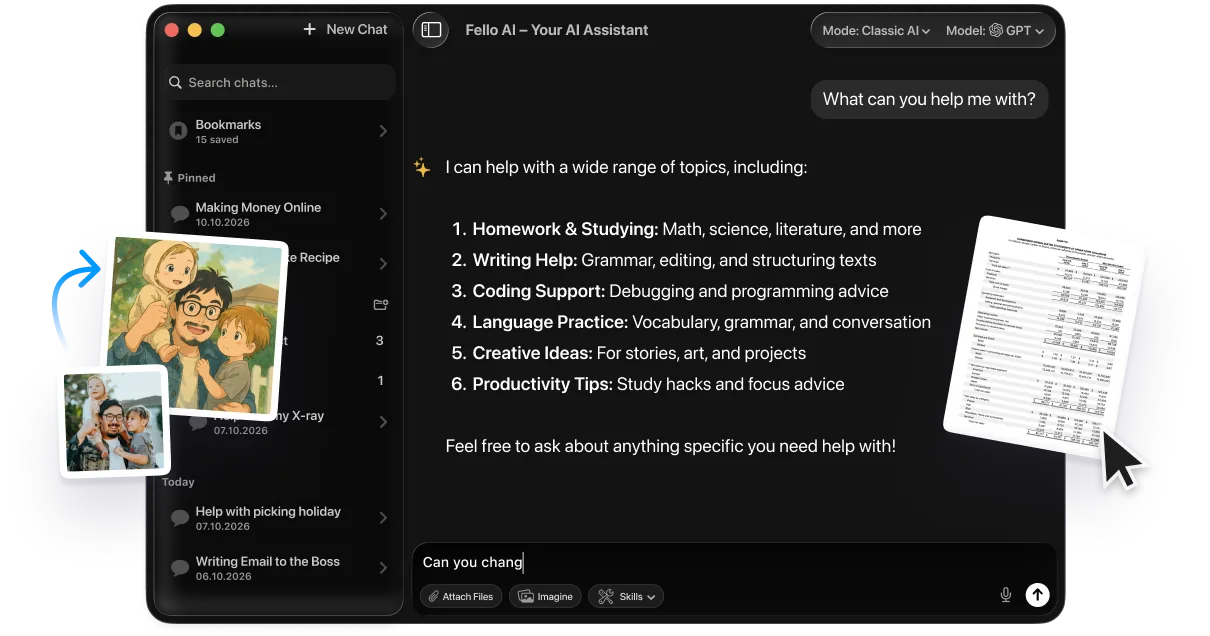
The honest answer for many people is that each one is better at something. Fello AI puts Kimi and GPT side by side in one native app, next to Claude, Gemini, Grok and DeepSeek, so you can send the same question to both and keep the better answer. It adds web search, PDF chat and real Word, Excel and PowerPoint files, and runs on Mac, iPhone and iPad. There is a free tier, so you can try both models before paying for either company's own plan.
The Verdict
ChatGPT wins for most people.
The reason is what each plan puts in the chat window. At $20, Plus runs a model that scores higher than Kimi K3, never charges your chats against a credit pool, and comes with a Mac app that runs on Intel as well as Apple silicon.
Kimi wins on openness. Its weights are downloadable, its desktop agent works directly in your own files and folders, and its cheap K2.6 tier suits bulk work. What it no longer wins is price for performance at the top, because OpenAI's GPT-6.1 Sol costs less than K3 on the API and scores higher.
If you want one assistant, get ChatGPT Plus. If you build with models rather than chat with them, start with Kimi's API and open weights, and test GPT-6.1 Sol before you commit.
Frequently Asked Questions
Is Kimi better than ChatGPT?
Not for most people. On the Artificial Analysis Intelligence Index v4.3.2, Kimi K3 scores 43.6, below the GPT-6 Sol model that ChatGPT Plus runs in chat (47.6 at maximum effort). K3 does beat Luna, the model free ChatGPT runs (37.3 as GPT-5.6 Luna, 38.1 as GPT-6 Luna), and Kimi is better if you need open weights.
Is Kimi free to use?
Kimi has a free tier, called Adagio, but it runs on a small allowance of credits that Moonshot does not publish, and every chat spends credits, K2.6 included. Paid plans start at $19 a month. Free ChatGPT, by contrast, offers unlimited text chats on Luna, with ads.
Is Kimi better than ChatGPT for coding?
On a consumer plan, no. Codex on ChatGPT Plus runs GPT-6.1 Sol, which scores 51.8 on the Intelligence Index against 43.6 for Kimi K3. On the API, GPT-6.1 Sol also costs less than K3, at $2 / $10 per million tokens against $3 / $15. Kimi's edge for developers is its open weights and the cheap K2.6 model.
Is Kimi safe to use?
Kimi is a mainstream product from Moonshot AI, but read its privacy policy before sharing anything sensitive. It says Moonshot processes your prompts and files to train its models and that it can store data outside your country, and it describes no opt-out switch. ChatGPT offers an opt-out under Settings, Data controls.
Does Kimi have a Mac app?
Yes. Kimi's desktop client runs on Macs with Apple silicon and macOS 12 or later, with a Chat mode and a Work mode that acts as a local agent. The Work mode is in beta. ChatGPT's Mac app needs macOS 14 and also runs on Intel Macs.