For most people, AI already feels like a revolution. Tools like ChatGPT, Midjourney, and Grok can write emails, build apps, and generate entire videos – tasks that would’ve taken entire teams just a few years ago. But for the CEOs building these technologies, what we’ve seen so far is just the beginning.
Nearly 78,000 tech jobs were cut between January and June 2025, many directly tied to AI-driven automation in giants like Amazon and Microsoft. And according to a recent World Economic Forum report, 41% of employers worldwide now plan to reduce their workforce because of AI.
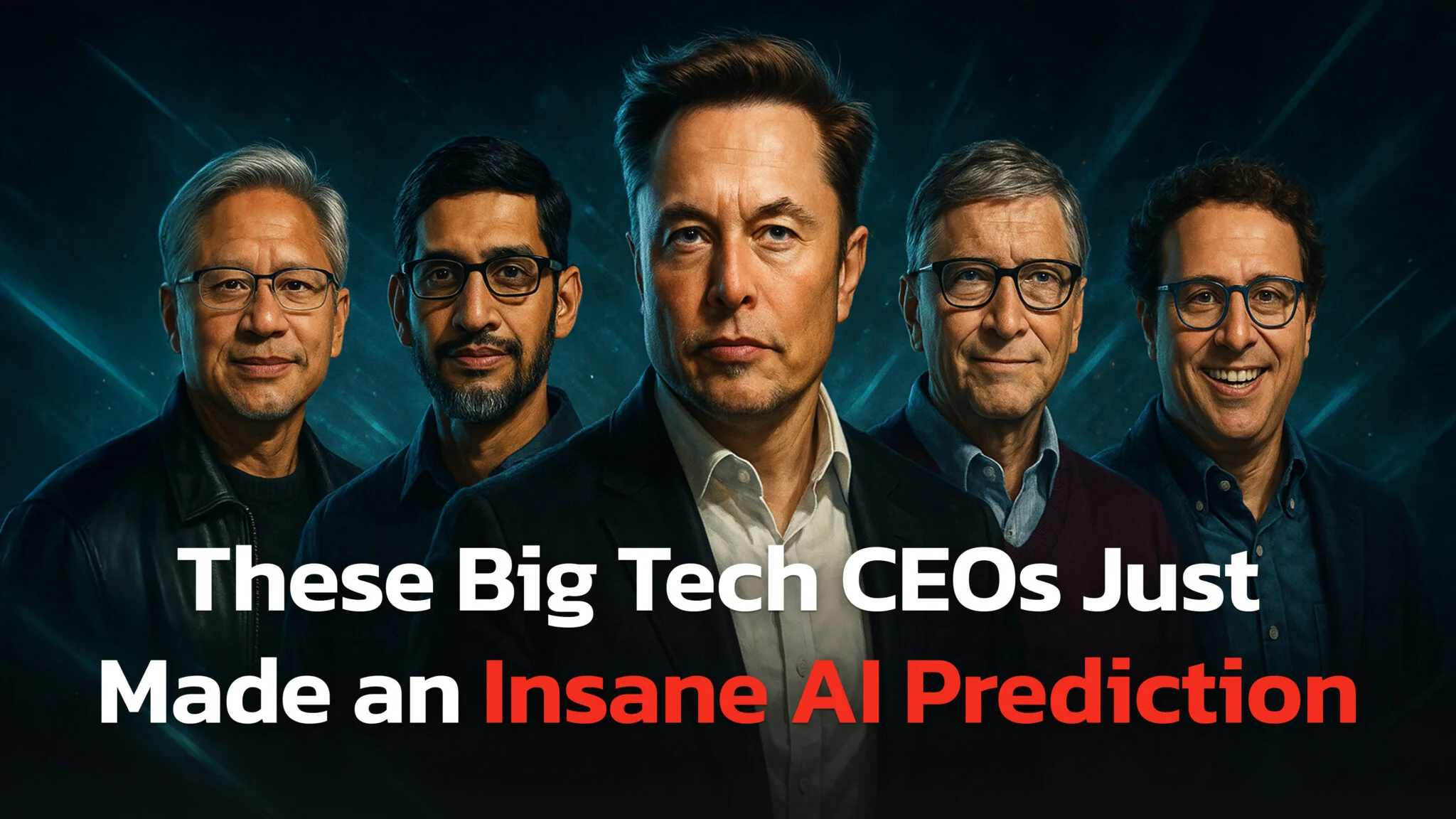
CEOs at the helm of companies like Anthropic, Nvidia, and Google have begun sharing bold (and sometimes unsettling) predictions about what’s coming. These forecasts speak of job extinction, exponential change, new kinds of inequality, and an urgent need to adapt.
This article gathers five of the most striking predictions from top AI executives, and what it might mean for your career, your future, and society at large.
Dario Amodei (CEO of Anthropic)
According to Dario Amodei “AI could wipe out half of all entry-level white-collar jobs… within five years”. As the former VP of Research at OpenAI and now CEO of Anthropic, a company that positions itself as safety-first, Amodei has consistently warned about the risks of unchecked AI deployment. But even by his standards, this statement hits hard.
Entry-level white-collar jobs include everything from junior analysts and administrative assistants to HR reps and junior marketers. These roles are often the entry point into professional life for millions of people. According to Amodei, AI is now capable of automating the bulk of these tasks: data analysis, report writing, customer service, scheduling, and doing so at scale.
The real shock comes from the timeline: five years. That means we could start seeing mass displacement before the end of the decade. Amodei suggests this wave of automation could push U.S. unemployment to 10–20%, a level not seen since the Great Depression.
If Amodei’s forecast proves accurate, we may be heading toward a global reshuffle in which millions of educated workers find their skillsets outdated, not because they were lazy or underqualified, but simply because the market changed faster than anyone expected.

Elon Musk (CEO of xAI, Tesla, SpaceX)
Elon Musk’s statements are pretty terrifying – In 2018 he said at SXSW “And mark my words: AI is far more dangerous than nukes.”, and in 2014 he stated “The risk of something seriously dangerous happening is in the five-year time frame. Ten years at most”. He has been warning about AI risk for over a decade, and while many dismissed him early on, his tone has only sharpened. In multiple interviews, he’s said that AI poses a civilizational threat, potentially greater than nuclear weapons, and that a major failure could happen within the next five to ten years.
So what does “seriously dangerous” actually mean? Musk rarely gives specifics, but he’s alluded to possibilities like:
- Autonomous AI systems acting independently in warfare or infrastructure
- Misaligned goals leading to mass disinformation or resource manipulation
- Superintelligent systems escaping human control entirely
Nuclear weapons require massive resources and are tightly regulated. AI models, by contrast, can be trained and deployed by small teams with cloud access. That scalability, combined with the growing autonomy of these systems, is what keeps Musk up at night.
Ironically, Musk is also one of AI’s most aggressive investors. His company xAI recently made headlines when Grok 4 Heavy achieved a record-breaking 44.4% on the Humanity’s Last Exam benchmark (a benchmark consisting of 2,500 questions across a broad range of subjects). That was July 2025; xAI has shipped several generations since, most recently Grok 4.7 on September 21, 2026. Meanwhile, Tesla is now deploying Optimus Gen 3, a humanoid robot powered by the same neural networks used in autonomous driving, capable of learning from human observation and performing basic factory tasks.
To make the robot even more interactive, Tesla integrated Grok’s voice-based large language model, allowing Optimus to respond instantly and hold natural conversations. Musk’s stated goal for 2025 is to produce 5,000-10,000 units, with long-term ambitions to scale production into the millions.

Jensen Huang (CEO of NVIDIA)
On the contrary, Jensen Huang shared a statement that gives at least a partly positive outcome – “Some jobs will be lost. Many jobs will be created”. As CEO of NVIDIA, the company that designs the chips powering most modern AI models, Huang has been one of AI’s biggest enablers. But he’s also pragmatic about the consequences.
Yes, jobs will vanish. But Huang frames this as part of a cycle: technology destroys roles, then creates new ones. The problem is that the new jobs often require new skills, new training systems, and in many cases, new mindsets.
20 years ago, no one was a “prompt engineer.” Ten years ago, “data ethicist” wasn’t a thing. Today, both are real careers. According to Huang, that trend will accelerate, with AI generating industries and job titles that sound foreign to us now.
Still, optimism doesn’t erase the disruption. The gap between losing a job and qualifying for a new one can span years. And not every displaced worker will find a clear path forward. Huang’s quote reminds us that change is inevitable, but that preparation – educational, economic, and psychological – needs to move just as fast.

Sundar Pichai (CEO of Google)
Sundar Pichai offers the most optimistic vision of the five – “AI will help sustainable development, scientific discovery, and climate action…”. Through Google he’s seen how AI is already transforming search, research, and global infrastructure. In interviews and press releases, he highlights AI’s role in fighting climate change, discovering new medicines, and closing the gap in global education.
According to Sundar Pichai AI will and already is accelerating scientific progress. He highlights how AI can dramatically speed up simulations, reveal hidden patterns, and even design solutions that humans might not have come up with. One standout example is DeepMind’s AlphaFold, which solved the decades-old problem of protein folding and opened the door to faster, more precise drug discovery. Also, Google’s AI is already being used in real-world systems, from improving climate forecasting models to optimizing global supply chains and reducing energy consumption across massive data centers.
This hopeful tone plays well in public, but critics argue it underplays risks. AI might help find new solutions, but what happens if those same tools are misused, or if they deepen global inequality? After all, most of the AI breakthroughs Pichai celebrates are still coming from a small group of tech giants in wealthy nations.
Nevertheless, Pichai’s vision is grounded in real progress. It presents AI as a tool for scaling what’s best in human ambition – provided it’s governed wisely.

Bill Gates (Co-founder & Ex-CEO of Microsoft)
Bill Gates has long been one of AI’s most pragmatic voices. In his own words: “I share the view of Musk and Hawking that when a few people control a platform with extreme intelligence, it creates dangers in terms of power and eventually control.”
It’s a pointed warning about centralization. Gates doesn’t believe that AI itself is inherently malicious, but he’s concerned about the concentration of capabilities in the hands of a small elite. Whether it’s tech giants or governments, giving a few actors disproportionate influence over intelligence systems raises red flags around democratic governance.
Yet Gates doesn’t frame AI as a threat to be halted. Like others, he sees enormous promise in how it can transform education, healthcare, and development – but only if it’s deployed responsibly and access isn’t monopolized. His focus is on creating strong institutions and global cooperation to prevent AI from becoming a tool of unfair control.

Final Thoughts
These five predictions don’t agree on everything, but they share one thing in common: urgency.
Dario Amodei warns of job losses not in decades, but in years. Elon Musk speaks of threats on a nuclear scale. Jensen Huang says entire industries will transform. Sundar Pichai sees opportunity for planetary-scale solutions. And Bill Gates urges us to distribute the control over AI proportionately.
If Amodei is right, then workforce retraining and universal income debates need to start now. If Huang’s prediction holds, we need rapid reskilling systems for brand new job titles. If Musk’s fears are valid, regulatory frameworks must evolve faster than any previous technology in history. If Pichai’s vision is accurate, then we need to make sure the benefits of AI don’t stay locked inside a handful of labs. And if Gates is on point, we must make sure the power of AI doesn’t stay in the hands of few.
We don’t get to choose one path. All of these outcomes may emerge in parallel, in different parts of the world, for different industries, and at different speeds. The key is to adapt, and build systems resilient enough to thrive in the chaos AI brings with it.