Update, September 22, 2026: Anthropic released Claude Opus 5.5 and moved Claude Opus 5 to its Legacy models list the same day. Opus 5 is still sold on the API at $5/$25, so the pricing below is current for the model itself, but it is no longer the model Anthropic tells you to start with, and the Opus that Pro and Max subscribers reach is now Opus 5.5 at $4/$20. This review stands as the record of what Opus 5 shipped with, retensed where it claimed to be Anthropic’s current pick.
Claude Opus 5 landed on July 24, 2026, and the headline was hard to ignore: it delivered close to Claude Fable 5 intelligence at Opus speed and cost, for roughly half the price of Fable 5. At $5 per million input tokens and $25 per million output tokens, Opus 5 cost exactly the same as the model it replaced, Opus 4.8, while pushing well past it on nearly every benchmark Anthropic published. Independent testing from Artificial Analysis ranked Opus 5 number one on both its Intelligence Index and its Agentic Index on launch day, a position it held until Claude Fable 5.1 arrived on September 1, 2026. Two model generations later it sits on Anthropic’s Legacy list, and this review tracks both what it launched with and where it stands now.
This is Anthropic’s fourth model in under two months, following Mythos 5, Fable 5, and Sonnet 5. Below you get the full picture, what Opus 5 costs, what the benchmarks actually show, how the new effort setting lets you trade capability for cost, and whether you should switch from Opus 4.8 or Fable 5. We also cover how to reach Opus 5 on your Mac, including running it alongside GPT-6 and Gemini in one app. Our guide to AI benchmarks explains what those scores actually measure.
The Key Takeaways
- Released July 24, 2026, Claude Opus 5 was Anthropic’s value flagship and the fourth model it shipped in under two months. Anthropic moved it to Legacy models on September 22, 2026, when Claude Opus 5.5 took the slot at $4/$20.
- $5 / $25 per million tokens, identical to Opus 4.8 and about half the price of Fable 5 ($10 / $50).
- Opus 5 launched at number one on the independent Artificial Analysis Intelligence Index at 61 and the Agentic Index at 55.3. Artificial Analysis has since rebuilt the index twice and retired the Agentic Index altogether, so those launch figures do not compare to today’s: on Intelligence Index v4.3.2 Opus 5 reads 50.8 at max effort, below Opus 5.5 at 57.6, Fable 5.1 at 53.4 and GPT-6 Astra at 52.7.
- A new effort setting (low to high, plus a max tier) lets you balance intelligence against token cost, and fast mode runs about 2.5x faster at twice the price.
- Its API ID is claude-opus-5, and it is now a legacy API model. The Opus that Pro and Max subscribers reach today is Opus 5.5.
What Is Claude Opus 5?
Claude Opus 5 was the value flagship of Anthropic’s Claude 5 family, a role that passed to Claude Opus 5.5 on September 22, 2026. According to Anthropic’s announcement, it reaches close to Fable 5’s frontier intelligence but runs at Opus speed and Opus pricing. In plain terms, you get near-top-tier quality without paying top-tier prices.
Anthropic framed Opus 5 at launch as its most capable generally available model for scientific research, with particular strength in biology and chemistry. It also called Opus 5 the most aligned Opus model to date, and the least susceptible to being tricked into misuse. The company points to its Fable line for the most advanced projects, including work a model might run autonomously for days, so Opus 5 was the everyday flagship rather than the absolute ceiling. That ceiling moved again on September 1, 2026 with Claude Fable 5.1, and the everyday slot moved three weeks after that, when Opus 5.5 arrived doing the same job for 20% less per token. Anthropic’s docs now open with Opus 5.5 as the model to start with and publish a migration guide for anyone still on Opus 5.
The model shipped across the Claude API (model ID claude-opus-5), Claude.ai, Claude Code, and Claude Cowork, and it stays callable on the API as a legacy model. Anthropic’s plan pages name the Opus family rather than a version, and the Opus that Pro and Max subscribers get today is Opus 5.5, so a paid plan no longer points at this model. Which of those two plans to pay for is covered in our comparison of Claude Pro against Max.
Claude Opus 5 Pricing
The pricing story is the reason Opus 5 mattered. It costs $5 per million input tokens and $25 per million output tokens, the exact same rate as Opus 4.8, and it still does on the Legacy list. Because Fable 5 sits at $10 / $50, Opus 5 offered close to Fable 5 quality for roughly half the cost per token. That trade is what Opus 5.5 then beat outright at $4 / $20, which is why there is now no case for starting a new project on Opus 5.
| Model | Input ($/1M) | Output ($/1M) | Best for | Availability |
|---|---|---|---|---|
| Claude Opus 5.5 | $4 | $20 | Current everyday flagship, value pick | Pro, Max, API, Code, Cowork |
| Claude Opus 5 | $5 | $25 | Superseded by Opus 5.5 | API, legacy models list |
| Claude Opus 4.8 | $5 | $25 | Flagship before Opus 5 | API, legacy |
| Claude Fable 5 | $10 | $50 | Ceiling before Fable 5.1 | API, legacy models list |
| Claude Fable 5.1 | $10 | $50 | Current ceiling, multi-day autonomous work | API, Max and Team premium seats, Pro on usage credits |
There is also a fast mode for when speed matters more than budget. It runs at roughly 2.5 times the default speed for about twice the base price, available on the Claude Platform and through usage credits in Claude Code. Anthropic now advertises that option against Opus 5.5 rather than Opus 5. For high-volume or latency-sensitive jobs, that is a straightforward lever to pull.
What the Benchmarks Show
Every figure below is reported by Anthropic at launch, so treat them as vendor numbers until independent testing catches up. Even with that caveat, the gains over Opus 4.8 are large, and several results land within striking distance of Fable 5 at a fraction of the cost per task.
| Benchmark | Claude Opus 5 result (Anthropic-reported) |
|---|---|
| Frontier-Bench v0.1 | Surpasses all other models, more than doubles Opus 4.8 at a lower cost per task |
| CursorBench 3.2 | Within 0.5% of Fable 5’s peak at max effort, at half the cost per task |
| ARC-AGI 3 | About 3x the next-best model |
| OSWorld 2.0 | Beats Fable 5’s best result at just over a third of the cost |
| Zapier AutomationBench | Pass rate around 1.5x the next-best model for the same cost per task |
| Organic chemistry | +10.2 points over Opus 4.8 |
| Protein tasks | +7.7 points over Opus 4.8 |
At launch the pattern was consistent. On coding, agents, computer use, and science, Opus 5 either topped the field or matched Fable 5 while costing far less to run. The one place it does not lead is cybersecurity, where Anthropic notes Opus 5 still trails Mythos 5. If you want a broader view of where each model fits, our guide to which AI to use for which task breaks it down by job.
Where Claude Opus 5 Ranks on the Artificial Analysis Leaderboard
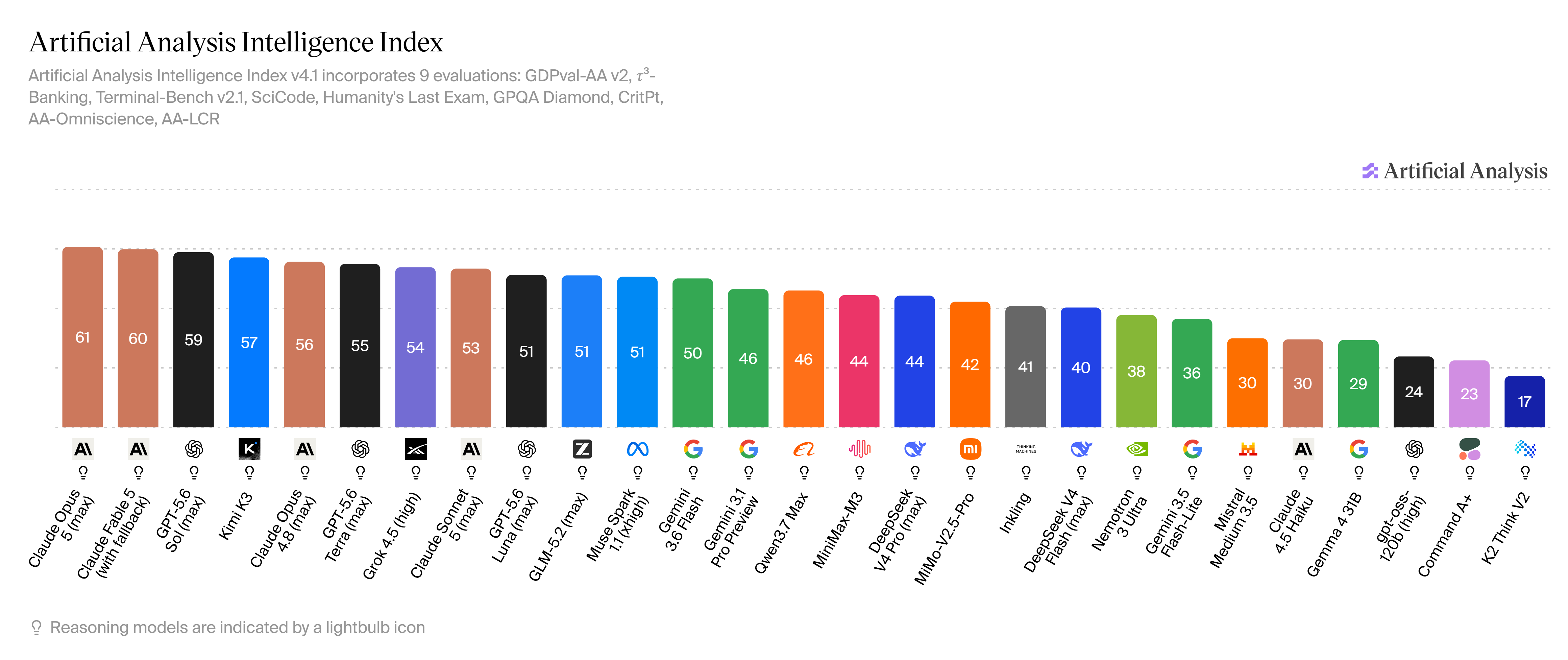
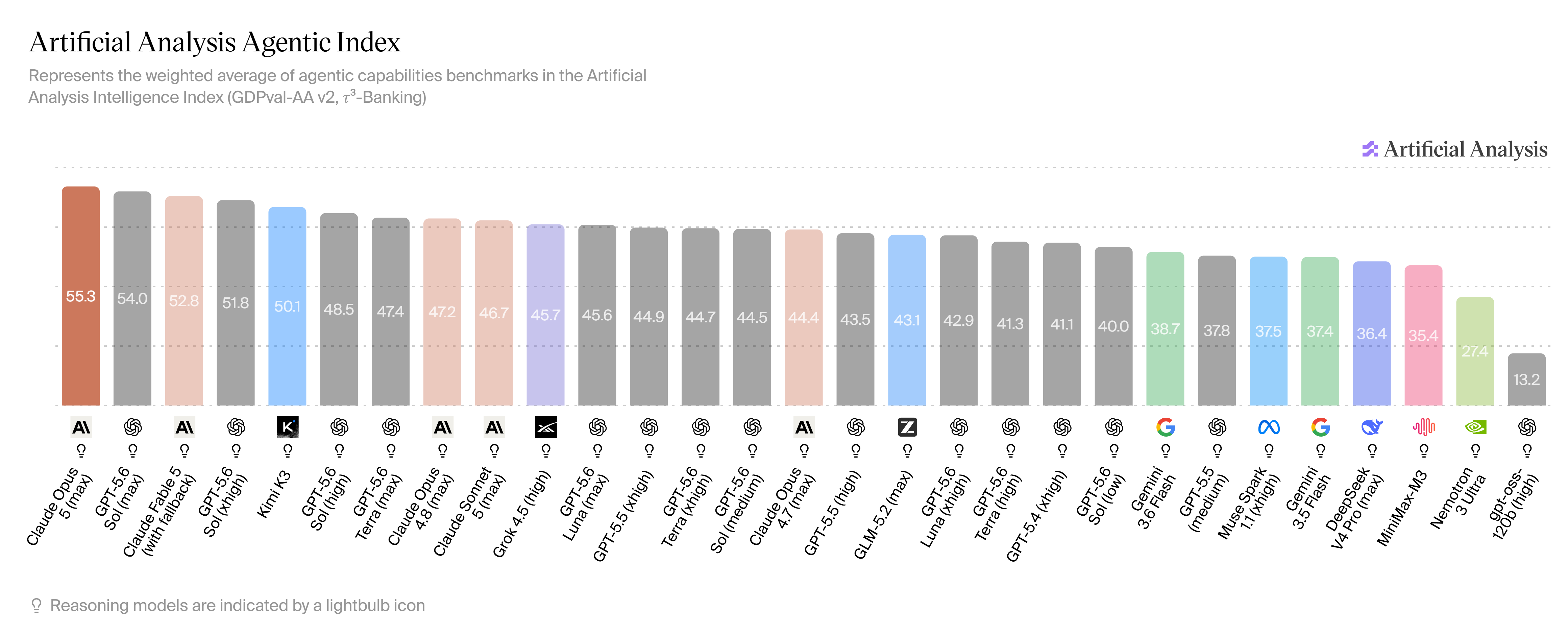
Independent testing backs up Anthropic’s numbers. On July 24, 2026, Artificial Analysis placed Claude Opus 5 at number one on both its Intelligence Index and its Agentic Index, ahead of Fable 5 and GPT-5.6 Sol. That is third-party confirmation rather than a vendor claim, which makes it the strongest single data point in Opus 5’s favor.
Opus 5 scored 61 on the Artificial Analysis Intelligence Index v4.1, one point above Fable 5 at 60 and two above GPT-5.6 Sol at 59. On the Agentic Index, which weights agentic-capability benchmarks, it led with 55.3 against 54.0 for GPT-5.6 Sol and 52.8 for Fable 5. Here is how the top of each leaderboard looks.
| Model | Intelligence Index (v4.1) | Agentic Index |
|---|---|---|
| Claude Opus 5 (max) | 61 (#1) | 55.3 (#1) |
| Claude Fable 5 | 60 | 52.8 |
| GPT-5.6 Sol (max) | 59 | 54.0 |
| Kimi K3 | 57 | 50.1 |
| Claude Opus 4.8 (max) | 56 | 47.2 |
| GPT-5.6 Terra (max) | 55 | 47.4 |
| Grok 4.5 (high) | 54 | 45.7 |
| Claude Sonnet 5 (max) | 53 | 46.7 |
| GLM-5.2 (max) | 51 | 43.1 |
| Gemini 3.6 Flash | 50 | 38.7 |
The jump over the previous flagship is the real story. Opus 5 climbs from Opus 4.8’s 56 to 61 on intelligence and from 47.2 to 55.3 on agentic tasks, all at the same $5 / $25 price. A capability gain that large with no price increase is rare. Those were the launch figures, and they are not comparable to today’s. Artificial Analysis has rebuilt the index twice since, and it no longer publishes a separate Agentic Index at all, having folded those evaluations into the main one. On Intelligence Index v4.3.2, read on September 24, 2026, Opus 5 scores 50.8 at max effort, behind Claude Opus 5.5 at 57.6, Claude Fable 5.1 at 53.4 and GPT-6 Astra at 52.7. The drop from 61 to 50.8 is the index being rescaled, not the model getting worse.
The New Effort Setting and Fast Mode
The standout new feature in Opus 5 is the effort setting. Instead of one fixed level of reasoning, you choose how hard the model works on a given task, which lets you optimize for intelligence on complex jobs or conserve tokens on simple ones. It is the same idea as picking a gear, more power when you need it, less when you do not.
How the effort levels work
The effort setting ranges from low to high, and Anthropic’s benchmark charts also reference a max effort tier used for its strongest results. Low effort answers faster and cheaper, which suits quick lookups, formatting, and routine drafting. High and max effort spend more tokens and time to squeeze out top-tier reasoning, which is where Opus 5 lands within 0.5% of Fable 5 on CursorBench. The practical upshot is that one model now covers both cheap-and-fast and slow-and-brilliant, so you are not paying flagship rates for trivial tasks.
Fast mode and other changes
Separate from effort, fast mode trades money for speed, running about 2.5 times faster at twice the base price. Opus 5 also adds mid-conversation tool changes and automatic API fallbacks, both in beta, which help developers building agentic workflows where tools and models shift mid-task. Anthropic also opened a Cyber Verification Program for enterprises, reflecting the stronger safety guardrails it built into this release.
Claude Opus 5 vs Fable 5 vs Opus 4.8: Which Should You Use?
For most people the answer is simple. If you are on Opus 4.8, moving to Opus 5 is a free upgrade in everything but name, same price, better results across the board. There is no reason to stay on the older model unless you have a workflow tuned to its exact behavior. That advice is now two generations stale. Anthropic shipped a cheaper successor on September 22, 2026, and Claude Opus 5.5 costs 20% less per token than Opus 5 while beating it on every benchmark the company published. Opus 5 went onto the Legacy models list the same day, and Anthropic’s docs now point anyone still on it at a migration guide, so the live question is no longer Opus 4.8 against Opus 5 but whether you have any reason left to run Opus 5 at all.
What Opus 5 was built to be
Opus 5 was the value default, and the shape of that argument is worth keeping because Opus 5.5 inherited it. It handles coding, research, writing, computer use, and agent tasks at close to Fable 5 quality for half the token cost, and the effort setting scales it down cleanly for cheap high-volume jobs, which Fable 5 cannot match on price. Opus 5.5 does the same job for $4/$20, which is why it, and not this model, is the one to reach for now.
Choose the Fable line for the hardest jobs
Anthropic still points to its Fable line for the most advanced projects, especially long-horizon work a model runs autonomously for days. Since September 1, 2026 that means Claude Fable 5.1, which reads 53.4 on Artificial Analysis’s Intelligence Index v4.3.2 against Opus 5’s 50.8, for twice the token price. Opus 5.5 beats both at 57.6 while costing less than either. If you need Anthropic’s long-horizon autonomous line, Fable 5.1 is still the pick it points you to. For everything else the sensible default is Opus 5.5. To see how the broader field compares, our full Gemini model comparison covers how Google’s lineup stacks up on price and performance.

How to Use Claude Opus 5 on Mac
If you subscribe to Claude Pro or Claude Max, the Opus you get in the model picker on Claude.ai, in the Claude desktop app, in Claude Code and in Cowork is now Opus 5.5. Opus 5 itself is a legacy API model, so reaching this exact version means calling it by its model ID, claude-opus-5.
The catch for many Mac users is juggling subscriptions. If you also use GPT-6 and Gemini, paying for three separate apps adds up fast. A multi-model Mac app like Fello AI lets you reach Claude alongside ChatGPT, Gemini, Grok, and more from one native interface, so you can put models head to head with other models on the same prompt without switching tabs or stacking plans.
That side-by-side setup is the fastest way to feel the difference the benchmarks describe. Run the same task through Claude, GPT and Gemini, compare the answers, and pick the winner for your use case. For the current lay of the land, our roundup of the best AI models available right now tracks how these flagships rank each month.
Conclusion
Claude Opus 5 was the clearest value upgrade Anthropic shipped in the middle of 2026. It brought near-Fable 5 intelligence to the Opus price point, topped the independent Artificial Analysis leaderboard on both intelligence and agentic tasks at launch, and introduced the effort setting that finally let one model cover both cheap-and-fast and top-tier work. That effort setting is the part that outlived it, because Opus 5.5 ships the same control at a lower price. As Fortune reported, it comes close to Fable 5’s capabilities at half the price.
If you already pay for Claude Pro or Max, the model to use today is Claude Opus 5.5, with Fable 5.1 in reserve for the heaviest autonomous jobs. If you run several AI models, put Claude next to GPT and Gemini in one Mac app and let your own prompts decide the winner.
FAQ
Is Claude Opus 5 out yet?
Yes. Anthropic released Claude Opus 5 on July 24, 2026. It is still callable on the Claude API, but Anthropic moved it to its legacy models list on September 22, 2026, and the Opus that Claude Pro and Max subscribers reach is now Claude Opus 5.5.
How much does Claude Opus 5 cost?
Claude Opus 5 costs $5 per million input tokens and $25 per million output tokens, the same as Opus 4.8 and about half the price of Fable 5. It keeps that rate on Anthropic’s legacy list, which now makes it more expensive than its own successor, because Claude Opus 5.5 runs at $4 and $20. A fast mode runs roughly 2.5 times faster at twice the base price.
Is Claude Opus 5 better than Fable 5?
Not quite. Opus 5 comes within about 0.5% of Fable 5’s peak coding score at max effort for half the cost per task, but Anthropic still recommends its Fable line for the most advanced, multi-day autonomous work, which since September 1, 2026 means Fable 5.1. Opus 5 was the value pick until September 22, 2026, when Claude Opus 5.5 took that place at a lower price.
Can I use Claude Opus 5 on Mac?
The Opus in the Claude desktop app and Claude.ai on Mac is now Opus 5.5, which comes with Pro or Max. You can also reach it through a multi-model Mac app like Fello AI, which puts Claude alongside ChatGPT, Gemini, and Grok in one native interface.
What is the Claude Opus 5 effort setting?
The effort setting lets you choose how hard Opus 5 works on a task, from low to high, plus a max tier for its strongest results. Lower effort is faster and cheaper for simple jobs, while higher effort spends more tokens to reach top-tier reasoning.