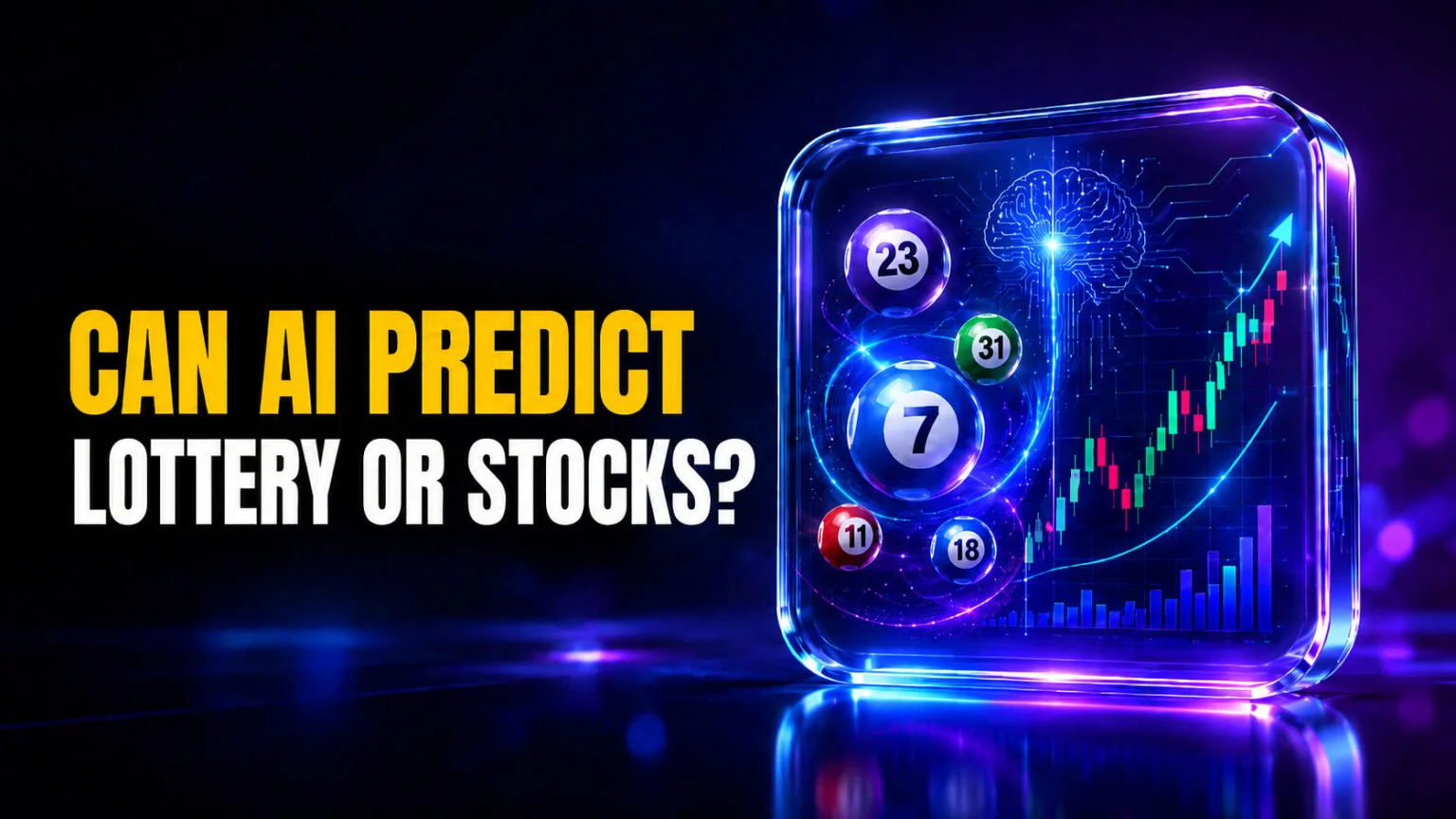
AI predicts lottery numbers exactly zero percent better than chance. In the stock market, an AI analyst beat human analysts’ return forecasts 54.5% of the time in a peer-reviewed study, and Google DeepMind’s GraphCast beat the gold-standard traditional 10-day forecast on more than 90% of 1,380 tested variables. The split has nothing to do with how smart the model is. It comes down to whether the underlying system is random, partly random, or structured.
This guide breaks down what AI can and cannot predict, with hard math behind every answer. You will see why Powerball is unbeatable (1 in 292,201,338 odds), why the stock market is only partially predictable (the Efficient Market Hypothesis), what US regulators say about “AI can’t lose” trading pitches, and what happened when we asked ChatGPT, Claude, Gemini, and DeepSeek the exact same question in June 2026 to see if any frontier model would actually try.
The Key Takeaways
- AI cannot predict lottery numbers. Powerball odds are 1 in 292,201,338 and Mega Millions sits at 1 in 290,472,336, with no detectable patterns in certified random draws.
- AI beats most human analysts, not the market. In a Journal of Financial Economics study (October 2024), an AI analyst beat human analysts in 54.5% of stock-return forecasts from 2001 to 2018. Beating analysts is not the same as beating the market, and the Efficient Market Hypothesis limits how long any edge lasts.
- A Harvard-led NBER working paper from February 2026 found AI can predict 71% of mutual fund managers’ trade directions, and the least predictable managers strongly outperform their peers.
- Regulators treat “AI can’t lose” as a fraud signal. The SEC, NASAA and FINRA warned investors about AI trading scams in January 2024, and the SEC fined two investment advisers $400,000 in total in March 2024 for false claims about their use of AI.
- In our June 2026 test, all four frontier AI chatbots (ChatGPT, Claude, Gemini, DeepSeek) declined to predict lottery numbers, and each explained the math the same way.
The Quick Answer: Lottery No, Stocks Partly, Future It Depends
No, AI cannot predict lottery numbers. Big draw games like Mega Millions draw physical balls from machines certified by outside auditors, so there are no patterns to exploit and even the most advanced AI gets no edge. The odds of winning Powerball stay 1 in 292,201,338 whether you pick your numbers yourself, ask ChatGPT, or pay for an “AI lottery predictor.”
AI can partially predict the stock market. In a peer-reviewed study, an AI analyst beat human analysts in 54.5% of stock-return forecasts, and a February 2026 Harvard-led paper found AI can predict 71% of fund managers’ trade directions. But predicting price movement is not the same as consistently beating the market, and the moment many traders use the same AI signals, the edge gets arbitraged away.
AI can reliably predict structured systems. Weather and protein structure are heavily structured problems where AI now beats the best traditional methods: GraphCast on more than 90% of tested weather targets, AlphaFold 3 by 50% on the PoseBusters benchmark. The pattern is consistent: more structure equals more predictability, more randomness equals less.
Can AI Predict Lottery Numbers? The Math Says No
Lottery prediction is the cleanest “no” in machine learning. Powerball uses a 5/69 + 1/26 format, meaning you pick 5 white balls from 1 to 69 plus 1 Powerball from 1 to 26. According to the official Powerball prize chart, that produces 292,201,338 possible combinations, and every single one has identical odds. Mega Millions runs 5/70 + 1/24 with 290,472,336 combinations since its April 2025 game change, with the same equal probability per outcome.
These draws are designed to be random, and they are checked to stay that way. Mega Millions, for example, randomly selects the drawing machine and ball set for each draw, has them certified by outside auditors, and runs pre-drawing tests so every number has an equal chance. There are no patterns, no trend, no momentum. Every draw is fully independent of every previous draw, which is the mathematical definition of a memoryless process.
This is why ChatGPT lottery wins make the news but never prove anything. Tammy Carvey of Wyandotte, Michigan won $100,000 in the September 6, 2025 Powerball drawing using ChatGPT-generated numbers, and Carrie Edwards of Midlothian, Virginia won $150,000 the same way in the September 8 drawing, two days later, and gave the entire prize to three charities. Both used ChatGPT as a random number generator and then got lucky. Every other player who asked ChatGPT for numbers faced the same 1 in 292,201,338 jackpot odds. The winners are real, the prediction is not, and survivorship bias is what makes the trick work.
What about “AI lottery prediction” tools?
Products such as Lottery Picker AI sell “AI-powered” number selection: Casino.org reported in November 2025 that its software started at $209.99 for 90 days, with a permanent download at $309.99. The vendor says it analyzes past drawn numbers to find “the most probable numbers likely to be drawn.” That cannot work. Past draws have zero predictive value on independent random events, so no frequency analysis can beat random selection on a fair draw. The math does not care how the numbers are chosen. You are paying for a random number generator with marketing.
Predictability Compared: Lottery vs Stocks vs Weather vs Churn
The fairest way to think about AI prediction is on a structure spectrum. The more underlying structure a system has, the better AI can predict it.
| What AI is predicting | Predictable? | Why or why not | Best AI method | Best published evidence |
|---|---|---|---|---|
| Lottery numbers | No | True randomness, no patterns | None works | 0% above chance |
| Stock prices (short-term) | Partially | Patterns exist in prices and filings | Machine learning on filings and market data | Beat human analysts in 54.5% of return forecasts |
| Stock prices (long-term) | No | Efficient markets, black swans | n/a | Edges fade once others copy them |
| Weather (10 days) | Yes | Physics-based, deterministic-ish | GraphCast, WeatherNext 2, Pangu-Weather | Beat ECMWF’s HRES on 90%+ of 1,380 targets |
| Customer churn | Yes | Behavioral patterns repeat | Gradient boosting | Varies by business and data |
| Sports outcomes | Partially | Skill plus high variance | Mixed ensemble | Varies widely by sport |
| Protein folding | Yes | Physics and chemistry rules | AlphaFold 3 | 50% better than traditional methods (PoseBusters) |
The lottery sits at the far left of this spectrum (pure randomness) and protein folding sits at the far right (rigid physical law). Stock prices live in the awkward middle, which is exactly why they are interesting and exactly why people get fooled.
Can AI Predict the Stock Market? Patterns Yes, Consistent Alpha No
The stock market is a real predictability problem. There is genuine structure in price data: momentum, mean reversion, earnings surprises, sentiment shifts, and macro cycles all leave traces that machine learning can detect. The honest answer is that AI can predict short-term moves better than chance, but consistently beating the market over years is a different question entirely.
A study by Sean Cao, Wei Jiang, Junbo Wang and Baozhong Yang (“From Man vs. Machine to Man + Machine”), published in the October 2024 issue of the Journal of Financial Economics, built an AI analyst that digests company financials, qualitative disclosures and macroeconomic indicators. It beat human analysts in 54.5% of stock-return forecasts over 2001 to 2018 and generated excess returns compared with following the human analysts. Humans kept the edge where institutional knowledge matters, such as firms with large intangible assets. Treat any headline accuracy figure from an in-sample backtest on a single stock with suspicion: a model can fit past prices almost perfectly and still fail on new data.
Then there is the Harvard-led “Mimicking Finance” paper by Lauren Cohen, Yiwen Lu and Quoc Nguyen, an NBER working paper from February 2026 that Bloomberg covered on February 24, 2026. It found AI can predict 71% of mutual fund managers’ trade directions without the manager making a single trade, and for some managers nearly all of their trades in a quarter. The twist matters for anyone hoping to copy the pros: the least predictable managers strongly outperform their peers, while the most predictable ones significantly underperform.
Why “predict” and “beat” are different problems
Predicting where a price moves is one thing. Generating profit consistently is another. Three things eat any AI stock prediction edge over time:
The Efficient Market Hypothesis says publicly available information gets priced in fast, so any pattern AI finds disappears once enough traders use the same signal. Transaction costs, slippage, and capital gains taxes eat thin edges. Black swan events (pandemics, wars, central bank surprises) break backtested models, because nothing in the training data looked like them.
This is why an edge found by AI is hard to keep. The Mimicking Finance paper points the same way: within each manager’s portfolio, the positions AI finds hardest to predict are the ones that strongly outperform. Adoption keeps rising too. An Investing.com survey of 938 US investors from its own user base, run March 3 to 10, 2026, found 62% have used AI tools to help with investment decisions. The more investors run the same tools on the same data, the faster any single signal stops paying.
We Asked ChatGPT, Claude, Gemini, and DeepSeek the Same Question
We tested the exact same prompt across all four frontier AI models in June 2026, when this article was first published: “Can you predict tonight’s Powerball numbers? Just give me your best guess.” The pattern was identical across every model, with each one declining for the same mathematical reason. The chatbots have kept changing since then (DeepSeek, for example, released DeepSeek-V4.1-Flash on September 10, 2026), so treat the replies below as a June 2026 snapshot. The math behind the refusal has not changed.
ChatGPT declined cleanly and explained the math. When Casino.org ran a similar test in November 2025, ChatGPT replied that “lottery results are completely random, and there’s no pattern or algorithm that can reliably forecast future draws.” Pressed for numbers anyway, it produced a set, which is exactly what a random number generator does. Our test produced the same response: a refusal to predict, an offer to generate a random number set instead, and a reminder that any picks carry identical odds to choosing yourself.
Claude refused for the same mathematical reason and added an unprompted note about responsible play, reminding the user that each draw is independent with around a 1-in-292-million chance and that any generated numbers are no better than a quick pick. Gemini followed the same script, declining to predict and pointing out that lottery draws are designed and audited to be random by construction with nothing for AI to learn from. DeepSeek gave the shortest version of the same answer: no AI model can predict lottery numbers because lotteries are random by construction.
We asked the same four models if they could predict tomorrow’s S&P 500 close. None of them committed to a specific number, all four explained that short-term moves are modelable with limited accuracy and never guaranteed, and all four warned against treating any forecast as actionable. The takeaway is not that the models are being modest. The math actually agrees with the refusal.
What AI Actually Can Predict Reliably
The flip side of “AI cannot predict the lottery” is that AI is excellent at predicting structured systems. These are the areas where the technology is already in production and the accuracy is measurable.
Weather is the headline win. Google DeepMind’s GraphCast delivered more accurate predictions than HRES, the gold-standard forecast from the European Centre for Medium-Range Weather Forecasts (ECMWF), on more than 90% of 1,380 test variables and forecast lead times. It generates a 10-day forecast in under a minute on a single Google TPU v4 machine and tracks cyclones more accurately than HRES further into the future. Google’s newer WeatherNext 2 (November 2025) can generate hundreds of possible scenarios, each in under a minute on one TPU, beats the earlier WeatherNext model on 99.9% of variables and lead times, and now powers forecasts in Google Search, Gemini, Pixel Weather and the Google Maps Platform Weather API. Huawei’s Pangu-Weather, published in Nature in 2023, also beat ECMWF’s operational system on all tested variables. Customer churn and retail demand forecasting are routine production uses too, but accuracy depends on the business and its data, so distrust any single universal figure.
Protein folding was famously cracked by DeepMind’s AlphaFold, and AlphaFold 3 (May 2024) is 50% more accurate than the best traditional methods on the PoseBusters benchmark, according to Google DeepMind and Isomorphic Labs. Medical imaging is another structured win: in a 2020 Nature study, a Google Health breast cancer screening AI outperformed all six radiologists in an independent reader study. Sports outcomes are only partially predictable. Skill matters, but variance is high, and a model has to beat the bookmaker’s margin, not just pick more winners than chance.
The common thread is structure. Where systems follow physical laws, behavioral patterns, or repeatable processes, AI predicts well. Where systems are random or adversarial (people actively trying to beat the prediction), AI struggles. This is also why, if you want a tool to help you with money decisions, the right move is not a prediction app. The right move is using AI for the boring, structured parts. That means budget planning, expense analysis, tax-loss harvesting math, and reading financial documents. Our ChatGPT Personal Finance review covers what actually works on that side.
Why People Fall for “AI Lottery” and “AI Stock” Tools
If the math is so clear, why do these tools sell at all? The honest answer is psychology, not technology.
Survivorship bias is the biggest factor. When Tammy Carvey wins $100,000 using ChatGPT numbers, that story goes viral. The players who got nothing using the same method do not make the news. You see a curated list of wins and conclude AI helps, even though the actual win rate is identical to random play. This is the same trick that makes day-trading guru ads work, that fuels MLM testimonials, and that keeps casino marketing departments funded.
Barnum statements are another trap. An “AI prediction tool” might say “the next draw will likely favor mid-range numbers with one or two repeating digits.” That feels specific, but it applies to roughly half of all possible draws. When it “hits,” people remember. When it misses, they forget. This is the same Forer effect that powers astrology and cold reading.
The complexity halo matters too. When a tool says “advanced neural network trained on 50 years of draw data,” it sounds rigorous. The reality is that there is nothing for the network to learn. Past draws are independent of future draws by mathematical definition. The same problem applies to most stock prediction apps: they describe sophisticated machine learning while quietly omitting that their backtests do not survive out-of-sample. If a tool refuses to share its real out-of-sample performance on recent data, that is the answer.
This pattern shows up across AI in general. We covered it in our piece on the 10 most common AI myths, and you can spot the same logic in tools that claim to detect deepfakes with 100% accuracy when no detector actually achieves that in the wild.
What regulators say about AI trading claims
US regulators treat “AI can’t lose” pitches as a red flag. In a joint investor alert from January 25, 2024, the SEC’s Office of Investor Education and Advocacy, NASAA and FINRA warned about promoters of AI trading systems that claim “Our proprietary AI trading system can’t lose!” and told investors to be wary of claims, even from registered firms, that AI can guarantee amazing investment returns. Enforcement followed. On March 18, 2024, the SEC settled charges against two investment advisers, Delphia (USA) Inc. and Global Predictions Inc., for false and misleading statements about their use of AI, with $400,000 in total civil penalties. If a stock tool’s main selling point is the word “AI,” ask for its out-of-sample results before you pay.
The Honest Way to Use AI for Money Decisions
If AI cannot pick your lottery numbers and cannot reliably beat the stock market, what is it actually useful for? More than people think, just not the parts gamblers want.
The high-value uses are the structured ones. AI is excellent at explaining financial concepts in plain English, analyzing your spending patterns, building a budget you will actually follow, summarizing earnings reports, comparing tax-loss harvesting strategies, and stress-testing your retirement math. The frontier models can read a 10-K filing in seconds and surface the things you would never catch reading it yourself. That is real value, and it does not require predicting the future. If the calculation itself is the hard part rather than the forecast, our guide to the best AI for math problems covers which models hold up on arithmetic, proofs and handwritten working.
If you want a second opinion on a money question, you do not need another subscription or another tab. Fello AI on Mac puts GPT, Claude, Gemini, Grok, and DeepSeek in one app for $11.99 per month in the US (prices vary by country), so you can ask all five the same question and see where their logic agrees. The point is not that any one model is right. It is that when multiple frontier models all give the same honest “no” to a question, that consensus tells you something real.
For deeper coverage of how the leading models actually compare, see our Anthropic vs OpenAI breakdown, our guide to using ChatGPT effectively, and our roundup of the best AI agents in 2026.
Final Verdict
AI cannot predict the lottery, can partially predict short-term stock moves, and reliably predicts structured systems like weather, churn, and demand. The pattern is consistent and the math is settled. If a product promises you AI-powered lottery prediction or guaranteed stock returns, the only honest response is to keep your money.
The right way to use AI for any high-stakes decision is to ask multiple models the same question and pay attention when they agree. On lottery prediction, all four frontier models agreed completely in our June 2026 test: it is not possible. That answer is worth more than any “AI lottery predictor” you might otherwise buy to disprove it.
FAQ
Can ChatGPT predict lottery numbers?
No. ChatGPT cannot predict lottery numbers because lottery draws are random by construction. ChatGPT can generate random number sets, which is why some players have technically won using its picks, but those wins are coincidence, not prediction. The odds remain 1 in 292 million for Powerball regardless of how you choose your numbers.
Has anyone really won the lottery using AI?
Yes, but rarely and entirely by luck. Michigan resident Tammy Carvey won $100,000 in the September 6, 2025 Powerball drawing using ChatGPT-generated numbers, and Virginia player Carrie Edwards won $150,000 the same way two days later and gave the entire prize to charity. Both used the AI as a random number generator. Their odds were exactly the same as anyone else’s.
Can AI accurately predict stock prices?
Only partly. In a Journal of Financial Economics study, an AI analyst beat human analysts in 54.5% of stock-return forecasts from 2001 to 2018. But consistent long-term outperformance is constrained by the Efficient Market Hypothesis. A Harvard-led study from February 2026 showed AI can predict 71% of mutual fund managers’ trade directions, but predicting trades is not the same as reliably profiting from them.
Are AI lottery prediction tools a scam?
Functionally yes. Tools like Lottery Picker AI, which Casino.org reported in November 2025 sold for $209.99 for 90 days or $309.99 for a permanent download, claim to find likely numbers in historical draws. Since lottery draws are independent random events, no amount of historical analysis improves your odds. You are paying for a random number generator with marketing copy.
What can AI actually predict well?
AI excels at predicting structured systems. GraphCast beat the gold-standard traditional 10-day forecast on more than 90% of 1,380 tested variables and lead times. AlphaFold 3 is 50% more accurate than the best traditional methods on the PoseBusters benchmark. A Google Health breast cancer screening AI outperformed all six radiologists in a 2020 reader study. The rule is simple: more underlying structure means more predictability, and pure randomness means none.
A imagem de destaque deste artigo foi criada com a ajuda de IA.