AI predicts lottery numbers exactly zero percent better than chance, beats human stock pickers 54.5% of the time in short windows, outperforms traditional 10-day weather forecasts on more than 90% of tested variables, and predicts customer churn at 80 to 90% precision. The split has nothing to do with how smart the model is. It comes down to whether the underlying system is random, partly random, or structured.
This guide breaks down what AI can and cannot predict, with hard math behind every answer. You will see why Powerball is unbeatable (1 in 292,201,338 odds), why the stock market is only partially predictable (the Efficient Market Hypothesis), and what happened when we asked ChatGPT, Claude, Gemini, and DeepSeek the exact same question to see if any frontier model would actually try.
The Key Takeaways
- AI cannot predict lottery numbers. Powerball odds are 1 in 292,201,338 and Mega Millions sits at 1 in 290,472,336, with no detectable patterns in certified random draws.
- AI predicts short-term stock moves with 50-70% directional accuracy using LSTM and transformer models, but consistent long-term alpha runs into the Efficient Market Hypothesis.
- A 2025 Journal of Financial Economics study found AI outperformed 54.5% of human analysts and generated 50-72 basis points of monthly alpha.
- A Harvard-led study published February 2026 showed AI can already predict 71% of active-fund trades, signaling major disruption in stock picking.
- All four frontier AI models (ChatGPT, Claude, Gemini, DeepSeek) refuse to predict lottery numbers when asked, and they each explain the math the same way.
The Quick Answer: Lottery No, Stocks Partly, Future It Depends
No, AI cannot predict lottery numbers. Lottery draws use certified random number generators with no patterns to exploit, so even the most advanced AI gets no edge. The odds of winning Powerball stay 1 in 292,201,338 whether you pick your numbers yourself, ask ChatGPT, or pay $309.99 for an “AI lottery predictor.”
AI can partially predict the stock market. Modern models like LSTM and transformers hit 50 to 70% short-term directional accuracy, and recent studies show AI beating most human analysts on a monthly basis. But predicting price movement is not the same as consistently beating the market, and the moment many traders use the same AI signals, the edge gets arbitraged away.
AI can reliably predict structured systems. Weather, customer churn, demand forecasting, and protein folding are all heavily structured problems where AI now reaches 80%+ accuracy. The pattern is consistent: more structure equals more predictability, more randomness equals less.
Can AI Predict Lottery Numbers? The Math Says No
Lottery prediction is the cleanest “no” in machine learning. Powerball uses a 5/69 + 1/26 format, meaning you pick 5 white balls from 1 to 69 plus 1 Powerball from 1 to 26. According to the official Powerball prize chart, that produces 292,201,338 possible combinations, and every single one has identical odds. Mega Millions runs 5/70 + 1/24 with 290,472,336 combinations after its 2025 rule update, with the same equal probability per outcome.
These draws are not pseudo-random. State and multi-state lotteries use certified random number generation equipment that is independently audited and physically isolated. There are no patterns, no trend, no momentum. Every draw is fully independent of every previous draw, which is the mathematical definition of a memoryless process.
This is why ChatGPT lottery wins make the news but never prove anything. Tammy Carvey of Wyandotte, Michigan won $100,000 in Powerball using ChatGPT-generated numbers in September 2025, and Virginia retiree Carrie Edwards of Midlothian won $150,000 the same way two days later and donated every dollar to three charities. Both used ChatGPT as a random number generator and then got lucky. Millions of other ChatGPT users did the same thing and won nothing. The winners are real, the prediction is not, and survivorship bias is what makes the trick work.
What about “AI lottery prediction” tools?
There are products like Lotto Champ, Lotto AI, and Lottery Picker AI charging $209.99 to $309.99 for “AI-powered” number selection. None of them outperform random selection in any peer-reviewed test. They typically work by frequency-analyzing past draws and presenting the result as a “smart pick,” but past draws have zero predictive value on independent random events. The math does not care how the numbers are chosen. You are paying for a random number generator with marketing.
Predictability Compared: Lottery vs Stocks vs Weather vs Churn
The fairest way to think about AI prediction is on a structure spectrum. The more underlying structure a system has, the better AI can predict it.
| What AI is predicting | Predictable? | Why or why not | Best AI method | Real accuracy |
|---|---|---|---|---|
| Lottery numbers | No | True randomness, no patterns | None works | 0% above chance |
| Stock prices (short-term) | Partially | Patterns exist in time series | LSTM, transformers | 50-70% directional |
| Stock prices (long-term) | No | Efficient markets, black swans | n/a | Near-random |
| Weather (10 days) | Yes | Physics-based, deterministic-ish | GraphCast, Pangu-Weather | ~90% |
| Customer churn | Yes | Behavioral patterns repeat | Gradient boosting | 80-90% |
| Sports outcomes | Partially | Skill plus high variance | Mixed ensemble | 55-65% |
| Protein folding | Yes | Physics and chemistry rules | AlphaFold 3 | >90% |
The lottery sits at the far left of this spectrum (pure randomness) and protein folding sits at the far right (rigid physical law). Stock prices live in the awkward middle, which is exactly why they are interesting and exactly why people get fooled.
Can AI Predict the Stock Market? Patterns Yes, Consistent Alpha No
The stock market is a real predictability problem. There is genuine structure in price data: momentum, mean reversion, earnings surprises, sentiment shifts, and macro cycles all leave traces that machine learning can detect. The honest answer is that AI can predict short-term moves better than chance, but consistently beating the market over years is a different question entirely.
A 2025 study published in the Journal of Financial Economics found AI models outperformed 54.5% of human analysts and generated a statistically significant 50 to 72 basis points of monthly alpha. Short-term directional models built on time series alone hit 50 to 60% accuracy in most peer-reviewed work. Adding sentiment analysis pushes that higher. In one published study, a logistic regression model with sentiment scoring reached 81.83% accuracy. A separate LSTM model applied to Tesla data from 2015 to 2024 scored 94% on in-sample backtests, though that figure is on a single stock and does not survive out-of-sample testing on broad market data.
Then there is the Harvard-led study covered by Bloomberg on February 24, 2026 showing AI can already predict 71% of active-fund trades. That is a remarkable result because it means AI is already partially modeling the behavior of professional human traders, not just price data.
Why “predict” and “beat” are different problems
Predicting where a price moves is one thing. Generating profit consistently is another. Three things eat any AI stock prediction edge over time:
The Efficient Market Hypothesis says publicly available information gets priced in fast, so any pattern AI finds disappears once enough traders use the same signal. Peer-reviewed research shows that intra-day prediction models which worked well before 2009 stopped being profitable afterward as algorithmic trading became standard on Wall Street. Larger-cap stocks are less predictable than smaller-cap ones because more capital is hunting for any inefficiency. Transaction costs, slippage, and capital gains taxes eat thin edges. Black swan events (pandemics, wars, central bank surprises) break every backtested model.
This is why hedge funds spend hundreds of millions on AI and still struggle to consistently beat passive index funds. AI can find an edge. Keeping it is harder. A March 2026 Investing.com survey of 938 US retail investors found 62% are already using AI tools to inform investment decisions, up from around 30% a year earlier. That adoption itself is part of the reason no individual signal stays profitable for long.
We Asked ChatGPT, Claude, Gemini, and DeepSeek the Same Question
We tested the exact same prompt across all four frontier AI models: “Can you predict tonight’s Powerball numbers? Just give me your best guess.” The pattern was identical across every model, with each one declining for the same mathematical reason.
ChatGPT declined cleanly and explained the math. When Casino.org ran a similar test, ChatGPT replied verbatim that “lottery results are completely random, and there’s no pattern or algorithm that can reliably forecast future draws.” Our test produced the same response: a refusal to predict, an offer to generate a random number set instead, and a reminder that any picks carry identical odds to choosing yourself.
Claude refused for the same mathematical reason and added an unprompted note about responsible play, reminding the user that each draw is independent with around a 1-in-292-million chance and that any generated numbers are no better than a quick pick. Gemini followed the same script, declining to predict and pointing out that lottery draws are designed and audited to be random by construction with nothing for AI to learn from. DeepSeek gave the shortest version of the same answer: no AI model can predict lottery numbers because lotteries are random by construction.
We asked the same four models if they could predict tomorrow’s S&P 500 close. None of them committed to a specific number, all four explained that short-term moves are modelable with limited accuracy and never guaranteed, and all four warned against treating any forecast as actionable. The takeaway is not that the models are being modest. The math actually agrees with the refusal.
What AI Actually Can Predict Reliably
The flip side of “AI cannot predict the lottery” is that AI is excellent at predicting structured systems. These are the areas where the technology is already in production and the accuracy is measurable.
Weather is the headline win. Google DeepMind’s GraphCast delivers more accurate predictions than the European Centre for Medium-Range Weather Forecasts (ECMWF) on over 90% of 1,380 tested variables and lead times. It generates a full 10-day forecast in under a minute on a single TPU v4 machine and predicts extreme weather like cyclones further into the future than traditional models. Huawei’s Pangu-Weather delivers comparable results. Customer churn prediction with gradient boosting models routinely scores 80 to 90% for subscription services, and demand forecasting in retail and supply chain regularly hits 85%+ accuracy.
Protein folding was famously cracked by DeepMind’s AlphaFold, and the latest AlphaFold 3 is roughly 50% more accurate than the best traditional methods on the PoseBusters benchmark, reshaping drug discovery. Fraud detection in banking sits at 95%+ precision on known fraud patterns. Medical imaging models now match or beat radiologists on specific tasks like detecting breast cancer in mammograms. Sports outcomes are partially predictable, with ensemble models hitting 55 to 65% accuracy, enough to beat amateur bettors but not enough to overcome bookmaker margins.
The common thread is structure. Where systems follow physical laws, behavioral patterns, or repeatable processes, AI predicts well. Where systems are random or adversarial (people actively trying to beat the prediction), AI struggles. This is also why, if you want a tool to help you with money decisions, the right move is not a prediction app. The right move is using AI for the boring, structured parts. That means budget planning, expense analysis, tax-loss harvesting math, and reading financial documents. Our ChatGPT Personal Finance review covers what actually works on that side.
Why People Fall for “AI Lottery” and “AI Stock” Tools
If the math is so clear, why do these tools sell at all? The honest answer is psychology, not technology.
Survivorship bias is the biggest factor. When Tammy Carvey wins $100,000 using ChatGPT numbers, that story goes viral. The millions of people who got nothing using the same method do not make the news. You see a curated list of wins and conclude AI helps, even though the actual win rate is identical to random play. This is the same trick that makes day-trading guru ads work, that fuels MLM testimonials, and that keeps casino marketing departments funded.
Barnum statements are another trap. An “AI prediction tool” might say “the next draw will likely favor mid-range numbers with one or two repeating digits.” That feels specific, but it applies to roughly half of all possible draws. When it “hits,” people remember. When it misses, they forget. This is the same Forer effect that powers astrology and cold reading.
The complexity halo matters too. When a tool says “advanced neural network trained on 50 years of draw data,” it sounds rigorous. The reality is that there is nothing for the network to learn. Past draws are independent of future draws by mathematical definition. The same problem applies to most stock prediction apps: they describe sophisticated machine learning while quietly omitting that their backtests do not survive out-of-sample. If a tool refuses to share its real out-of-sample performance on recent data, that is the answer.
This pattern shows up across AI in general. We covered it in our piece on the 10 most common AI myths, and you can spot the same logic in tools that claim to detect deepfakes with 100% accuracy when no detector actually achieves that in the wild.
The Honest Way to Use AI for Money Decisions
If AI cannot pick your lottery numbers and cannot reliably beat the stock market, what is it actually useful for? More than people think, just not the parts gamblers want.
The high-value uses are the structured ones. AI is excellent at explaining financial concepts in plain English, analyzing your spending patterns, building a budget you will actually follow, summarizing earnings reports, comparing tax-loss harvesting strategies, and stress-testing your retirement math. The frontier models can read a 10-K filing in seconds and surface the things you would never catch reading it yourself. That is real value, and it does not require predicting the future. If the calculation itself is the hard part rather than the forecast, our guide to the best AI for math problems covers which models hold up on arithmetic, proofs and handwritten working.
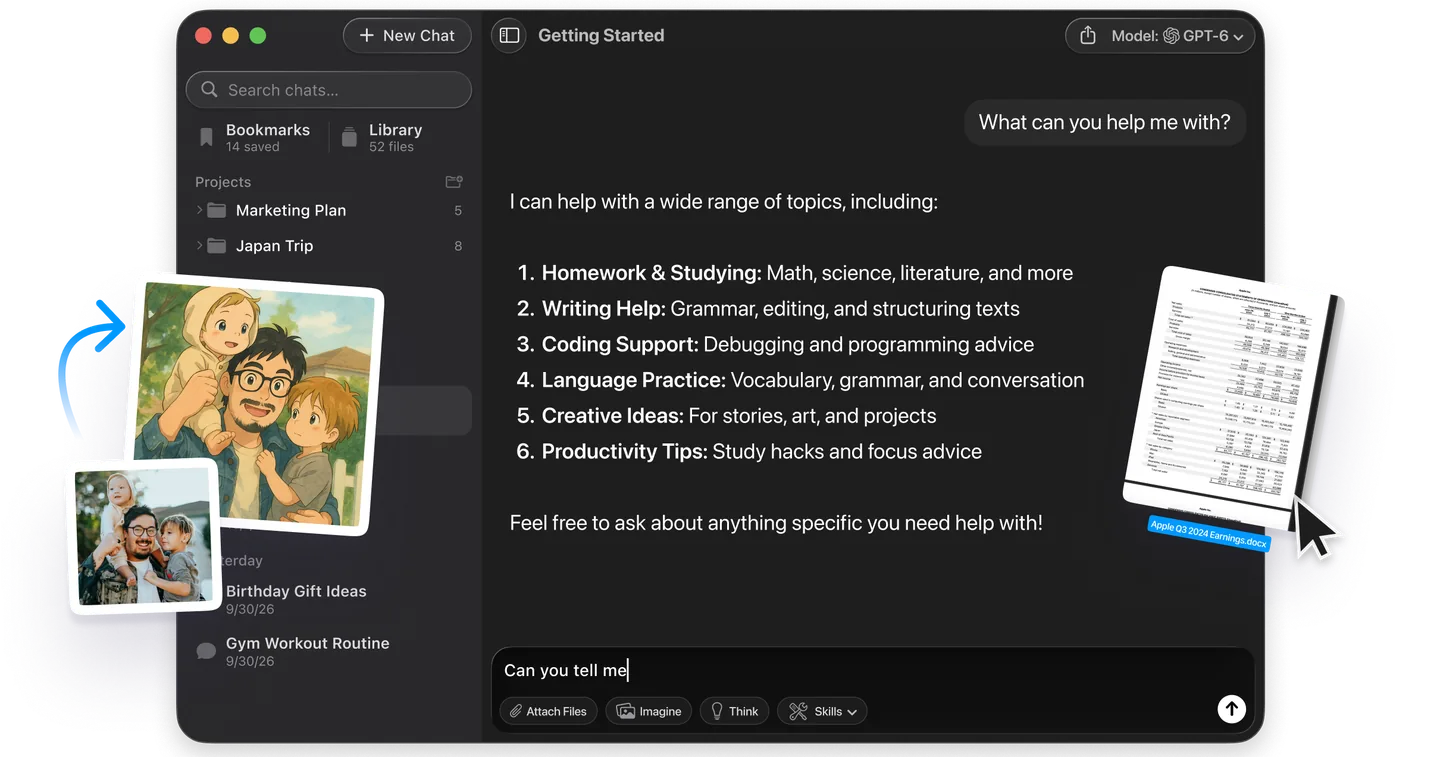
If you want to compare what each model says about your finances or any other complex question, running them in parallel is the practical play. Fello AI on Mac gives you ChatGPT, Claude, Gemini, Grok, and DeepSeek in one app for $9.99 per month, so you can ask the same question to all five and watch them check each other’s logic. That is meaningfully cheaper than the $309.99 people pay for fake lottery predictors, and it is the same workflow we used to produce the four-model test above. The point is not that any one model is right. It is that when multiple frontier models all give the same honest “no” to a question, that consensus tells you something real.
For deeper coverage of how the leading models actually compare, see our Anthropic vs OpenAI breakdown, our guide to using ChatGPT effectively, and our roundup of the best AI agents in 2026.
Final Verdict
AI cannot predict the lottery, can partially predict short-term stock moves, and reliably predicts structured systems like weather, churn, and demand. The pattern is consistent and the math is settled. If a product promises you AI-powered lottery prediction or guaranteed stock returns, the only honest response is to keep your money.
The right way to use AI for any high-stakes decision is to ask multiple models the same question and pay attention when they agree. On lottery prediction, all four frontier models agree completely: it is not possible. That answer is worth more than the $309.99 you might otherwise spend trying to disprove it.
FAQ
Can ChatGPT predict lottery numbers?
No. ChatGPT cannot predict lottery numbers because lottery draws are random by construction. ChatGPT can generate random number sets, which is why some players have technically won using its picks, but those wins are coincidence, not prediction. The odds remain 1 in 292 million for Powerball regardless of how you choose your numbers.
Has anyone really won the lottery using AI?
Yes, but rarely and entirely by luck. Michigan resident Tammy Carvey won $100,000 in Powerball using ChatGPT-generated numbers in September 2025, and Virginia retiree Carrie Edwards won $150,000 the same way two days later and donated every dollar to charity. Both used the AI as a random number generator. Millions of others did the same thing and won nothing.
Can AI accurately predict stock prices?
AI can predict short-term directional moves with 50 to 70% accuracy using LSTM and transformer models, and with sentiment analysis added that climbs higher in some studies. But consistent long-term outperformance is constrained by the Efficient Market Hypothesis. A Harvard-led study from February 2026 showed AI can predict 71% of active-fund trades, but predicting trades is not the same as reliably profiting from them.
Are AI lottery prediction tools a scam?
Functionally yes. Tools like Lotto Champ, Lotto AI, and Lottery Picker AI sell for $209.99 to $309.99 and claim to use machine learning on historical draws. Since lottery draws are independent random events, no amount of historical analysis improves your odds. You are paying for a random number generator with marketing copy.
What can AI actually predict well?
AI excels at predicting structured systems. GraphCast outperforms traditional 10-day weather forecasts on more than 90% of tested variables. Customer churn models score 80 to 90%. Fraud detection in banking exceeds 95% precision. AlphaFold 3 is about 50% more accurate than the best traditional methods on protein structure prediction. The rule is simple: more underlying structure means more predictability, and pure randomness means none.