Every Microsoft Copilot vs Gemini comparison you will find today prices them as business seats, roughly $18 per user against $14 per user, and then tells you to pick whichever suite your employer already runs. Almost nobody reading this buys either one that way. As consumer subscriptions the numbers look different and the conclusion flips twice. Google is the cheaper way in, at $4.99 a month against a Microsoft entry plan that works out at about $8.33. At the top of the two consumer ladders it reverses: Microsoft 365 Premium at $199.99 a year is around $16.67 a month, where Google AI Pro asks $19.99.
This comparison uses the prices on Google's and Microsoft's own subscription pages, checked on 10 September 2026. It covers what each tier actually costs, what the free versions still do, what Microsoft quietly stopped telling you about its usage limits, and the part no other comparison covers at all: what happens when you put both of these on a Mac. That last section matters more than it sounds, because both apps claim the same keyboard shortcut.
The Key Takeaways
- Google is cheaper to start, Microsoft is cheaper at the top: Google AI Plus is $4.99/month against about $8.33 for Microsoft 365 Personal. But Microsoft 365 Premium works out at roughly $16.67/month, undercutting Google AI Pro at $19.99.
- Sharing a Microsoft family plan does not share the AI: Microsoft states that AI features on Family and Premium plans are "only available to the subscription owner and cannot be shared with others". Google publishes no equivalent restriction and Google AI Plus supports family sharing for up to six people.
- Microsoft stopped publishing its consumer limits as numbers. Its support page now lists only "Standard usage", "More usage" and "Highest usage" instead of credits and minutes.
- Gemini has the better Mac app, with a catch: it runs only on Apple Silicon and needs macOS Sequoia 15 or later. Copilot's Mac app works back to macOS 14 but cannot do Copilot Pages or Deep Research.
- Install both and they fight: Gemini for Mac and Copilot for Mac both open on Option + Space. One of them has to be reassigned.
Microsoft Copilot vs Gemini: The Short Answer
Neither of these is really chosen on merit. They are bought as a side effect of something else you already pay for, which is why the honest answer starts with your existing subscription rather than with a benchmark score.
| Microsoft Copilot | Google Gemini | ChatGPT (for reference) | |
|---|---|---|---|
| Cheapest paid tier | $99.99/yr, about $8.33/mo (365 Personal) | $4.99/mo (Google AI Plus) | $8/mo (Go) |
| Top consumer tier | $199.99/yr, about $16.67/mo (365 Premium) | $19.99/mo (Google AI Pro) | $100, $200 or $500/mo (Pro) |
| Free tier | Yes, web and app chat | Yes, Auto from Oct 9 (mostly Flash-Lite) | Yes |
| Shared on family plans | No, owner only | Family sharing for up to six on AI Plus | No family plan |
| Lives inside | Word, Excel, Outlook, PowerPoint, Teams, Windows | Gmail, Docs, Sheets, Slides, Meet, Chrome, Android | Its own apps |
| Native Mac app | Yes | Yes | Yes |
| Mac requirement | macOS 14 or later | Apple Silicon only, macOS 15+ | macOS 14 or later |
| Mac shortcut | Option + Space | Option + Space | Option + Space |
| Buy it if | You already pay for Microsoft 365 | You already live in Gmail and Docs | You want the assistant, not the suite |
Read that bottom row again. All three of these apps ship with the same default hotkey, which is a problem the moment you install more than one. We come back to it below, because on a Mac it is the single most practical difference between them.
What Microsoft Copilot vs Gemini Actually Costs
Both companies sell their assistant across several surfaces at once, and the number you see advertised is rarely the number you pay. Microsoft splits Copilot across a consumer storefront, a small-business storefront and an enterprise one. Google splits Gemini across consumer subscriptions, a per-token API, Vertex AI and Workspace seats.
Microsoft's consumer ladder
The free Copilot assistant costs nothing and handles web chat, voice and image generation. To get Copilot inside Word, Excel and Outlook you need a Microsoft 365 subscription, and there are three. Microsoft publishes them as yearly prices: Personal at $99.99 a year, Family at $129.99, and Premium at $199.99. Divided out, that is roughly $8.33, $10.83 and $16.67 a month. Monthly billing exists and costs more, but Microsoft does not list the monthly rate on its comparison page, so treat any guide quoting one as unsourced. Premium is where the old Copilot Pro features went when Microsoft stopped selling that plan on 1 October 2025. Support for the last Copilot Pro subscribers ended on 1 August 2026, so any guide still comparing it is quoting a plan nobody can buy.
There is one restriction that changes the maths on the shared plans, and no competing comparison mentions it. Microsoft's own product page states that AI features on Family and Premium "are only available to the subscription owner and cannot be shared with others". A Family plan covers six people for Office. It covers one person for Copilot. If you are buying Family at $129.99 a year so that the household gets AI, you are buying the wrong thing. The full picture across every tier, including the business licences and the add-on trap that sits under them, is in our guide to every Copilot plan and what you really pay. If you are not sure which of the four products called Copilot you are even looking at, start with which version of Copilot you actually have.
Google's consumer ladder
Google's entry point is the cheaper one. Google AI Plus costs $4.99 a month and brings 400 GB of storage and twice the free usage limits. Google AI Pro is $19.99 with 5 TB and four times the free limits. Google AI Ultra starts at $99.99 with 20 TB, and there is a $199.99 tier above it for twenty times the Pro allowance. Google says the plans are sold in more than 140 countries.
One warning about researching this yourself: Google prices the same plan names differently on two of its own websites. The Google One storage page lists a "Google AI Plus" at $9.99 with 2 TB and shows no Ultra tier at all. The Gemini subscriptions page is the one that describes the AI plans, and it is the source used here. The full breakdown, including the API token rates and the Workspace bundling, is in our Gemini pricing guide.
What the free versions still do
Both free tiers are more capable than the plan cards suggest, and for a lot of people they are the correct answer. Free Copilot does web chat, voice conversations and image generation. Free Gemini runs on Auto since October 9, 2026, sending most prompts to Flash-Lite with no model choice, and has lower usage limits than any paid plan. Microsoft also draws one hard line worth knowing: it states that Microsoft 365 Basic "does not include advanced AI features", so the cheap storage plan is not a shortcut to Copilot. Our guide to what Gemini's free plan actually includes goes through the limits in detail.
The Limits Microsoft Stopped Publishing
Here is something that turned up while checking this article and that no other comparison has noticed. Microsoft used to publish hard numbers for what a consumer subscription buys: a monthly allowance of AI credits, a daily cap in minutes on Copilot Vision, another on voice, and a monthly count of agent tasks. Those numbers are gone.
The current support page for AI credits and limits describes the tiers only in relative words. Personal and Family get "Standard usage". Premium gets "More usage". A higher tier gets "Highest usage". Microsoft adds that limits "may also change over time as new AI models become available" and points you at your own account page to see where you stand. Google is not much better, expressing its own tiers as multiples of the free plan rather than as absolute quotas, though at least a multiple is a number. We went through every current Microsoft page on this for our guide to what the free Copilot tier actually gets you, and the free tier does not appear in Microsoft’s limits table at all.
The practical consequence is that you cannot compare these two on allowances any more, because one side has stopped quoting them and the other only quotes ratios. Any comparison that hands you a confident table of credits and minutes is reading a page that has since been rewritten. Judge these two on where they live and what they do instead, which is the more useful test anyway.
Microsoft Copilot vs Gemini on a Mac
Not one page ranking for this comparison mentions macOS. Both companies ship a native Mac app, both have real restrictions, and one of those restrictions will stop some readers dead.
Gemini for Mac
Google's Mac app is the more ambitious of the two. It opens as a mini chat on Option + Space, or a full window on Option + Shift + Space. Pressing both Command keys shares your screen with it, and holding the Fn key starts voice input. Google describes it as reading "your screen's context to get instant, tailored help without leaving your flow", and it carries Gemini Live, image generation, video generation, Deep Research, Canvas and Gems.
The restriction is the hardware. Google states that the app runs exclusively on Apple Silicon MacBooks and requires macOS Sequoia 15.0 or later. If you are on an Intel Mac, this app does not exist for you. There is a second catch on the headline feature: Gemini Spark, which cleans up folders and summarises local files into Docs and Sheets, is rolling out first in English to Google AI Ultra subscribers aged 18 and over. That is the $99.99 plan, not the $19.99 one. Our full Gemini for Mac setup guide and review walks through what it does once installed.
Copilot for Mac
Microsoft ships a Mac app too, and two competing comparisons state flatly that it does not exist. It does. The consumer Copilot app is on the Mac App Store from Microsoft Corporation and needs macOS 14.0 or later, which covers Intel machines that Gemini's app locks out. There is also a separate Microsoft 365 Copilot app for work accounts, which is a different download for a different licence.
Microsoft's own documentation says the Mac app "generally supports the same features available on copilot.com", plus three Mac additions: the keyboard shortcut, light and dark mode, and device context. It also names what is missing. Copilot Pages and Deep Research do not work in the Mac app. As for what runs underneath, Microsoft says only "OpenAI and Microsoft models" and publishes no version, so treat any comparison that names a specific model behind consumer Copilot as guessing. Copilot in Excel is the exception on Microsoft 365 Premium, where a model switcher lets you pick Claude.
Both apps want the same keyboard shortcut
This is the finding that matters most if you are the kind of person who tries both. Gemini for Mac opens on Option + Space. Copilot for Mac opens on Option + Spacebar. They are the same chord, and macOS will not give it to both. Whichever you install second either loses its shortcut or takes it from the first one, and you get to discover which by pressing it.
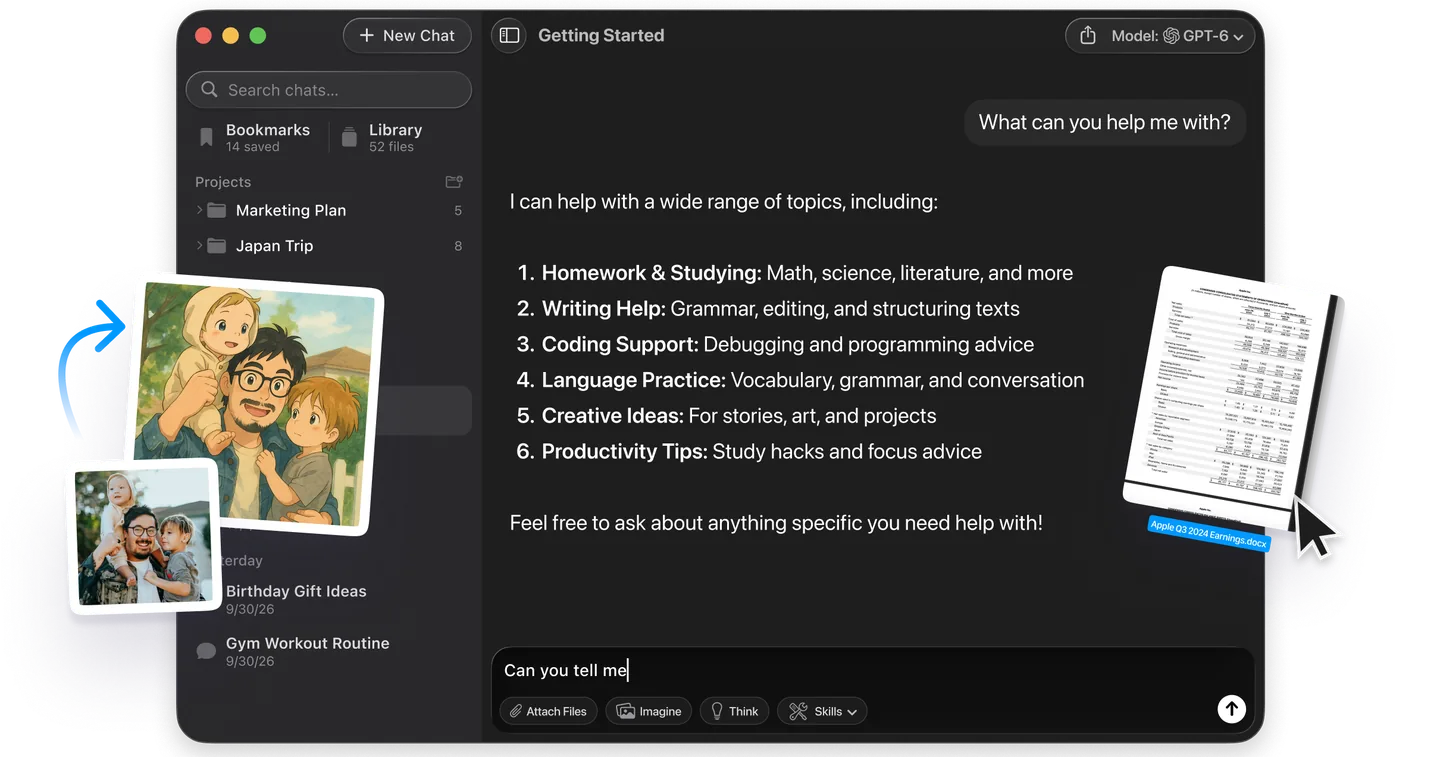
Microsoft at least lets you fix it: the shortcut is editable under Account then Keyboard Shortcut. But the deeper point is that the hotkey is the whole value of a desktop assistant. An assistant you have to go and find in the Dock is a website. This is the problem Fello AI was built around, and it is why it puts several models behind one keystroke instead of asking you to run an app per vendor and referee the collisions. If you are weighing up the desktop clients specifically, our comparison of the main AI desktop apps on macOS covers them side by side.
Where Each One Actually Wins
Strip out the pricing and the platform notes and a clean split remains, and it follows the documents you keep rather than the quality of the answers.
Copilot is the stronger choice for structured work inside Office. It turns a Word document into a formatted deck, reads an Excel sheet in place, drafts in Outlook against your mail history, and summarises Teams calls with owners and action items attached. None of that is about raw model quality. It is about the fact that your files are already in the place where the assistant is standing.
Gemini is the stronger choice for open research, long documents and anything creative. It has the longer context, the better multimodal handling, image and video generation built into the same subscription, and it sits inside Gmail and Docs the way Copilot sits inside Outlook and Word. On a Mac it also has the more capable desktop app, screen context included.
The comparison neither company wants you to make is against the third option. Both of these are assistants attached to a suite, and if you do not need the suite, a standalone assistant such as ChatGPT is a better use of the same money. That is the real reason the seat-price comparisons everyone else publishes lead nowhere: they compare two bundles and never ask whether you want a bundle. If what you actually want is sourced research rather than an assistant in your documents, Perplexity vs Copilot makes that case.
The Verdict
Buy Copilot if you already pay for Microsoft 365 and your work lives in Word, Excel and Teams. Take Personal at $99.99 a year rather than Family unless the other five people only need Office, because they will not get any AI from it. Buy Gemini if your day runs through Gmail and Docs, and start at Google AI Plus at $4.99 rather than jumping to Pro, since the entry tier already doubles the free limits and covers a household. On an Apple Silicon Mac running macOS 15 or later, Gemini also gives you the better desktop app.
If you are choosing purely on price, note which way each end of the ladder falls. Google wins the cheap end outright at $4.99. Microsoft wins the top end, because Premium works out below Google AI Pro and carries the full Office suite with it. Nobody comparing business seats will ever tell you that, because at business prices the ordering is the other way round.
And if you find yourself installing both to get the best of each, notice what that tells you. You are not choosing an assistant, you are collecting subscriptions and keyboard conflicts. At that point the question is no longer Copilot or Gemini, it is whether you want one place to reach every model instead.
Frequently Asked Questions
Is Gemini cheaper than Microsoft Copilot?
At the entry tier, yes. Google AI Plus costs $4.99 a month, while the cheapest Microsoft plan that puts Copilot inside Word and Excel is Microsoft 365 Personal at $99.99 a year, about $8.33 a month. At the top it reverses: Microsoft 365 Premium is $199.99 a year, roughly $16.67 a month, against $19.99 for Google AI Pro. Prices checked 10 September 2026.
Does Microsoft Copilot have a Mac app?
Yes. Microsoft ships two: the consumer Copilot app, which needs macOS 14.0 or later, and a separate Microsoft 365 Copilot app for work accounts. Copilot Pages and Deep Research do not work in the Mac app. Some comparisons claim Copilot on macOS is browser-only, and that is wrong.
Can my whole family use Copilot on a Microsoft 365 Family plan?
No. Microsoft states that AI features on Family and Premium plans are only available to the subscription owner and cannot be shared. The plan covers up to six people for Office apps and one person for Copilot, so buying Family for household AI access does not work.
Will Gemini for Mac run on an Intel Mac?
No. Google states that the Gemini Mac app runs exclusively on Apple Silicon and requires macOS Sequoia 15.0 or later. On an Intel Mac you are limited to Gemini in the browser. Microsoft's Copilot app supports macOS 14 and later, so it is the one that still installs on older hardware.
Do I still need ChatGPT if I pay for Copilot or Gemini?
It depends on whether you want the suite. Copilot and Gemini are assistants attached to Office and Google Workspace, and their value comes from sitting next to your files. If you want an assistant without the suite, a standalone subscription covers that better for the same money.