Microsoft Copilot is Microsoft’s AI assistant, built into Windows, the Edge browser and the Microsoft 365 apps you already use. Ask it a question in plain English and it answers, drafts, summarises or builds something for you, in the context of whatever app you are sitting in. That much has been true since 2023. What changed in 2026 is far stranger. The name “Microsoft Copilot” now refers to two completely different products, one free and one costing up to $30 per user a month. Microsoft’s own documentation and its own marketing pages currently disagree about what to call them.
That is not a trivial branding footnote. It is the single reason most people cannot work out whether they already have Copilot, whether they are paying for it, or why a colleague’s Copilot looks nothing like the one in their taskbar. This guide sorts it out properly. What Copilot is, how to identify which version you have, what each tier costs according to Microsoft’s own pricing pages, and which AI models are running underneath. It also covers what happened to Copilot Pro, which quietly reached end of support three weeks ago. Once you know which version you have, our companion guide walks through how to actually use Microsoft Copilot on each surface.
The Key Takeaways
- One name, two products: Microsoft’s documentation now states that Microsoft 365 Copilot is named Microsoft Copilot, which is also the name of the free consumer assistant. Microsoft’s own consumer marketing pages still use the old name.
- The free version really is free: Copilot at copilot.microsoft.com costs nothing and does not even require a sign-in. Signing in adds chat history and image creation.
- The version inside Word and Excel is not free: it starts at $9.99 a month on Microsoft 365 Personal and runs to $30 per user a month for the enterprise licence, always on top of a qualifying base plan.
- Copilot Pro is gone: Microsoft confirms it is no longer sold and that support ended on 1 August 2026. Microsoft 365 Premium at $19.99 a month replaced it.
- It is not just ChatGPT: Microsoft has onboarded both OpenAI and Anthropic as subprocessors, Claude runs in Word, Excel and PowerPoint on a work licence, and its own MAI models power Copilot’s voice features.
What Is Microsoft Copilot? A Plain Definition
Microsoft’s own overview page puts it in one sentence: “Microsoft Copilot is an AI-powered tool that helps with your work tasks.” You type a prompt. Copilot responds with generated text, a summary, a chart suggestion, a draft deck or an answer pulled from the web. What separates it from a standalone chatbot is context.
On the licensed work version, Copilot also reads the emails, documents, chats and meetings your account already has permission to open. It will only ever surface data you were allowed to see in the first place.
Where You Actually Meet Copilot
Most people do not go looking for Copilot. They find it because it is already there.
On a new Windows 11 PC it is pinned to the taskbar and opens with a dedicated Copilot key or the Windows key and C together. It sits in the Edge browser sidebar. It appears as a ribbon button in Word, Excel, PowerPoint and Outlook. It shows up in Teams meetings offering to write the recap. And it lives on the open web at copilot.microsoft.com, where anyone can use it without an account. Each of those surfaces has its own off switch, which is why turning Copilot off takes more than one setting.
What Copilot Can Do at a Glance
Microsoft documents a long list. Drafting and rewriting text, summarising documents and email threads, suggesting Excel formulas and chart types, building a presentation from a prompt or an existing Word file, recapping meetings from the live transcript, searching across your files and connected services, creating images, and running agents that automate a repeatable business process. On Windows it adds Copilot Vision, which interprets what is currently on your screen, plus file search across local and OneDrive documents.
Why “Microsoft Copilot” Now Means Two Different Things
Here is the confusing part, and it is worth being precise about it because almost every guide published this year still gets it wrong. Microsoft has renamed its paid work product. A note on Microsoft’s technical documentation, updated on 18 August 2026, reads: “Microsoft 365 Copilot is now named Microsoft Copilot, and Microsoft 365 Copilot Chat is now named Microsoft Copilot Chat.” The page that used to be titled “What is Microsoft 365 Copilot?” is now titled “What is Microsoft Copilot?”. Its web address still contains the old name.
The problem is that “Microsoft Copilot” was already taken. It was, and still is, the name of the free consumer assistant. The result is visible on Microsoft’s own Decide which Copilot is right for you page, which now carries two separate sections with identical headings, both reading “Microsoft Copilot”. One describes a licensed work product that reads your company data. The other describes a free consumer tool for drafting birthday cards. The page’s own description text lists “Microsoft Copilot, Microsoft Copilot” twice in a row.
And the rename is only half done. Microsoft’s consumer marketing pages, the ones you land on if you search for Copilot pricing, still use “Microsoft 365 Copilot” as the product name. So the technical documentation and the sales pages are describing the same products under different names at the same time.
If you have been confused, you were reading it correctly.
Which Microsoft Copilot Do You Actually Have?
Use this table to identify yours. The clearest signal is what Copilot can see: if it can quote your own emails and documents back to you, you are on a paid work licence. If it can only search the web, you are not.
| Version | Where you meet it | What it costs | What it can see |
|---|---|---|---|
| Microsoft Copilot (consumer) | copilot.microsoft.com, Windows taskbar, Edge, Bing | Free | The web only |
| Copilot in Microsoft 365 | Word, Excel, PowerPoint, Outlook, OneNote on a personal plan | From $9.99/month | Your own documents and mail |
| Microsoft Copilot Chat | Teams, Outlook, Edge, at work | Included with a business Microsoft 365 plan | The web, plus files you upload |
| Microsoft Copilot (work licence) | All Microsoft 365 apps, m365.cloud.microsoft | $18 to $30 per user/month | Your organisation’s mail, files, chats and meetings |
| Microsoft Security Copilot | Defender, Purview, Intune, Entra | Separate licence | Security and threat data |
| GitHub Copilot | VS Code and other code editors | Separate, free for verified students and teachers | Your code |
| Copilot Studio | Low-code agent builder | Separate licence | Whatever you connect it to |
Microsoft has also started labelling this inside the apps themselves, which is the fastest way to check. A label reading M365 Copilot (Premium) means you hold the paid add-on licence with priority access. M365 Copilot (Basic) means you do not have the add-on but still get standard access in those apps. Copilot chat (Basic) means you have no add-on licence and no Copilot chat in Word, Excel, PowerPoint or OneNote at all. If you want the coding assistant instead, our guide to getting GitHub and Microsoft Copilot free as a student covers that route.
What Microsoft Copilot Does in Each Office App
This is where the paid version earns its money, and where the free one simply cannot follow. Microsoft publishes a feature breakdown per app, and the differences between them are bigger than most summaries suggest.
Copilot in Word and Outlook
In Word, Copilot generates text with or without formatting in new or existing documents. Other Word files work as grounding material too, so you can ask it to write a new document in the style of an old one. It will also summarise, answer questions about the document and handle light commands. In Outlook it summarises an email thread so you can catch up quickly and drafts replies by pulling from other emails you already have access to. It also offers coaching tips on clarity, sentiment and tone before you send. For the practical mechanics, see our walkthrough on how to use AI in Word.
Copilot in Excel and PowerPoint
Excel is the narrowest of the four. Microsoft describes it as suggesting formulas, chart types and insights about the data already in your spreadsheet, which is useful but is not the full analyst many people expect. Our complete guide to using AI in Excel covers what fills the gaps. PowerPoint is more generous: Copilot can build a new presentation from a prompt or from an existing Word file using your organisation’s templates, then add slides, insert pictures and make deck-wide formatting changes on request. If that is your main use case, our guide to using AI in PowerPoint goes deeper.
Copilot in Teams
Teams gets the most specific limits, and they matter. Copilot can summarise up to 30 days of chat content before the last message in a thread, but it uses only that single thread as source material. It cannot reference other chats, meeting transcripts, emails or files while doing so. In meetings it works from the live transcript in real time, answers questions about the conversation only, and stays available after the meeting ends. Responses carry clickable citations back to the source content, which is the detail that makes it auditable.
Which AI Models Power Microsoft Copilot?
The common answer is “it is ChatGPT underneath”, and that has been out of date for a while. Microsoft states plainly in its documentation that it has onboarded OpenAI as a Microsoft subprocessor and, separately, that it has onboarded Anthropic as a Microsoft subprocessor. Copilot is a multi-vendor product now. That alone undoes most of what a Microsoft Copilot versus ChatGPT comparison used to conclude.
Claude Inside Word, Excel and PowerPoint
Anthropic’s Claude models are available in Copilot experiences across Excel and PowerPoint, and Word joined them in August 2026: Microsoft’s Copilot release notes record that Word users on the web can choose Anthropic models alongside the OpenAI ones. Note that Microsoft’s admin documentation has not caught up and still describes Word as coming, so go by the release notes. It is controlled by a setting in the Microsoft 365 admin centre and is switched on by default for EU, EFTA and UK tenants created after 25 March 2026. One caveat matters for administrators. When Anthropic models are used this way, data processing happens outside the Microsoft EU Data Boundary.
Microsoft’s Own MAI Models
Microsoft is also building in-house. Its MAI family already runs parts of Copilot rather than sitting in a lab: MAI-Voice-1 powers the expressive voice output behind Copilot’s Audio Expressions, and MAI-Transcribe-1 handles Copilot’s Voice Mode transcription and dictation. We covered that family in more detail in our piece on Microsoft’s MAI models. The practical takeaway is that asking “does Copilot use ChatGPT” no longer has a single answer. It depends on the app, the tenant and the task.
How Much Does Microsoft Copilot Cost?
Every figure below comes from Microsoft’s own pricing pages rather than a reseller estimate.
One rule catches people out. The business and enterprise licences are add-ons, and you cannot buy them without a qualifying Microsoft 365 base plan underneath. For the all-in per-seat maths and the promotional rates that expire this year, see the full Microsoft Copilot pricing breakdown.
| Plan | Price | Who it is for |
|---|---|---|
| Microsoft Copilot (free) | $0 | Anyone, no account needed |
| Microsoft 365 Personal | $9.99/month or $99.99/year | One person, higher usage than free |
| Microsoft 365 Family | $12.99/month or $129.99/year | Households, AI for the owner only |
| Microsoft 365 Premium | $19.99/month or $199.99/year | Individuals wanting the most AI |
| Copilot Business add-on | $18/user/month yearly, list $21 | Small business, needs a base plan |
| Business Standard with Copilot | $23.50/user/month yearly | Bundled, small business |
| Business Premium with Copilot | $32/user/month yearly | Bundled, small business |
| Microsoft 365 Copilot (enterprise) | $30/user/month yearly | Large organisations, needs a base plan |
Two things are easy to miss. On the consumer plans, Microsoft states that AI features are available only to the subscription owner and cannot be shared, so a Family plan does not hand Copilot to five people. And in business, Copilot Chat arrives automatically with any Microsoft 365 subscription at no extra cost, which means a lot of organisations already have a Copilot they have not switched on.
What Happened to Copilot Pro
If you have read a Copilot guide published earlier this year, it almost certainly recommended Copilot Pro as the consumer upgrade. Do not go looking for it. Microsoft’s support page states that Copilot Pro is no longer available for purchase, and that existing subscribers could keep using it until they cancelled or support ended on 1 August 2026. That date has passed.
Microsoft 365 Premium took its place at $19.99 a month, and Microsoft now describes it as its most comprehensive AI and productivity plan, with the highest Copilot usage limits and Copilot in the desktop apps. We break down exactly what that $19.99 buys in usage limits against the cheaper consumer tiers. Alongside it the consumer plans have picked up named features that did not exist under Copilot Pro, including Researcher for synthesising information, Analyst for working through data, and AI Restyle for photo editing.
Anyone still budgeting around a Copilot Pro seat is budgeting for a product that no longer exists.
Three More Features Retired in August 2026
Copilot Pro was not the only thing cut. Microsoft’s support documentation confirms that three consumer features left the Copilot app on 18 August 2026: Podcasts, Group Chat and Deep Research. The podcast retirement was the harshest of the three. Microsoft offered no bulk export, so anything users had generated and not downloaded episode by episode before that date is gone. Previously shared podcast links stopped working. If you read an older guide praising Copilot’s podcast generator, that feature no longer exists.
Microsoft Copilot vs a Multi-Model App on Mac
Copilot has one advantage nothing else can copy, and it is worth stating plainly before anything else: it reads your organisation’s own SharePoint, Outlook and Teams content, inside the permissions you already have. If your working day is Microsoft documents and Microsoft meetings, that grounding is the whole point, and no general chatbot substitutes for it.
The Same $9.99, Spent Differently
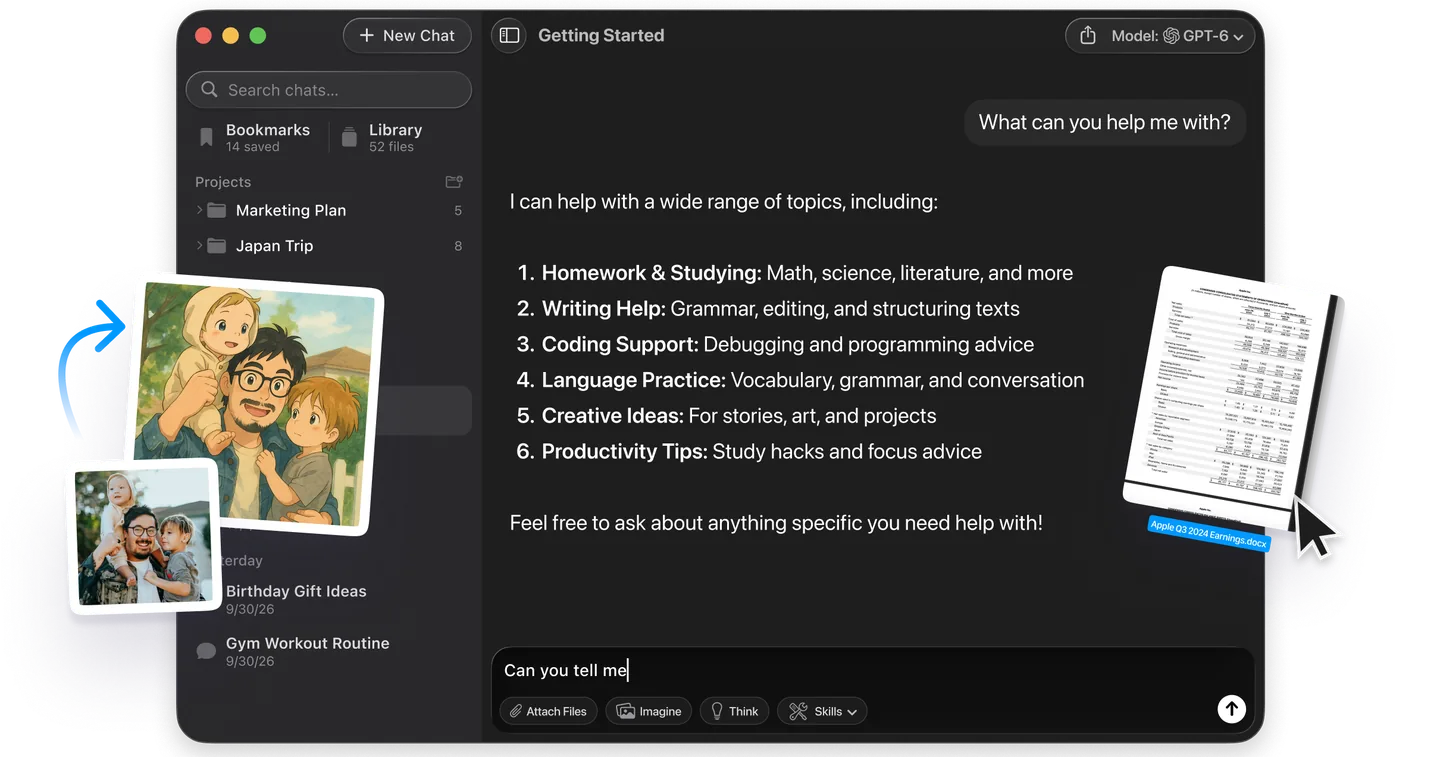
The trade is that you get Microsoft’s choice of model, inside Microsoft’s apps, on Microsoft’s terms, and the entry price for Copilot in the desktop apps is $9.99 a month on Microsoft 365 Personal. Fello AI costs the same $9.99 a month and makes the opposite bet. Instead of one vendor’s stack, it puts more than 30 models side by side in a native Mac app, including Claude, GPT-5.6, Gemini, Grok, DeepSeek and Kimi. Run the same prompt through several and keep the best answer. If the comparison you actually want is against Google rather than against a multi-model app, we cover Copilot against Google’s Gemini plans in full.
It also does the deliverable work. Drop in a PDF or a pile of notes and get back a report, a PowerPoint or an Excel table, then export to PDF, Word or PowerPoint. It turns any topic into a podcast with a script and AI voices, the feature Copilot just retired. It generates images with GPT Image 2, Nano Banana 2, Seedream 5 and FLUX.2, and searches YouTube, X and booking sites with real citations rather than just Google. It runs on Mac, iPhone and iPad, rated 4.7 stars across 27,000 ratings, with a free tier of five premium questions an hour.
Which One Fits Your Work
The honest split is this. Copilot wins when the answer lives inside your company’s files. A multi-model app wins when the answer depends on which model you ask, or when you are on a Mac and would rather not buy into one vendor’s ecosystem to get AI in your documents.
Plenty of people run both. Our best AI models hub tracks what each one is currently good at. You can try Fello AI on Mac to test the multi-model approach directly.
So, Is Microsoft Copilot Worth It?
Start with the free one.
It costs nothing, needs no account, and will tell you within an afternoon whether Microsoft’s style of assistant suits how you work. If it does and your documents live in Microsoft 365, the $9.99 Personal plan is the cheapest way to get Copilot into Word, Excel and Outlook. The jump to $19.99 Premium only makes sense once you are hitting usage limits.
For businesses the calculation is different, because Copilot Chat is already included with your existing subscription. Turn that on and measure real usage before anyone signs off on $18 or $30 per seat for the full licence. And whichever way you go, check the label in the app rather than trusting the plan name. With two products sharing one name and Microsoft’s own pages disagreeing, the label is currently the only reliable answer to the question of which Copilot you are actually using. Agents are the next thing to understand from here, and our explainer on what an AI agent actually is is the place to start.
FAQ
Is Microsoft Copilot free?
Yes, partly. The consumer version at copilot.microsoft.com is free with any Microsoft account, and Microsoft says sign-in is not even required, though signing in adds chat history, image creation and longer conversations. Copilot inside Word, Excel, PowerPoint and Outlook is not free. It needs a Microsoft 365 subscription from $9.99 a month, or a work licence from $18 per user. We break the whole question down in our guide to whether Microsoft Copilot is free.
Does Microsoft Copilot use ChatGPT?
Not exactly. Copilot runs on OpenAI models, the same family behind ChatGPT, but it is not ChatGPT. Microsoft has also onboarded Anthropic as a subprocessor and runs Claude models in Copilot in Word, Excel and PowerPoint, and its own MAI models power Copilot’s voice features. The model behind any given answer depends on the app and your tenant settings.
Is GitHub Copilot the same as Microsoft Copilot?
No. They share a brand and an owner, nothing else. GitHub Copilot is a coding assistant that suggests and writes code inside editors like VS Code, licensed separately and free for verified students and teachers. Microsoft Copilot is the general assistant in Windows, Edge and the Microsoft 365 apps. Having one gives you no access to the other.
What happened to Copilot Pro?
Microsoft retired it. Its support page confirms Copilot Pro is no longer available for purchase and that support for existing subscribers ended on 1 August 2026. Microsoft 365 Premium at $19.99 a month replaced it as the top consumer tier, offering the highest Copilot usage limits and Copilot in the Microsoft 365 desktop apps.
What is the difference between Microsoft Copilot and Microsoft 365 Copilot?
As of 2026 they are the same product. Microsoft’s documentation states that Microsoft 365 Copilot is now named Microsoft Copilot. The complication is that the free consumer assistant already had that name, so one name now covers two very different things, and Microsoft’s consumer marketing pages still use the old name. Check the label inside the app to see which you have.