Until recently, the idea of a single individual launching a billion-dollar company seemed like science fiction. Building a unicorn required years of work, dozens—if not hundreds—of employees, millions in venture capital, and a bit of luck. But in 2025, thanks to the rapid evolution of AI agents, that paradigm is changing fast.
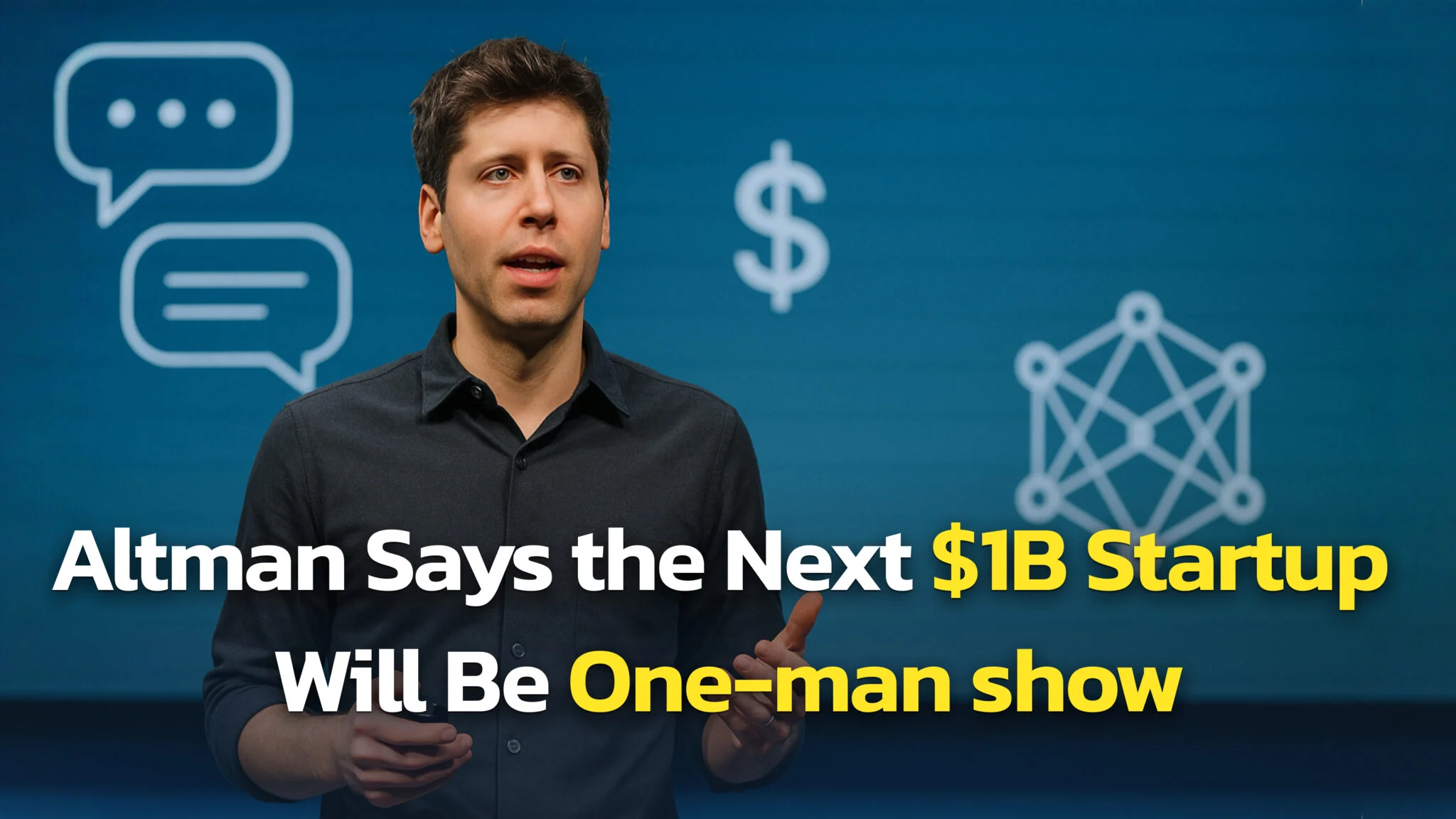
OpenAI CEO Sam Altman recently made waves by predicting the arrival of the first “one-person billion-dollar company.” At the World Economic Forum in Davos, tech leaders echoed that sentiment. And now, real-world examples and playbooks are starting to emerge—complete with strategies, tools, and business models that make the solo-unicorn vision more than just a thought experiment. The era of the one-person unicorn is no longer a distant dream.
Creators like @gregisenberg have highlighted how solo founders are already building $1M+ businesses with AI — and scaling faster than ever. Others, including investors like @Codie_Sanchez, see AI-powered solo ventures as the next wave of high-leverage entrepreneurship.
Across the AI landscape, a growing number of influential voices are aligned: AI is giving individuals the kind of scale that used to require entire teams. The solo unicorn may be closer than it seems.
The AI Co-founder
The key to this shift is what experts call agentic AI—autonomous or semi-autonomous systems that can plan, decide, and execute complex tasks. Instead of just generating text or code, AI agents can now:
- Run customer support desks
- Design marketing assets
- Write and send outreach emails
- Manage data workflows
- Debug and deploy code
- Perform compliance tasks
And soon, even more.
OpenAI defines these systems across levels. At Level 1–2, agents perform single tasks—summarizing documents or writing replies. By Level 3, they handle multi-step workflows, such as managing ad campaigns or processing support tickets. At Level 4–5, they evolve into strategic co-pilots—capable of overseeing teams, managing budgets, or negotiating contracts.
While most tools today hover around Levels 2–3, the rapid pace of development suggests that highly capable agents are just a few years away. According to Gartner, by 2028, one-third of enterprise applications will feature embedded AI agents, enabling 15% of all business decisions to be made autonomously.
The AI agent is becoming the new employee. And in many cases, the only one.
How to Start a One-Person AI Business
You don’t need to raise millions or build a complex product to get started. Some entrepreneurs are already making six-figure monthly income running lean, profitable AI-based businesses entirely on their own—or with minimal outsourced help.
Here’s one such blueprint:
- “Hire” an AI Agent: AI Agentic platforms let you access agents that handle customer support, marketing, content creation, outbound sales, and more. These tools often cost around $99/month per agent.
- Find Boomer Businesses: Identify businesses with minimal AI adoption—often older industries like IT services, accounting, or real estate.
- Make the Pitch: A simple outreach message could be:
“We help [business type] save X hours/week and $Y/month by automating customer support with AI. Want to hop on a quick call?” - Install the Agent: Charge a $2,000 one-time setup fee, and offer a $1,000/month retainer to maintain and fine-tune the agent. You can do this yourself—or outsource it to a virtual assistant from platforms like OnlineJobs.ph for ~$250/month.
- Scale: Identify other pain points (e.g., outbound sales, document processing) and upsell additional agents. Many clients will pay $5,000–10,000+ per month for multi-agent setups that replace several human roles.
This model is being used today to generate over $100,000/month in revenue by some solo founders. It’s lean, high-margin, and extremely scalable.
What’s Behind One-Person AI Startups
The idea of a solo founder running a multi-million dollar business is no longer a fantasy — and it’s largely due to recent advances in AI infrastructure, tooling, and interoperability. What used to require teams of engineers, designers, marketers, and operators can now be handled by a single person working alongside AI agents. What drives this shift?
First, AI tools have become dramatically cheaper and more accessible. With platforms like AWS, Google Cloud, and a growing ecosystem of open-source models (including Llama 3, Mistral, and DeepSeek R1), deploying and running AI-powered services no longer requires a massive budget. A basic infrastructure stack that used to cost thousands per month can now be operated for under $100.
Second, the models themselves are getting better at adapting and optimizing over time. Newer systems — such as OpenAI’s O1 or DeepSeek’s R1 — are designed with Mixture of Experts architectures, which allow them to dynamically allocate resources and learn from previous outputs. This results in more efficient agents that can handle increasingly complex tasks with minimal human intervention.
Third, AI agents are becoming collaborative. Rather than relying on a single model to handle everything, developers can now chain multiple agents together, each specializing in a specific task — coding, testing, deploying, writing content, managing CRM workflows, and more. These agents can pass data and instructions between each other in a pipeline, automating entire workflows end-to-end.
This combination of low cost, high performance, and agent interoperability is what makes the one-person startup model viable. Founders don’t need to build large teams to scale; instead, they orchestrate fleets of AI agents to handle execution, while focusing their own time on strategy, partnerships, and product vision.
New Challenges
Not everything about one-person unicorns is rosy. Serious questions remain:
- Liability: Who is responsible if a medical AI makes a harmful decision?
- Bias: If agents are trained on biased data, how do we audit and fix them?
- Job Displacement: If solo founders can run what used to be 50-person companies, where do all those displaced employees go?
Regulatory efforts like the EU AI Act and Biden’s Executive Order 14110 are attempting to address these issues. But so far, global governance of agentic AI is fragmented and slow to adapt.
There’s also the human element. As Kanjun Qiu, CEO of AI lab Imbue, pointed out: relationships still matter. Go-to-market strategies, sales, and partnerships often rely on human trust—a factor that’s hard to automate.
And as Benjamine Liu, CEO of Formation Bio, noted: entrepreneurship is lonely. Even if AI can run the business, many founders will still crave human connection, feedback, and collaboration.
In reality, many of tomorrow’s successful companies might consist of a tiny core team managing a fleet of AI agents and contractors.
Final Thought
We may not see a true one-person billion-dollar company this year, but the path is now real — and getting easier to follow. AI agents are already replacing the need for entire departments. Tasks like coding, customer support, marketing, and operations can now be handled by software.
Thanks to open-source models like Llama 3 and platforms like DeepSeek or OpenAI, solo founders have access to tools that used to require teams and venture capital. Add low-cost infrastructure and agent-based workflows, and you have a setup where one person can run what looks like a 20-person company.
It’s a major shift. The barrier to building a scalable business has dropped. It’s now less about team size and more about how well you use automation and AI.
Not every solo founder will build a unicorn. But many can build lean, profitable companies generating millions in revenue — without hiring full-time staff. And this isn’t a future trend or prediction for upcoming decades. It’s already happening.