TL;DR: AI is a powerful tool for pattern prediction and task automation, not a conscious entity that “knows” the truth. While it transforms jobs by automating specific tasks, it requires human verification to manage hallucinations (errors) and bias. Current “Agents” can perform workflows but still need supervision. The safest way to use AI is to treat it as a drafting assistant, not a final decision-maker.
Myth vs. Reality Summary
| Myth | The Reality |
|---|---|
| 1. AI is conscious | AI predicts the next word based on math; it has no feelings or awareness. |
| 2. AI is always accurate | AI “hallucinates” confidently; it optimizes for plausibility, not facts. |
| 3. AI will replace all jobs | AI replaces tasks, not necessarily whole roles. It changes how we work. |
| 4. All AI models are the same | Different models (Gemini, Claude, GPT) excel at different tasks (reasoning vs. speed). |
| 5. AI learns from my data | Enterprise/API tools usually don’t train on data; consumer apps often do unless opted out. |
| 6. AI Agents run autonomously | Agents can perform actions but are brittle; they require human oversight to prevent loops/errors. |
| 7. AI is objective/unbiased | AI mirrors the biases found in its human-generated training data. |
| 8. AI reads huge files perfectly | Even with large context windows, AI can get “lost in the middle” of long documents. |
| 9. You can detect AI writing | AI detectors are unreliable and biased; software cannot definitively prove authorship. |
| 10. AI is only for tech people | If you can write an email, you can prompt an AI. English is the new coding language. |
Opening
Artificial Intelligence is no longer just a buzzword. It is the engine behind your search results, your work software, and your creative tools. Yet, as AI adoption accelerates into the era of Agents and Generative AI, confusion has only grown.
Is AI actually “thinking”? Will it replace your job tomorrow? Can you trust it with your private data?
Separating fact from fiction is critical for using these tools safely and effectively. Below, we debunk the 10 most common myths about AI, clarify the reality, and give you practical steps to navigate the technology in 2026.
The Key Takeaways
- AI is a predictor, not a knower: It generates text based on probability, which can lead to “hallucinations” (confident errors).
- Your data privacy depends on the tool: Enterprise/API tools generally protect data; free consumer tools often use it for training.
- Humans are still essential: From verifying facts to supervising agents, the “Human-in-the-Loop” is critical for safety.
- Task transformation > Job replacement: AI handles repetitive tasks, freeing humans for strategy and oversight.
What are we actually talking about?
Before diving in, let’s distinguish the three main terms used in 2026:
AI Agents: Systems that don’t just generate text but can use tools to perform multi-step workflows (e.g., “Book a flight and add it to my calendar”).
Traditional AI: Systems designed for specific tasks (e.g., spam filters, recommendation engines).
Generative AI (GenAI): Models (LLMs) that create new content (text, images, code) based on patterns.
Let’s break down ten of the most common AI myths and separate fact from fiction.
1. Myth: AI is Smarter Than Humans
Reality: AI can outperform humans in specific tasks like chess or image recognition, but this does not equate to general intelligence. AI lacks understanding, common sense, and emotional intelligence.
For example, AI language models like GPT-5 generate text by analyzing vast amounts of data and predicting the next word, but they don’t comprehend meaning the way humans do. A study conducted at Stanford University found that people often overestimate AI’s intelligence, mistakenly attributing deeper cognitive abilities to systems that are fundamentally statistical.
According to Stanford researchers, while AI can appear smart, it operates on probabilities rather than reasoning or intuition.
2. Myth: AI is Creative
Reality: AI can generate art, music, and text, but this creativity is derivative.
For example, AI art programs like DALL·E generate images by remixing patterns from existing data, not by conjuring new ideas out of thin air. A paper titled “Can Machines Be Creative?” by Elgammal et al. highlights that while AI can produce visually stunning works, these creations lack the intentionality and emotional depth of human art.
The authors argue that AI’s outputs are ultimately the result of pattern recognition rather than inspiration or lived experience.
3. Myth: AI Has Emotions
Reality: AI can simulate emotions but does not experience them.
Chatbots and virtual assistants use empathetic language because their algorithms are designed to reflect the tone of the input they receive. However, this is mere simulation, not genuine feeling.
Alan Turing’s famous Turing Test was developed to measure whether a machine can mimic human behavior convincingly, not to determine whether machines actually feel emotions. As explained on Simply Psychology, even if an AI passes the test, it doesn’t mean it possesses consciousness or emotional depth.
4. Myth: AI Understands What It Writes
Reality: Language models like GPT-5 and Claude do not understand language in the same way humans do.
They predict the next word in a sequence based on massive datasets, not on comprehension, and that prediction is re-rolled every time you ask. For example, AI-generated medical texts can appear well-informed but may include factual inaccuracies due to a lack of true understanding.
Research from the Allen Institute for AI emphasizes that AI operates based on statistical analysis, which can result in impressively fluent but sometimes misleading outputs.
5. Myth: AI Remembers Everything
Reality: Most AI models, including ChatGPT, do not retain information from past interactions.
Each conversation starts anew, as AI systems are designed to prioritize privacy and minimize data retention. OpenAI’s documentation clarifies that while AI may seem to recall details during a single session, this memory is temporary and disappears once the session ends unless the model is part of a specialized application designed for long-term use.
6. Myth: AI is Error-Free
Reality: AI systems frequently make mistakes and sometimes confidently provide incorrect information.
These errors stem from biases in training data, limited contextual understanding, and overfitting to certain datasets. A paper by Lipton, “The Myth of Model Interpretability“, explains that while AI models can be highly accurate, they are not immune to generating misleading or incorrect outputs, especially in novel scenarios where data is scarce.
7. Myth: AI Will Take All Our Jobs
Reality: AI will automate some tasks, but it is more likely to augment jobs rather than replace them.
According to a McKinsey report, AI-driven automation will primarily handle repetitive and predictable tasks, freeing up workers to focus on creative, strategic, and emotionally driven work.
The report notes that while certain roles may disappear, AI is expected to create new opportunities in industries that require collaboration between humans and machines.
8. Myth: AI Has Opinions
Reality: AI does not form personal opinions.
AI models function like sponges, absorbing biases, perspectives, and trends present in their training data. As highlighted by MIT Technology Review, any opinions or viewpoints expressed by AI are a direct result of this data, not genuine beliefs or independent thought.
This means AI can unintentionally echo the biases, inaccuracies, or dominant perspectives found in its sources. While it may seem like AI is offering personal insights, it’s simply mirroring what it has learned, without understanding or holding opinions of its own.
Recognizing this is essential when interpreting AI-generated content, ensuring users stay critical of the outputs and mindful of potential biases in the data behind them.
9. Myth: AI is Objective
Reality: AI models are only as unbiased as the data they are trained on.
A groundbreaking study by Buolamwini and Gebru revealed that facial recognition systems trained on unbalanced datasets showed significant racial and gender biases. For example, these systems were far less accurate when identifying individuals from underrepresented groups, highlighting how gaps in the data can lead to discriminatory outcomes.
This research underscores the critical need for diverse and representative datasets in AI development. Without addressing biases in the training data, AI systems risk perpetuating inequality and reinforcing harmful stereotypes.
Ultimately, the fairness of AI depends not just on the technology itself but on the quality and inclusivity of the data that shapes it.
10. Myth: AI Excels at Technical Tasks
Reality: AI can write code, diagnose diseases, and perform technical tasks, but errors are common.
While AI can speed up processes and automate repetitive work, it often produces code with bugs or security vulnerabilities that require human intervention. This highlights a key limitation – AI lacks the deeper contextual understanding needed to solve complex problems or make judgment calls.
A study published in the Journal of Systems and Software found that although AI can assist developers by generating code or suggesting solutions, it cannot fully replace experienced professionals. Developers bring essential skills like critical thinking, creative problem-solving, and the ability to adapt to unique project requirements – areas where AI falls short.
In short, AI is a powerful tool, but human oversight remains crucial to ensure quality, security, and the success of technical projects.
Fact Checking AI Answers in 3 Steps
Use this workflow to verify any claim made by an AI.
| Step | Action | Why? |
|---|---|---|
| 1. Gut Check | Does it sound too good to be true? | AI optimizes for “sounding right,” not being right. |
| 2. Cross-Reference | Search the web for a primary source. | Deep Online Search (in FelloAI) cites real URLs to verify claims. |
| 3. Second Opinion | Ask a different model (e.g., Claude vs. Gemini). | If models disagree, the fact is likely nuanced or disputed. |
Conclusion
The myths surrounding AI usually stem from a lack of understanding. AI is neither a magic solution that solves every problem nor a monster that will ruin society. It is a tool, powerful, imperfect, and rapidly evolving.
The best way to separate myth from reality is to stop reading about AI and start using it.
Ready to see for yourself? Don’t take our word for it. Test the myths.
- Compare Models: Switch between Gemini 3 and GPT-5 to see different answers.
- Fact Check: Use Deep Online Search to verify claims with real citations.
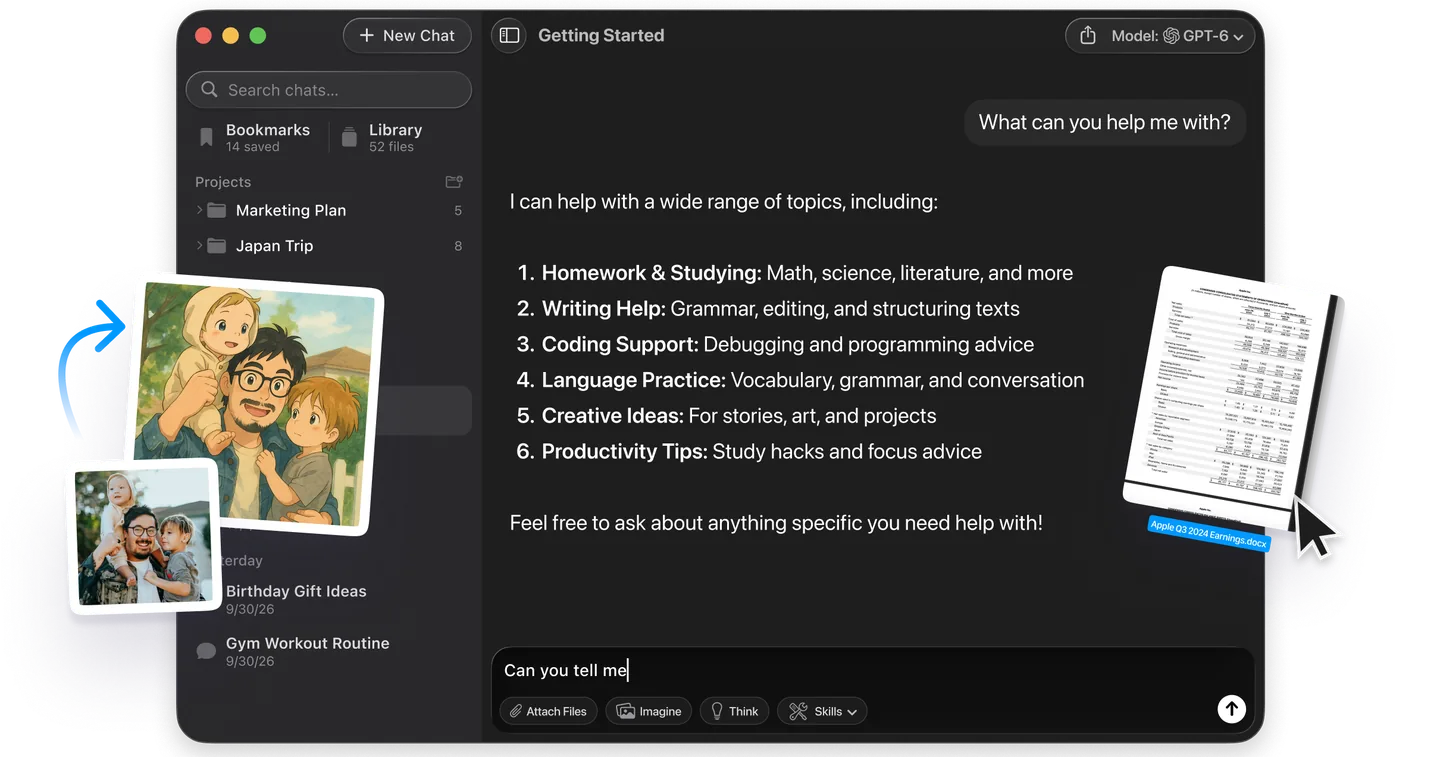
- Analyze Docs: Chat with your own PDFs to see the power of context.
Get Started with Fello AI for Free
Sources & Further Reading
- NIST: AI Risk Management Framework (Defining “Confabulation” risk).
- ILO: Generative AI and Jobs Report (Task transformation vs. replacement).
- OpenAI: Enterprise Privacy Policy (Data training distinctions).
- Google Cloud: Data Privacy & AI (Context window and data handling).
- Stanford University: Study on AI Detector Bias against non-native speakers.
Frequently Asked Questions (FAQ)
Jobs & Society
Will AI replace my job?
AI is more likely to automate specific tasks within your job (like data entry or drafting) rather than the whole role. However, jobs that consist entirely of repetitive digital tasks are at higher risk.
What jobs will AI create?
AI is creating demand for roles like AI Ethicists, Prompt Engineers, AI Editors, and specialized curators who can verify AI outputs.
Is AI good or bad for the economy?
Most economists view AI as a productivity booster, similar to the internet or electricity. It disrupts specific sectors but generally increases overall output and creates new types of value.
Trust & Accuracy
Why does AI hallucinate?
LLMs predict the next likely word based on patterns, not facts. If they don’t have the specific data, they prioritize completing the pattern over accuracy.
Is AI always accurate?
No. You should treat AI drafts as “unverified information” that requires human review, especially for medical, legal, or financial topics.
Can I trust AI for medical advice?
AI can provide general information, but it can also make dangerous errors. Never use it as a replacement for a doctor.
How do I know if an image is AI-generated?
Look for visual glitches (hands, text), but note that models are getting better. Metadata standards (like C2PA) are emerging but not universal.
Privacy & Safety
Does ChatGPT/Gemini store my data?
By default, many free consumer tools use chat history to improve their models. Enterprise and API-based tools typically do not.
What is the difference between AI and AGI?
Current AI (Narrow AI) excels at specific tasks. AGI (Artificial General Intelligence) is a hypothetical future state where a machine possesses human-level cognitive abilities across any task.
Is my conversation private?
On free tiers of public chatbots, assume it is not. On enterprise tools, privacy protections are usually contractual.
What should I never put in AI?
Avoid passwords, credit card numbers, confidential client data (unless using an enterprise agreement), and deeply personal health information.
Capabilities
Can AI write code?
Yes, AI is excellent at writing, debugging, and explaining code, though it can still introduce bugs or security vulnerabilities.
Does AI understand emotions?
No. It can simulate empathy based on language patterns, but it does not “feel” anything.
What is the best AI model?
It depends on the task. Gemini is great for research; Claude is great for writing; GPT is a strong generalist. It changes all the time though.