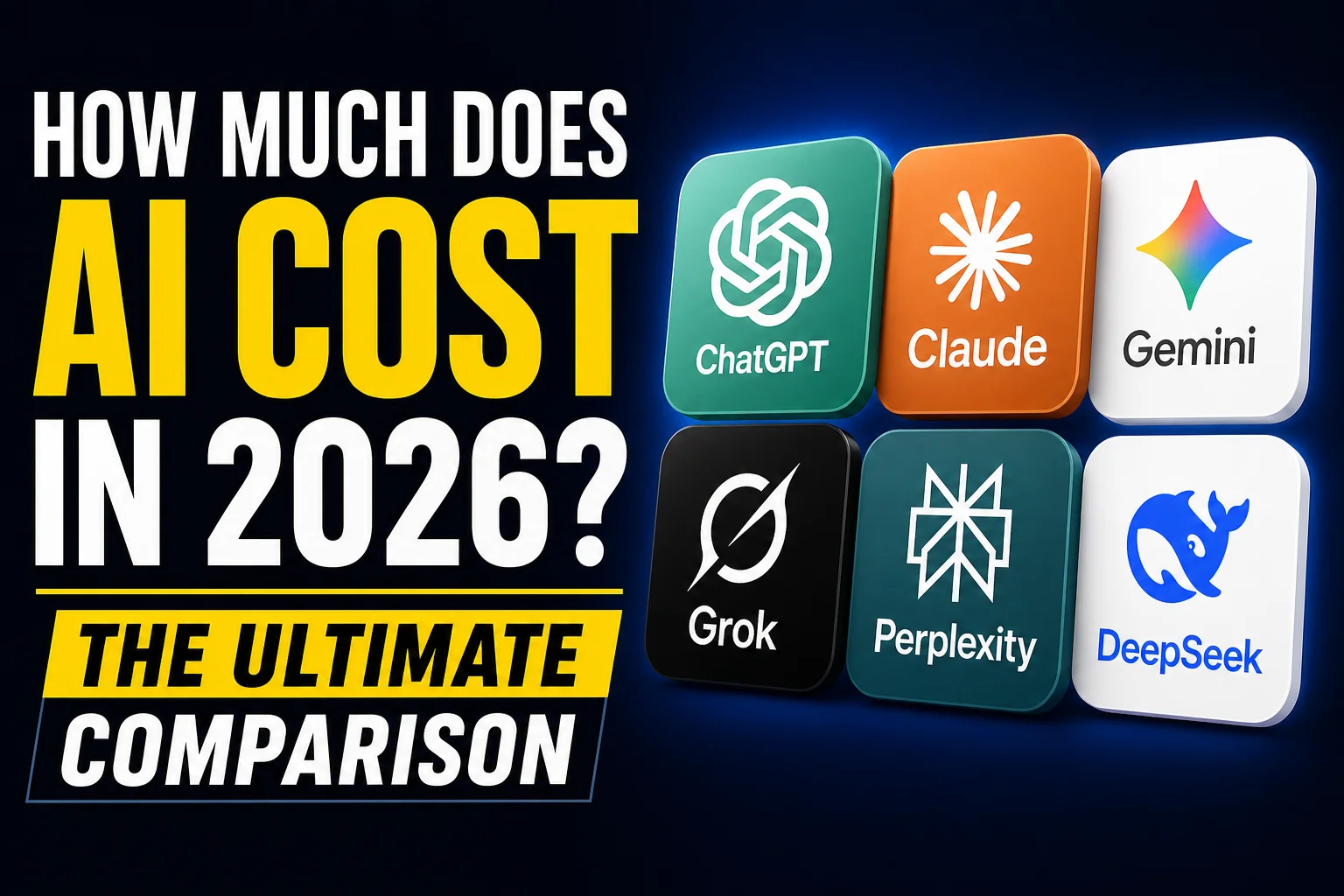
The standard cost of a major AI assistant in 2026 is $20 per month: ChatGPT Plus at $20, Claude Pro at $20, Google AI Pro at $19.99, and Perplexity Pro at $20. Budget tiers start at Google AI Plus at $4.99 and ChatGPT Go at $8, with Plus at $8 on Grok’s new X Subscription matching it. Power-user plans run Claude Max at $100 and $200, ChatGPT Pro at $100, $200 and $500, and Grok’s Super at $100 and Ultra at $200, which replaced SuperGrok on October 12, 2026, while Google AI Ultra was cut to $99.99 at Google I/O 2026 (with a $199.99 higher-limit plan on top). DeepSeek has no monthly plan; web chat is free and the rest runs on per-token API pricing. On Claude specifically, our guide to Pro or Max works through which tier the extra usage justifies.
This guide answers one question: how much does AI cost in 2026, across every major tool, every tier, and every API. We compared ChatGPT, Claude, Gemini, Grok, Perplexity, and DeepSeek plan by plan, and pulled token prices for twenty production models. The result: a clear answer to who should pay $20, who should pay $100, who should pay nothing, and who should stop paying for three apps when one bundle covers the lot. Last reviewed in full in July 2026, with individual rates updated since, most recently in September 2026. For a closer look at two of them, see Claude vs Gemini pricing.
The Key Takeaways
- The standard tier across ChatGPT, Claude, Google AI Pro, and Perplexity all sit at $20/month in July 2026, a real industry convergence point.
- Cheapest entry tier: Google AI Plus at $4.99/mo (cut from $7.99 on June 8, 2026), then ChatGPT Go at $8/mo. At the other end, ChatGPT Pro 500 runs $500/mo, Grok Ultra $200/mo (down from SuperGrok Heavy’s $300), and Google AI Ultra was cut to $99.99/mo at I/O 2026, with a $199.99 high-limit plan above it.
- The flagship line-up has turned over twice since July, and the September wave cut prices rather than raising them. Claude Opus 5 arrived July 24, 2026 at $5 input / $25 output per million, the same rate as Opus 4.8, and moved to Anthropic’s Legacy list on September 22, 2026, when Claude Opus 5.5 replaced it at $4/$20. GPT-5.6 (Sol, Terra, Luna) went generally available July 9 with Sol at $5/$30, cut to $4/$20 on August 21. OpenAI then shipped GPT-6 Sol and Luna on September 22, 2026 at $2/$10 and $0.10/$0.50, halving Sol’s rates and taking 58% off Luna’s output. A week later, on September 29, GPT-6.1 Sol took over as OpenAI’s mid model at the same $2/$10, with cached input halved to $0.10. Claude Fable 5.1 still holds the Fable 5 list price of $10/$50.
- Cheapest API tokens in 2026: GPT-6 Luna at $0.10 input / $0.50 output per million took the title on September 22, and Grok 4.1 Fast, which used to hold it at $0.20/$0.50, was retired in May. DeepSeek moved to peak and off-peak billing on August 16, 2026 and cut its cheap tier again on September 10, 2026: V4.1 Flash is $0.15/$0.60 off-peak and double that at peak, V4 Pro $0.66/$1.98 off-peak, and the 75% cut it once called permanent is gone. Gemini 3.8 Flash at $0.75/$3.75 is the closed-frontier value point, with Gemini 3.7 Flash and 3.6 Flash carried over on the same rate. All three are introductory and double on January 1, 2027.
- Three stacked $20 subscriptions cost $60/month; the Fello AI Mac bundle covers ChatGPT, Claude, Gemini, Grok, and DeepSeek for $9.99/month.
AI Assistant Pricing in 2026 (ChatGPT $8 to $500, Claude $20 to $200, Gemini $4.99 to $199.99, Grok $8 to $200, Perplexity $20 to $325)
The table below is the fastest way to see where each major AI assistant sits in July 2026. Prices are monthly unless stated, in US dollars, and apply to individual plans (we cover business and enterprise tiers further down).
| Tool | Free tier | Entry | Standard | Power-user | Max |
|---|---|---|---|---|---|
| ChatGPT (OpenAI) | Free with ads (US, Europe) | Go $8 | Plus $20 | Pro $100 | Pro $200 / $500 |
| Claude (Anthropic) | Free | none | Pro $20 (or $17 annual) | Max 5x $100 | Max 20x $200 |
| Gemini (Google) | Free | AI Plus $4.99 | AI Pro $19.99 | AI Ultra $99.99 | Ultra high-limit $199.99 |
| Grok (xAI) | Free, limited | X Subscription Plus $8 | Premium $30 | Super $100 | Ultra $200 |
| Perplexity | Free | none | Pro $20 (or $200/yr) | Enterprise Pro $40/seat | Enterprise Max $325/seat |
| DeepSeek | Free web chat | API only | API only | API only | API only |
| Fello AI (bundle) | Free trial | none | $9.99 (all 5 models) | none | none |
The pattern is clear: four of the six standalone tools land on the same $20 line, and four now have power-user tiers at $100 (ChatGPT Pro, Claude Max 5x, Grok Super, and Google AI Ultra at $99.99). The absolute ceiling is now a consumer plan, ChatGPT Pro 500 at $500, above business seats such as Perplexity Enterprise Max at $325. Grok’s top tier fell from $300 to $200 when The X Subscription took over from SuperGrok on October 12, 2026. The bundled route through Fello AI sits below the $20 line at $9.99/month and covers five of the six tools at once.
ChatGPT Pricing in 2026: Free, Go at $8, Plus at $20, Pro at $100, $200 and $500
ChatGPT runs six consumer tiers in 2026: Free (with ads in the US since February and in Europe since August 24, 2026), Go at $8/month, Plus at $20/month, Pro at $100/month (launched April 9, 2026), Pro at $200/month and Pro at $500/month (launched September 29, 2026). Free and Go now show ads across the US and 31 European markets, while Plus, Pro, Business, and Enterprise stay ad-free. There is also a free ad-free route on the Free plan that trades ads for lower limits.
OpenAI added the $100 tier in April 2026 specifically to compete with Anthropic’s Claude Max. The GPT-5.6 family (Sol, Terra, Luna) went generally available on July 9, 2026 across ChatGPT, the API, and Codex, after a limited preview that opened June 26 to roughly 20 approved organizations. OpenAI has since moved past it twice: GPT-6 Astra launched on September 3, 2026 and now powers GPT-6 Pro in Chat for Pro, Business and Enterprise, while Plus reaches it through ChatGPT Work and Codex; GPT-6 Sol and Luna followed on September 22 and GPT-6.1 Sol on September 29, also in Work and Codex, and OpenAI says none of them is available in Chat yet. The GPT-5.6 tiers still serve the thinking levels below Pro in the chat window. Team plans run $30 per user monthly or $25 with annual billing, while Business is cheaper at $25 monthly or $20 annual per user (the annual tier dropped to $20 on April 2, 2026). OpenAI announced a second Business seat type on August 10, 2026, Premium at $125 per user monthly or $100 annual, carrying 5x a standard seat's usage and no five-hour cap. It is waitlisted and was still absent from OpenAI's public pricing page on August 20, so treat it as announced rather than purchasable. It also matches Claude Team Premium to the dollar on both terms. For the full breakdown of every plan, ad placements, and the GPT-5.6 rollout details, see our ChatGPT pricing tiers in detail. Both Pro tiers also include the new Personal Finance preview for US subscribers, which links 12,000+ bank accounts through Plaid.
Claude Pricing in 2026: Free, Pro at $20, Max at $100 and $200
Anthropic Claude keeps it simple: Free, Pro at $20/month (or $17/month billed annually at $200 upfront), and two Max tiers at $100/month (5x usage) and $200/month (20x usage). Pro now includes Claude Code, Claude Cowork, projects, Research, cross-conversation memory, and Office integrations.
Team pricing runs $25/seat monthly or $20/seat with annual billing for standard seats, and $125/seat monthly or $100/seat annual for premium seats that bundle Claude Code. Enterprise starts at $20/seat plus usage. Anthropic’s API charges $10 input / $50 output per million tokens for its newest flagship, Claude Fable 5.1, released September 1, 2026, which holds the Fable 5 list price and cuts cache reads 75% to $0.25. Claude Opus 5.5 is the step down at $4/$20 with cache reads at $0.20, and it replaced Claude Opus 5 on September 22, 2026, which now sits on Anthropic’s Legacy list at its old $5/$25 beside Opus 4.8 and Opus 4.7. Claude Sonnet 5.5, released September 28, 2026, keeps Sonnet 5’s $2/$10 and lands close to Opus 5.5 on several benchmarks; see our review of Claude Sonnet 5.5, the best-value Claude model at its default settings, or our full Claude pricing guide for every plan and API rate.
Google Gemini Pricing in 2026: Free, AI Plus at $4.99, AI Pro at $19.99, AI Ultra at $99.99 and $199.99
The Google company restructured its AI pricing for 2026 around four consumer tiers. The cheapest subscription Google AI Plus runs $4.99/month (cut from $7.99 on June 8, 2026, with storage doubled to 400GB), the cheapest entry into a major AI ecosystem. Google AI Pro is $19.99/month with Gemini 4 Argon (since October 13, 2026) and Gemini 3.1 Pro, 5TB storage, and a 1M-token context. At Google I/O 2026, Google added a new Google AI Ultra entry tier at $99.99/month with 5x higher Gemini app usage than AI Pro (Deep Think, Gemini Spark, Project Mariner, 20TB storage). Both Spark and Claude Cowork now anchor the agent-tier features at $100 to $200, and dropped the previous top Ultra plan from $249.99 to $199.99/month, keeping the exact same capabilities at higher usage caps. From October 9, 2026 the free tier runs Gemini Flash-Lite only; Gemini 3.6 Flash and varying access to Gemini 3.1 Pro move to the paid plans. Gemini 3.5 Pro still has no public launch: Bloomberg reported on July 16, 2026 that it is months behind schedule and has fallen short of Google’s internal goals, and the model is absent from both the Gemini API and Vertex AI catalogs. Google’s own line is that it is “currently testing with partners”. Students should check whether Google AI Pro is still free for students in their own country: Google relaunched the 12-month student offer on August 19, 2026, with a free year of AI Pro in the US and a free year of AI Plus in more than 140 other markets. Google’s newest model, Gemini 4 Argon, opened to Google AI Pro and Ultra subscribers and the paid API on October 13, 2026, at an introductory $2 input and $10 output per million tokens until November 30, then $4 / $20; for every current Gemini price, see our Gemini pricing guide. On the API side, Gemini 3.8 Flash arrived on September 2, 2026 at the same introductory $0.75 input and $3.75 output per million tokens that Gemini 3.7 Flash has carried since August 13, and all of those rates double on January 1, 2027.
The $4.99 floor is the most aggressive consumer pricing in the market and pairs Gemini with 400GB of Google One storage, which makes it a strong value if you already pay for Drive backup. After the I/O 2026 cut, Google AI Ultra at $99.99 is no longer the priciest consumer plan; since 29 September 2026 that spot belongs to ChatGPT Pro 500 at $500, well ahead of Grok Ultra at $200. For deeper coverage including API, Vertex AI, and Workspace pricing, our Gemini’s full pricing breakdown has the numbers, and we compared ChatGPT to Gemini if you want the head-to-head view. NotebookLM uses the same four-tier ladder; see our NotebookLM pricing in detail for the per-plan caps.
Grok Pricing in 2026: The X Subscription at $8, $30, $100 and $200
xAI Grok rebuilt its pricing on October 12, 2026. Grok is now sold through The X Subscription, one plan that bundles Grok, the Cursor code editor and X Premium perks in five tiers. Free gives limited Grok Chat, image generation and Grok Build. Plus at $8/month adds Chat, Voice, Imagine and Build, but no video and no Grok Bot. Premium at $30/month is the standard plan, with 4x the usage of Plus, Grok Bot and video. Super at $100/month gives 15x, and Ultra at $200/month gives 50x at the top. The old SuperGrok and X Premium plans, from SuperGrok Lite at $10 to SuperGrok Heavy at $300, are no longer sold to new buyers, though existing subscribers can keep them.
Teams seats start at $30/seat/month and cost the same as the matching individual tier. Grok’s defining strength is API economics. The newest flagship Grok 4.7 arrived September 21, 2026 at exactly what Grok 4.6 cost, $2 input / $6 output per million tokens ($0.50 cached, and note that crossing a 200K-token prompt re-bills the entire request at double, not just the overage) with a 500K-token context window, while the older Grok 4.1 Fast and its $0.20 input / $0.50 output per million were retired on May 15, 2026, and requests to that slug now bill at Grok 4.3’s $1.25/$2.50. Grok 4.7 launched on the API, in Cursor and in Grok Build, and took over grok.com’s Expert and Heavy modes from Grok 4.6 on October 3. Grok 4.7 scores 46.3 on Artificial Analysis’s Intelligence Index v4.3.2 against Grok 4.6’s 44.3 at the same reasoning setting, and 4.6 in turn sits five and a half points above Grok 4.5 at 38.8. Read those against v4.3.2 only: AA rescaled the index twice in September, so the 61 Grok 4.6 scored on v4.1.1 is not comparable. Claude Opus 5.5 at 57.6, Claude Sonnet 5.5 at 56.0, Muse Wonder Full at 55.8, Claude Fable 5.1 at 53.4, GPT-6 Astra at 52.7, Muse Wonder at 52.4, GPT-6.1 Sol at 51.8, Claude Opus 5 at 50.8, Muse Spark 1.3 at 48.1, GPT-6 Sol at 47.5 and GPT-5.6 Sol at 47.0 still score higher, while GLM-5.3 at 44.8 no longer does. The token price held flat but the bill did not: on AA’s cost-per-index-task measure Grok 4.7 runs $2.73 against Grok 4.6’s $1.86, a 47% rise, because the new model writes roughly twice as much to reach the same answer. Both sit above Gemini 3.8 Flash at $1.24 and Grok’s own 4.5 at $1.04. For the full breakdown of every X Subscription tier, the old SuperGrok plans, and Imagine pricing, see our Grok pricing guide.
Perplexity Pricing in 2026: Free, Pro at $20, Max at $200, Enterprise Pro at $40, Enterprise Max at $325
Perplexity keeps its consumer plan tight: Free, then Pro at $20/month (or $200/year) with unlimited searches, the full model selector, unlimited file uploads, and $5/month in API credits included. The consumer Max tier sits around $200/month for very heavy users.
Enterprise pricing splits into Enterprise Pro at $40/seat/month ($400/year, 20% off) and Enterprise Max at $325/seat/month ($3,250/year). Enterprise Pro adds team features, SSO, 500 daily research queries, and compliance certifications. Pricing is per active seat, which makes scaling team usage straightforward. For the full breakdown including the Sonar API, Comet Plus, and Education Pro, see our Perplexity pricing guide.
DeepSeek Pricing in 2026: Free web chat, V4.1 Flash at $0.15/$0.60, V4 Pro at $0.66/$1.98 (off-peak)
DeepSeek is the outlier: there is no monthly subscription tier at all. Web and mobile chat are free, and the entire commercial product is API-driven. Since 16:00 UTC on August 16, 2026 the API also bills by the clock: peak hours are 01:00 to 04:00 and 06:00 to 10:00 UTC, Monday to Friday, and every other hour is off-peak at half the peak rate. DeepSeek V4.1 Flash costs $0.15 input / $0.60 output per million tokens off-peak and $0.30/$1.20 at peak, with cache hits at $0.003 per million input tokens off-peak. That tier got cheaper, not dearer: on September 10, 2026 DeepSeek replaced V4 Flash with V4.1 Flash, retired the deepseek-v4-flash model name in favour of deepseek-flash, and took off-peak input down by about a third, output by about a tenth, and the cache-hit rate by more than half. DeepSeek V4 Pro costs $0.66 input / $1.98 output off-peak and $1.32/$3.96 at peak, with a 1-million-token context window included. The 75% price cut DeepSeek called permanent on May 22, 2026 did not survive: it ended with that August increase.
That still leaves DeepSeek among the cheapest frontier-class models on the market, though no longer at a flat rate, though its cheapest rival is now GPT-6 Luna rather than the retired Grok 4.1 Fast. Off-peak, V4.1 Flash is dearer on both sides, $0.15 against $0.10 on input and $0.60 against $0.50 on output, and at peak it is double that. For the full breakdown including OpenRouter and AWS Bedrock pricing, see our DeepSeek API rates guide.
AI API Pricing Comparison: Tokens, Context, and Discounts
Subscriptions are only half the story. If you’re building products, automating workflows, or running anything beyond a chat window, you pay per token, and it is worth knowing what a token actually is before reading the rates. Whether you need a key at all is a separate question. The table below lists current API pricing for the most relevant frontier models in September 2026.
| Model | Input ($/M tokens) | Output ($/M tokens) | Context window | Discounts |
|---|---|---|---|---|
| GPT-6 Astra | $10.00 | $50.00 | 1.05M | Batch 50%; cached input $1.00; 2x input and 1.5x output above 272K |
| GPT-6.1 Sol | $2.00 | $10.00 | 1.05M | Successor to GPT-6 Sol from Sept 29, 2026, same rate; batch 50%; cached input $0.10 |
| GPT-6 Sol | $2.00 | $10.00 | 1.05M | Half the GPT-5.6 Sol rate from Sept 22, 2026; batch 50%; cached input $0.20 |
| GPT-6 Luna | $0.10 | $0.50 | 1.05M | Cheapest rate in this table; batch 50%; cached input $0.01 |
| GPT-5.6 Sol | $4.00 | $20.00 | 1M | Promotional $4/$20 at least through Nov 21, 2026 (then $5/$30); batch 50%, cache reads |
| GPT-5.6 Luna | $0.20 | $1.20 | 1M | Cut 80% on July 30, 2026; batch 50%; cached input $0.02 |
| GPT-5.5 Pro | $30.00 | $180.00 | 1M | Batch 50% |
| Claude Fable 5.1 | $10.00 | $50.00 | 1M | Cache reads cut 75% to $0.25 on Sept 1, 2026; batch 50% |
| Claude Opus 5.5 | $4.00 | $20.00 | 1M | Replaced Opus 5 on Sept 22, 2026; batch 50%; cache reads $0.20; Fast mode $8/$40 |
| Claude Opus 5 | $5.00 | $25.00 | 1M | Legacy model since Sept 22, 2026; batch 50%, cache hits up to 90% off; Fast mode $10/$50 |
| Claude Sonnet 5.5 | $2.00 | $10.00 | 1M | Replaced Sonnet 5 on Sept 28, 2026 at the same rate; batch 50% |
| Gemini 4 Argon | $2.00 | $10.00 | 1M | Public since Oct 13, 2026; introductory until Nov 30, 2026 (then $4/$20); cached input $0.10; 1M shared by input and output |
| Gemini 3.8 Flash | $0.75 | $3.75 | 1M | Introductory; $1.50/$7.50 from Jan 1, 2027; batch 50% |
| Gemini 3.7 Flash | $0.75 | $3.75 | 1M | Same rate as 3.8 Flash; same January expiry |
| Gemini 3.6 Flash | $0.75 | $3.75 | 1M | Cut to match the newer Flash models; same January expiry |
| Gemini 3.5 Flash-Lite | $0.30 | $2.50 | 1M | Cheapest Gemini tier; batch 50% |
| Gemini 3.1 Pro | $2.00 | $12.00 | 1M | $4/$18 above 200K tokens; cache reads, batch 50% |
| Grok 4.7 | $2.00 | $6.00 | 500K | Cache $0.50/M; 2x above 200K |
| Grok 4.6 | $2.00 | $6.00 | 500K | Cache $0.50/M; 2x above 200K |
| DeepSeek V4.1 Flash | $0.15 / $0.30 | $0.60 / $1.20 | 1M | Off-peak / peak; cut Sept 10, 2026 when V4 Flash was retired; cache hit $0.003/$0.006 |
| DeepSeek V4 Pro | $0.66 / $1.32 | $1.98 / $3.96 | 1M | Off-peak / peak; 75% cut ended Aug 16, 2026; cache $0.022/$0.044 |
| Muse Wonder | $4.00 | $20.00 | 1M | Muse Wonder Full only via Muse Code ($50 and $200 plans); cached input $0.20 |
| Muse Spark 1.3 | $1.25 | $4.25 | 1M | Contributor tier $0.10/$0.20 in exchange for training rights on your prompts; cached input $0.15 |
Two numbers tell the whole story. Output tokens cost 3 to 10 times more than input tokens across every provider, which means apps that generate long responses pay disproportionately. And the gap between cheapest and most expensive output in the table is roughly 360x: $0.50 per million for GPT-6 Luna versus $180 for GPT-5.5 Pro. Across the current flagships it is 20x, $0.50 against $10 for GPT-6.1 Sol. For perspective on which models actually deliver intelligence per dollar, Artificial Analysis’s price-vs-intelligence chart is the cleanest external benchmark. The cheapest route to near-frontier coding is Meta’s Muse Spark 1.3 at $1.25 and $4.25, and cheaper still on its Contributor tier, which trades a 92% discount for permission to train on your prompts. Meta’s new flagship Muse Wonder sits higher up the price list, at $4 and $20, the same as Claude Opus 5.5.
Cost Per 1 Million Words: A Worked Example
Token pricing only feels real once you translate it into something you’d actually generate. One million words is roughly 1.33 million output tokens, which is what a small team produces in a busy month: a few long reports, a handful of marketing pieces, a stack of customer emails, some code documentation. Here’s what that bill looks like across the major providers.
| Model | Output cost ($/M tokens) | Cost to generate 1M words |
|---|---|---|
| GPT-6 Luna | $0.50 | $0.67 |
| DeepSeek V4.1 Flash | $0.60 off-peak | $0.80 |
| GPT-5.6 Luna | $1.20 | ~$1.60 |
| DeepSeek V4 Pro | $1.98 off-peak | $2.64 |
| Gemini 3.8 Flash | $3.75 | ~$5 |
| Muse Spark 1.3 | $4.25 | ~$6 |
| Grok 4.6 / 4.7 | $6.00 | ~$8 |
| GPT-6.1 Sol | $10.00 | ~$13 |
| Claude Sonnet 5.5 | $10.00 | ~$13 |
| Gemini 4 Argon | $10.00 intro | ~$13 |
| Gemini 3.1 Pro | $12.00 | ~$16 |
| Claude Opus 5.5 | $20.00 | ~$27 |
| Muse Wonder | $20.00 | ~$27 |
| GPT-5.6 Sol | $20.00 promo | ~$27 |
| Claude Opus 5 | $25.00 | ~$33 |
| Claude Fable 5.1 | $50.00 | ~$67 |
| GPT-5.5 Pro | $180.00 | $240 |
Two things jump out. Generating 1 million words via the cheapest API costs less than a cup of coffee ($0.67 on GPT-6 Luna, or $0.80 on DeepSeek V4.1 Flash off-peak). And the same workload on GPT-5.5 Pro costs $240, which is more than a year of ChatGPT Plus. If you’re running anything at scale, model selection is the single biggest cost lever you have, larger than batch discounts, larger than caching, larger than negotiating enterprise rates.
This is also why $20 consumer subscriptions are such strong value for casual users. ChatGPT Plus at $20/month effectively gives you generous conversational use of OpenAI’s current chat models; replicating that volume on the API would cost a multiple of the subscription price.
The $20 Convergence (and Where It’s Already Breaking)
The fact that ChatGPT Plus, Claude Pro, Google AI Pro, and Perplexity Pro all sit within a dollar of each other is not a coincidence. It’s the price each company arrived at independently as the maximum a typical consumer will pay before churning. Anthropic, OpenAI, Google, and Perplexity all tested it; all four held. Microsoft never joined the convergence at all. It folded Copilot into Microsoft 365 instead of selling a $20 tier, as our Microsoft Copilot pricing guide sets out. That makes Copilot awkward to price against Google, so we put the Copilot and Gemini tiers side by side separately.
But the convergence is starting to break in three places.
First, the entry tier. Google AI Plus at $4.99 and ChatGPT Go at $8 represent a deliberate move down-market, and the same logic runs through Nano Banana image pricing. OpenAI is targeting 122 million paid subscribers by the end of 2026, up from around 47 million in 2025, and the $8 plan is the volume engine.
Second, the power-user tier. Anthropic’s Claude Max set the $100 floor in 2025; OpenAI matched with the new ChatGPT Pro $100 tier in April 2026, and Google AI Ultra rounds out the segment at $99.99 after its I/O 2026 cut.
Third, DeepSeek and Grok are pulling away from per-month pricing entirely. They’re betting that token economics will dominate as agentic apps and automated workflows replace chat sessions.
Is the $100 or $200 Power-User Tier Worth It?
For 95% of readers, no.
The $100 and $200 plans are designed for one specific user, the person who hits usage caps on the standard plan multiple times per week. Model access counts again on the Claude side, after a spell where it barely mattered. Anthropic’s plan table now compares families rather than versions: the free plan gets no Opus at all, while Pro and both Max tiers do, which since September 22, 2026 means Opus 5.5. The newer Fable 5.1 flagship comes with Max and Team premium seats only up to 50% of weekly usage limits, and Pro and Team standard seats reach it on pay-as-you-go usage credits rather than flat-rate access. Elsewhere the gate is still real, with GPT-6 Pro and Google Veo sitting above the standard tier.
Here’s the honest math. If you write code with Claude for 4+ hours daily, Claude Max 5x at $100 stops the rate-limit interruptions that kill flow. If you generate dozens of long research outputs weekly with ChatGPT, Pro at $100 removes the cap. If you produce video content with Gemini Omni, Google AI Ultra at $99.99 gives the highest generation limits, though Omni video is now available across Google’s paid tiers. For everyone else, the standard $20 plan is the better economic choice, since the upgrade buys usage headroom you won’t use, not new capabilities. If you’d rather pay per credit than per month for video, our Kling AI pricing breakdown shows where the cheapest commercial-use entry point sits.
How to Pick the Right AI Plan in 2026
If you write for a living, the choice is between Claude Pro and ChatGPT Plus. Claude produces cleaner long-form prose and better dialogue; ChatGPT handles tighter reasoning and structured tasks faster. Both at $20 are fine; the differentiator is editorial taste, not price. Annual cost: $200–$240. If you are still weighing the models themselves rather than the plans, start with which of the big three is worth paying for.
If you code, Claude Pro with Claude Code included now matches GitHub Copilot territory at the same price, and GLM-4.7 is the current value play if you want a coding-only secondary tool, with free API access to GLM-4.7 Flash or a Coding Plan from $18/month. Our full GLM pricing guide lays out the current API rates and Coding Plan tiers. Pair Claude Pro with GLM’s Lite plan and you’re at around $38/month for a stronger coding setup than most $100 power-user plans deliver to non-coders.
If you research and cite sources, Perplexity Pro at $20 is uniquely positioned: it’s the only plan that ships with API credits included for power users. Annual cost: $200, plus the $5/month API credit allowance.
If you run a small business, the question is whether you need a multi-seat plan at all. ChatGPT Team at $25–$30/user/month and Claude Team at $20–$25/user/month are similar; the real decision is whether your team will use one model or several. A 5-person team on Claude Team annual is $1,200/year; the same team paying for three different AI subscriptions individually would clear $3,600/year. If they need three or more models, see the next section.
If you’re a hobbyist or casual user, the free tier covers most needs in 2026. Claude’s free tier handles most use cases, Gemini’s free tier runs Gemini Flash-Lite from October 9, and ChatGPT’s free tier (now ad-supported) handles light queries fine. Annual cost: $0.
If you care about AI’s environmental impact, EcoGPT is the niche option in 2026: a tree-planting AI chatbot that funds a tree for every 200 prompts, is free with ads, and undercuts ChatGPT Plus with an ad-free Pro plan at $10/month on the US web.
The Math Problem: One Bundle vs Three Subscriptions
Here’s the trap most AI users fall into. You start with ChatGPT at $20. Then you add Claude because the writing is better, $40 total. You also add Gemini for Google Workspace, $60. Maybe Perplexity for research, $80. By month four you’re paying $80/month for four AI subscriptions that overlap on 70% of what you actually do.
Fello AI solves the math problem by bundling ChatGPT, Claude, Gemini, Grok, and DeepSeek into a single native Mac app for $9.99/month. One subscription, all five models, switch between them with a keyboard shortcut, and your conversations live in one searchable history.
The trade-off is honest. Fello AI updates models on a regular cadence rather than always shipping the latest flagship the day it launches, and very heavy users who actually hit Claude Max or ChatGPT Pro caps still need a direct subscription. For 80% of readers comparing prices on this page, the bundled bill is the right move; see how Fello AI is set up for the full picture. If you are not sure which of your current plans still earns its place, run the subscription audit first.

Which AI Has the Best Price-Performance Ratio in 2026?
By blended price across input and output tokens, GPT-6 Luna at $0.10/$0.50 per million has been the cheapest serious model since September 22, 2026, under DeepSeek’s V4.1 Flash at $0.15/$0.60 off-peak on both sides, a rate that doubles at peak anyway. The $0.20/$0.50 Grok 4.1 Fast that used to hold this spot was retired on May 15, 2026. By price-per-quality on independent benchmarks, Grok 4.7 is no longer the value pick its $2/$6 token price suggests. On Artificial Analysis’s current v4.3.2 index Grok 4.7 scores 46.3 and Grok 4.6 44.3, and AA’s own cost-per-index-task figure puts them at $2.73 and $1.86, against $0.72 for GPT-6.1 Sol, which outscores both at 51.8, $1.24 for Gemini 3.8 Flash, $0.27 for DeepSeek V4.1 Flash and $0.07 for GPT-6 Luna. The newer Grok is the more expensive of the two to run, not the cheaper. Gemini 3.8 Flash at $0.75/$3.75 is now the cheaper option on both sides, with 3.7 Flash and 3.6 Flash matched to it, and Claude Sonnet 5.5 delivers near-Opus quality at a fraction of the API cost ($2/$10, the same rate as Sonnet 5). GPT-5.6 Sol was one of the most expensive models per token until August 21, 2026, when OpenAI cut it to $4/$20 and moved under Claude Opus 5 on both sides. That is temporary: OpenAI says the rate runs about three months, and it covers the API plus Codex and ChatGPT Work credits, not consumer subscriptions. The Luna tier is now the counterweight, cut again on September 22, 2026 to $0.10/$0.50, which undercuts both Grok flagships and the Gemini Flash tier on raw token price and matches the 37.3 index score of the GPT-5.6 Luna it replaces at a third of the cost per task, though Luna is a fast tier rather than a frontier one.
For free, Claude’s free tier, Gemini Free, and DeepSeek’s web chat all give you access to capable models with no payment. Among Chinese-built models, DeepSeek V4 Pro at $0.66/$1.98 off-peak ($1.32/$3.96 at peak) is still the cheapest frontier-class reasoning model, and the V4.1 Flash tier below it came down again on September 10, 2026. Alibaba’s Qwen3.7-Max sits one tier up at $2.50/$7.50 per million tokens (currently $1.25/$3.75 on a 50% promo) with a 1M context and Anthropic API drop-in compatibility. Pricing this aggressive is a deliberate market move, and DeepSeek is not done moving: it lifted the floor in August with peak and off-peak billing, then cut the Flash tier’s off-peak input by about a third in September.
What’s Next: Pick Your Plan
The cheapest viable AI in 2026 is free: Claude Free, Gemini Free, ChatGPT Free, or DeepSeek’s web chat. The standard paid tier is $20/month and any of the four major options at that price point are excellent. The power-user tier is real but only worth it if you actually hit usage caps. And the bundled Fello AI route at $9.99/month is the cleanest answer if you currently pay for two or more AI subscriptions. If switching plans means dropping one you already pay for, do that part properly: our guide to cancelling an AI subscription on a Mac or iPhone covers who is actually billing you and why a refund request does not stop the charge.
If you want to compare model performance instead of just pricing, every ChatGPT model from GPT-5.0 to 5.6 breaks down what each one is actually good at. And if Claude Opus 5.5 is on your shortlist, our full Claude Opus 5.5 review covers what the upgrade changes and where the $100 tier earns its money. Before you commit to a plan for a specific model, it is also worth checking which models are being retired, because several are scheduled to disappear this year.
This guide focuses on general-purpose chat assistants, but several specialized AI tools have pricing worth comparing too. Developers can weigh up our Cursor pricing breakdown, while creators get the full picture from our Midjourney pricing guide for images and MiniMax pricing for AI video. For everyday productivity, see how Notion AI pricing, Manus AI pricing, Genspark AI pricing and Otter AI pricing stack up, and check Qwen pricing for one of the cheapest API options around.
FAQ
How much does AI cost per month in 2026?
The standard cost for a major AI assistant is $20/month: that’s the price of ChatGPT Plus, Claude Pro, Google AI Pro ($19.99), and Perplexity Pro. Cheaper plans start at $4.99 (Google AI Plus) or $8 (ChatGPT Go). Power-user tiers run $100 to $500/month. Google AI Ultra was cut to $99.99/month at I/O 2026 (with a $199.99 high-limit plan), while the priciest consumer plan is now ChatGPT Pro 500 at $500/month, well ahead of Grok Ultra at $200. If you want to bring those numbers down, our guide on how to pay less for AI rounds up the discounts, free tiers, and bundles that actually work in 2026.
What is the cheapest AI chatbot?
For paid plans, Google AI Plus at $4.99/month is the cheapest tier from any major lab. Below that, every major AI assistant offers a free plan: Claude Free, Gemini Free, ChatGPT Free (now ad-supported in the US and Europe), and DeepSeek’s free web chat all give meaningful access at no cost.
Is ChatGPT Pro at $200 worth it?
For most people, no. The $200 tier is built for users who hit Plus’s usage caps multiple times a week and need more room than the $100 tier gives; GPT-6 Pro itself already comes with Pro $100, and Pro $500 sits above both. For typical work and writing, ChatGPT Plus at $20 is the better value.
What’s the cheapest AI API in 2026?
GPT-6 Luna at $0.10 input / $0.50 output per million tokens is the cheapest production-grade API since September 22, 2026. Grok 4.1 Fast matched it on output at $0.20/$0.50, but xAI retired it on May 15, 2026, and its cheapest current model is Grok 4.3 at $1.25/$2.50. DeepSeek V4.1 Flash is close behind at $0.15/$0.60 off-peak, cheaper on input and dearer on output, but it doubles to $0.30/$1.20 during peak hours, and DeepSeek V4 Pro costs $0.66/$1.98 off-peak. DeepSeek raised both on August 16, 2026, ending the 75% discount it had called permanent, then cut the Flash tier again on September 10, 2026.
Why do all the major AI tools cost $20 a month?
Because each company arrived independently at the same price ceiling: $20 is roughly the maximum monthly fee a typical consumer will pay for a single productivity tool before churning. OpenAI, Anthropic, Google, and Perplexity all tested higher and lower, and all four converged on the same line in 2024-2025. The convergence is now starting to break at the $8 entry point and the $100+ power-user tier.