On August 5, 2025, Google DeepMind introduced Genie 3, a major leap in AI-generated interactive environments. The release came on a day packed with significant AI announcements, including Anthropic’s Claude Opus 4.1 and OpenAI’s open-weight GPT-OSS model. While those releases focused on multimodal performance and open-access NLP, Genie 3 targets a different space: real-time virtual world generation.
Designed to turn simple text prompts into explorable, dynamic 3D environments, Genie 3 is part of DeepMind’s growing focus on world models — systems that simulate environments for both human users and AI agents to interact with. Unlike previous iterations, Genie 3 supports multiple minutes of consistent simulation, real-time rendering, and the ability to inject events into the environment using natural language.

A Real-Time World Generator From Text
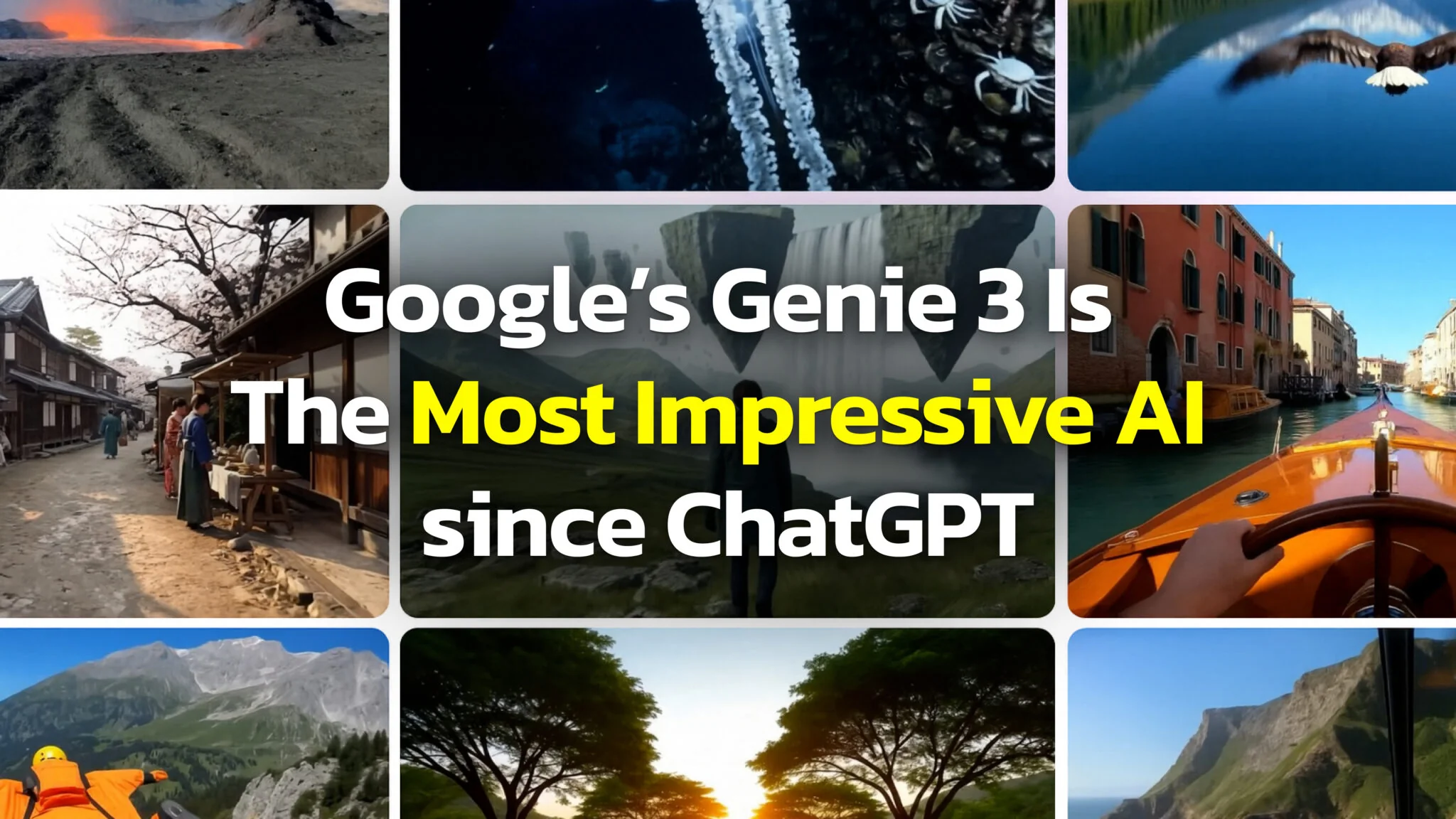
Genie 3 builds on earlier versions of the model, but introduces major improvements in interactivity, consistency, and visual quality. Users can now type simple prompts like “a rainforest during a thunderstorm” or “a Martian colony” and get fully rendered, explorable 3D environments in seconds.
The worlds are generated at 720p resolution and run smoothly at 24 frames per second. They’re also interactive — users and AI agents can move through them, objects stay where they were placed, and the scene updates naturally in response to changes.
What sets Genie 3 apart is its ability to remember what it previously generated. The model references up to one minute of visual history, allowing environments to remain coherent over time. If a user walks away from an object and returns, it’s still there — just like in a real simulation.
This frame-by-frame generation approach is what DeepMind calls auto-regressive. It makes the experience feel less like a looping video and more like a living world that evolves with each interaction.
“It’s the first real-time interactive general-purpose world model,” said Shlomi Fruchter, research director at DeepMind.
Endless Use Cases
While Genie 3 might sound like a game engine, DeepMind sees it as infrastructure for far more diverse applications — especially in education, simulation, and AI research. Big game studios are drawing a line here: Take-Two says generative AI has no part in GTA 6.
In Education
Teachers can create immersive lessons on demand:
- A biology class could explore the inside of a cell
- A history teacher might generate ancient Babylon
- A geography lesson could visualize climate zones in transition
Because scenes are generated from plain language, no 3D modeling, animation scripting, or coding is required. Educators can input prompts like:
“A savannah during dry season with elephants and baobab trees,” and Genie 3 will generate it on the spot.
For AI Agent Development
Genie 3 also provides simulated environments for training embodied agents, such as robots or generalist virtual assistants. In testing, DeepMind used the model with SIMA, an instruction-following AI agent, which successfully completed tasks like:
- Navigating to a forklift
- Approaching a designated object
- Responding to scene changes in real time
Because Genie 3 responds to an agent’s actions without knowing its goals, it provides a neutral sandbox for testing planning, adaptation, and self-driven behavior — key milestones on the path to artificial general intelligence (AGI).
Genie 3 vs Other Models
To better understand where Genie 3 stands in the evolving landscape of world models, DeepMind shared a comparison chart against its predecessors (Genie 2), earlier efforts like GameNGen, and its video-generation sibling Veo. The table highlights key improvements across resolution, control, interaction time, and real-time responsiveness.

As the chart shows, Genie 3 is the only model in the lineup to combine real-time interaction, multi-minute continuity, and navigation + event control within a general-purpose domain. This positions it not just as an upgrade, but as a shift toward more persistent and controllable virtual environments — a key requirement for both training agents and immersive experiences. of physical consistency across time.
Why Genie 3 Matters?
Genie 3 isn’t just a tool for creating pretty visuals — it’s a shift in how we interact with AI. It turns simple text into rich, explorable environments that respond to actions and evolve over time. This opens the door to new ways of teaching, training, and experimenting without needing technical expertise.
For educators, it means immersive learning is now accessible with just a prompt. For researchers, it creates safer, flexible simulation environments to test AI agents. Designers and creatives can use it to prototype ideas instantly, skipping the need for complex 3D workflows.
But the bigger implication is what this means for AI itself. Genie 3 supports embodied learning — giving AI agents a space to act, fail, adapt, and learn by doing, much like humans. It’s a necessary step if AI is to move beyond static inputs and learn from interaction.
“We haven’t had a Move 37 moment for embodied agents yet,” said DeepMind researcher Jack Parker-Holder. “But now, we can potentially usher in a new era.”
Genie 3 may not be the final version of that vision — but it’s clearly a step toward it.
Conclusion
Genie 3 could be a turning point for generative AI — one that moves beyond language, images, or even video, and into fully realized, interactive 3D environments. While other models focus on perception, Genie 3 focuses on experience. It generates spaces you can walk through, interact with, and alter — all in real time.
Though still in limited research preview, its implications are clear. From virtual classrooms and training simulations to autonomous agent testing and creative prototyping, Genie 3 lowers the barrier to building dynamic, immersive environments. It compresses what once required entire teams and toolchains into a few lines of text.
As DeepMind continues to refine the model, the next steps will involve improving realism, expanding interaction time, supporting multi-agent scenarios, and eventually opening access to broader audiences. Genie 3 isn’t just a technical milestone — it’s a glimpse into how generative AI might soon shape how we teach, train, build, and learn.