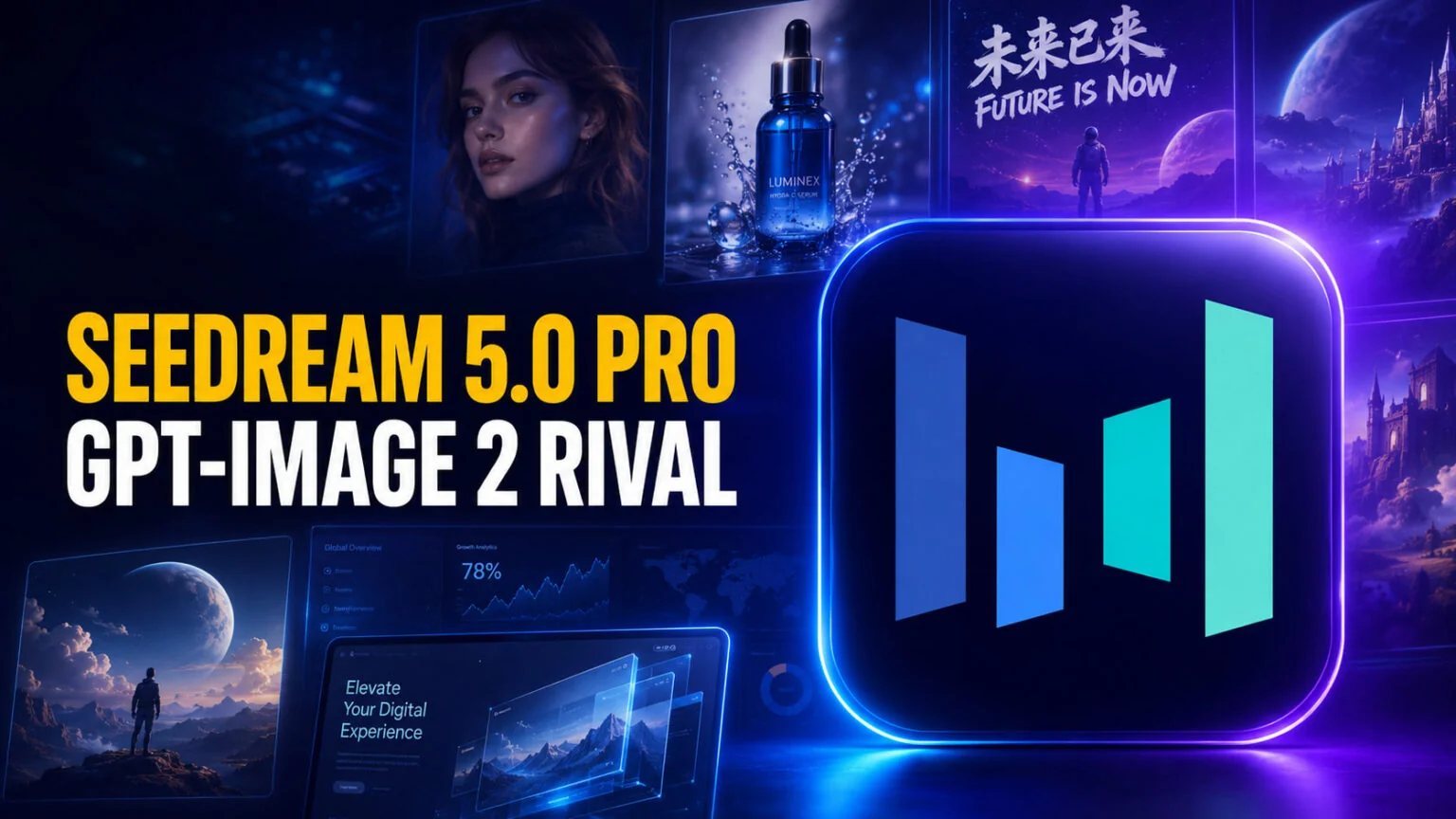
ByteDance released Seedream 5.0 Pro on July 8, 2026, and it is the company’s most direct challenger yet to GPT-Image 2. The new model from ByteDance’s Seed research team is built for production design rather than one-off pictures, with native output up to 2K resolution, pixel-level editing, separable layers, and text rendering across more than 10 languages.
This article breaks down what Seedream 5 actually does, how it compares to GPT-Image 2 and Google’s Nano Banana Pro, what the API costs, and how the new Pro model differs from the cheaper Seedream 5.0 Lite. You will also see where to try it, whether there is a free option, and who should care about ByteDance entering the high-end image race.
The Key Takeaways
- Released July 8, 2026 by ByteDance’s Seed team, first on the Volcano Ark platform.
- Outputs up to 2K resolution (2048×2048) with pixel-level editing and 10+ separable layers.
- Native text rendering in more than 10 languages, including right-to-left Arabic and Spanish accent marks.
- API pricing starts around $0.03 per image, a fraction of what GPT-Image 2’s high-quality tier costs.
- Seedream 5.0 Lite stays the budget option with web search and deep reasoning; Pro adds editing, layers, and design control.
What Is Seedream 5.0 Pro?
Seedream 5.0 Pro is ByteDance Seed’s flagship multimodal image-creation model, announced on the official ByteDance Seed blog. It handles text-to-image, single image-to-image, and multi-reference image-to-image generation in one system. The pitch is straightforward, ByteDance wants a model that understands design intent, not just one that paints pretty pixels.
That framing matters because it puts Seedream 5 in the same conversation as GPT-Image 2 and Nano Banana Pro, the two models that have owned the premium image tier through 2026. ByteDance is not chasing casual selfie filters here. The company is going after posters, infographics, product mockups, and layout-heavy work where the AI has to reason about structure before it renders anything.
What’s New in Seedream 5.0 Pro
ByteDance groups the upgrade into four core breakthroughs. Each one targets a weak spot that has plagued AI image tools for years, from garbled text to sloppy edits that force a full regeneration. Here is what actually changed.
Complex information visualization
Seedream 5.0 Pro can turn dense data, concepts, and long blocks of text into professional layouts that are ready to use. ByteDance says the model parses user intent, handles the logical reasoning, and plans the layout on its own before generating high-density infographics. This is the capability that separates a design tool from a novelty generator, and it directly attacks the kind of structured work GPT-Image 2 does well.
Interactive precision editing
This is the headline feature. Instead of regenerating a whole image to fix one detail, you can use point selection, lasso, box selection, and sketch rendering to change a specific region. The model understands spatial position and regional meaning well enough to do pixel-level edits, swap colors and materials using hex codes, and split a single image into more than 10 independent layers. That layer separation hands you an editable asset for further design work, which is a real step toward replacing parts of a traditional editing workflow.
Photorealistic imagery and portraits
ByteDance improved how the model reproduces real-world lighting, materials, and skin texture. Portraits get a noticeable bump in realism, with the model balancing polished CG expressiveness against genuine photographic quality. In practice that means fewer plastic-looking faces and more believable product shots, which is where a lot of commercial image work actually lives.
Multilingual text rendering
Seedream 5.0 Pro natively renders text in more than 10 world languages, including French, German, Russian, Japanese, Korean, Spanish, and Arabic. It handles right-to-left Arabic layouts and reproduces Spanish accent marks correctly, two things most image models still botch. For anyone making multilingual ads or packaging, reliable in-image text is often the whole ballgame, and this is where ByteDance is quietly ahead of much of the field.
Seedream 5.0 Pro vs GPT-Image 2 vs Nano Banana Pro
The obvious question is whether Seedream 5 beats the models everyone already uses. Independent API benchmarking from Atlas Cloud gives a useful snapshot, though these are one lab’s numbers and your results will vary by prompt. The short version is that each model still wins a different category.
| Feature | Seedream 5.0 Pro | GPT-Image 2 | Nano Banana Pro |
|---|---|---|---|
| Max resolution | Up to 2K (2048×2048) | 4K | 4K |
| Speed (Atlas Cloud test) | ~2.1 seconds | ~4.2 seconds | ~1.8 seconds |
| Text accuracy (Atlas Cloud) | 89.5% | 98.5% | 94.8% |
| Price per image (from) | ~$0.045 | ~$0.28 | ~$0.14 |
| Editing and layers | Pixel-level, 10+ layers | Strong layout control | Fast edit loops |
| Best for | Infographics, multilingual, value | Typography, branding | Speed, social content |
The takeaway is clear. GPT-Image 2 still owns typography and high-stakes branding, where its near-perfect text accuracy earns its premium price. Nano Banana Pro wins on raw speed and quick experimentation, which is why social and e-commerce teams lean on it. Seedream 5.0 Pro lands as the value play with the strongest editing toolkit, and it competes hardest on price and on layout-heavy, multilingual work rather than on winning every single quality test.
If you want the full backstory on how ByteDance got here, the earlier Seedream 4.5 release was the version that first put the series on Western radar, and Google’s Nano Banana Pro launch set the bar that Seedream 5 is now chasing.

Seedream 5.0 Pro Pricing
Seedream 5.0 Pro is aggressively cheap, though exact rates vary by platform since each marketplace sets its own markup. Across API providers, generation runs from about $0.032 per image at the low end to roughly $0.09 per image at full 2K resolution, with several platforms pricing by output size. The first reference image is typically free on the platforms that support multi-reference input.
| Model or tier | Price per image (from) | Notes |
|---|---|---|
| Seedream 5.0 Pro (lower resolution) | ~$0.032 | Varies by platform |
| Seedream 5.0 Pro (up to 2K) | ~$0.09 | Full 2048×2048 output |
| Seedream 5.0 Lite | ~$0.032 | Web search and deep thinking |
| Nano Banana Pro | ~$0.14 | Extra cost for 4K |
| GPT-Image 2 | ~$0.28 | Premium quality tier |
That pricing is the real story. At the lower resolutions Seedream 5.0 Pro undercuts Nano Banana Pro by a wide margin, and even at full 2K it sits well below GPT-Image 2’s high-quality tier per output image. For teams generating thousands of images a month, that gap changes the math entirely, and it is exactly how ByteDance plans to win share it cannot yet take on pure quality.
Is Seedream 5.0 Pro Free?
There is no unlimited free version of Seedream 5.0 Pro, but you can try it without paying upfront. ByteDance is rolling the model into consumer apps Doubao and Jimeng, where casual generation is free within daily limits. Third-party platforms including Magnific also offer previews, so you can test output quality before committing to the paid API.
For serious or high-volume use, the API is the route, and that is where the per-image pricing above kicks in. If you would rather not manage API keys at all, tools that bundle several image models let you test Seedream-style output alongside GPT-Image and Nano Banana without picking one lab. You can browse more no-cost options in our guide to free AI image generators.
Seedream 5.0 Pro vs Seedream 5.0 Lite
ByteDance now ships two Seedream 5 models, and they are built for different jobs. Picking the right one saves you money and avoids overkill, so here is how they split.
When to use Seedream 5.0 Lite
Seedream 5.0 Lite launched earlier in 2026 and was billed as the first consumer-facing image model with built-in web search and multi-step visual reasoning, which ByteDance calls “deep thinking.” You can toggle real-time search on to pull current trends and facts into a generation, or off for standard creation. Lite is the cheaper, faster pick when you want a strong single image and do not need heavy editing, and the official Seedream 5.0 Lite blog covers the reasoning features in detail.
When to use Seedream 5.0 Pro
Pro is the design workhorse. It brings stronger prompt understanding, cleaner handling of complex scenes with multiple subjects, and the full editing and layer-separation toolkit that Lite lacks. The difference is simple, Lite generates a good image, while Pro lets you change one element inside that image and hands you separable layers to keep working. Pro is also reported to serve as a still-frame generator for ByteDance’s Seedance video model, producing high-quality frames that feed straight into video generation. Google takes the same generate-a-still-then-animate route with its Gemini Omni Flash video model.
How to Use Seedream 5.0 Pro
Getting to Seedream 5.0 Pro depends on whether you want a quick test or full API access. Here are the main routes available at launch.
- Volcano Ark, ByteDance’s own platform, is the first place the Pro model went live for direct use.
- Doubao and Jimeng, ByteDance’s consumer apps, are receiving the model for free casual generation within daily limits.
- BytePlus, fal, and Magnific expose the model through APIs and hosted interfaces for developers and creators.
- ComfyUI already supports Seedream 5.0 Pro, so you can wire it into node-based workflows alongside other models.
Whichever route you choose, the core capabilities stay the same, and the editing tools are what you will want to test first since they are the model’s biggest advantage over the previous GPT-Image update.
The Bottom Line
Seedream 5.0 Pro does not dethrone GPT-Image 2 on outright quality, but it does not need to. By pairing serious editing tools, strong multilingual text, and layer separation with pricing that undercuts the field, ByteDance built a model that a lot of teams will reach for on cost and workflow alone. It is the clearest sign yet that the premium image race is now a three-way fight between OpenAI, Google, and ByteDance.
If you would rather compare these models side by side without juggling separate apps and API keys, the Fello AI app puts leading AI models in one place on your Mac, so you can generate images, decks, and documents and see which model fits your work best. That is the fastest way to judge whether Seedream-style output beats what you already use.
FAQ
When was Seedream 5.0 Pro released?
ByteDance’s Seed team released Seedream 5.0 Pro on July 8, 2026. It went live first on the Volcano Ark platform and is rolling out to the Doubao and Jimeng consumer apps plus API platforms like BytePlus and fal.
Is Seedream 5.0 Pro better than Nano Banana Pro?
It depends on the job. Nano Banana Pro is faster and slightly more accurate on in-image text, while Seedream 5.0 Pro is much cheaper and offers deeper editing with separable layers. For value and layout-heavy or multilingual work, Seedream is the stronger pick.
How much does Seedream 5.0 Pro cost?
API pricing runs from about $0.032 per image at lower resolutions to roughly $0.09 per image at full 2K, and exact rates vary by platform. That puts it well below GPT-Image 2’s high-quality tier, which is Seedream’s main selling point.
What is the difference between Seedream 5.0 Pro and Lite?
Lite is the cheaper model built around web search and deep-thinking reasoning for strong single images. Pro adds precision editing, 10+ separable layers, and better handling of complex, multi-subject scenes, making it the choice for design work rather than one-off generation.
Can Seedream 5.0 Pro generate text in images?
Yes, and text is one of its strengths. It renders text natively in more than 10 languages, handles right-to-left Arabic layouts, and reproduces Spanish accent marks correctly, which makes it well suited to multilingual ads and packaging.