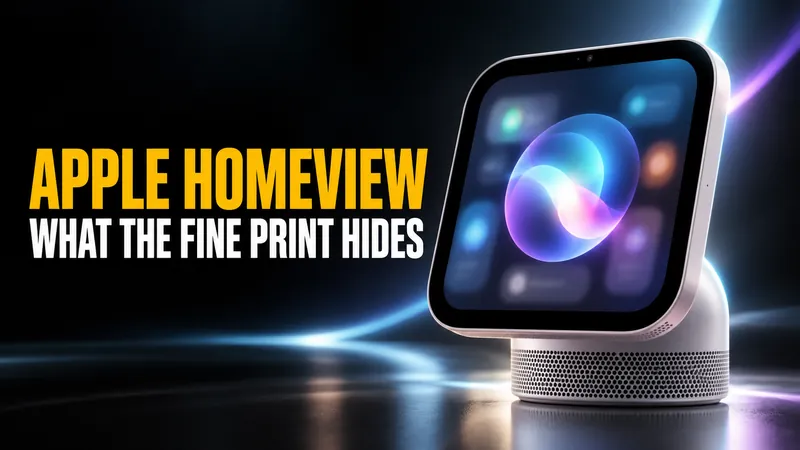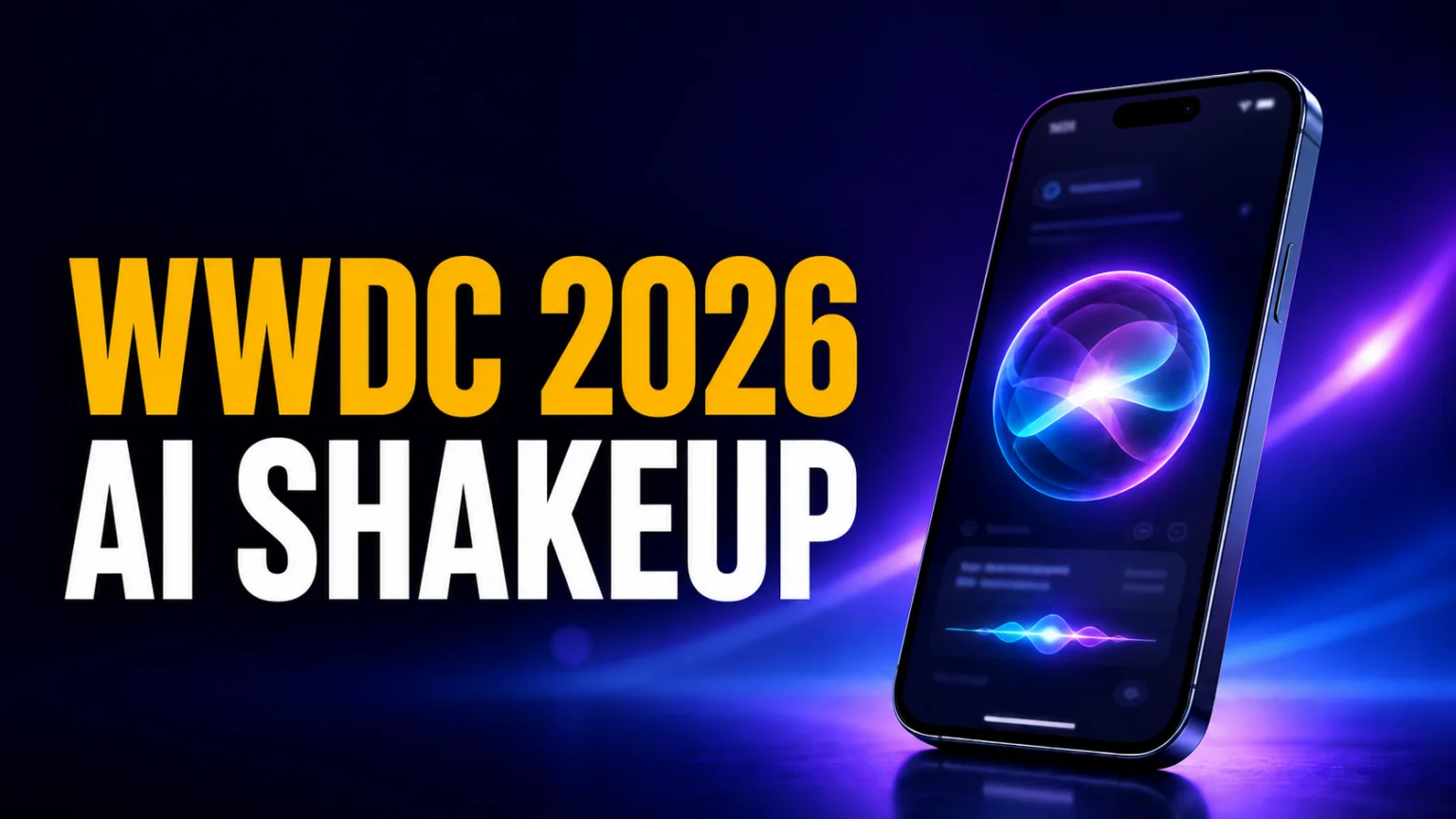
WWDC 2026 ran June 8 to 12, 2026, with the keynote on Monday, June 8 at 10am Pacific Time, streamed on Apple.com, the Apple TV app, and the Apple YouTube channel. Apple sent media invites on May 18, 2026 confirming the full schedule, and on May 23 registered a genai.apple.com subdomain that MacRumors spotted and that has still not gone live.
This preview went up before the keynote, and the keynote turned out to be the most consequential AI moment Apple has ever had. On January 12, 2026, Apple and Google jointly announced that the next generation of Apple Foundation Models would be built on a custom 1.2-trillion-parameter Google Gemini model, reportedly for around $1 billion per year. That part shipped. The other half of the story going in, that the same iOS 27 release would open Siri to Claude, ChatGPT, and other third-party AI through a new Extensions system, did not. Below is what Apple had confirmed, what was leaked, and how each one actually resolved.
Update, 10 September 2026: WWDC 2026 has happened and iOS 27 ships on Monday, 14 September 2026. Apple announced Siri AI, but it never announced the third-party Extensions framework previewed below, and it still has not. ChatGPT remains the only AI Siri can hand off to. The “Gemini-powered Siri” shorthand used below is what everyone called it before the keynote, and Apple disputes it: Siri AI runs on Apple Foundation Models that Apple refined using Gemini outputs, and Craig Federighi said Apple uses “none of the models that Google deploys to their customers.” Siri AI itself arrives gated, as an English-only beta behind a waitlist, on iPhone 15 Pro and newer, and it does not reach EU iPhones. For what Apple actually announced, read our full WWDC 2026 recap, and for the shipping release see our iOS 27 guide.
The Key Takeaways
- The WWDC 2026 keynote was Monday, June 8, 2026 at 10am PT (1pm ET, 6pm UK), streamed on Apple.com, the Apple TV app, and the Apple YouTube channel.
- Apple and Google officially announced their AI partnership on January 12, 2026. A custom 1.2-trillion-parameter Gemini model, eight times larger than Apple’s then-current 150-billion-parameter foundation model, powers the new Siri AI. Apple is reportedly paying around $1 billion per year for it, per Bloomberg’s November 2025 reporting.
- The Extensions framework never arrived. Bloomberg reported in March 2026 that iOS 27, iPadOS 27, and macOS 27 would open Siri, Writing Tools, and Image Playground to Claude, ChatGPT, and Gemini, and matching strings turned up in iOS 27 test builds on May 5, 2026. Apple has never announced it, the framework is still switched off, and ChatGPT is the only extension Apple has ever shipped.
- Apple registered a new genai.apple.com subdomain on May 23, spotted by MacRumors leaker Aaron Perris and read at the time as a public-facing AI hub timed to WWDC. It never launched, and the domain still does not resolve.
- Siri 2.0 was real, and it is called Siri AI. The chatbot-style redesign, the Dynamic Island treatment, the dedicated Siri app, conversation history, and multi-step task handling all shipped, but the rollout is gated: an English-only beta behind a waitlist, iPhone 15 Pro and newer, and not on EU iPhones.
- iOS 27 supports iPhone 11 and later, plus iPhone SE (2nd gen) and newer (a pre-launch leak predicting an iPhone 11 drop did not pan out). Apple Intelligence still requires iPhone 15 Pro or newer. macOS 27 is Apple silicon only.
- Photos AI tools shipped. Bloomberg had warned that Extend and Reframe might slip or be scaled back; both are in the iOS 27 build, as Extend and Spatial Reframing, alongside a Clean Up that handles larger distractions.
When Was WWDC 2026? Date, Keynote, and How It Streamed
WWDC 2026 ran from June 8 to June 12, 2026. The keynote started on Monday, June 8 at 10am Pacific Time, which was 1pm Eastern, 6pm UK, and 7pm Central European Time. Apple sent media invites on May 18, 2026, and streamed the full keynote for the first time across three channels, Apple.com, the Apple TV app, and the Apple YouTube channel. A small group of developers and students watched in person at Apple Park.
The format mirrored recent years. The conference was hybrid, online globally with over a hundred video sessions, group labs, and engineer Q&As running through the week, and the Platforms State of the Union followed the keynote at 1pm Pacific. Apple’s own confirmation had said the event would spotlight “incredible updates for Apple platforms, including AI advancements and exciting new software and developer tools.” That was unusually direct AI signaling from a company that has historically been quiet about machine learning until showtime, and it read correctly.
Apple x Google’s Gemini-for-Siri Deal: What Is Actually Confirmed
This is the single biggest AI story Apple has ever told, and it is no longer a rumor. On January 12, 2026, Apple and Google posted a joint statement confirming “a multi-year collaboration under which the next generation of Apple Foundation Models will be based on Google’s Gemini models and cloud technology.” The statement adds that these models “will help power future Apple Intelligence features, including a more personalized Siri coming this year.” Apple determined that “Google’s technology provides the most capable foundation for Apple Foundation Models.”
The financial and technical specifics come from Bloomberg’s November 2025 reporting and have not been disputed since. Apple is reportedly paying around $1 billion per year for access to a custom 1.2-trillion-parameter Gemini model, eight times the size of Apple’s existing 150-billion-parameter cloud foundation model. The model uses a mixture-of-experts architecture tuned for summarization, planning, and natural-language understanding, which maps directly to how Siri parses and answers compound questions.
On Apple’s Q1 2026 earnings call, Tim Cook framed the partnership carefully. “You should think of it as a collaboration. And we’ll obviously independently continue to do some of our own stuff,” he said. On the financial terms, Cook only added, “We’re not releasing the details of that.” All Gemini queries route through Apple’s Private Cloud Compute architecture, the same hardware-isolated server stack that handles Apple Intelligence today. Apple says queries are anonymized, not stored, and never used to train future Google models.
The first user-facing Gemini features were originally targeted for iOS 26.4, but 9to5Mac reported on February 11 that Apple was spreading them over later 26.x updates rather than the single 26.4 release. The full Siri reveal was saved for WWDC on June 8, and the rebuilt assistant ships inside iOS 27 on 14 September 2026, comfortably inside the December 31, 2026 deadline the agreement set.
What Apple Had Confirmed Before WWDC 2026
Going into the keynote, Apple had confirmed the dates, the keynote time, the hybrid format, the in-person Apple Park event, the three-channel stream, and the AI focus. The company’s own promotional graphic teased a redesigned Siri interface, with MacRumors reporting that the swirling cursor and glow effect in the artwork matched leaked details about the new Dynamic Island integration. That one landed.
The OS lineup was implicit but confirmed by Apple’s developer page: iOS 27, iPadOS 27, macOS 27, watchOS 27, tvOS 27, and visionOS 27. Apple unified version numbers the year before, starting at 26, so all platforms share the same number going forward. Everything past that list was leak territory. The compatibility list and the Photos tools held up. The Extensions UI did not, because Apple never put it on stage or in a newsroom release.
One fresh signal arrived on May 23, 2026. MacRumors leaker Aaron Perris spotted that Apple had registered a new genai.apple.com subdomain. The timing two weeks ahead of WWDC read as a public-facing generative AI hub, possibly a marketing page for the Gemini-powered Siri rollout, and “GenAI” would have been a notable departure from Apple’s preference for “Apple Intelligence” branding. Nothing came of it. The domain still does not resolve, and Apple stayed with Apple Intelligence.
Siri 2.0: The Biggest iOS 27 Story
The Siri overhaul was the headline, and this is the part the leaks got right. MacRumors and AppleInsider described a Siri that behaves like a chatbot rather than a voice command parser, with a glowing border on the Dynamic Island when you invoke it and a dedicated Siri app preinstalled on iOS 27 and macOS 27, where you hold back-and-forth conversations and keep a history just as you would in Claude or ChatGPT. That is what Apple announced in June and what ships as Siri AI.
Capability-wise, the leaks pointed to three big upgrades, and all three made the cut. Siri handles multi-step tasks across apps from a single command, like “find the email from my landlord, summarize it, and add the rent date to my calendar.” Personal context awareness pulls from your messages, mail, and calendar. On-screen awareness lets Siri see what is on your iPhone or Mac at the moment of the request, so you can ask about a photo, an article, or a Maps result without describing it. Reviewers testing the beta found it capable but unfinished, tapping out on some device-settings questions and leaning heavily on Apple’s own apps.
Underneath, the heavy lifting runs on the 1.2-trillion-parameter Gemini model. That is the engine, and it is the half of this story that survived. The Extensions framework that was supposed to sit on top of it, letting you swap in Claude or ChatGPT, is the half that did not, so what you actually get is a stronger default Siri without the routing layer. Mark Gurman framed the broader project as Apple’s catch-up moment. Siri had been behind ChatGPT, Claude, and Gemini for two years, and Apple needed a credible chatbot to stop hemorrhaging mindshare.
The May 5 find was read as a confirmation, and that was the mistake. 9to5Mac and MacRumors reported on May 5, 2026 that the Extensions framework was visible inside iOS 27 test builds, carrying an internal description: “Extensions allow you to access generative AI capabilities from installed apps on demand, through Apple Intelligence features such as Siri, Writing Tools, Image Playground and more.” Internal strings in a test build are not an announcement. Apple never repeated that language on stage or in a newsroom release, and the framework is still disabled.
iOS 27 Extensions: The Claude and Gemini Siri Swap That Never Shipped
This was billed as the single biggest piece of news for anyone who already uses third-party AI on Apple devices. The reported Extensions framework in iOS 27, iPadOS 27, and macOS 27 would let you pick which AI assistant Siri hands off to, breaking the ChatGPT exclusivity that iOS 26 set up and treating Claude, Gemini, and ChatGPT as peers, with the door open to Grok and anyone else who shipped support. It did not happen. Apple has never announced Extensions, and on the iOS 26 release and the iOS 27 beta alike the handoff still goes to ChatGPT and only ChatGPT.
The reporting described a list of installed AI apps in the Apple Intelligence section of Settings, working the way default browsers and email apps do today, with Anthropic and Google named by Bloomberg as the first two third-party partners Apple was testing. Open that screen now and you find one entry, ChatGPT, because it is the only integration Apple has ever shipped. If you want Claude or Gemini answering instead, the working routes are the Action button and app-published shortcuts, which our guide to replacing Siri with ChatGPT, Claude or Gemini walks through step by step.
The strategic shift would have been enormous. On-device Apple Intelligence handles the routine work, the Gemini-powered Siri handles most cloud queries by default, and a third party handles the cases where you prefer a different model. Two of those three are true today. The third is the one that would have made the choice of AI app matter more than the choice of operating system, and Apple has not taken that step.
One UX detail surfaced on May 5 that nobody had reported before, voice differentiation per provider. The beta strings suggested that when Siri answers you hear Apple’s voice, and when Claude, Gemini, or another provider handles a query you hear a voice tied to that provider, so it is always clear which AI is talking. MacRumors also described a single toggle that would route Siri, Writing Tools, and Image Playground to your chosen provider at once. Both details belong to the same unshipped framework, so neither is something you can try.
If you are buying a new Mac with a multi-AI workflow in mind, the ChatGPT vs Claude vs Gemini on Mac comparison is a sensible starting point. Installing one app that already handles all five major models avoids the friction of juggling separate accounts and subscriptions.
The Multi-Model AI App
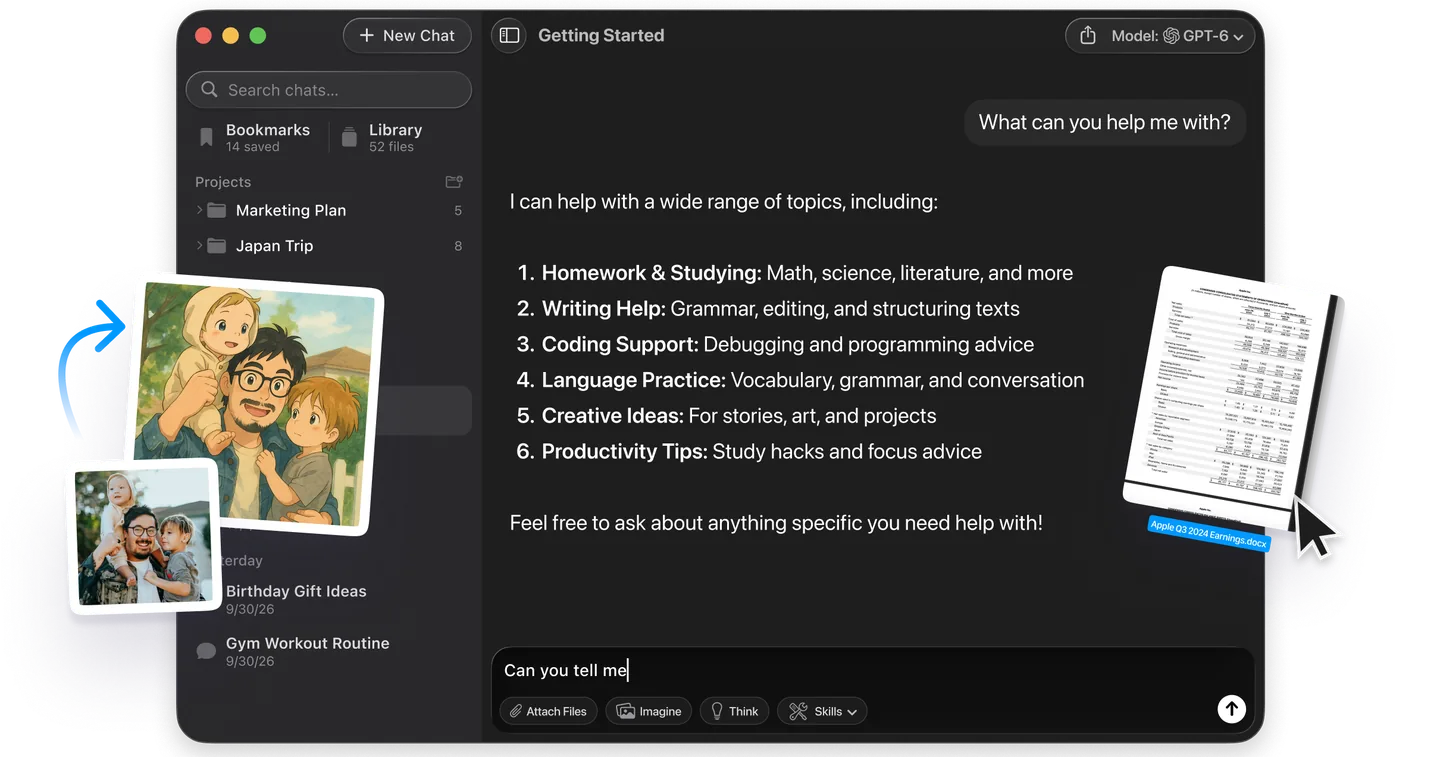
This is also where Fello AI fits the picture cleanly, and the case got stronger when Extensions did not ship. Rather than installing the ChatGPT, Claude, Gemini, Grok, and DeepSeek apps separately and managing five subscriptions, Fello AI gives you Claude, ChatGPT, Gemini, Grok, and DeepSeek in one native Mac and iPhone app for $9.99 per month, with no API keys and no provider lock-in. It carries 25,000+ five-star reviews across the App Store. With Siri still routing to a single provider, a multi-model app is how you actually keep more than one model on the device.
Other iOS 27 and macOS 27 Features Leaked Ahead of WWDC 2026
Beyond Siri, Visual Intelligence was tipped for the biggest expansion. iOS 27 leaks, surfaced by MacRumors on April 16 from internal code strings, pointed to a dedicated Siri Camera Mode in the Camera app’s mode strip, plus scanning food nutrition labels into Health, pulling phone numbers and addresses from photos into Contacts, generating Wallet passes from event tickets and membership cards, and naming Safari Tab Groups automatically. Safari’s automatic tab organization is confirmed and in the iOS 27 beta. The rest of that list came from code strings and we have not been able to confirm it in Apple’s own material, so treat the Camera Mode and Wallet items as unverified.
The Photos app gets a dedicated Apple Intelligence Tools section, first reported by Bloomberg on April 28 and picked up by MacRumors and 9to5Mac the same day. Bloomberg warned that internal testing had been bumpy and that Extend and Reframe could ship later or scaled back. They made it, and both are in the iOS 27 public beta. Extend generates image content beyond the original frame when you crop or zoom out, and Spatial Reframing shifts the apparent camera angle after the shot, alongside a Clean Up that handles larger distractions. macOS 27 picks up the AI-driven Safari that groups tabs by theme, plus the redesigned Liquid Glass intensity slider you can dial down if the iOS 26 transparency makes you queasy.
iOS 27 was also tipped to expand satellite connectivity. According to Digit.in and other leakers, Apple Maps would work over satellite for offline navigation, and Messages would send and receive photos over satellite for the first time. That one is still leak-only. We have not been able to confirm either feature in Apple’s own material, so it stays in the leak column rather than the shipped one.
The Snow Leopard Year
The Snow Leopard framing was the other through-line, and it held up. Mark Gurman reported that Apple’s engineering teams spent the year hunting down bloat and bugs rather than racing for new features, and the beta does land as a release built around speed, battery life, and reliability, with the system-wide intensity slider that lets you tune the Liquid Glass transparency and motion that shipped in iOS 26. The wrinkle is that it is not a quiet year at all, because the Siri AI rebuild sits on top of it. Call it Snow Leopard with a brain.
iOS 27 and macOS 27 Compatibility
iOS 27 keeps support for the iPhone 11, iPhone 11 Pro, iPhone 11 Pro Max, and iPhone SE (2nd generation), the same lineup as iOS 26. A MacRumors leak published April 21, 2026 predicted those models would be dropped, but Apple kept them. Siri AI is restricted to iPhone 15 Pro and newer, and even there it is an English-only beta behind a waitlist that does not reach EU iPhones. macOS 27 is Apple silicon only, so any Intel Mac is out. See our full iOS 27 supported devices guide for the confirmed list.
| Device tier | iOS 27 | Apple Intelligence | Siri AI |
|---|---|---|---|
| iPhone 15 Pro, iPhone 16, iPhone 17 series | Yes | Yes | Yes, English-only beta behind a waitlist, not on EU iPhones |
| iPhone 12, 13, 14, 15 (non-Pro) | Yes | No | No |
| iPhone 11, 11 Pro, 11 Pro Max, SE (2nd gen) | Yes | No | No |
| iPhone SE (3rd gen) | Yes | No | No |
| Macs | Apple silicon only (M1 or later) | Apple silicon only | Apple silicon only |
Hardware Rumors: M5 Mac mini, iMac, and Mac Studio
WWDC has historically been a software event, but Apple does occasionally drop hardware on stage. The strongest rumors for WWDC 2026 centred on the M5 chip family. The base M5 was tipped for a refreshed Mac mini, possibly alongside an M5 Pro variant, with Macworld flagging that supply shortages could push the release later in the year, and the M5 Max and M5 Ultra Mac Studio was widely reported as delayed to October 2026 on high-bandwidth memory constraints. AppleInsider summed up the broader expectation in a May 18 piece bluntly titled “Don’t expect new Macs at WWDC 2026.” That is roughly how it played out, with one date wrong. No Macs appeared at the keynote, and Apple announced the M5 Max and M5 Ultra Mac Studio on 25 August 2026 in a newsroom post rather than at an event, alongside a Mac mini carrying the M6 and M5 Pro rather than the base M5. Both machines ship on 22 September, earlier than the October date the spring reporting pointed at, although the 512GB Mac Studio configuration does slip to late October. Our M5 Ultra Mac Studio breakdown has the specifications, the memory prices and who the tier is actually for.
The bigger hardware story was always going to be Apple’s September iPhone event rather than WWDC, and iOS 27’s multitasking architecture is shaped around the long-rumored foldable iPhone. Our iPhone buying guide covers that line-up, the prices, and whether the new Apple Intelligence features need new hardware at all.
What WWDC 2026 Means for Mac and iPhone AI Users
If you already use AI heavily on your Mac or iPhone, WWDC 2026 changed one thing and left another exactly where it was. The change: Apple has effectively conceded the foundation-model race to Google for this generation, while keeping the user-facing layer, Apple Intelligence, Private Cloud Compute, and the new Siri app, under its own roof. What did not change is the part the pre-keynote coverage led with. Siri is still a closed system tied to OpenAI, the Extensions framework that would have let you route queries to the model you prefer was never announced, and ChatGPT is still the only handoff on offer.
For most readers this argues for keeping a multi-model app installed regardless of which AI you currently favor, and the months since WWDC have made the point for us. In the weeks around the keynote, GPT-5.5 Instant arrived as the new ChatGPT default, Claude Opus 4.7 led on agentic coding benchmarks, Gemini 3.5 Flash went generally available at Google I/O 2026, and DeepSeek V4 Pro undercut everyone on price. Every one of those has since been superseded or repriced. Our best AI models comparison tracks the current order.
The other shift worth flagging is the rise of agent-class apps running alongside the chatbots. Perplexity Personal Computer launched for all Pro and Max users on May 7. OpenAI Codex Mobile launched May 14 and lets you steer Mac-based Codex sessions from your iPhone. Claude Cowork and Claude for Small Business push into desk work. Apple’s June 8 reveal of Siri AI landed in a market where third-party agents already existed on Mac. If your AI work is less “chat with the model” and more “have it run tasks across files,” you have had options for a while.
Locking yourself into a single vendor is the wrong move, and the Extensions story is the reason why. Fello AI is built for exactly this market. For $9.99 per month you get Claude, ChatGPT, Gemini, Grok, and DeepSeek in one native Mac and iPhone app, no API keys, 25,000+ five-star reviews. You also keep your conversation history when you switch models inside a single thread.
WWDC 2026: What Was Confirmed, What Was Leaked, and How It Resolved
| Topic | Status | Source / detail |
|---|---|---|
| WWDC 2026 dates (June 8 to 12) | Confirmed | Apple Newsroom; invites sent May 18, 2026 |
| Keynote at 10am PT, June 8 | Confirmed | Apple Newsroom |
| Stream on Apple.com, Apple TV app, YouTube | Confirmed | Apple Newsroom (May 18, 2026) |
| Apple-Google Gemini partnership for Siri | Confirmed | Joint Apple-Google statement, January 12, 2026 |
| 1.2T-parameter custom Gemini model, ~$1B/year | Reported | Bloomberg, November 5, 2025; Apple has not disclosed terms |
| iOS 27, iPadOS 27, macOS 27, watchOS 27, tvOS 27, visionOS 27 | Confirmed | Apple Newsroom |
| genai.apple.com subdomain registered | Never launched | Aaron Perris / MacRumors, May 23, 2026; the domain still does not resolve |
| Siri 2.0 chatbot-style redesign | Shipped, gated | Announced at WWDC as Siri AI; English-only beta behind a waitlist, iPhone 15 Pro and newer, not on EU iPhones |
| Extensions framework (Claude, Gemini, ChatGPT) | Never announced | Bloomberg (March 2026) and beta strings found by 9to5Mac and MacRumors (May 5, 2026); Apple has never announced it, and ChatGPT remains the only Siri extension |
| Extensions voice differentiation per AI provider | Never announced | MacRumors, May 5, 2026; part of the same unshipped framework |
| Photos AI tools: Extend and Reframe | Shipped | Bloomberg, April 28, 2026; both are in iOS 27 as Extend and Spatial Reframing despite the slip warning |
| Safari AI tab grouping | Shipped | MacRumors; confirmed in iOS 27 and macOS 27 |
| Siri Camera Mode + Visual Intelligence expansions | Leaked, unconfirmed | MacRumors, April 16, 2026; from code strings, not confirmed by Apple |
| iOS 27 satellite Messages and Maps | Leaked, unconfirmed | Digit.in; not confirmed by Apple |
| iOS 27 dropping iPhone 11 / 11 Pro / 11 Pro Max / SE 2 | Did not pan out | MacRumors, April 21, 2026; Apple kept iPhone 11 and SE 2 support |
| Snow Leopard-style stability focus | Held up | Mark Gurman, Bloomberg; iOS 27 leads on speed and battery, with the Siri AI rebuild on top |
| M5 Mac mini at WWDC; M5 Ultra Mac Studio delayed to October | Half right, resolved 25 August | Macworld, AppleInsider (May 2026); no Macs at WWDC, but Apple announced the M6 and M5 Pro Mac mini and the M5 Max and M5 Ultra Mac Studio on 25 August 2026, shipping 22 September |
| Foldable iPhone iOS 27 multitasking | Rumored | Mark Gurman; a September iPhone story, not a WWDC one |
Conclusion
WWDC 2026 will be remembered for two things, the moment Siri finally became a real chatbot and the moment Apple stopped pretending it was building the foundation model itself. It will not be remembered for the headline this preview led with. Third-party Extensions were reported, found in beta strings, and never announced, and Siri still hands off to ChatGPT alone.
If you are an AI-first Mac or iPhone user, the practical takeaway from May still stands, and the keynote only sharpened it. You cannot route Siri to the model of your choice, so the model choice has to live in an app you install. Get Fello AI on the App Store if you want one app that already handles Claude, ChatGPT, Gemini, Grok, and DeepSeek for $9.99 per month.
FAQ
When was WWDC 2026?
WWDC 2026 ran from June 8 to June 12, 2026. The keynote was on Monday, June 8 at 10am Pacific Time (1pm Eastern, 6pm UK). Apple streamed it on Apple.com, the Apple TV app, and the Apple YouTube channel, and the sessions are still there to watch back.
Was WWDC 2026 free to attend?
Yes, the online portion was free for all developers worldwide. The in-person Apple Park event on June 8 was invite-only and capacity-limited. The keynote and the session library remain free to stream on apple.com, the Apple TV app, and Apple’s YouTube channel.
How much is Apple paying Google for Gemini?
Bloomberg reported on November 5, 2025 that Apple is paying around $1 billion per year for access to a custom 1.2-trillion-parameter Google Gemini model, eight times larger than Apple’s current 150-billion-parameter foundation model. Apple and Google announced the deal jointly on January 12, 2026, but Tim Cook declined to confirm the price on Apple’s Q1 2026 earnings call.
Will iOS 27 work on my iPhone?
iOS 27 supports iPhone 11 and newer, plus the iPhone SE (2nd gen and later), the same list as iOS 26, and it ships on Monday, 14 September 2026. An April 21, 2026 MacRumors leak predicted iPhone 11 and SE 2 would be dropped, but Apple kept them. The new Siri AI stays restricted to iPhone 15 Pro and newer, and even there it is an English-only beta behind a waitlist that does not reach EU iPhones. macOS 27 is Apple silicon only, so M-series Macs only.
Can I use Claude or Gemini instead of ChatGPT in Siri?
No. ChatGPT is the only AI Siri hands off to, on iOS 26 and on iOS 27. An Extensions framework that would let you pick Claude or Gemini for Siri, Writing Tools, and Image Playground was reported by Bloomberg in March 2026 and found in iOS 27 beta strings on May 5, 2026, but Apple has never announced it and it is switched off. The routes that do work are the Action button and app-published shortcuts, covered in our guide to replacing Siri. Note that the default Siri itself runs on Apple’s own foundation models either way, not on a Gemini model.
When does Gemini-powered Siri launch?
Apple demoed the new Siri at WWDC on June 8, 2026, and it ships as Siri AI with iOS 27 on Monday, 14 September 2026. It arrives gated: an English-only beta behind a waitlist, on iPhone 15 Pro and newer, and it is not coming to EU iPhones for now, though EU Macs do get it. Earlier Gemini-powered context features were originally targeted for iOS 26.4 but were spread across later 26.x updates instead, per a 9to5Mac report on February 11.
What is the best AI app for Mac and iPhone in 2026?
For most users, a multi-model app is the safest bet because models leapfrog each other every few months. Fello AI bundles Claude, ChatGPT, Gemini, Grok, and DeepSeek in one Mac and iPhone app for $9.99 per month, with no API keys and 25,000+ five-star reviews. It is the simplest way to keep your options open, and it matters more now that iOS 27 is arriving without the Extensions switch.