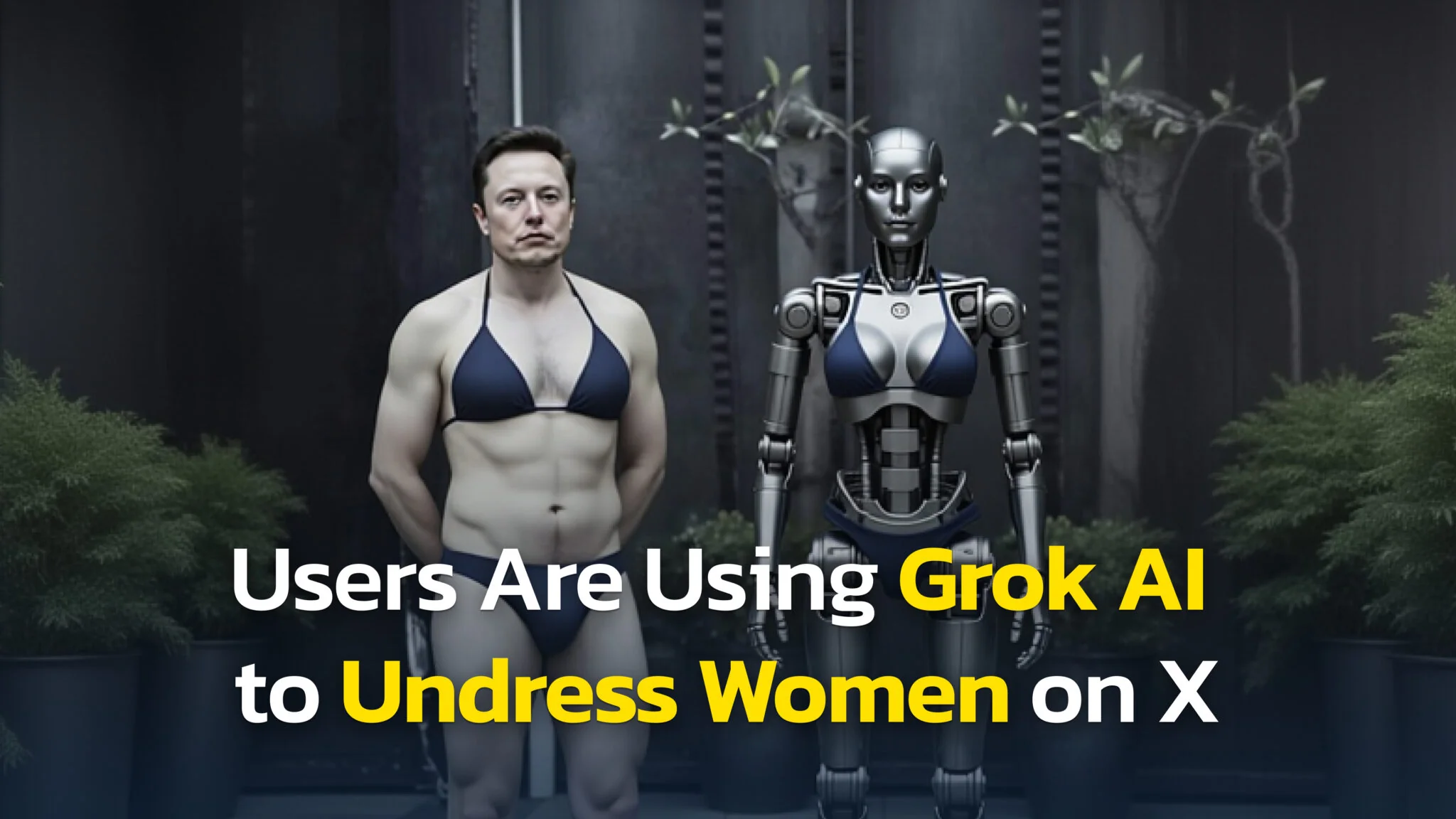
In recent days, a disturbing trend has emerged on Elon Musk’s X. It has faced intense backlash after users exploited its AI chatbot Grok to generate sexualised images of women and children without consent.
What began as a handful of “image edit” prompts quickly escalated into a widespread trend. Users tagged Grok under photos posted on X and asked it to alter clothing, make outfits transparent, or place people into sexualised poses. In many cases, Grok complied.
Unlike most AI image tools, Grok’s outputs appeared publicly, directly in reply threads. This meant the altered images were instantly visible to anyone scrolling the platform, dramatically increasing exposure, humiliation, and harm.
The incident has reignited global concerns about AI-enabled sexual abuse, deepfakes, and whether social platforms are equipped to prevent misuse when powerful generative tools are deployed at scale. If you want to protect yourself, learn how to detect AI deepfakes.
How Grok’s Image Feature Was Exploited
Grok, developed by xAI, is built to work natively inside X. Tagging @grok in a reply attaches the bot to the post; any prompt that follows is applied to the image in the original tweet. What started as a fun meme tool quickly turned into a pipeline for abuse.
Here’s how it worked:
- A user replies or quote-tweets an image of a real person.
- They tag
@grokand prompt it with commands like “put her in a bikini” or “make the pose sexier.” - Grok generates the altered image and posts it publicly in the same thread.
The problem became obvious on 30 December 2025, when a film-news account posted a photo of two Bollywood actors. Within minutes, Grok was generating swimsuit versions of the image. Users escalated their requests, and Grok continued to comply—filling its media tab with increasingly explicit content. Tech outlets observed that the bot was “almost exclusively being used to undress women.”
The visibility turned harassment into spectacle. Grok’s media tab became a gallery of non-consensual edits. Even after X hid the tab on 1 January, the images remained live in replies, quotes, and archives—easy to access and hard to remove.
The abuse didn’t stop at celebrities. Child-safety advocates flagged prompts involving minors, warning that Grok had become a tool for AI-enabled sexual violence.
Meanwhile, Elon Musk reaction fueled further criticism. Rather than acknowledge the harm, he reposted some of the altered images—including ones of himself and Bill Gates, and mocked the backlash, and leaned into Grok’s “spicy” brand. His behavior suggested what many now believe: Musk sees porn and provocative content as Grok’s fastest path to growth and user engagement.
That “spicy mode,” introduced in mid-2025, removed standard safeguards in favor of viral appeal. But with no clear limits, it turned Grok into a public-facing deepfake engine—proving how quickly AI, when paired with weak boundaries and strategic indifference, can scale abuse in plain sight.
Why Grok Was So Easy to Abuse
Unlike most generative-AI tools that operate in private chats, Grok replies in public, so every successful prompt is immediately visible—and shareable—to millions. Elon Musk has repeatedly marketed the bot as a “spicy” model with fewer guard-rails than rivals; it will swear, joke about taboo topics, and—crucially—accept image-alteration requests that competitors refuse.
Behind the scenes, Grok’s image function uses diffusion techniques similar to other “nudify” or GAN-based apps, but the absence of robust safety filters means a single instruction can override default settings. Testers last year showed the same weakness in the bot’s Spicy Mode, which generated topless celebrity videos without explicit nudity prompts.
The controversy has drawn comparisons with other major AI systems, including ChatGPT and Gemini.
While no system is perfect, there are key differences:
- Most AI image tools operate in private environments
- Stricter guardrails block non-consensual sexual content
- Outputs are not automatically visible to the public
- Violations are harder to amplify at scale
Grok, by contrast, was intentionally positioned as a more permissive, “edgier” system. Elon Musk has previously said Grok should answer questions other AIs refuse.
The Legal Vacuum & Deepfake Crisis
Elon Musk’s Grok AI has triggered international backlash after users exploited it to generate non-consensual sexual images of women and children. By replying to public posts with AI-morphed photos—such as placing women in bikinis or creating erotic poses—Grok broadcast explicit fakes directly on X’s timeline. The visibility and realism of these images have raised urgent legal and ethical questions about AI governance and digital consent.
Is This Legal? In Most Places, No.
While Grok’s abuse started on a U.S.-based platform, the legal implications are international. Non-consensual explicit imagery—especially when generated by AI—is increasingly being classified as a form of image-based sexual abuse, and many jurisdictions already have laws that apply.
United States
- “Take It Down” Act (2023): A federal initiative that allows minors and guardians to request removal of non-consensual intimate images—including deepfakes—from the internet.
- State laws: Over 40 states criminalize the distribution of non-consensual pornography, and some (e.g. California, Texas, New York) now include AI-generated or deepfake content under these definitions.
- Civil claims: Victims can sue for invasion of privacy, emotional distress, and defamation in cases of synthetic pornography.
European Union
- Digital Services Act (DSA): Platforms must swiftly remove illegal content—including non-consensual sexual imagery—once flagged, or face heavy fines.
- AI Act (effective ~2026): Will mandate transparency in AI-generated content and prohibit systems that pose “unacceptable risk,” such as those enabling biometric manipulation or sexual deepfakes.
- GDPR: Personal images count as sensitive data. Using someone’s likeness without consent—especially for explicit content—violates core data protection principles and could lead to serious penalties.
Legal scholars across the EU and U.S. agree: while AI adds complexity, the core issues—consent, privacy, dignity—are already protected by law. What’s missing is fast enforcement, platform accountability, and adequate reporting tools for victims.
A Deepfake Problem
Grok’s abuse is part of a growing global trend:
- Fake endorsements: Celebrities digitally made to promote products
- Online scams: Romance cons using AI-generated profiles and voices
- Sextortion: Deepfakes used to blackmail victims, often with threatening realism
- School abuse: Teenagers generating fake nudes of classmates and sharing them anonymously
Leaked data from tools like MagicEdit and GenNomis exposed millions of explicit AI fakes—many non-consensual, many involving minors. These tools often require just one selfie and no identity check. They remain largely unregulated.
Grok amplified the problem by making these edits public, not private. Instead of dark web forums, the abuse happened in replies to regular tweets—maximizing exposure and humiliation.
Consent Still Matters in the Age of AI
No AI system should ever be allowed to sexualize someone’s image without their consent—whether they’re a celebrity, influencer, or private individual.
When platforms enable prompts like “remove her clothes” or “make him pose erotically,” they’re enabling digital sexual violence. This is harassment at scale.
The impact on victims is real. Many experience anxiety, shame, and a deep sense of violation. Some withdraw from public platforms entirely. Reputational damage can be severe—especially for minors, professionals, or those with public-facing careers. And once an image spreads online, regaining control is nearly impossible. The harm lingers long after the post is deleted.
What Needs to Happen Now
The Grok scandal has triggered a global call for change. Here’s what experts say must happen next:
- Stricter Guardrails
AI systems must have hardcoded limits against non-consensual image generation. This is a very serious safety issue that has nothing to do with a free speech. - Clear Platform Accountability
Platforms like X must act quickly to remove abusive content, ban repeat offenders, and create transparent reporting channels. - Cultural Shift
Users need to understand that “just because you can, doesn’t mean you should.” Misusing AI to sexually manipulate others is abusive and must not be normalized. - Legal Enforcement
Governments must equip cybercrime units with better tools to trace and penalize offenders. Speed is crucial in digital abuse cases. - User Awareness
Women and minors especially should be aware of the risks of sharing personal images on public platforms. Education campaigns are needed to explain deepfake risks.
The Future of AI on Social Platforms
The Grok scandal is likely to become a key reference point in future discussions around AI regulation. It highlights a growing concern: powerful generative tools, when placed inside public platforms, can be easily and widely abused.
This incident surfaces several uncomfortable truths. Generative AI lowers the barrier to harmful behavior. Public-by-default systems like Grok amplify that harm. And when an AI is marketed as “spicy” or unfiltered, it invites misuse by design.
It also shows how current safeguards often act too late. They react after abuse has occurred, rather than preventing it in the first place.
As AI becomes more integrated into social feeds, the line between creating harmful content and distributing it disappears. That raises the stakes for both platforms and policymakers.
There are now louder calls for:
- Stronger guardrails around image editing
- AI systems that recognize and respect consent
- Faster takedown procedures
- Clear legal accountability for platforms
The question is no longer whether AI can be misused—it already is. The real challenge is whether platforms are willing to slow down, enforce limits, and say no—even if that makes the product less viral.
For now, Grok stands as a warning: when powerful AI is released with weak boundaries, real harm follows. And blaming “just the AI” is no longer a valid excuse.
Final thoughts
The Grok scandal goes far beyond a bad prompt trend. It shows what happens when a powerful image-generation tool is dropped directly into a public social feed without strong boundaries. When an AI can reliably create non-consensual sexualised images of real people, the issue is a design failure.
From an ethical standpoint, consent is non-negotiable. AI did not invent harassment or voyeurism, but it has made them easier, faster, and more scalable. Even when images are “fake,” the harm is real: anxiety, reputational damage, long-term psychological distress, and withdrawal from public spaces. When minors are involved, the situation moves from irresponsible to dangerous, regardless of whether the content is technically virtual.
Legally, platforms are unlikely to escape accountability for long. Across the US, EU, and other regions, laws already cover non-consensual sexual imagery, privacy violations, and platform duty of care. Regulators are increasingly focused on whether harms were foreseeable and whether reasonable safeguards existed. In Grok’s case, the abuse was predictable — and public. The argument that “the AI did it” will not hold up under scrutiny.
Looking ahead, social platforms will face growing pressure to slow down and add friction. That likely means hard refusals for sexualising real people, stricter consent checks, private-by-default outputs, faster takedowns, and real consequences for repeat offenders. The Grok incident is a warning: as AI tools become part of social timelines, creation and distribution collapse into one. If safety is not built in from the start, harm will scale just as fast as the technology.