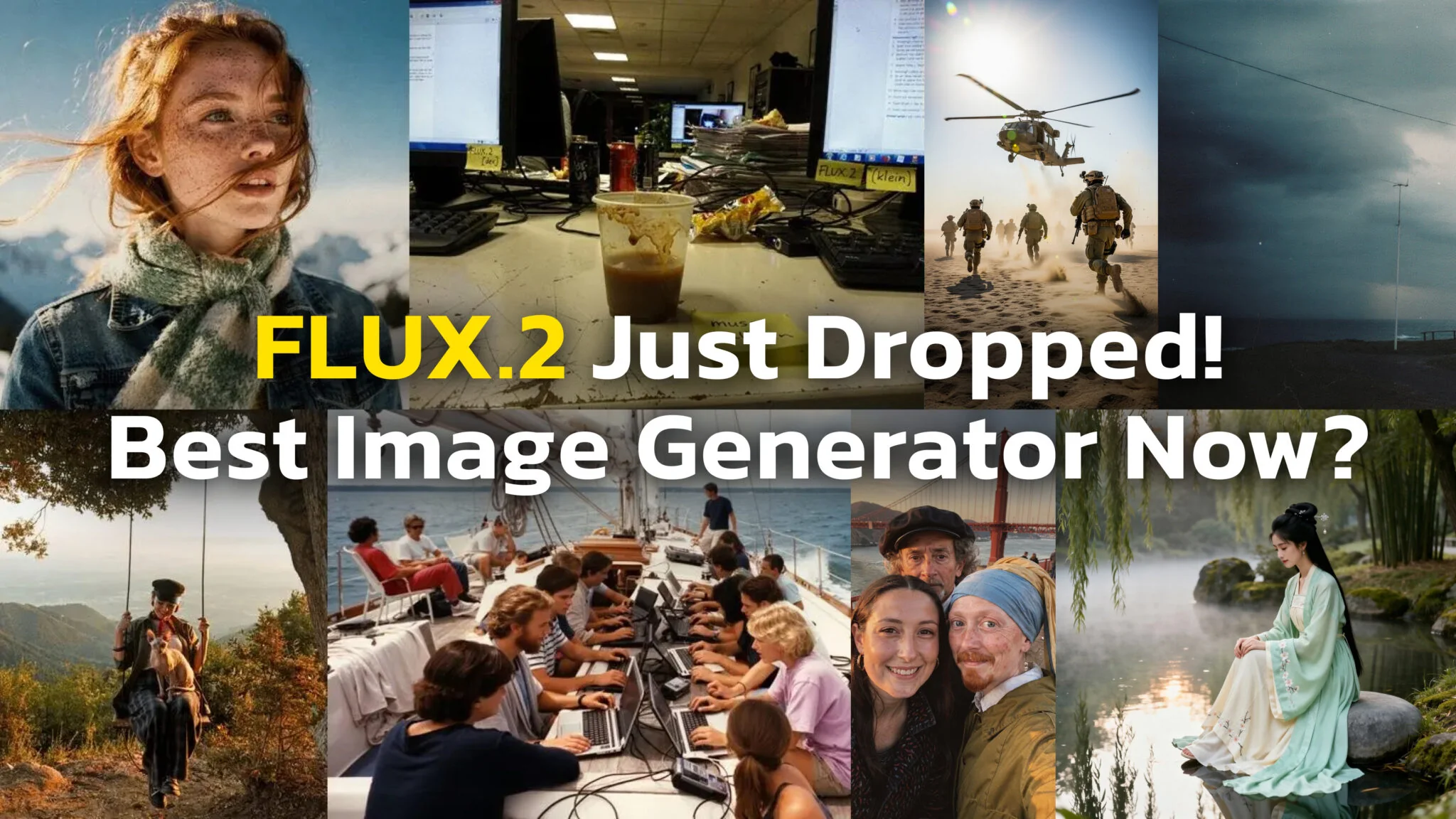
Today, November 25, 2025, Black Forest Labs released FLUX.2, a new family of image-generation models aimed directly at the high-end creative, marketing, and product-visualization markets. The company, founded in 2024 and known for its open-core approach to multimodal research, positions FLUX.2 as both a frontier-level image generator and a model that can actually hold up in real production workflows—something many AI tools still struggle with.
The release comes at a busy time for image-generation models. OpenAI’s GPT-4o tools, Google’s Imagen 4 and Nano Banana Pro, Midjourney v6, and Stability’s SD3 are all fighting for attention. FLUX.2 enters the mix with a clear focus: photorealism, consistent references, reliable text, and practical workflow control. Here’s a closer look at what’s new and how it stacks up. Black Forest Labs has since followed it with FLUX 3, which adds video generation.
What’s New in FLUX.2
FLUX.2 brings several major upgrades, many of which directly address the pain points of creative teams.
Multi-Reference Consistency
FLUX.2 can now take up to ten reference images at once, keeping characters, products, or styles perfectly consistent across an entire set of generations. This works for both new images and edits, and doesn’t require any fine-tuning or custom training. According to Black Forest Labs, it’s the most stable reference pipeline they’ve built so far.
For creative teams, this means you can generate full campaigns, product variations, or character sequences that actually match from image to image — something older models often failed at.
Higher Photorealism at 4MP Resolution
The model now supports 4-megapixel output, with sharper textures, more stable lighting, and better handling of materials like metal, fabric, wood, or skin. The goal is to remove the subtle “AI look” that many tools still produce.
This improvement comes from a redesigned latent space and a new FLUX.2 VAE described in the technical blog, which helps the model preserve detail while keeping generation flexible and fast.


Stronger Text Rendering
Text inside images has been a long-standing weakness for most generators. FLUX.2 makes a noticeable jump here: small fonts are readable, UI mockups look clean, and structured layouts (charts, menus, labels, infographics) hold their shape much better.
This matters for practical design work — app screens, posters, social assets, ads — where accuracy and legibility are essential, not optional.
Better Prompt Following
FLUX.2 handles complex instructions more reliably. It follows multi-step prompts, understands object relationships (“A on top of B”), and keeps compositions coherent even in busy scenes. The model also includes direct pose guidance, letting users specify the exact position or angle of a subject.
This level of control is especially useful for product shots, fashion photography, and any workflow where framing and placement need to stay consistent across many images.
Unified Generation & Editing
Unlike older systems that required switching between text-to-image and image-editing checkpoints, FLUX.2 unifies both workflows. You can generate an image, edit it, add references, or change the layout without swapping models or pipelines.
For teams working in tools like ComfyUI or via the BFL API, this reduces friction and makes iterative editing much faster.

Open-weights option with real hardware support.
The FLUX.2 [dev] model offers open weights on Hugging Face, and NVIDIA’s FP8 optimizations make it feasible to run on consumer-grade RTX GPUs. For teams that want to self-host or integrate image generation directly into their stack, this lowers deployment costs and provides much more flexibility than closed-only systems.
FLUX.2 vs. Other Leading Image Models
The image-generation space is moving fast in late 2025. OpenAI’s GPT-4o image tools, Google’s Imagen 4 and Nano Banana Pro, Midjourney v6, and Stability’s SD3 are all pushing toward higher realism, better text handling, and more control. FLUX.2 enters the field at a moment when competition is tight, and quality differences are getting smaller.
What makes FLUX.2 stand out is its focus on photoreal detail, reference stability, and predictable editing—features aimed at real production work, not just creative exploration.
While the leading players each have clear strengths—OpenAI in instruction accuracy, Google in raw photorealism and speed, Midjourney in stylization, and Stability in open-source innovation—FLUX.2 positions itself as a practical middle ground.
| Metric / Model | FLUX 2 [pro] | Google Imagen 4 | Google Nano Banana Pro | GPT-4o Image Gen | Midjourney v6 |
|---|---|---|---|---|---|
| Photorealism | High | Very high | Very high | High | High ( stylised ) |
| Native Resolution | 4 MP | 2 MP | 4 K | 2 MP | 4 K |
| Text & UI Rendering | Much improved | Strong | Very strong | Strongest | Weak |
| Reference Consistency | Up to 10 refs | Moderate | High | 1 ref | Limited |
| Pose Control | Direct pose + JSON | Limited | Partial | Limited | None |
| Speed (API median) | < 10 s | 6 s | 8 s | 12-16 s | 10-12 s |
| Watermarking | Optional | SynthID | SynthID | SynthID | None |
| LM Arena Score* | n/a (new) | 1 143 | 1 242 | 1 121 | n/a |
Early internal ELO tests cited by Black Forest Labs show FLUX 2 variants “score high while keeping inference costs low,” roughly matching Google’s Nano Banana Pro on price-per-image.
Several open-source models also remain important, especially for developers running image generation locally. Stability’s SD3, PixArt-α, Playground v3, and other diffusion-based systems offer strong flexibility and customizable pipelines, but they generally lag behind FLUX.2 [dev] in detail, prompt accuracy, reference consistency, and text rendering. For teams that need full control over deployment, these models are still valuable—but FLUX.2 now sets the performance bar for open weights.

Early Take
FLUX.2 lands with several clear advantages, but also a few practical limitations depending on how and where it’s used. Here are the key strengths that stand out so far, along with the main trade-offs teams should keep in mind when deciding whether to switch or integrate it into their workflows.
Strengths
- Multi-reference consistency (up to 10 images).
Keeps characters, products, and styles stable across dozens of outputs without fine-tuning — ideal for campaigns and product photography. - Direct pose and layout control.
Supports pose guidance and structured prompts, making object placement, framing, and complex compositions much easier to control. - Readable text and UI-friendly rendering.
Handles small fonts, UI elements, and infographics far more reliably than previous versions, reducing the need for manual cleanup. - Open-weights model with RTX FP8 optimizations.
The FLUX.2 [dev] version can run locally on consumer RTX GPUs with reduced VRAM requirements, giving teams a flexible and cost-efficient deployment option.
Trade-Offs
- No built-in watermarking or provenance.
Google’s Imagen models still offer the most seamless path for enterprises that require SynthID watermarking and Workspace integration. - Not as convenient for ChatGPT-only users.
If your workflow sits entirely inside ChatGPT and you don’t need multi-reference pipelines, GPT-4o image generation remains simpler. - Setup and hardware matter for local use.
Running FLUX.2 [dev] requires ComfyUI, FP8 checkpoints, and enough system RAM — it’s more technical compared to cloud-only tools. - Weaker stylization compared to Midjourney v6.
FLUX.2 prioritizes realism and control, while Midjourney is still stronger for artistic styles, mood-driven scenes, and expressive compositions.


Conclusion
FLUX.2 is one of the most solid image-model releases of the year. It doesn’t try to reinvent the category, but it meaningfully improves the parts that matter for real creative work: consistency, control, text quality, and predictable editing. In a landscape where most models excel at one thing and fall short in another, FLUX.2 aims for balance — strong realism, stable references, usable typography, and an open-weights path that gives teams options beyond closed APIs.
Google still leads on watermarking and speed. OpenAI still offers the smoothest assistant-driven experience. Midjourney still dominates stylized, artistic imagery. But FLUX.2 shows that there’s room for a model built around production workflows rather than demos. For companies creating campaigns, product visuals, UI mockups, or any work that needs repeatability across dozens of images, this release moves the needle.
The bigger question is how long this window lasts. Google, OpenAI, Midjourney, Stability, and Black Forest Labs are all shipping updates faster than ever, and each new model pushes expectations higher. FLUX.2 raises the bar for open-weights performance and reference consistency — and now the rest of the field will have to respond.