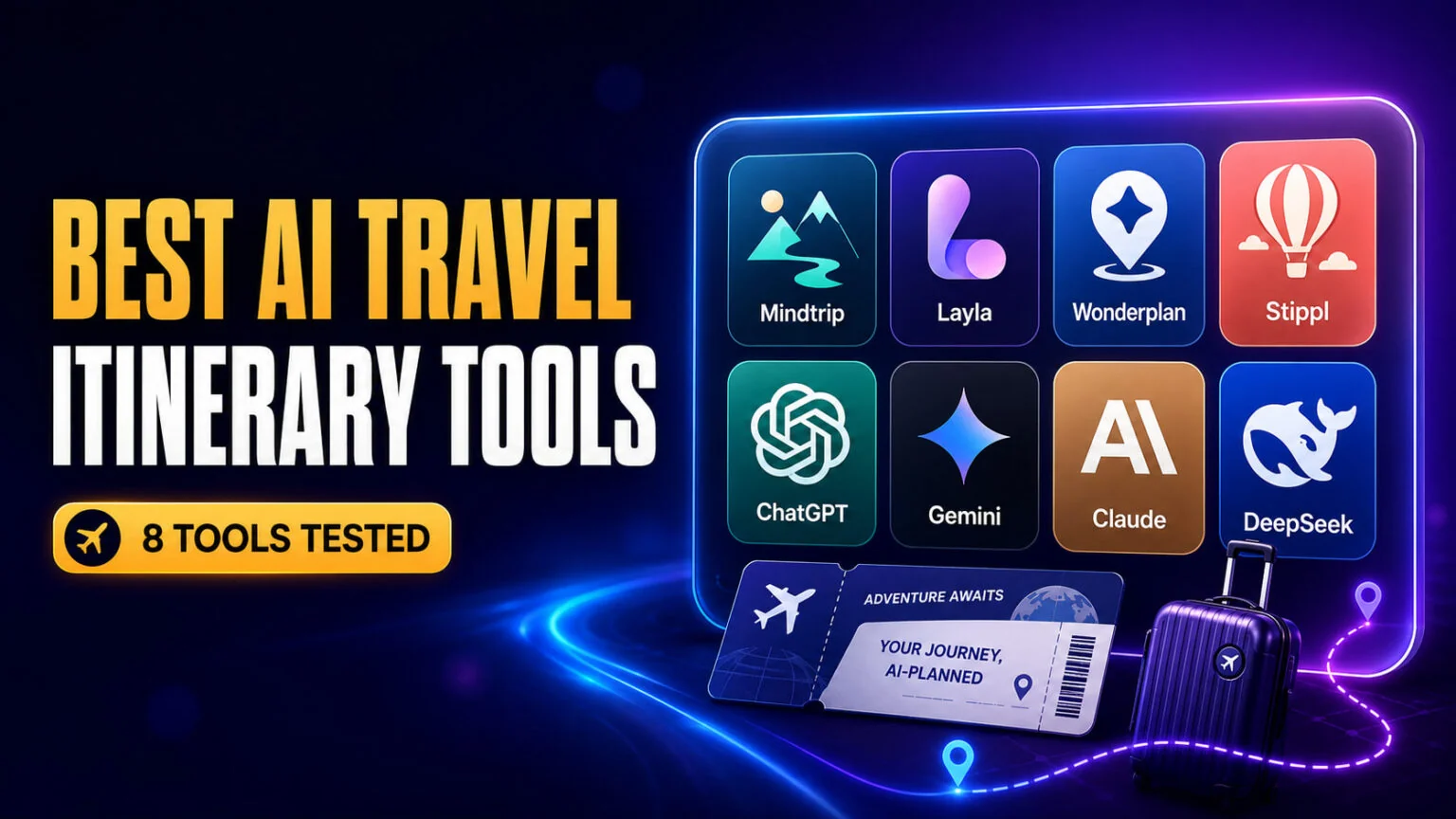
The best AI travel itinerary generators in 2026 fall into two camps. There are dedicated trip-planning apps like Mindtrip, Layla, Wonderplan and Stippl, and there are general chatbots like ChatGPT, Gemini, Claude and DeepSeek that you can prompt into a full day-by-day plan. Both draft a week-long trip in under a minute, and the gap between them is closing fast as apps add live booking and chatbots add live web data. The question is no longer whether AI can build an itinerary; it is which one builds an itinerary you can actually trust.
Speed is not the problem; accuracy is. A 2026 study found roughly 90% of AI-generated travel itineraries contain at least one error, and independent testing puts hallucination rates near 4% for Claude, 6% for ChatGPT, 9% for Gemini and 12% for Grok. This guide tests and ranks the eight AI travel itinerary generators worth your time in 2026, with real pricing, what each one does best, and the single rule that keeps an AI itinerary from wrecking your trip.
The Key Takeaways
- Mindtrip is the most complete app, and since May 6, 2026 it can book flights end-to-end with Sabre and PayPal.
- Wonderplan is the best fully free option; Layla ($49/year premium) is the best conversational planner.
- Among chatbots, Claude is the most accurate (~4% hallucination), Gemini pulls the freshest live data, and DeepSeek won Tom’s Guide’s 5-chatbot vacation test.
- Roughly 90% of AI itineraries contain at least one error, so every plan needs a manual fact-check before you book.
- Running Claude, ChatGPT, Gemini and DeepSeek side by side costs $9.99/month with a multi-model app, instead of stacking separate subscriptions.
The best AI travel itinerary generators in 2026 at a glance
Here is how the eight tools compare on the things that decide a trip, what each is best for, whether it handles live data or booking, an accuracy note, and the real price.
| Tool | Best for | Live data / booking | Accuracy or note | Price |
|---|---|---|---|---|
| Mindtrip | End-to-end plan and book | Yes, flights + hotels + activities | Strong, occasional map glitches | Free (beta) |
| Layla | Conversational planning | Live pricing, limited booking | Friendly, light on maps | Free; $49/year premium |
| Wonderplan | Fast free itineraries | No live booking | Solid, weak on niche trips | Free |
| Stippl | Whole-trip management | No booking; budget + packing | Reliable structure | Free; paid PRO tier |
| ChatGPT (GPT-5.5) | Creative structure | Web search, no booking | ~6% (GPT-5.4 test) | Free; $20/month Plus |
| Gemini (3.5) | Live data and Maps | Google Search + Maps | ~9% hallucination | Free; ~$20/month Pro |
| Claude (4.6) | Accuracy and budgets | Web search, no booking | ~4% hallucination, lowest | Free; $20/month Pro |
| DeepSeek | Sensible real-trip logic | Web search, no booking | Won a real-trip chatbot test | Free |
No single tool wins every column. That is the whole point of the breakdown below.
How we tested these AI itinerary generators
Two things separate a useful AI itinerary from a pretty list of places, accuracy and structure. We weighted how well each tool produces a realistic day-by-day plan, whether it respects budget and travel-with-kids constraints, whether it can pull live prices or book anything, and how often it invents details. Pricing reflects each tool’s public plans as of May 2026, and accuracy figures come from independent 2026 testing of ChatGPT, Gemini and Claude on real itineraries. We kept the scoring neutral because, unlike most “best trip planner” lists, we are not ranking our own product into first place.
The best dedicated AI travel apps
1. Mindtrip, the most complete plan-and-book tool
Mindtrip is free in beta and is the closest thing to an AI travel agent that also handles the booking. It builds visual itineraries with maps, photos and reviews, and lets a whole group comment and co-edit a plan in one place. On May 6, 2026, Mindtrip launched what it calls travel’s first all-in-one agentic AI flight booking experience, powered by Sabre and PayPal, so you can find, compare and pay for flights without leaving the chat, including Buy Now, Pay Later.
Hotels and activities are bookable inside the same app, and confirmations are stored in one organized place. This is the practical edge of a true AI agent that can act on your behalf, not just suggest. The weak spots are occasional inaccuracies and clunky map filtering, so treat its picks as a strong starting point rather than gospel.
2. Layla, the best conversational planner
Layla is free with a $49/year premium tier and plans trips the way you would talk to a well-traveled friend. You describe dates, budget and style, and it builds a day-by-day plan with live pricing across flights, hotels and activities, plus off-the-beaten-path suggestions. It is strong on natural language and cultural context, and it handles multi-city and road-trip routing well.
The trade-off is visual. Layla leans on conversation rather than rich maps, so travelers who think spatially will miss Mindtrip’s interface. If you enjoy refining a plan by chatting rather than clicking, the premium tier is worth it for frequent travelers, and the free tier is plenty for one trip.
3. Wonderplan, the best free generator
Wonderplan is completely free with no premium tier and no meaningful paywall. Enter a destination and dates and it returns a clean, structured, day-by-day schedule in seconds, with sensible budget filtering. It is the fastest way to get a reasonable skeleton itinerary you can then refine elsewhere.
Its limitation is imagination. Wonderplan is reliable for a standard city break but lacks surprise on unusual or niche requests, and it does not book anything or pull live prices. Use it to generate the frame, then validate the details.
4. Stippl, the best whole-trip organizer
Stippl is free with a paid PRO tier and is the only tool here that treats the itinerary as one part of a full trip system. It bundles the day-by-day plan with a budget, a packing list, expense tracking and group sharing, so the plan does not fall apart once the trip starts. It will not book flights, but as a single home for everything before and during a trip it is hard to beat.
Two more apps deserve a mention. Wanderlog has the best map-based interface for groups coordinating visually, and Roam Around offers quick generated plans on a token model that starts at $5 for 30 plans. Both are fine secondary tools, but the four above cover most travelers.
Using ChatGPT, Gemini and Claude as itinerary generators
You do not need a dedicated app at all. A general chatbot will produce a detailed, well-reasoned 10-day itinerary from a single prompt, and the best AI travel planner for many people is simply the model they already pay for. The catch is that each model is good at a different part of the job.
5. ChatGPT for creative structure
ChatGPT, which now defaults to GPT-5.5 Instant after a May 2026 update, is the strongest model for itinerary structure and narrative, turning a vague idea into a coherent, well-paced trip with a good mix of cities and downtime. It is free, with a $20/month Plus tier for higher limits. Its weakness is the one that matters most for travel, fluent answers that sound right even when a restaurant closed two years ago. The version independently tested, GPT-5.4, hallucinated on roughly 6% of factual queries; GPT-5.5 Instant is built to cut that down.
6. Gemini for live data
Gemini’s edge is Google. Its Search and Maps integration make it the strongest model for current flight pricing, opening hours and weather, and in family tests it accounted for luggage space and suggested kid-friendly restaurants without being asked. It hallucinates more than its rivals at around 9%, so its live-data strength comes with a verify-the-specifics caveat. The free tier is generous, with a Pro plan near $20/month.
7. Claude for accuracy and budgets
Claude posted the lowest hallucination rate of any model tested, around 4%, because it refuses rather than guesses. It was also the most budget-conscious planner, constantly surfacing cost estimates and transit options the others skipped, which makes it the best chatbot for fact-sensitive details like visa rules and safety advisories. It is free with a $20/month Pro tier. The downside of caution is that it occasionally declines an answer the others would attempt.
8. DeepSeek, the surprise winner
When Tom’s Guide had five chatbots plan a real family road trip, DeepSeek beat ChatGPT, Gemini, Claude and Copilot. It was the only model that caught a logistical mistake the others made, steering the family away from a pointless one-night detour because the next stop was only 75 miles further. It is free, and that real-world reasoning makes it a strong itinerary generator at no cost.
AI travel app vs chatbot: which should you use?
The honest answer is that they solve different problems. A dedicated app like Mindtrip or Layla wins when you want maps, live pricing and one-click booking in a single place, because it connects to flight and hotel inventory a raw chatbot cannot touch. It removes the copy-paste step between planning and booking, which is where most AI trip planning falls apart.
A chatbot wins on flexibility and depth. You can argue with it, change the entire trip on a sentence, ask it to rebuild day three around rain, and get reasoning a fixed app interface will not give you. For research-heavy trips, pairing a chatbot with a focused research tool such as Perplexity for fast sourced research covers the gaps a single planner leaves. Many experienced travelers do both: a chatbot to design the trip, an app to book it.
How accurate are AI travel itineraries?
Not accurate enough to follow blindly. A 2026 study that fact-checked every business name, opening hour, distance and price found that roughly 90% of AI-generated itineraries contained at least one error, and hallucination rates across the major models still range from about 4% to 12%. Paid tiers buy speed and longer context, not meaningfully better facts, so a Pro subscription does not fix this.
The one rule that keeps this from ruining a trip is simple: treat every AI itinerary as a first draft, never a booking. Independently confirm opening hours, prices and reservations before you commit money, especially for anything that only happens once on your trip. Used that way, AI is the fastest planning assistant ever built; used as gospel, it will eventually send you to a museum that closed in 2024.
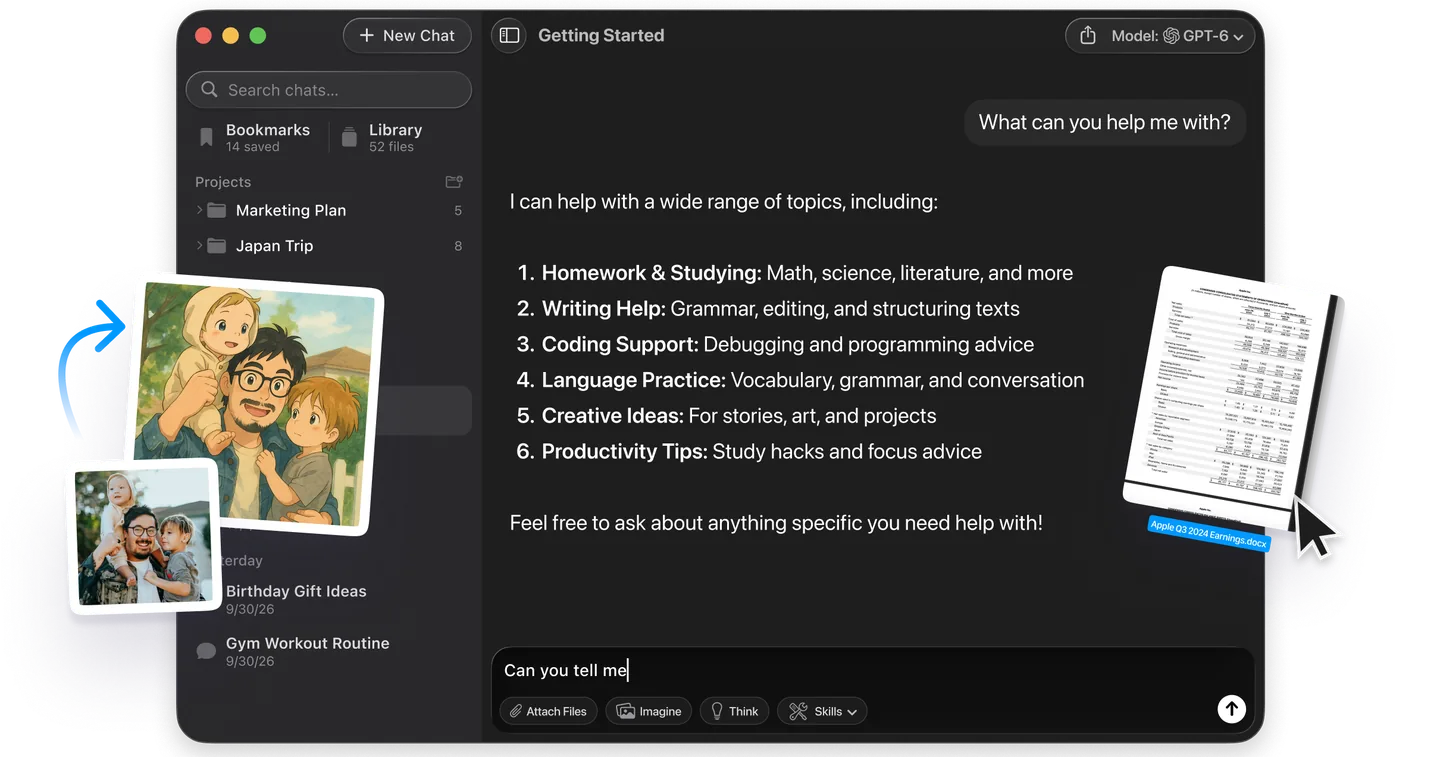
Run every model in one place with Fello AI
The takeaway from the testing is that no single model wins. Claude is the most accurate, Gemini has the freshest data, ChatGPT structures the best narrative, and DeepSeek often shows the soundest real-world logic. The smart move is to run the same trip prompt through several models and compare, which is exactly what Fello AI is built for. It puts Claude, ChatGPT, Gemini, Grok and DeepSeek in one app for $9.99/month, instead of stacking three separate $20 subscriptions.
It also closes the gap between a plan and a usable document. With built-in Skills, you can ask it to turn the itinerary into a budget spreadsheet, a packing-list PDF, or a shared trip deck for a group, without leaving the chat. That combination, many models plus document output, is one of the more practical ways to use AI to make everyday planning easier.
Which AI itinerary generator should you pick?
If you want one tool that plans and books, choose Mindtrip. For the best free generator, choose Wonderplan. if you like planning by conversation, choose Layla and if you want one place to manage the whole trip, choose Stippl. If you would rather use a chatbot, use Claude for accuracy, Gemini for live prices, ChatGPT for structure, and DeepSeek for sensible routing, ideally comparing two of them on the same prompt. And to have Claude, Gemini, ChatGPT, DeepSeek and more in one place, Fello AI is what you looking for.
Whichever you pick, the workflow that consistently produces a great trip is the same. Generate the plan with AI, fact-check the bookable details yourself, and book through a tool with live inventory. For the flights specifically, it is worth pairing any of these with a dedicated approach to finding cheap flights with AI before you lock in dates, and it is one of the highest-value everyday ways AI saves you money.
FAQ
What is the best AI travel itinerary generator in 2026?
For most travelers, Mindtrip is the best overall because it plans and books in one place. Wonderplan is the best free option, and Claude is the most accurate chatbot for building a plan you can trust.
What is the best free AI trip planner?
Wonderplan is fully free with no paywall, Mindtrip is free in beta with built-in booking, and Stippl’s free tier adds budget and packing tools. The free tiers of ChatGPT, Gemini, Claude and DeepSeek also produce strong day-by-day drafts.
Can ChatGPT plan a whole trip?
Yes, ChatGPT can produce a detailed multi-day itinerary in seconds, and it is excellent at structure and pacing. It cannot check live prices or confirm a venue is still open, and it hallucinates on roughly 6% of factual queries, so verify the details before booking.
Are AI travel itineraries accurate?
Not reliably. A 2026 study found about 90% of AI itineraries contain at least one error, with model hallucination rates from roughly 4% to 12%. Always confirm hours, prices and reservations independently before you commit.
Can AI book my flights and hotels?
Some apps now can. Since May 2026, Mindtrip books flights end-to-end through Sabre and PayPal, and handles hotels and activities inside the same app. Standalone chatbots like ChatGPT and Claude still only plan, not book.