TL;DR: Use AI to build a complete success system: turn vague wishes into smart goals, time-block them into your calendar, and let a chatbot act as your daily accountability coach. These 10 AI strategies – from “if-then” planning to data-driven weekly reviews – help you achieve with New Year’s resolutions and turn them into real lifestyle change.
| Feature | Best Use Case | Recommended Tools |
|---|---|---|
| Goal Refining | Clarifying vague ideas | ChatGPT, Claude, Gemini |
| Scheduling | Finding time to act | Reclaim, Motion, Google Calendar |
| Coaching | Daily motivation | Pi, ChatGPT (Voice Mode) |
| Tracking | Logging progress | Notion AI, Fitbit |
Why use AI for goals? It increases follow-through by adding structure and feedback – something most people lack, which is why only around 9% fully keep their resolutions.
Why Willpower Isn’t Enough (And How AI Fixes It)
Every January, millions of people set out with high hopes, yet statistics suggest that most New Year’s resolutions fail by February. This phenomenon, often called “Quitting Day,” happens not because people are lazy or incapable of change, but because their plans are fundamentally flawed. Saying “I want to get fit” is a wish; saying “I will work out for 20 minutes at 7 AM on Mondays” is a plan.
This year, you don’t have to figure out that plan alone. Artificial Intelligence can act as your personal strategist, behavior coach, and data analyst. It helps you design a system that fits your actual life, not your fantasy life. By offloading the mental burden of planning and scheduling to an algorithm, you free up your energy for the actual work of self-improvement.
Below are 10 practical, science-backed tips on how to use AI to ensure your resolutions stick for the long haul.
Tip 1: Transform Vague Wishes into SMART Goals
The number one reason resolutions fail is that they are too fluffy. A goal like “save money” or “learn to code” sounds nice, but it offers no instruction manual for your brain. To succeed, you need to tighten these loose concepts into SMART goals: Specific, Measurable, Achievable, Relevant, and Time-bound.
AI models like ChatGPT or Claude excel at this type of structural editing. This kind of AI goal setting is perfect for turning “save money” into “put $50 every Friday into a savings account until December 31.” Instead of a vague desire to “be better with money,” AI can help you calculate exactly how much you need to save per week to hit a specific target by December, based on your income.
How to do it
Open your preferred chatbot and paste your current resolution. Ask it to act as a harsh editor and rewrite the goal.
Prompt to use:
“I want to ‘read more’ next year. Rewrite this as 3 variations of a SMART goal for someone who works full-time and is tired in the evenings. Focus on achievable, small steps.”
Tip 2: Generate “If-Then” Plans for Obstacles
Motivation is a battery that drains throughout the day. By 7:00 PM, you likely won’t have the willpower to decide to go to the gym. This is where implementation intentions come in. Psychological research shows that simple “if-then” rules drastically increase success rates because they pre-decide your actions.
You are essentially programming your brain: “If [situation happens], then I will [do specific action].” The problem is that it takes time to think of all the things that could go wrong. AI can predict these obstacles for you and write the code for your behavior.
How to do it
Ask AI to act as a pessimist and predict why you will fail, then solve it.
Prompt to use:
“List 5 likely obstacles for a beginner trying to run 3 times a week (e.g., bad weather, working late). Then, write an ‘If [obstacle], then [action]’ rule for each one to keep me on track.”
Tip 3: Break the Year into a 12-Week Roadmap
A year is a terrifyingly long time to plan for. When the deadline is 12 months away, it is easy to procrastinate in January. Productivity experts often recommend the concept of the “12-Week Year,” where you treat a 12-week block as if it were a full year. That shorter horizon creates urgency and focus.
AI can instantly break a massive, overwhelming goal down into bite-sized milestones. Instead of staring at a mountain, you are just looking at the first three steps. This makes AI goal setting distinct from traditional methods. It handles the math of dividing a large task into small, daily units.
How to do it
Ask for a quarterly breakdown that respects your learning curve.
Prompt to use:
“Create a 12-week roadmap for learning Spanish basics. Give me one primary focus for each week, starting from zero knowledge, and gradually increasing difficulty.”
Tip 4: Optimize Your Schedule with Time-Blocking
A goal that doesn’t exist on your calendar is just a dream. If you don’t assign a specific time slot to your new habit, other tasks will cannibalize it. This technique is called time-blocking.
While you can do this manually, AI scheduling tools like Reclaim or Motion can auto-schedule habits into your free slots, shifting them around if meetings run late. If you don’t want to use a specialized app, you can use a standard LLM (Large Language Model) like ChatGPT or Claude to design the routine for you to copy into Google Calendar.
How to do it
Feed your current schedule constraints to the AI to find the hidden pockets of time.
Prompt to use:
“I work 9-5 and have dinner at 7. Find three 30-minute slots in this daily schedule where I could realistically fit in a workout without feeling rushed. Include a 15-minute buffer for changing clothes.”
Tip 5: Use AI-Powered Tracking (Without the Mess)
You can’t improve what you don’t measure, but manual logging is boring and often leads to abandonment. If tracking your habit feels like a chore, you will stop doing it. The solution is to use automated tools.
Look for an AI habit tracker or fitness app that offers “smart logging” or “AI insights” like Fitbit for automatic workout tracking or specialized Notion AI templates for more customized logging. Even simple voice notes can be parsed by AI tools to update your journal or calorie tracker without you typing a single number.
How to do it
Look for apps with “AI insights” or “Smart Logging.” If you want to keep it simple, use this workflow:
- Open ChatGPT on your phone (Voice Mode).
- Dictate your day: “I ate oatmeal, walked 5,000 steps, and read 10 pages.”
- Ask it to “Format this into a table I can copy into Excel.”
Tip 6: Turn Your Chatbot into a Daily Coach
You don’t need to pay hundreds of dollars a month for a life coach to get daily accountability. You can prompt ChatGPT, Gemini, or Pi to act as a supportive partner. This works best if you keep one specific chat thread open just for this purpose, training the context window to remember your specific goals.
Think of this as building your own free AI accountability partner. Even though you know it’s a bot, the act of “reporting” to someone helps maintain consistency. You can customize the persona to be a “kind grandmother” or a “drill sergeant,” depending on what motivates you.
How to do it
Set the persona once and use it daily.
Prompt to use:
“Act as my strict but kind fitness coach. Every morning when I type ‘Check in’, ask me: 1. Did you sleep 7 hours? 2. What is your workout plan today? 3. What is one thing you are grateful for? Keep your responses short.”
Tip 7: Analyze Your Data to Spot Hidden Patterns
We are often bad at remembering why we failed. We tend to blame our character (“I was just lazy”) rather than our circumstances. AI can look at your tracking logs and see the objective truth.
Perhaps you notice you always skip your habit on Tuesdays. An AI analysis might point out that you have a standing meeting on Tuesday afternoons that drains your energy, suggesting you move the habit to the morning. This turns failure into data analysis, which is much easier to fix.
How to do it
Copy your habit log (from a spreadsheet or app export) and paste it into AI.
Prompt to use:
“Here is my habit log for January. Identify patterns in the days I missed. Is there a specific time or day of the week where I struggle most? Give me 2 hypotheses on why.”
Tip 8: “Debug” Your Home Environment
Your environment dictates your behavior more than your willpower does. If you want to eat healthy, but cookies are on the counter, you will eventually eat cookies. This is known as Choice Architecture. AI can help you “audit” your space to remove friction for good habits and add friction for bad ones.
By describing your room or office to an AI, you can get an objective third-party opinion on why your habits aren’t sticking. It might suggest simple changes, like unplugging the TV or moving your running shoes to the front door.
How to do it
Describe a room to the AI or upload a photo if the tool supports it.
Prompt to use:
“I want to practice guitar more. My guitar is currently in its case in the closet. My living room has a TV and a big sofa. Suggest 3 changes to the room layout that would nudge me to play guitar instead of watching TV.”
Tip 9: Accelerate Learning with an AI Tutor
Many resolutions involve learning a new skill, such as coding, cooking, or speaking a new language. Traditional learning can be slow and rigid. AI learning support offers the ultimate personalized tutor – basically an always-on AI tutor that never gets tired, it doesn’t judge you for asking “stupid” questions, and it can adjust the difficulty level instantly.
If you don’t understand a concept in a textbook, you can ask AI to “explain it like I’m 12.” If you want to practice conversational French, you can speak directly to the AI. This keeps engagement high, which is critical for retention.
How to do it
Create a personalized curriculum and test yourself.
Prompt to use:
“I want to learn Python. Act as a tutor and give me a 30-minute lesson plan for Day 1, followed by a quiz. If I get the quiz wrong, explain it again in simpler terms.”
Tip 10: Run a Weekly Review Ritual
The Weekly Review is the glue that holds resolutions together. It is the designated time to look back, forgive yourself for mistakes, and adjust the plan for next week. Without this loop, a single bad week can turn into a bad month, leading to the resolution being abandoned.
Turn this into your AI-powered Sunday Reset: you bring the data, the bot brings the neutral analysis. Instead of sitting there feeling guilty about what you didn’t do, you feed the data to the AI and ask for a plan adjustment. It helps you pivot rather than quit.
How to do it
Do a Sunday review to reset for the week.
Prompt to use:
“I completed 4 out of 7 planned workouts this week. I felt tired on Thursday and Friday. Help me adjust next week’s plan to be slightly lighter so I can recover, but still make progress toward my Q1 goal.”
Conclusion
The difference between a wish and a resolution is a system. Most people rely on motivation, which is fleeting. By using these 10 tips, you turn AI into a tool that handles the organization, scheduling, and analysis, leaving you to focus on the only thing that matters: taking action.
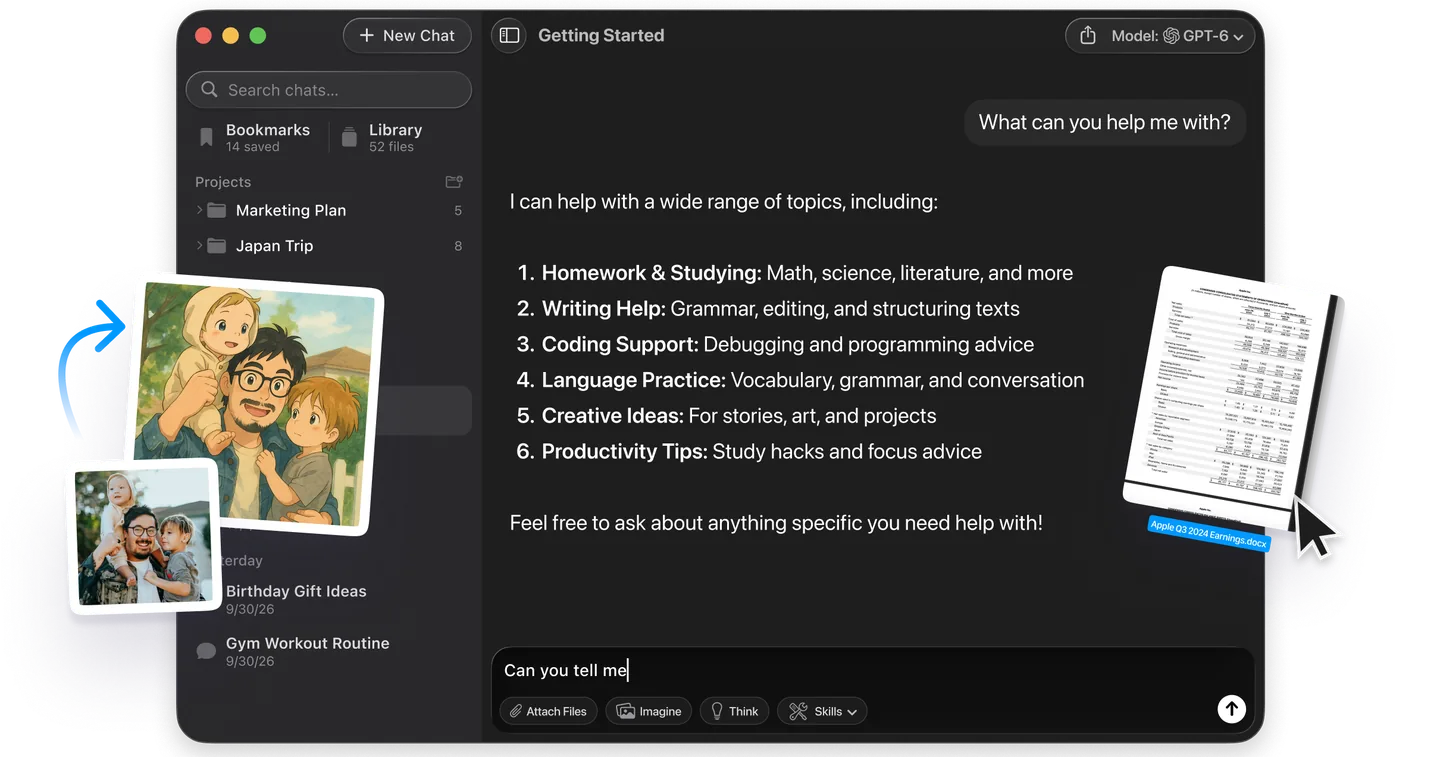
Next Step: Pick Tip 1 right now. Open FelloAI, ChatGPT, or Gemini. FelloAI is ideal for this because it puts multiple frontier models in one app. You can literally switch between GPT , Claude and Gemini to ensure you get the absolute best result. Ask it: “Help me turn my vague resolution of [Insert Goal] into a SMART goal.” Do it before you close this tab.
FAQ
Which AI tools are best for New Year’s resolutions?
For text-based planning (Tips 1, 2, 3, 6, 8, 9, 10), generic large language models like ChatGPT (OpenAI), Claude (Anthropic), or Gemini (Google) are excellent. Optionally you can use Fello AI, the all in one AI chatbot. For scheduling (Tip 4), try specialized tools like Reclaim or Motion.
Can AI actually motivate me?
AI can’t feel emotions, but as a goal-setting and habit-tracking assistant, it can provide prompts, reminders, and reframes that nudge you to act. For many people, simply having “someone” (even a bot) to report to increases consistency.
Is this private?
Be careful. Standard AI chats may be used to train future models. If your resolutions involve sensitive medical conditions, legal issues, or deeply personal data, look for tools that offer enterprise-grade or pro privacy settings and clear data retention policies.
How do I start using AI for my resolutions in 10 minutes?
Pick Tip 1 (Goal Refining) and Tip 4 (Scheduling). Spend 5 minutes asking an AI to create a SMART goal, then spend 5 minutes blocking time for it in your calendar.
What if I miss a day?
That is normal and expected. Use Tip 10 (Weekly Review) to adjust. Ask AI: “I missed 3 days. Create a ‘get back on track’ plan that is easy and low-pressure for tomorrow.”
Methodology & Sources
We didn’t just guess these tips; they are built on the intersection of modern technology and established behavioral psychology.
Testing: These tips were compiled by analyzing common “failure points” in goal setting (vague goals, lack of planning, lack of tracking) and matching them with current Generative AI capabilities available in 2025/2026.
Concepts: The advice relies on established behavioral science, specifically “SMART goals” (introduced by George T. Doran, 1981) for structure and “Implementation Intentions” (Peter Gollwitzer, 1999) for habit formation.
Sources:
- Success rates: The 9% success rate and data on drop-offs by January are derived from research by Ohio State University’s Fisher College of Business.
- “Quitter’s Day”: The concept of mid-January drop-offs was popularized by Strava’s analysis of over 800 million user activities.
- AI application: Trends in AI coaching and habits are referenced from Axios and TechRadar.