TL;DR: AI is now a staple in education. Students use it as an on-demand tutor; teachers use it to plan lessons and mark faster. But the same tools raise hard questions about cheating, student privacy and whether well-resourced schools will race even further ahead of those without devices or reliable internet.
By the numbers (2023–2025)
| Metric | Key Stats |
|---|---|
| Guidance gap | Fewer than 10% of schools and universities had formal guidance on generative AI in mid-2023 (UNESCO). |
| Teacher time | Existing tech, including AI, could eventually automate 20–40% of teachers’ tasks – roughly up to 13 hours a week. |
| Student usage | 88% of UK university students have used generative AI for assessments. |
| Cheating trends | Overall cheating rates appear stable, but methods are shifting towards AI-assisted work. |
| Top risk | AI-powered proctoring and surveillance raise serious privacy and bias concerns. |
Artificial intelligence is no longer just a futuristic concept; it is already woven into the fabric of daily school life. Students are using tools like ChatGPT to brainstorm essays, debug code, and translate foreign texts, often faster than schools can create rules to manage them. The specialist end of that stack is covered in our guide to AI tools for students and researchers.
While some educators see a powerful assistant that can personalize learning, others worry about a future of deep fakes, erosion of critical thinking, and invasive surveillance. This article cuts through the noise to look at the data on AI in schools and what it actually means for students and teachers. If you are a teacher looking for the practical side instead, start with our guide to AI for teachers.
We will answer these questions:
- Is AI actually helping students learn better?
- Are cheating rates skyrocketing because of chatbots?
- What are the privacy risks of AI in the classroom?
How Deeply Has AI Entered Student Life?
AI adoption has moved faster than almost any other educational technology in recent memory. By mid-2023, a UNESCO survey revealed that fewer than 10% of schools and universities had formal guidance on generative AI, yet students were already using it daily.
Recent data supports this disconnect. In the UK, for example, 88% of university students reported using generative AI for assessments. They aren’t only using it to write essays from scratch; they use it to explain complex concepts, summarize long readings, and generate ideas. The technology is widespread, but the institutional safety nets are still catching up.
The Good: Benefits of AI in Education
Beyond the headlines about cheating and disruption, AI is quietly solving some of education’s oldest challenges. When integrated thoughtfully, these tools are shifting the focus from rote administrative work to human connection, offering practical solutions that go far beyond the hype.
Personalized Learning & Tutors
One of the strongest arguments for AI is its ability to act as a “24/7” tutor. Recent 2025 surveys suggest that around seven in ten students feel generative AI improves their grades or study efficiency, even as many worry about learning less deeply.
When used correctly, these tools allow for:
- Instant feedback: Students get corrections on math problems immediately, rather than waiting a week for a grade.
- Adaptive difficulty: Platforms adjust the complexity of questions based on how well a student is performing.
- Scaffolding: Chatbots can re-explain a difficult physics concept in simple terms, acting as a bridge for struggling learners.
This personalization is about more than just convenience; it’s about meeting students exactly where they are. In a traditional classroom of 30 students, a teacher cannot physically pause to explain a concept in three different ways for three different learning speeds. AI tools can, providing a safety net that keeps students from falling behind simply because they needed one extra explanation.
Accessibility & Inclusion
For students with disabilities, AI can remove barriers that have existed for decades. A recent example from the Swavalamban Resource Centre in New Delhi shows how AI-enabled voice recorders and Braille displays are making printed materials accessible to visually impaired students.
Beyond hardware, software tools provide automated captioning for deaf students and image recognition that describes surroundings for those with low vision. In these contexts, AI isn’t just a convenience; it is a necessity for independent learning.
Teacher Support & Workload
Teachers are often buried under administrative tasks that take time away from actual teaching. A widely cited analysis by McKinsey suggests that technology, including AI, could eventually automate 20–40% of the tasks teachers currently do, such as grading, lesson prep, and routine admin, roughly up to 13 hours a week.
In practice, recent teacher surveys suggest many educators haven’t seen that full benefit yet, but early adopters do report meaningful time-savings on repetitive tasks like:
- Drafting lesson plans and rubrics.
- Generating creative class activities.
- Writing emails to parents or administrative updates.
Greece recently launched a nationwide initiative to train secondary school teachers on using ChatGPT Edu. The goal is to help them handle lesson planning and personalization more efficiently, freeing them up to focus on student relationships.
In short: AI works best when it acts as a tutor, translator, and assistant, not a ghostwriter.
Free AI Access for Education
Access to advanced AI tools doesn’t always have to be expensive. Major providers have launched significant grants, free tiers, and extended trials specifically for the education sector. Here is a detailed breakdown of the best current offers:
| Platform | Who It’s For | What’s Included | How to Claim |
|---|---|---|---|
| ChatGPT | K-12 Teachers (US) | Free until June 2028. Includes GPT-5.1, education-grade data privacy (no training on your data by default), and file uploads. | Claim free ChatGPT for teachers |
| Perplexity Pro | Students & Educators | $10/month Education Pro. Half the $20 Pro price for verified students and educators, and verified students also get one free month. Includes Pro Search and file analysis. | Claim Perplexity Pro free/cheap |
| Microsoft and GitHub Copilot | Students, Teachers & Devs | Free Copilot Student. Unlimited code completions and 200 AI credits a month in VS Code and other IDEs, with automatic model selection. Requires GitHub Education verification. | Get Copilot free as a student |
| Google Gemini | College Students (18+) | 12 Months Free, redeem by December 31, 2026. Google AI Pro (Gemini 3.1 Pro, 5 TB storage) in the US; Google AI Plus in 140+ other markets. | Claim Google AI Pro for students |
University researchers have a newer route as well. OpenAI now runs a free programme for academic researchers, which covers research faculty and postdocs rather than students.
Securing access to these tools is just the first step. Once teachers have these powerful assistants at their fingertips, the immediate benefit isn’t just about generating lesson plans. It’s about reclaiming lost time. By automating the repetitive “busy work” of grading and administration, educators can shift their energy back to where it matters most: the students in front of them.
The Ugly: Risks and Controversies
However, the rapid integration of AI is not without its dark side. As schools rush to adopt these tools, they often encounter serious ethical and practical pitfalls ranging from privacy violations to the deepening of social inequalities. The problem isn’t that AI exists in schools; it’s that it’s so easy to use it badly.
Cheating & Academic Integrity
The fear that “everyone is cheating” dominates the conversation, but the data is surprising. A study comparing cheating rates before and after the release of ChatGPT found that the overall frequency of cheating remained relatively stable.
However, the method of cheating has changed. Instead of copying Wikipedia, students may use AI to generate answers. The risk here is “undisclosed assistance,” where a student submits AI work as their own. Furthermore, the “arms race” between AI writing and AI detection is messy. Detection tools are often unreliable and can falsely flag honest work, causing stress for innocent students. We put a number on that for one tool in GPTZero’s real false-positive rate.
Privacy & Surveillance
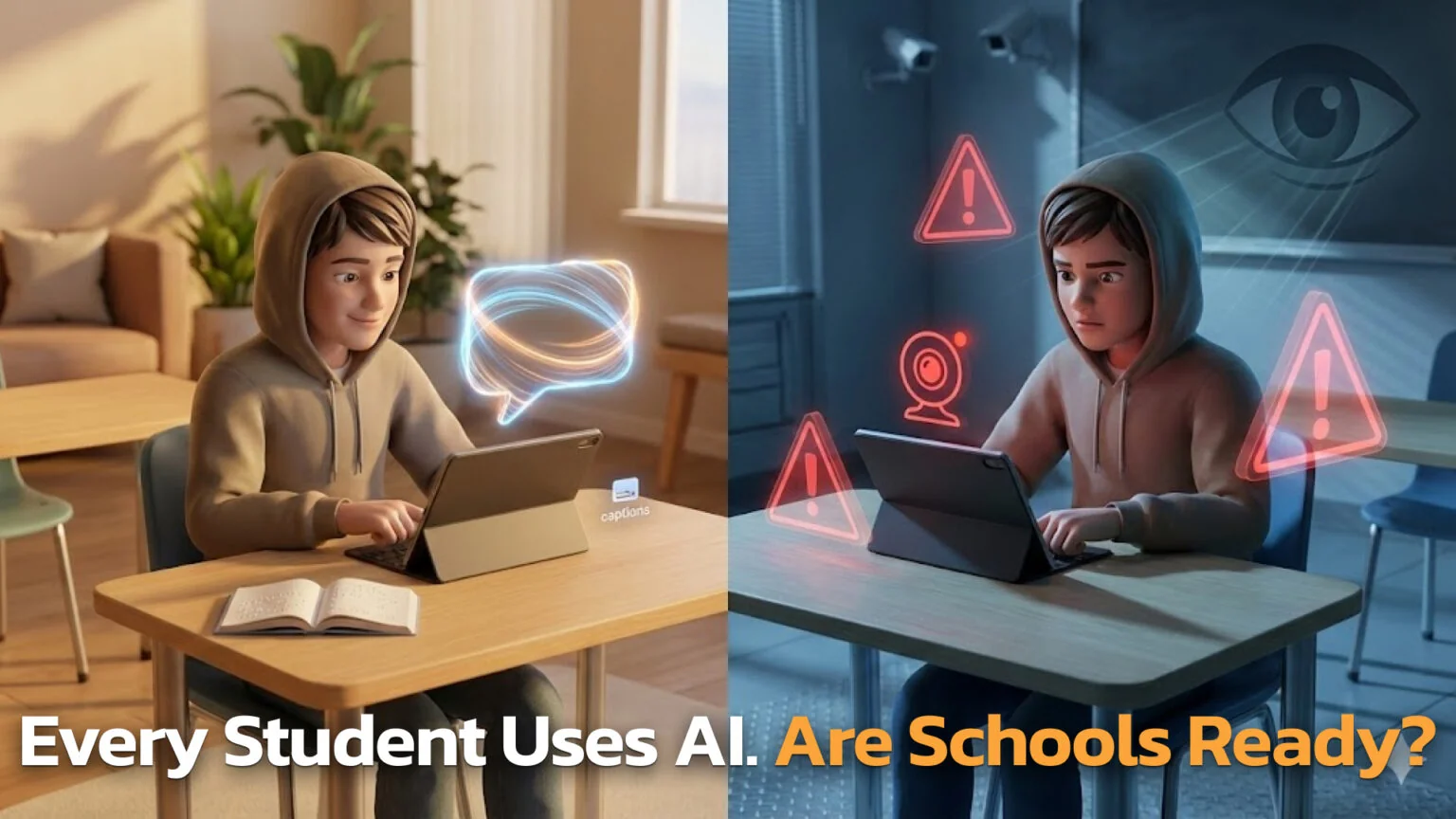
Perhaps the most concerning aspect of AI in schools is the rise of surveillance technology. To prevent cheating, some schools use online proctoring systems that rely on AI to monitor students through their webcams.
These systems can scan a student’s room, track eye movements, and flag “suspicious” behavior. One 2022 study of automated proctoring software found that students with darker skin tones were significantly more likely to be flagged for potential cheating, underlining how biased training data can turn into unequal treatment in exams. This creates a “Big Brother” atmosphere where students feel watched rather than trusted.
Inequality & The Digital Divide
AI amplifies existing inequalities. Wealthy schools can afford enterprise-grade AI tools, teacher training, and modern devices. Meanwhile, under-resourced schools may lack reliable internet, let alone a budget for AI integration.
The result is a two-tiered system:
- Tier 1: Students use high-quality AI as a personalized tutor and creative partner.
- Tier 2: Students rely on free, ad-supported tools or have no access at all, falling further behind in digital literacy.
This uneven playing field complicates the narrative of AI as a universal equalizer. It forces us to look past the optimistic marketing and ask a harder question. Beyond the issues of access and privilege, when students actually do use these tools in the classroom, is the technology genuinely boosting their intelligence, or is it merely automating their homework?
Does AI Actually Improve Learning Outcomes?
The verdict is mixed but currently leaning positive for assisted learning. Early empirical studies suggest that when students use AI to clarify doubts, brainstorm ideas, or practice skills, their engagement and perceived learning significantly increase.
However, there is a clear danger of overreliance. Research indicates that if a student uses AI to solve every math problem or write every sentence without trying it first, their critical thinking and problem-solving skills can erode.
The key difference lies in the pedagogical intent: is the AI being used as a “thinking partner” to deepen understanding, or merely as a “shortcut machine” to bypass cognitive effort? Schools that actively teach this distinction tend to see better outcomes than those that simply ban or ignore the tools.

How Schools Are Responding
The reaction from schools has swung from panic to practical integration. Initially, many districts banned tools like ChatGPT. Now, realizing that bans are largely ineffective, systems are moving toward regulation and literacy, helped along by Google Classroom’s AI tools arriving directly in the platforms teachers already run. The practical effect is that assessments increasingly value how a student reached an answer rather than the finished essay, and permission has shifted from a blanket ban to a disclosure rule that varies by class. We cover what students are actually allowed to use in full separately.
Conclusion
AI in education acts as a powerful amplifier of the existing system. In well-supported, thoughtful environments, it can boost accessibility, deepen personalization, and free up teachers to mentor students. But in unregulated or under-funded settings, it risks accelerating privacy violations and widening the fairness gap. The technology itself is neither a villain nor a savior; it is a tool that is here to stay.
The critical next step is for students, parents, and educators to look past the breathless hype. We must demand clear, human-centered school policies that prioritize deep learning over automated shortcuts, ensuring that AI serves the students, not the other way around.
Next Step: Check your school or university’s code of conduct today. Many have recently updated their rules on exactly how and when you can use these tools.
FAQ
Has cheating increased because of AI?
Surprisingly, most studies show overall cheating rates have stayed stable. Long-term research on academic dishonesty shows that 60–70% of students admitted to some form of cheating even before AI tools existed. What’s new is the mix of methods, not the basic temptation.
Can AI replace teachers?
No. While AI can handle grading and lesson planning, it cannot replace the emotional support, mentorship, and behavioral management that human teachers provide.
Is it safe for students to use free AI tools?
There are risks. Free tools often collect user data to train their models. Experts recommend that schools provide enterprise/managed accounts to protect student privacy.
How can I tell if a student used AI?
AI detectors are currently unreliable and prone to false positives. It is better to look for changes in writing style, lack of specific personal examples, or hallucinations (made-up facts) in the text. This is the heart of AI detectors and the 4% false-positive problem.
Methodology & Sources
This overview synthesizes findings from recent academic papers, policy reports, and news investigations from 2023 to 2025.
- Data Sources: We reviewed survey data from UNESCO, HEPI (UK), and reports from the OECD AI incident database.
- Academic Reviews: Findings on learning outcomes and cheating were drawn from systematic reviews in journals like MDPI, ScienceDirect, and Open Praxis.
- News Context: Real-world examples were sourced from The Times of India, The Guardian, and The Australian.