Mistral AI pricing runs on two separate tracks, and the headline number is hard to beat. The Le Chat consumer app starts at $0/month and tops out at $14.99/month for Pro, while the developer API charges per million tokens, starting around $0.10. That makes Mistral one of the cheapest ways to reach a frontier model in 2026, and the flagship Mistral Large 3 undercuts GPT-5.6 Sol by roughly 90% on input and 95% on output.
This guide breaks down every price you care about, the four Le Chat plans, the full API rate card per million tokens, the free tier limits, and how the numbers stack up against ChatGPT, Claude, and DeepSeek. We verified all figures against Mistral’s official pricing page in June 2026, because most third-party trackers are months out of date and still quote retired rates. If you want Mistral plus several other models without juggling subscriptions, we cover that route too. And if you saw the viral Le Chaton Fat model making the rounds, that one is a hoax; everything below is Mistral’s real, current pricing.
The Key Takeaways
- Le Chat Free costs $0/month with real frontier-model access, soft-capped around 25 messages per day
- Le Chat Pro is $14.99/month, one of the cheapest premium AI chat subscriptions from a major lab
- The Mistral API starts at $0.10 per million input tokens and runs to $1.50 in / $7.50 out on Mistral Medium 3.5
- Mistral Large 3 costs just $0.50 input / $1.50 output per million tokens, about 90% cheaper than GPT-5.6 Sol
- Verified students get Pro for $5.99/month, and a Le Chat subscription does not include API credits
How Mistral AI Pricing Works: Two Separate Tracks
The single biggest source of confusion is that Mistral sells two different things that are billed independently. The first is Le Chat, the consumer chat app you use in a browser or mobile app, sold as a flat monthly subscription. The second is the API on La Plateforme, which developers pay for by the token based on how much text goes in and out.
Paying $14.99/month for Le Chat Pro gives you zero API credits, and topping up your API balance does nothing for your chat subscription. If you just want to chat, generate images, and run code, you want a Le Chat plan. If you are building an app, a chatbot, or an automation, you want the API. Plenty of people use both, and they show up as two separate line items.
Mistral also includes Mistral Vibe, its coding workspace, inside the paid Le Chat plans rather than as a separate purchase. So the Pro subscription covers chat, image generation, deep research, and all-day coding under one price.
Le Chat Pricing Plans
Le Chat comes in four tiers, from a genuinely useful free plan up to custom enterprise deals. Here is what each one costs and unlocks.
| Plan | Price | Limits | Key features | Best for |
|---|---|---|---|---|
| Free | $0/mo | ~25 messages/day soft cap | Frontier models, image generation, code interpreter, 40+ connectors | Casual users testing Mistral |
| Pro | $14.99/mo | Much higher limits than Free | Extended thinking, deep research, more Vibe coding, no-telemetry mode | Power users and solo pros |
| Team | $24.99/user/mo | Higher shared limits | Collaborative workspace, 30GB storage per user, admin controls | Small teams |
| Enterprise | Custom | Custom | Private deployment, custom models, SAML SSO, audit logs, support | Larger organisations |
Le Chat Free
The free tier is more generous than most rivals. You get real access to Mistral’s current models, image generation, a code interpreter, and more than 40 connectors, with usage soft-capped at roughly 25 messages per day on the better models. For light daily use, many people never need to pay.
Le Chat Pro
Pro at $14.99/month is the sweet spot, and it is one of the cheapest premium chat plans any major lab offers. You get far higher message limits than the free tier, more web searches, expanded deep research reports, and more Mistral Vibe coding capacity. Pro also unlocks no-telemetry mode, which stops Mistral using your prompts and outputs for training.
Le Chat Team and Enterprise
Team at $24.99/user/month adds a shared workspace, 30GB of storage per user, and admin controls, which suits small startups that want one billing relationship. Enterprise pricing is custom and aimed at companies that need private deployment, custom models, SAML single sign-on, audit logs, and dedicated support. You contact Mistral sales for a quote.
Student Discount
Verified students can get Le Chat Pro for $5.99/month instead of $14.99, valid for up to 12 months. If you are at university, that is a hard discount to argue with, and it pairs well with other AI free trials and student deals worth stacking.
Mistral API Pricing Per Million Tokens
The Mistral API charges by the token, split between input (your prompt) and output (the model’s reply), priced per million tokens. The lineup runs from tiny edge models at a few cents up to the multimodal flagship. Batch processing earns a 50% discount on most models.
| Model | Input ($/1M) | Output ($/1M) | Best for | Context |
|---|---|---|---|---|
| Mistral Large 3 | $0.50 | $1.50 | Flagship reasoning and general use | 128K |
| Mistral Medium 3.5 | $1.50 | $7.50 | Highest-quality balanced tier | 256K |
| Mistral Small 4 | $0.15 | $0.60 | Fast, cheap everyday tasks | 128K |
| Codestral | $0.30 | $0.90 | Code completion and generation | 256K |
| Devstral 2 | $0.40 | $2.00 | Agentic coding workflows | 256K |
| Ministral 8B | $0.15 | $0.15 | On-device and edge use | 128K |
| Ministral 3B | $0.10 | $0.10 | Cheapest lightweight tasks | 128K |
Notice that Mistral Large 3 is actually cheaper than Mistral Medium 3.5 on paper. Large 3 is tuned as a cost-efficient flagship, while Medium 3.5 targets the highest output quality and prices accordingly. For most builders, Large 3 is the default, and Small 4 handles high-volume, simple jobs for pennies.
Reasoning and Specialized Models
Beyond the core lineup, Mistral prices a few specialists separately. Magistral, the reasoning family, runs $0.50 / $1.50 for Magistral Small and $2.00 / $5.00 for Magistral Medium, and Pixtral handles vision and image understanding. On the document side, OCR 4 costs about $4 per 1,000 pages, Voxtral handles speech, and the embedding models (Mistral Embed and Codestral Embed) run around $0.10 to $0.15 per million input tokens. If you only need chat or simple generation, you can ignore all of these.
Is There a Free API Tier?
Mistral offers a limited free experimentation tier on La Plateforme so you can test models before committing spend, but production traffic moves you onto paid per-token rates fast. The free API tier is for prototyping, not for running a real product. For day-to-day chatting, the Le Chat Free plan is the better no-cost option.
How Mistral Pricing Compares to ChatGPT, Claude, and DeepSeek
The reason Mistral keeps showing up in cost-cutting conversations is simple. Its flagship is priced like a budget model while performing near the top tier. Here is Mistral Large 3 against the comparable flagships from OpenAI and Anthropic.
| Model | Input ($/1M) | Output ($/1M) | vs Mistral Large 3 |
|---|---|---|---|
| Mistral Large 3 | $0.50 | $1.50 | baseline |
| GPT-5.6 Sol | $4.00 | $20.00 | ~88% / 93% pricier |
| GPT-5.6 Luna | $0.20 | $1.20 | ~60% / 20% cheaper |
| Claude Sonnet 5 | $3.00 | $15.00 | ~83% / 90% pricier |
| Claude Opus 4.8 | $5.00 | $25.00 | ~90% / 94% pricier |
| DeepSeek V4 Flash | $0.14 | $0.28 | cheaper |
The takeaway is clear. If raw cost per token is your priority and you do not specifically need OpenAI or Anthropic, Mistral Large 3 delivers flagship-class output at a fraction of the price. Since OpenAI cut its cheapest tier by 80% on 30 July 2026, GPT-5.6 Luna at $0.20 / $1.20 also comes in under it, on both input and output. DeepSeek still undercuts everything, which is why it keeps appearing in our Qwen pricing and MiniMax pricing breakdowns of cheap-but-capable models. For a wider field, our DeepSeek pricing guide and Anthropic vs OpenAI cost comparison go deeper on the trade-offs.
Want Mistral and Every Other Model in One App?
The catch with single-lab pricing is that no one model wins every task. Mistral Large 3 is brilliant value, but you might want Claude for long writing, ChatGPT for general questions, Gemini for research, or DeepSeek when cost matters most. Paying for several subscriptions adds up fast.
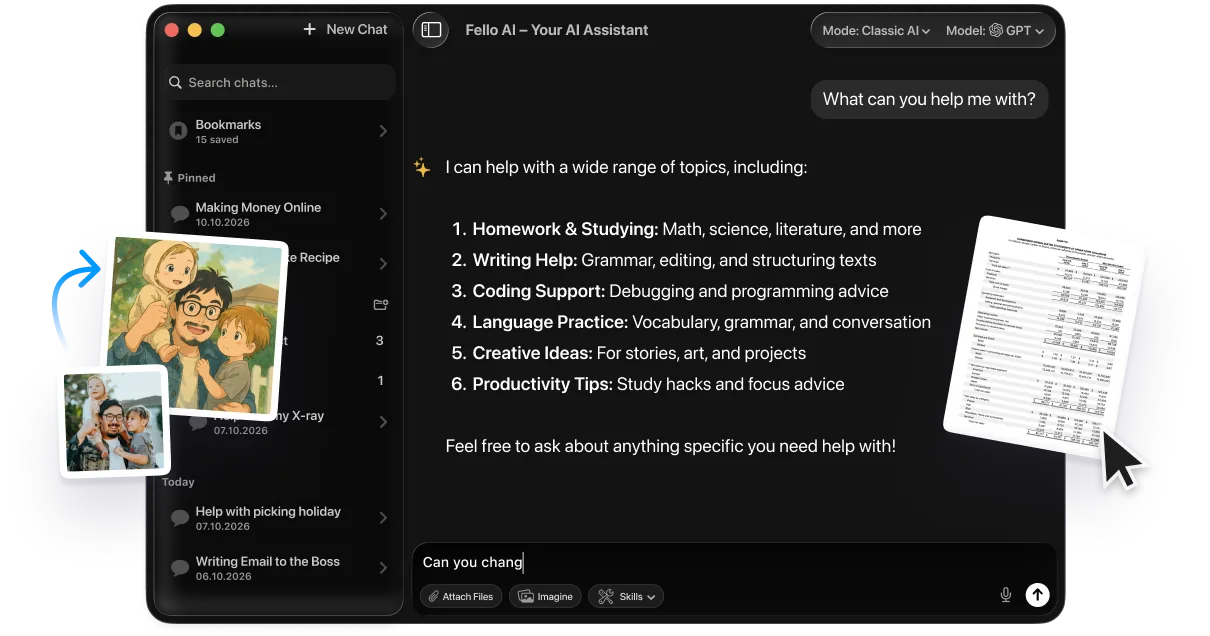
This is where a multi-model app changes the maths. Fello AI gives you Claude, ChatGPT, Gemini, Grok, and DeepSeek through one $9.99/month subscription on your Mac, so you can run the same prompt across models and keep the best answer. You can get started with Fello AI and stop guessing which lab to commit to. For a model-by-model rundown of what each one is good at, see our best AI models guide.
Conclusion
Mistral AI pricing is among the most aggressive in the market. Le Chat is free for casual use or $14.99/month for Pro, and the API starts at $0.10 per million tokens with a flagship that beats the GPT-5.6 Sol flagship and Claude on cost by wide margins. If you want a cheap, private, capable AI and you are comfortable outside the OpenAI and Anthropic ecosystems, Mistral is one of the best-value picks of 2026. If you would rather not bet on a single lab, a multi-model app like Fello AI gets you Mistral-class value plus four other top models for less than the price of one premium subscription.
FAQ
Is Mistral AI free?
Yes. Le Chat Free costs $0/month and gives you real access to Mistral’s frontier models, image generation, and a code interpreter, soft-capped at about 25 messages per day. The API has a small free experimentation tier, but production use is billed per token.
How much does Le Chat Pro cost?
Le Chat Pro is $14.99/month (excluding tax). It raises your message and web-search limits, adds deep research and more Mistral Vibe coding capacity, and unlocks no-telemetry mode. Verified students pay $5.99/month.
How much is the Mistral API per million tokens?
It depends on the model. Mistral Small 4 is $0.10 input / $0.30 output, Mistral Large 3 is $0.50 / $1.50, and Mistral Medium 3.5 is $1.50 / $7.50 per million tokens. Edge models like Ministral 3B cost as little as $0.10 for both input and output.
Does Le Chat Pro include API access?
No. The Le Chat subscription and the API are billed separately. Paying for Pro gives you no API credits, and buying API usage does nothing for your chat plan.
Is Mistral cheaper than ChatGPT and Claude?
On the API, yes, by a lot. Mistral Large 3 at $0.50/$1.50 undercuts GPT-5.6 Sol ($4.00/$20.00) and Claude Sonnet 5 ($3.00/$15.00) by 83% to 93%. DeepSeek and OpenAI’s own budget tier, GPT-5.6 Luna at $0.20/$1.20 since the July 2026 cut, are the ones that reliably cost less per token.