GLM on Mac

The best way to use
GLM on your Mac

Fello AI is a native Mac app giving you GLM 5.3 through secure US-based infrastructure, plus every other frontier model in one place. No browser tabs, no data concerns.

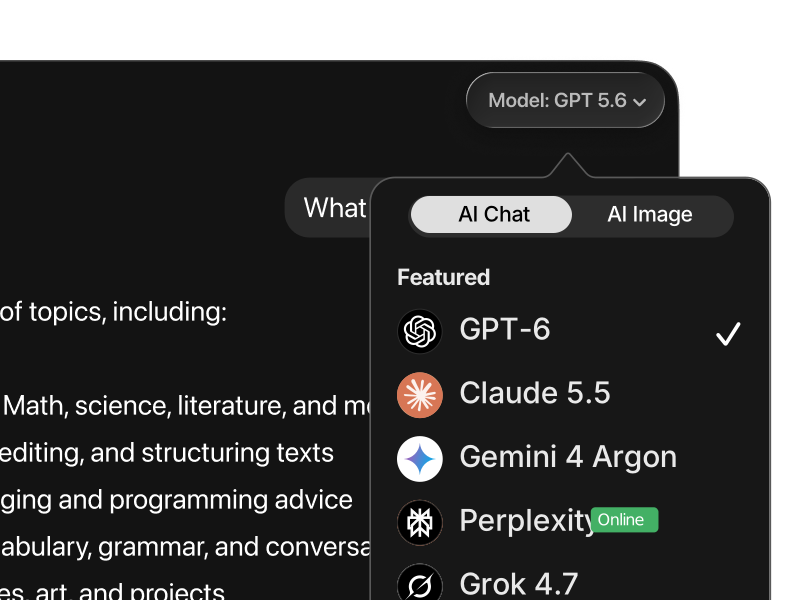
Fello AI on macOS with the model picker open, showing 11 AI models
What is GLM

What GLM actually is

GLM is the flagship model family from Zhipu AI, the Chinese lab internationally branded as Z.ai. Zhipu was spun out of Tsinghua University in 2019 and has grown into one of the most closely watched AI companies in the world. In January 2026 it listed on the Hong Kong Stock Exchange (among the first standalone AI-model developers to go public), with backing from Alibaba, Tencent, Meituan, Xiaomi and others. GLM stands for "General Language Model," and its current flagship is GLM 5.3, released in August 2026.

What makes GLM 5.3 stand out is its positioning as one of the top open-weight models for coding and agentic work. Z.ai publishes its weights: GLM 5.3 went up on Hugging Face on August 28, 2026, under Z.ai's own license, and the lighter GLM 5.3 Flash arrived two days earlier under plain MIT. Anyone can download, inspect, modify, and self-host either one. It lists at $1.40 per million input tokens and $4.40 output, about a third of Claude Opus 5.5's input price and a fifth of its output, and it supports a context window of up to 1M tokens. That combination has made it a favorite for developers who want a capable model they can actually run and audit themselves.

For everyday work, GLM 5.3 shines inside agent harnesses and coding tools like Claude Code, Cline, and Roo Code, where it can run long, multi-step autonomous tasks without losing the thread. It also handles general reasoning, writing, and Q&A competently. It trails the very top closed models on the hardest reasoning problems, but as a cost-efficient, tool-using workhorse it is genuinely compelling.

GLM vs GLM 5.3: GLM ("General Language Model") is the model family from Zhipu AI, branded internationally as Z.ai. 5.3 is the current flagship version, tuned for coding and agentic tasks. In Fello AI, GLM queries are routed through secure US-based servers, not through Z.ai's own infrastructure.

Open
Weights on Hugging Face
~1/3 price
Input, vs Claude Opus 5.5
1M tokens
Context window
Coding
Built for agents and code

Getting started

3 ways to use GLM on Mac

02
Z.ai website and ZCode

Visit chat.z.ai in any browser for general chat with GLM 5.3. Free with usage limits, no setup required. Z.ai's own Mac download is ZCode, which it calls an Agentic Development Environment: a free agent harness for developers, with no code editor, rather than a chat client. Zhipu does ship a general chat app for Mac, 智谱清言 (Zhipu Qingyan), but its interface is Chinese only. Important caveat: hosted GLM sends your conversations to Z.ai's servers, which run on Chinese-company infrastructure subject to Chinese data laws.

03
API and open weights

Developers can access GLM 5.3 directly through the Z.ai API at $1.40 per million input tokens and $4.40 output, well under the closed flagship rates. The open model weights are also published on Hugging Face (org zai-org), GLM 5.3 under Z.ai's own license and GLM 5.3 Flash under MIT, so you can self-host GLM on your own hardware for full control. Running the full model requires significant compute, but it keeps your data entirely in-house.


Why Fello AI

GLM, done right

GLM is a capable open model, but running it yourself needs powerful, expensive hardware. Fello AI gives you GLM instantly on your Mac, next to Claude, ChatGPT, and Gemini. You can also generate AI images and turn any answer into a real PowerPoint, Excel, or Word file.

Your data stays out of China
Fello AI routes GLM queries through a secure US-based pipeline. Your conversations are not sent to or stored on Z.ai's own servers, making it the privacy-conscious way to access GLM 5.3's coding and agent capabilities.
A native chat app, every model
Z.ai's only Mac download is ZCode, an agent harness for developers with no code editor, and Zhipu's own Mac chat app has a Chinese-only interface. Fello AI gives you GLM 5.3 as a proper native chat app alongside every other model, optimized and at a better price, no IDE, no browser tab, just fast native chat.
GLM plus the frontier stack
GLM 5.3 is excellent and cost-efficient at coding and agentic tasks. For polished writing Claude 5 is stronger, and GPT-6 leads on computer-use automation. Fello AI gives you all of them in one app with instant switching.

Side by side

Fello AI vs GLM (chat.z.ai)

Feature Fello AI GLM (chat.z.ai)
Price Free tier + $9.99/mo or $79.99/yr Free tier + from $18/mo (GLM Coding Plan)
Access to GLM 5.3 ✓ Yes ✓ Yes (limited free tier)
Native Mac app ✓ Native chat, macOS 12+, Intel + Apple silicon ✗ Only ZCode (a developer agent harness); chat app is Chinese only
Data privacy ✓ US-based infrastructure ✗ Servers in China
Models available ✓ GLM 5.3, Claude 5, GPT-6, Gemini 3.8, Grok 4.7 and more ✗ GLM only
Image generation ✓ GPT Image 2.5, Nano Banana 2, Seedream 5, FLUX.2 ✗ No
PDF support ✓ Up to 16 PDFs at once Limited
iPhone and iPad ✓ Yes, same app Browser only

In depth

A closer look at GLM 5.3

A top open-weight model for coding and agents

GLM 5.3 is positioned as one of the strongest open-weight models available for coding and agentic, tool-using work. It slots directly into agent harnesses and coding tools like Claude Code, Cline, and Roo Code, holding its own against frontier closed models on real development tasks.

Open weights you can download and self-host

Unlike GPT-6 and Claude 5, which are locked behind company APIs, GLM 5.3's full model weights are published on Hugging Face. They carry Z.ai's own GLM 5.3 License rather than the plain MIT of earlier releases, but commercial use and self-hosting are still allowed, and the one added condition applies only to Model-as-a-Service operators above $10B in revenue. GLM 5.3 Flash, the smaller sibling, is MIT outright.

Built for long-horizon autonomous tasks

GLM 5.3 is tuned to run long, multi-step autonomous workflows without losing coherence. It can plan, call tools, and iterate across many steps, which makes it a strong engine for agents that need to complete real work rather than answer a single prompt.

Cost-efficient at a fraction of frontier pricing

GLM 5.3 lists at $1.40 per million input tokens and $4.40 output, against $4 and $20 for Claude Opus 5.5. It is no longer the cheapest way to buy this much capability: on Artificial Analysis's Intelligence Index v4.3.2, read on September 25, 2026, GPT-6 Sol scores 47.5 against GLM 5.3's 44.8 and costs less per completed task. What GLM keeps is a low rate card next to weights you can download and run yourself.


Model comparison

How does GLM compare to other AIs?

The AI landscape in 2026 is competitive at the frontier level. ChatGPT leads in computer-use automation, Claude 5 excels at writing and complex analysis, and Gemini pairs a 1M-token window with live Google Search grounding. Where does GLM 5.3 actually stand?

GLM 5.3 is one of the top open-weight models for coding and agentic work, and it undercuts the closed flagships on price per token. For developers, teams building agents, and organizations with data-privacy or budget constraints, it is a genuinely compelling alternative to closed models.

GLM VS ChatGPT

GLM vs ChatGPT

ChatGPT is the established standard. GLM is the open agent alternative.

ChatGPT powered by GPT-6 is the strongest model for computer-use tasks. It can operate software, navigate interfaces, and complete multi-step desktop workflows autonomously. It is also backed by OpenAI's fully managed infrastructure, extensive ecosystem integrations, and consistent production reliability.

GLM 5.3 is more cost-efficient and fully open. Its coding and agentic capabilities are competitive at the task level, and for teams that want to inspect, audit, or self-host the model weights, GLM is one of the few frontier-class options that publishes them at all, GLM 5.3 under Z.ai's own license and GLM 5.3 Flash under MIT.

Use ChatGPT for computer-use tasks, ecosystem integrations, and production reliability. Use GLM when cost, open-weight access, or agentic coding matter most.

GLM VS Claude

GLM vs Claude

Claude is the quality benchmark. GLM is the efficient one.

Claude 5 is the best model available for writing quality and following complex instructions. It produces the most natural, well-structured output of any major model, maintains consistency across very long documents, and is significantly more reliable at detailed multi-part tasks without drift.

GLM 5.3 competes strongly on coding and agentic tasks and wins on cost, at $1.40 and $4.40 per million tokens against Claude Opus 5.5's $4 and $20. It runs well inside coding tools and agent harnesses. What it does not match is Claude's quality on nuanced writing and the hardest reasoning problems.

Use Claude 5 for writing quality, structured analysis, and complex instruction-following. Use GLM for cost-sensitive coding and agent workflows where open-weight access helps.

GLM VS Gemini

GLM vs Gemini

Gemini scales wider. GLM runs leaner and opener.

Gemini 3.8 Flash leads on Google ecosystem integration and multimodal breadth. It pairs a large context window with native Google Search grounding for real-time factual access, and it understands images, audio, and video natively.

GLM 5.3 matches Gemini's headline context length of up to 1M tokens, but its real edge is being open-weight and highly cost-efficient for coding and agent tasks. For organizations that cannot send data to Google's servers, GLM is a viable, self-hostable alternative.

Use Gemini for Google integrations and multimodal inputs. Use GLM for cost-efficient coding and agents where open-weight, self-hostable access matters.

GLM VS Grok

GLM vs Grok

Grok is real-time. GLM is open and agentic.

Grok 4.7 is built around real-time information. It indexes X and the broader web live, making it the best model for breaking news, current sentiment, and anything time-sensitive. It is also more openly opinionated and willing to engage with edgy or controversial topics.

GLM 5.3 is stronger on structured coding and agentic tasks, and its weights are published for anyone to download and run. For serious development or autonomous tool-using work without a real-time data requirement, GLM is the more capable and cost-efficient choice.

Use Grok for real-time information, live X data, and brainstorming. Use GLM for coding and agent tasks where cost-efficiency or open-weight access matters.

GLM VS Perplexity

GLM vs Perplexity

Perplexity retrieves. GLM builds.

Perplexity is a search-first tool. It retrieves and summarizes information from the web with citations, making it the best option when you want sourced answers quickly without doing manual research.

GLM 5.3 is a general-purpose coding and reasoning model. It does not have native web search built in as a core feature, but it is significantly better at writing code, running agentic workflows, and turning information into something useful. These are complementary tools, not competing ones.

Use Perplexity to find and verify facts from the web. Use GLM to reason, code, and build agents with that information.

GLM VS DeepSeek Qwen Kimi

GLM vs other models

No single model wins every task.

Fello AI also gives you DeepSeek as a powerful, low-cost model, Qwen for math and coding, Kimi as a top open-weight model, and Muse Spark as Meta's cheap model for heavy coding. Each is a click away, right beside GLM.

Use all of them in one app

No single model is best at everything. GLM is one of the strongest open-weight models for coding and agents, but Claude writes better, ChatGPT handles computer use, and Grok has live data. The most capable AI setups use multiple models routed to the right task. And through Fello AI, your GLM queries run through US-based infrastructure, so your data never touches Z.ai's own servers. Fello AI puts GLM, ChatGPT, Claude, Gemini, Grok, and Perplexity in one native app.

Metric GLM 5.3 GPT-6 Claude 5 Gemini 3.8 Flash
Reasoning Very good Excellent Excellent Very good
Coding Top tier Top tier Top tier Very good
Agentic / tool use Excellent Excellent Very good Very good
Context window Up to 1M tokens 1M tokens 1M tokens 1M tokens
Open source weights ✓ Yes ✗ No ✗ No ✗ No
Best for Coding, agents, cost-efficiency All-round work, operators Long-form writing, docs Speed, large docs, research

What Fello AI offers

What you can actually do in Fello AI

Switching between AI models in Fello AI
Use the right model for the task

Different models are better at different kinds of work. In Fello AI, you switch between ChatGPT, Claude, Gemini, Grok, and more without leaving the app or rebuilding your workflow. Compare outputs, move faster, and use the model that fits instead of forcing everything through one tool.

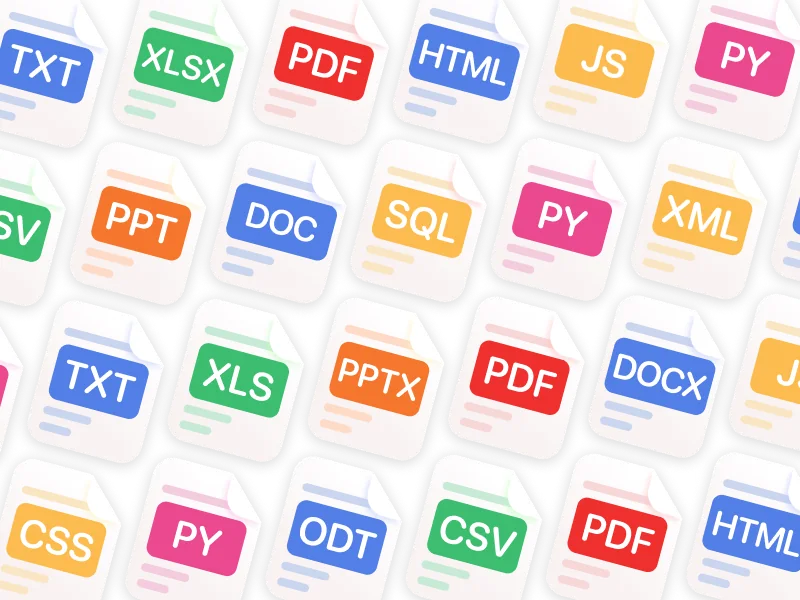
Fello AI supports PDF, Word, Excel, PowerPoint, images, and many more file formats
Chat with PDFs, images, and Office files

Upload PDFs, images, Excel sheets, slide decks, and documents, then ask for summaries, explanations, rewrites, or extracted insights. This makes Fello AI much more useful for study, research, reporting, and day-to-day professional tasks than a plain text chatbot.

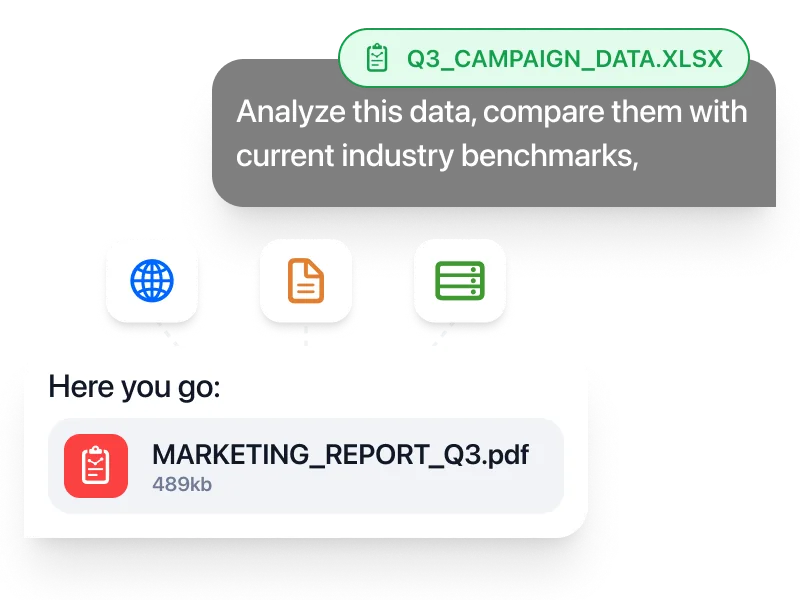
Fello AI generating a downloadable PDF report from a spreadsheet
Create real documents you can download

Generate PowerPoint presentations, Excel spreadsheets with formulas, Word documents, and PDFs, then download and use them immediately. That turns AI from a brainstorming tool into something much closer to a real productivity workspace.

Fello AI web search results with cited sources
Search the web and keep working in one place

When you need current information, Fello AI searches the web with cited sources instead of forcing you to leave the app and manually piece things together. Especially useful when researching a topic, checking facts, or turning fresh information into a finished document.

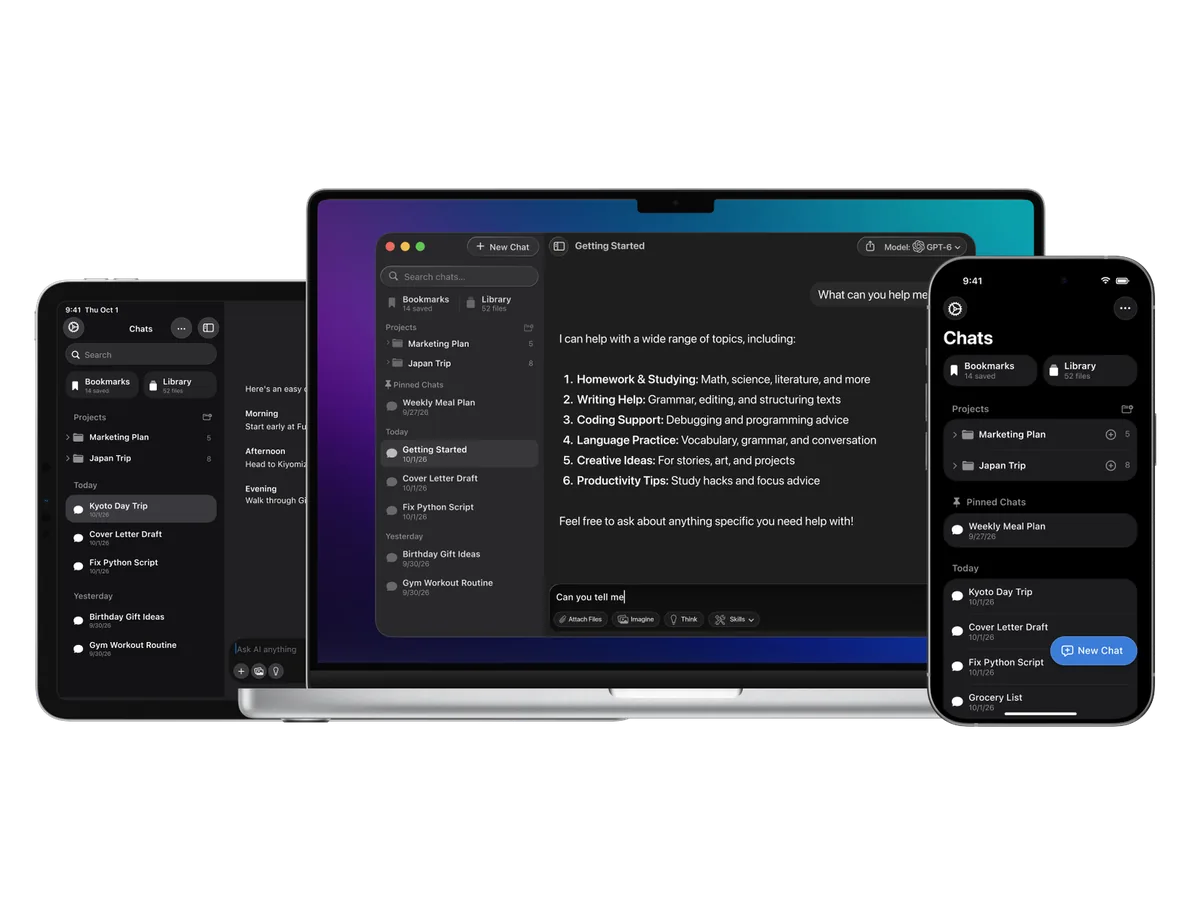
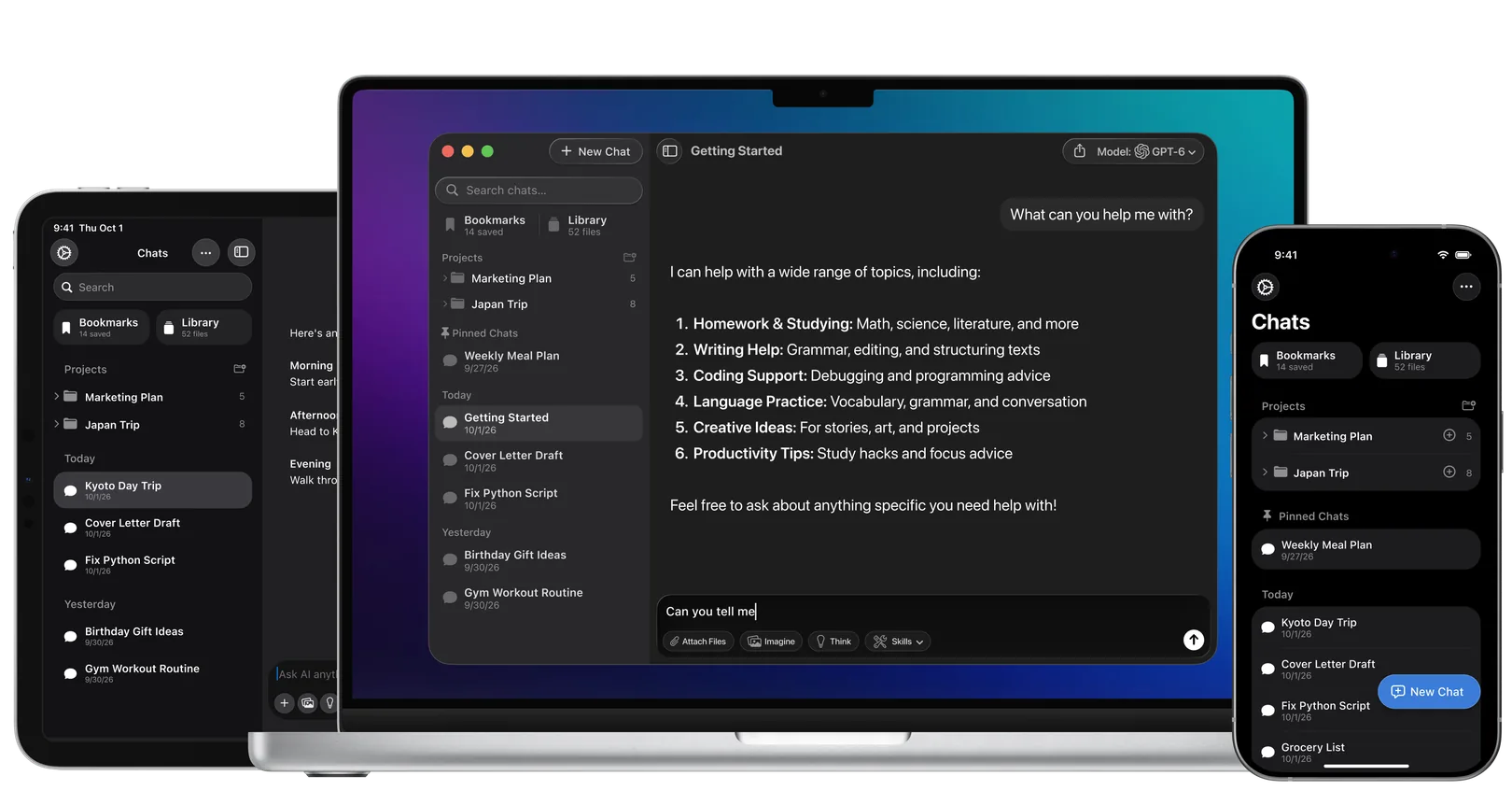
Fello AI on Mac, iPhone, and iPad
One workflow across Mac, iPhone, and iPad

Fello AI is native on all Apple devices, so you keep the same app, the same models, and the same workflow whether you're on your Mac at a desk or on your phone on the go. No separate setup, no switching tools, no restarting the context.

For professionals

Fello AI gives professionals a practical way to use ChatGPT, Claude, Gemini, Grok, and other top models across Mac, iPhone, and iPad as part of one consistent workflow. Analyze PDFs, Word files, Excel sheets, presentations, and images, then turn the result into real downloadable documents for client work, internal workflows, and day-to-day execution.

For students

Fello AI helps students handle everyday academic work more efficiently. Summarize readings, explain difficult topics, compare answers across models, and work with PDFs, slides, notes, and study materials in one place. Instead of relying on a single AI answer, use the model that fits the task and move from quick explanations to deeper research without jumping between apps.


Common questions

Frequently asked questions

Sort of, but not for general chat in English. Z.ai's Mac download is ZCode, which it calls an Agentic Development Environment: an agent harness for developers with no code editor, not a chat client. Zhipu does ship a general chat app for Mac, 智谱清言 (Zhipu Qingyan), free on the Mac App Store, but its interface is Chinese only and it runs on Zhipu's Chinese infrastructure. For English chat with GLM you use the web at chat.z.ai. Fello AI fills the gap by giving you GLM 5.3 as a proper native Mac chat app with no setup, alongside every other frontier model.
The GLM model itself is safe and capable. The data concern relates to using hosted GLM through chat.z.ai or the Z.ai API: your conversations are routed through Chinese-company infrastructure and are subject to Chinese data laws, which require companies to cooperate with government data requests. For casual or non-sensitive queries this is unlikely to matter, but for confidential business, legal, or personal data it is worth considering. Fello AI routes GLM queries through US-based infrastructure, which avoids this concern.
Yes. Zhipu AI (Z.ai) publishes GLM's model weights openly on Hugging Face under the org zai-org. GLM 5.3 shipped there on August 28, 2026, under Z.ai's own GLM 5.3 License, and GLM 5.3 Flash two days earlier under the permissive MIT license. Either way, commercial use and self-hosting are allowed, developers and organizations can download the weights and run GLM entirely on their own hardware with no data leaving their systems. Publishing the weights at all is one of GLM's major differentiators from OpenAI and Anthropic, which keep their models closed.
Very good. GLM 5.3 is positioned as one of the top open-weight models for coding and agentic, tool-using work. It performs strongly inside agent harnesses and coding tools like Claude Code, Cline, and Roo Code, and it can run long, multi-step autonomous tasks without losing the thread. It holds its own against frontier closed models on real development work, though it trails the very top models on the hardest reasoning problems. In Fello AI you can use GLM for heavy coding and agent work and switch to Claude 5 or GPT-6 when you need a second opinion.
Cheaper, though the gap has narrowed. GLM 5.3 lists at $1.40 per million input tokens and $4.40 output, against $4 and $20 for Claude Opus 5.5. OpenAI's GPT-6 Sol is now $2 and $10, close enough that on Artificial Analysis's Intelligence Index v4.3.2, read on September 25, 2026, it costs less per completed task than GLM 5.3 while scoring higher. Through Fello AI's subscription at $9.99/month, you get access to GLM alongside Claude, GPT, and more without managing API billing directly.
GLM 5.3 supports a context window of up to 1M tokens. That puts it at the top of the field for context length, alongside models like Gemini, and it is a meaningful advantage for long-horizon agentic tasks, large codebases, and workflows that need to keep a lot of history in view across many steps.
Yes, in some areas. Like all China-based models, hosted GLM declines to discuss topics that are politically sensitive in China, including events like Tiananmen Square, Taiwan independence, and similar subjects. For technical, scientific, coding, and most general-purpose tasks this is not a factor. For journalism, political research, or work involving Chinese geopolitics, it is a real limitation. Because the weights are published openly, self-hosted deployments can be fine-tuned to handle these cases differently.
Yes, but hardware requirements are significant. GLM's open weights are available on Hugging Face, so you can self-host. However, GLM 5.3 is a 753-billion-parameter mixture-of-experts model, so running it at full quality needs a multi-GPU server rather than a workstation or a Mac. The lighter GLM 5.3 Flash, 320 billion parameters with 18 billion active and MIT-licensed, is the realistic choice for self-hosting. Tools like Ollama and LM Studio make setup easier, and smaller quantized variants run on more modest machines. For most users, the cloud-based options (Fello AI or the web) are more practical.
Yes. Fello AI works on any Mac running macOS 12 Monterey or later, including Intel-based Macs. Because Fello AI uses cloud-based AI (API calls to GLM, Anthropic, OpenAI, etc.), your local hardware performance does not affect the quality or speed of the AI responses. This is different from running GLM locally, which requires substantial hardware.
Fello AI provides access to GLM 5.3, Z.ai's current flagship and its most capable model, released in August 2026. Fello AI keeps model access updated as new versions are released, so you are not locked into an older version. You get GLM 5.3 alongside Claude 5, GPT-6, Gemini, Grok, and 20+ more models in one app.

All the AI you need.
One beautiful app.

Download Fello AI for Mac, iPhone, and iPad. Free to start.

Fello AI running on Mac, iPad, and iPhone

4.7 rating·27,000+ reviews·Free to start