For past couple of years, Silicon Valley has treated artificial intelligence as the ultimate gold rush. Investors have poured hundreds of billions of dollars into data centers, chips, and model training. Startups have rebranded overnight as “AI companies.” Giants like Meta, Microsoft, Google, and Amazon are racing to out-spend one another in a frenzy that feels oddly familiar.
Now, some of the same people leading the boom are starting to sound alarms. The idea that artificial intelligence (AI) could be in a speculative bubble is gaining traction among senior tech leaders. On the one hand, many believe AI has transformative potential. On the other, they are warning that current investment, valuations and hype may be outpacing what can realistically be delivered.
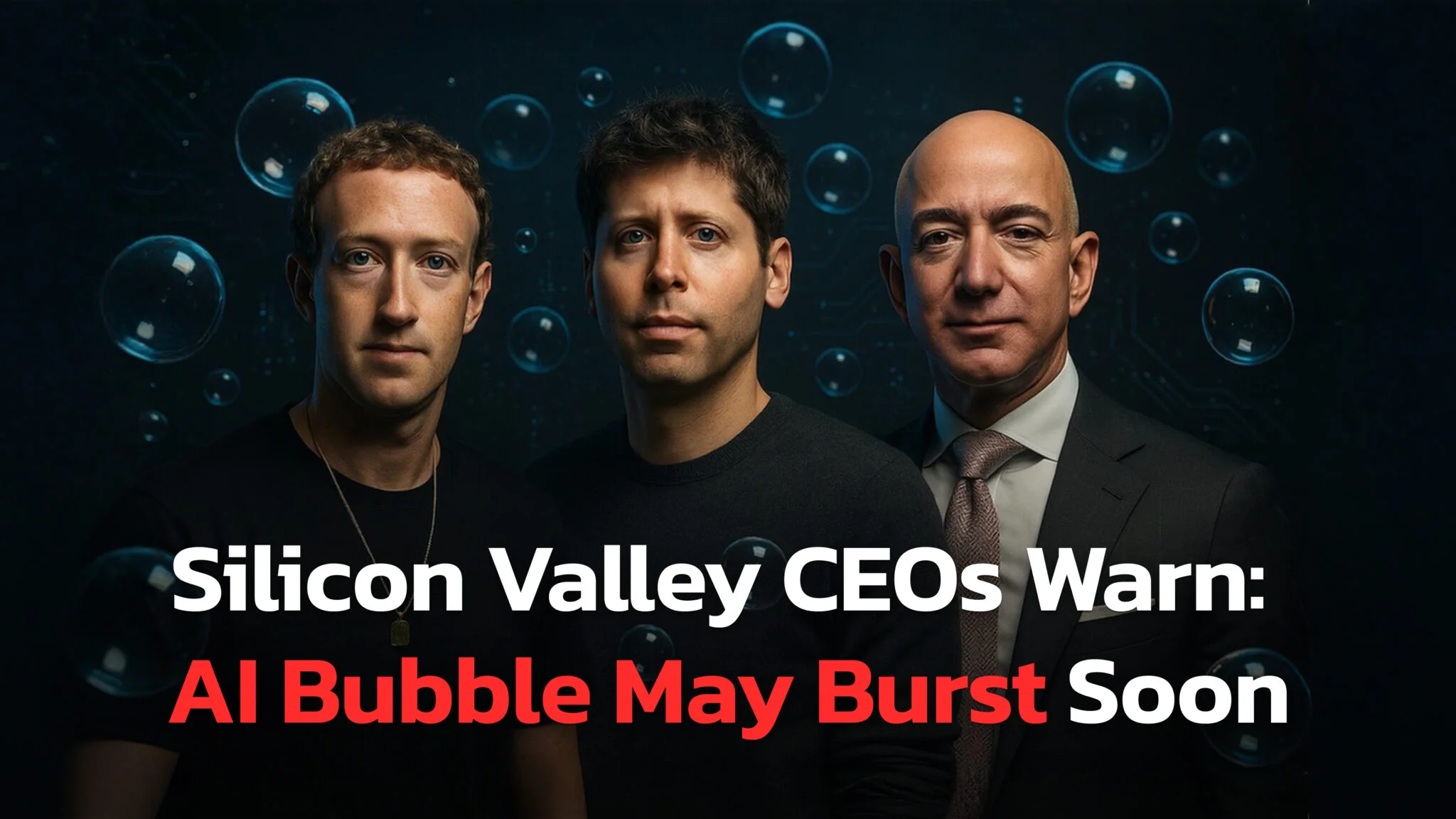
Sam Altman, CEO of OpenAI, has been among the most open voices: “Are we in a phase where investors as a whole are over-excited about AI? My opinion is yes,” he said.
Mark Zuckerberg, CEO of Meta Platforms, has also acknowledged the possibility of a “collapse” or “bubble” in the AI sector, even as he says his company must invest heavily now or risk falling behind.
Why They Thinks the AI Is a Bubble?
For all the excitement surrounding AI, a growing number of Silicon Valley CEOs and analysts are beginning to express serious concerns. The worry isn’t that AI isn’t real — it’s that the economics surrounding it are starting to resemble a classic speculative bubble. From runaway infrastructure spending to tangled financial incentives and disappointing enterprise returns, the red flags are stacking up.
Sam Altman, CEO of OpenAI, has been among the most direct: “Are we in a phase where investors as a whole are over-excited about AI? My opinion is yes,” he said in a recent interview. Mark Zuckerberg, CEO of Meta Platforms, has acknowledged the risk of a collapse, though he says Meta must continue investing heavily to stay competitive.
Even Jeff Bezos, founder of Amazon, has added his voice. Speaking at Italian Tech Week in October 2025, he described the current cycle as an “industrial bubble” — a phase where, in his words, “every experiment gets funded… the good ideas and the bad ideas.” But unlike traditional financial bubbles, Bezos sees this moment as necessary and even productive. AI, he said, “is real” and will “change every industry,” even if many of today’s investments fail. His comparison to past technological revolutions — from railroads to the internet — suggests he believes the long-term gains will outweigh the short-term chaos.
1. Runaway Capital Spending
AI infrastructure has become one of the most expensive bets in modern tech history. Meta expects to spend between $60 billion and $65 billion this year alone on GPUs and data centers. CEO Mark Zuckerberg projects that figure will rise to “hundreds of billions” through the rest of the decade. Microsoft, meanwhile, told investors to prepare for $80 billion in AI capex this fiscal year.
Even OpenAI’s latest partnership with Broadcom involves a staggering 10 gigawatts of compute power—a build estimated to cost over $500 billion, not including prior deals with AMD and Nvidia.
While some economists, like Julien Garran at MacroStrategy, argue that this level of spending is adding around three percentage points to U.S. GDP growth, others caution the comparison to the 1990s fiber-optic boom. That bubble also boosted growth briefly — until the overbuild became a drag on the economy.
2. A Web of Circular Financing
The second concern isn’t just how much money is flowing — but how entangled the money has become.
- Nvidia has pledged up to $100 billion in cash and equity toward OpenAI — while also selling it high-end H100 GPUs.
- AMD has signed supply deals that include warrants for OpenAI to buy up to 10% of its stock, contingent on chip deliveries.
- Microsoft remains OpenAI’s largest investor, major infrastructure provider, and customer — all at once.
These relationships have started to mirror the “vendor financing” practices that helped fuel the telecom crash of the early 2000s. Back then, equipment suppliers would finance purchases for their own customers to inflate sales numbers — until the house of cards collapsed.
If even one counterparty falters, analysts warn, the write-downs could cascade through chipmakers, cloud operators, and AI labs alike.
3. ROI Still Stuck in Pilot Mode
Despite the firehose of funding, most enterprise AI projects are failing to deliver results.
An MIT Sloan study found that 95% of generative AI pilots at large organisations never move past experimentation. And this despite $44 billion spent in just the first half of 2025.
The most common roadblocks:
- Use cases are narrow and don’t integrate easily across workflows
- Hidden costs include data preparation, compliance retraining, and manual overrides
- Employee resistance due to concerns over accuracy and job displacement
While targeted AI start-ups (e.g. contract review, code search) may find product-market fit, most large-scale deployments remain stuck. This growing gap between boardroom expectations and frontline reality is now being referred to as the “GenAI Divide.”
Why the Experts Agree
The deeper concern isn’t that AI will vanish — it’s that the economics behind it might not hold up.
- Infrastructure costs: Running large language models is expensive, and training them is even more so. OpenAI reportedly spends hundreds of millions monthly on cloud computing.
- Circular financing: Companies like Nvidia, AMD, Microsoft, and OpenAI are now financially entangled, creating systemic risk if one stumbles.
- Zero ROI: MIT and Yale studies both highlight that nearly all corporate AI experiments have failed to deliver profit.
- Speculative startups: Pitchbook data shows two-thirds of U.S. venture deal value in 2025 went to AI startups — many with no viable revenue streams.
In short, too much money is chasing too little proven value. And when expectations outgrow results, history shows what happens next.
What a Burst Might Look Like
The AI boom isn’t about to collapse — but a market correction is increasingly likely. According to insiders and analysts, the sector is headed for a phase of consolidation, repricing, and realism.
This won’t kill AI. Just like the dot-com crash didn’t end the internet, a correction would clear out weaker players and allow profitable, sustainable companies to rise.
A Likely Shakeout
Many AI startups are running on hype and VC cash, not viable business models. If funding tightens or interest rates stay high, cash-burning companies without real revenue may be the first to fall. Some will shut down. Others will be bought up by tech giants looking for IP, teams, or infrastructure.
Meanwhile, the massive infrastructure build-up — data centers, custom chips, GPU clusters — could become a burden if AI adoption slows. Billions could be locked up in underused compute.
Expect a surge in M&A activity as big players like Microsoft and Google scoop up distressed startups. And on the investor side, the narrative may shift from “growth at all costs” to “show me the ROI.”
Signs the Bubble May Be Deflating
To spot the shift, watch these indicators:
- Revenue vs Spending: Are companies making real money or just burning capital?
- Real-World Use: Is AI used daily across industries, or stuck in demos and pilots?
- Valuation Gaps: Do billion-dollar tags reflect real product adoption?
- Regulatory Risk: New laws could reshape AI economics overnight.
- Systemic Exposure: One stumble (e.g. a chipmaker) could ripple through the ecosystem.
Conclusion
The AI era is not ending — but it is entering a new phase. After two years of hype, billion-dollar rounds, and ambitious buildouts, the industry is starting to face harder questions: What is the real value? Who is actually using these tools at scale? And how much of today’s momentum is built on solid ground versus financial feedback loops?
The core technology is real. AI systems have proven their power across a range of tasks, from writing code to generating images to assisting with research. But usefulness doesn’t always equal profit, and that’s where the gap lies. Many companies have spent heavily without yet finding durable business models. Others are building tech for problems that don’t exist at scale.
What we’re seeing now is not a collapse but a shift — from ambition to execution, from storytelling to results. It’s a familiar cycle in tech. After the dot-com bust, the internet didn’t vanish — it matured. The same may happen here. Weak companies will fall, strong ones will adapt, and the AI sector may eventually settle into more realistic valuations and measured growth.
For investors, founders, and policymakers, this is a moment to pause and recalibrate. Optimism is still welcome — but it needs to be backed by numbers, not just demos. The path forward won’t be as fast or easy as early headlines promised, but the long game might prove even more meaningful. This argument is about whether AI progress can continue at its current rate, which is a different claim from the 2026 case for deliberately slowing it down.