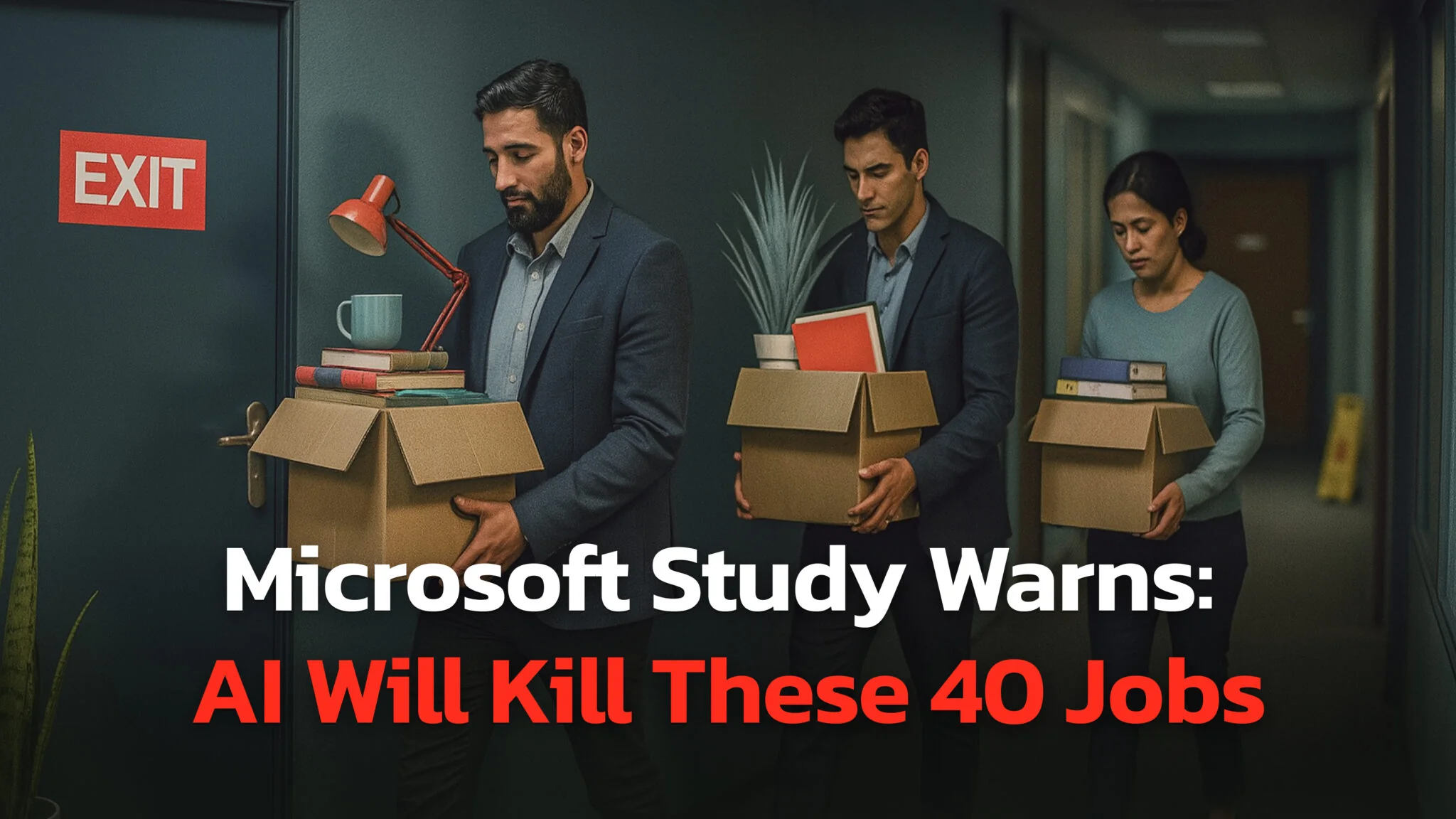
As generative AI tools like Microsoft Copilot, ChatGPT or Gemini become more common, their real-world impact on jobs is starting to take shape. In a major 2025 study, Microsoft Research analyzed 200,000 anonymized U.S.-based conversations with Bing Copilot to see what kinds of work tasks people are using AI for—and how well the AI handles them. By matching these tasks to official job categories from the O*NET database, the study maps out which occupations are most exposed to AI capabilities.
Instead of speculating how many jobs AI might replace, the researchers introduced an “AI applicability score” for each job, based on task frequency, success rate, and how much of the task AI can realistically do. The results show a strong overlap with knowledge work—especially writing, researching, and customer communication—while physical jobs like equipment operation or patient care show little impact. It’s one of the clearest looks so far at how AI is already reshaping work. That study measures what is happening now; for the longer view, we pulled together what the 2030 job forecasts actually say.
Jobs Most & Least Exposed to AI
To understand how generative AI might reshape the workforce, Microsoft researchers created an “AI applicability score” for over 900 occupations. This score reflects how often AI tools like chatGPT, Gemini or Claude are used for tasks tied to each job, how well the AI completes those tasks, and how much of the job it can realistically take on.
Jobs that scored highest are ones where a large portion of the work involves tasks LLMs already handles well—especially writing, researching, interpreting, and communicating. These roles are more language-heavy and involve managing or processing information, making them a better match for large language models.
Top 10 Most Affected Jobs by Generative AI
| Rank | Occupation | AI Applicability Score | U.S. Employment |
|---|---|---|---|
| 1 | Interpreters & Translators | 0.49 | 51,560 |
| 2 | Historians | 0.48 | 3,040 |
| 3 | Passenger Attendants | 0.47 | 20,190 |
| 4 | Sales Reps (Services) | 0.46 | 1,140,000 |
| 5 | Writers & Authors | 0.45 | 49,450 |
| 6 | Customer Service Reps | 0.44 | 2,860,000 |
| 7 | CNC Tool Programmers | 0.44 | 28,030 |
| 8 | Telephone Operators | 0.41 | 6,620 |
| 9 | Ticket Agents & Travel Clerks | 0.41 | 113,750 |
| 10 | Broadcast Announcers & DJs | 0.41 | 17,860 |
These jobs share one key trait: they rely heavily on structured communication, information handling, or standardized service. Copilot already supports many of these tasks—translating, drafting messages, retrieving facts, and summarizing content. Translators and historians often work with text, while sales and customer service reps need to respond clearly and consistently—something generative AI is increasingly good at.
Top 10 Least Affected Jobs by Generative AI
| Rank | Occupation | AI Applicability Score | U.S. Employment |
|---|---|---|---|
| 1 | Dredge Operators | 0.00 | 940 |
| 2 | Bridge & Lock Tenders | 0.00 | 3,460 |
| 3 | Water Treatment Operators | 0.00 | 120,710 |
| 4 | Foundry Mold Makers | 0.00 | 11,780 |
| 5 | Rail-Track Maintenance Workers | 0.00 | 18,770 |
| 6 | Roof Bolters (Mining) | 0.00 | 2,430 |
| 7 | Logging Equipment Operators | 0.00 | 34,500 |
| 8 | Derrick Operators (Oil & Gas) | 0.00 | 8,190 |
| 9 | Rotary Drill Operators (Oil) | 0.00 | 17,760 |
| 10 | Industrial Truck Operators | 0.00 | 714,800 |
These jobs involve physical activity, hands-on decisions, and equipment handling—areas where generative AI has little use today. AI might help indirectly through training tools or diagnostics, but the work itself remains human-led. These roles overlap heavily with the AI-proof jobs that current data says are safest. Many of these jobs also depend on awareness of surroundings, safety protocols, or real-time judgment that can’t be handled by text-based AI.
Where Generative AI Excels & Where It Fails
The study shows generative AI works best on tasks involving structured language and knowledge work. The top AI-supported task—“gathering information from multiple sources”—accounted for 19.8% of all Copilot user goals, more than double its share in typical U.S. jobs (8.6%). Other strong tasks included “explaining complex topics” (AI score: 0.48) and “writing or editing content” (0.45).
These strengths line up with roles like translators (0.49), writers (0.45), and customer service reps (0.44), where much of the work involves language and repetition. AI helped summarize, rewrite, brainstorm, and respond to questions. Even in technical jobs, it helped draft emails, code, or documentation. Still, in 39.4% of cases, the AI’s response didn’t match the original request—reinforcing its position as a helper, not a full substitute.
AI’s weak points are just as clear. Of 73 work tasks studied, 34 had near-zero applicability. These included operating equipment, checking visuals, physical monitoring, and manual work. Jobs like dredge operators, drill techs, and truck drivers (714,800 workers) had AI scores of 0.00. These roles depend on spatial sense, direct interaction, and human judgment that language models can’t yet mimic.
LLMs also have reliability issues. Hallucinations—confident but wrong answers—remain a risk, especially in legal, medical, or analytical work. Combined with its struggles in visual tasks and occasional mismatch with user intent, these limits mean AI is better at supporting text-heavy work than replacing it.
The Real Impact of AI on the Job Market
Generative AI is no longer just a futuristic concept—it’s actively reshaping the workforce. Microsoft’s 2025 study shows that AI is helping knowledge workers, especially in writing, research, and communication roles, complete tasks faster and more efficiently. But the shift isn’t just about productivity boosts—it’s also triggering a wave of layoffs in roles that can now be automated.
In 2025, IBM laid off 8,000 employees, primarily in human resources, as AI systems took over routine HR functions. Google initiated two rounds of layoffs starting in 2024, targeting its ad division while simultaneously rolling out AI tools to handle ad sales and customer support. Salesforce removed over 700 employees in 2024 and continued trimming headcount in 2025 while ramping up AI investments.
Even companies built around language, like Duolingo, let go of 10% of their contractors in early 2024 as AI replaced much of the translation workload. AI-native companies aren’t immune either—Klue, a Canadian AI startup, slashed 40% of its workforce in 2025. And in more physically intensive sectors, Intel reduced 20% of its factory workforce (around 21,000 jobs), citing the need for operational streamlining as it competes in the AI chip space.
Other companies—Bumble, Turnitin, Automattic, BlueFocus, and Okta—have all made cuts in 2024–2025, many of them linked directly to AI adoption or internal automation.
Yet, while some roles are vanishing, others are becoming more valuable. According to labor market intelligence firm Lightcast, U.S. job listings that mention AI skills now offer salaries nearly $18,000 higher than those that don’t. Since 2022, demand for generative AI skills has surged 800%, especially in marketing, HR, education, and customer service. Workers with two or more AI-related skills can earn up to 43% more.
Here’s the twist: even as tech companies cut jobs, other sectors are actively hiring people who know how to work with these tools. Skills like prompt engineering, LLM usage, and ChatGPT fluency are popping up in thousands of job postings.
So is AI taking jobs—or just changing them? The answer is still unfolding. But one thing is clear: those who know how to use it are more likely to stay employed—and get paid more.
Conclusion
Generative AI is beginning to influence a wide range of occupations, particularly those centered on language, knowledge work, and customer interaction. Studies show that while AI can assist with writing, researching, and interpreting information, it has limited utility in jobs that require physical presence, manual skills, or situational awareness.
Some sectors, especially in technology and support functions, have seen notable layoffs linked to AI adoption. At the same time, demand is rising for workers who understand and can apply AI tools, with data suggesting these roles often come with higher salaries. Skills in prompting, interpretation of AI outputs, and integration into workflows are increasingly valued across industries.
Rather than a straightforward story of job loss or replacement, the data points to a more complex shift. AI is likely to reshape tasks within jobs and redistribute demand across roles and sectors. For workers and employers alike, adaptability and ongoing learning will play a key role in navigating this transition.