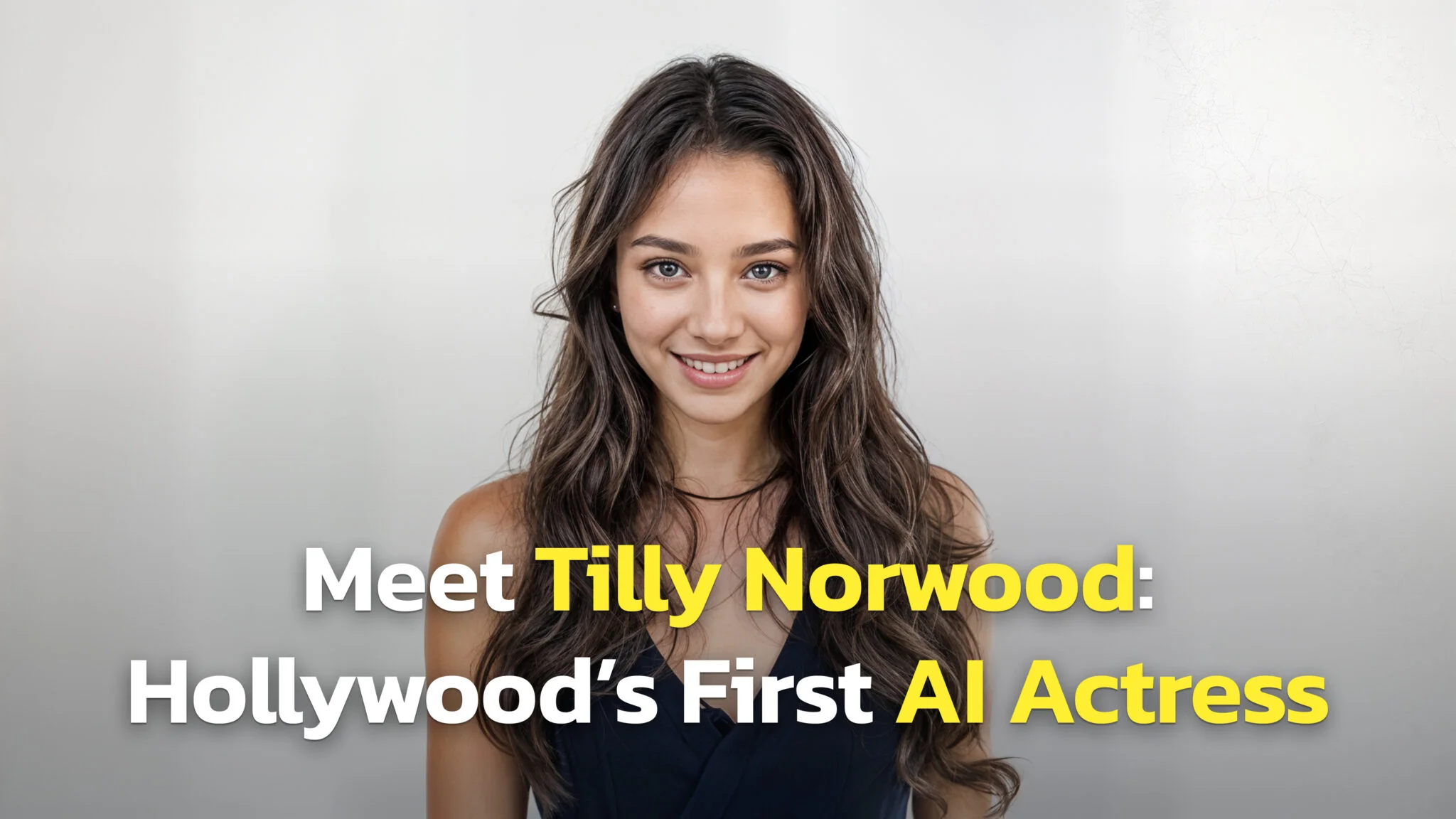
In 2025, a new name began making waves in the entertainment industry. Not for her breakout performance or red-carpet appearance, but because she isn’t human at all. Tilly Norwood is the world’s first fully AI-generated actress.
She’s is a photo-real, 20-something “girl-next-door” who lives entirely in the cloud. She was introduced at the Zurich Film Festival’s industry summit on 27 September 2025 and immediately began courting real Hollywood talent agents—even though she is nothing more than code, diffusion models and a fast-growing social-media presence that has topped 40 000 Instagram followers in five months.
While some call her a creative experiment or even a digital art piece, others see her as a direct threat to the future of real actors and the soul of storytelling. So, who is behind Tilly Norwood? And is this the beginning of a new Hollywood led by synthetic stars?


Who Is Tilly Norwood?
Tilly Norwood is not a real person. She is a fully AI-generated character—every pixel of her face, every frame of her videos, every line she speaks is the product of artificial intelligence. From her voice to her personality, Tilly was built entirely in the cloud, with no physical counterpart.
She first appeared quietly on Instagram in mid-2025, sharing polished portraits, short reels, and even a lighthearted comedy sketch. At first glance, she looked like a typical up-and-coming influencer or a fresh face trying to break into Hollywood. Her content was designed to feel authentic, casual, and familiar—complete with captions, hashtags, and even behind-the-scenes commentary.
But behind the scenes, there was no actress. No audition. No camera crew. Tilly was created by generative AI models trained on thousands of real human performances. Her appearance was deliberately crafted to evoke familiarity, blending traits of several well-known actresses. Observers have compared her to a digital mix of Gal Gadot, Hailee Steinfeld, and Rachel Zegler—photogenic, expressive, and camera-ready.
Unlike those stars, however, Tilly has no past. She has no childhood, no struggles, no life beyond the scripts her creators feed her. Her memories are synthetic. Her emotions are programmed. Her “career” exists entirely inside the server farms and production pipelines that keep her running.

Who’s Behind Tilly Norwood—and Why It Matters
Tilly Norwood was created by Dutch comedian and producer Eline Van der Velden, through her AI-focused content studio Particle6 and talent agency Xicoia, which calls itself the world’s first agency for AI performers.
Van der Velden has a background in acting and comedy, but recently shifted to AI-driven storytelling. She describes Tilly as a “work of art,” not a replacement for human actors, but a creative experiment built to explore what’s possible with AI.
“Creating Tilly has been an act of imagination and craftsmanship,” she said, comparing it to writing or designing a character.
Tilly was unveiled at the Zurich Film Festival Summit in September 2025, where Van der Velden pitched her as “the next Scarlett Johansson”—a comment that immediately sparked backlash from actors and unions.
The Business Logic Behind AI Talent
Beyond the artistic statement, there’s a clear commercial incentive. Hollywood already uses AI to de-age actors, tweak performances, and generate digital extras. Tilly takes that to the next level: a fully synthetic lead.
Why studios are interested:
- Cheaper production: No overtime, no travel, no union contracts.
- Always available: AI doesn’t get sick, age, or renegotiate.
- Easily localized: Languages and facial expressions can be tailored per region.
Why many are pushing back:
- Job risk: SAG-AFTRA warns that 160,000 jobs could be at stake if AI actors gain traction.
- Ethics: AI models are trained on countless real performances—often without consent or payment.
- Audience unease: Tilly’s first short film, AI Commissioner, was met with discomfort rather than acclaim.
Van der Velden insists Tilly is here to complement, not replace, human talent. But critics worry that studios may soon prioritize scalable AI over real performers—especially as the tech gets better and the savings get bigger.
Backlash from Hollywood
The arrival of Tilly Norwood has triggered a fierce response from actors, unions, and filmmakers who see her not as innovation—but as intrusion.
The Screen Actors Guild (SAG-AFTRA) was first to respond, calling Tilly “a character generated by a computer program with no life experience to draw from.” The union warned that the use of synthetic performers could trigger mandatory bargaining obligations under existing contracts and described the practice as a threat to real human jobs.
Their stance was clear: “This doesn’t solve any problem—it creates one. Using stolen performances to put real actors out of work.”
Other unions quickly followed suit. ACTRA (Canada) and Equity (UK) both issued statements criticizing AI characters trained on the unpaid labor of actors, calling for stronger protections and industry-wide restraint.
A-list actors also joined the resistance:
- Emily Blunt, after seeing a clip of Tilly during a Variety podcast, didn’t hold back: “Good Lord, we’re screwed… Please stop taking away our human connection.”
- Whoopi Goldberg, speaking on The View, said audiences would always notice the difference: “Our faces move differently, our bodies move differently.” Still, she warned that AI characters may benefit from “unfair advantages” over real performers.
- Natasha Lyonne called for a boycott of any agency that signs Tilly, labeling the entire idea “deeply misguided.”
- Melissa Barrera, known for Scream and In the Heights, posted bluntly: “How disgusting. Read the room.”
The outrage comes on the heels of the 2023 Hollywood strikes, where AI use was one of the most hotly contested issues. Many in the industry feel the wounds are still fresh—and Tilly’s debut just poured salt into them.
The message from real Hollywood talent is consistent: AI may be here, but don’t expect human artists to accept synthetic replacements quietly.
Is This the Future of Hollywood?
That’s the billion-dollar question.
Eline Van der Velden plans to launch 40 more AI characters under her company, spanning films, TV, podcasts, and games. She insists these creations won’t replace human actors but exist alongside them.
But many don’t buy it. The fear is that once AI characters become cheaper and more customizable than hiring real talent, studios—always looking to cut costs—will start using them more widely. Especially for background roles, social content, and low-budget productions.
Hollywood has seen this cycle before. First it was CGI. Then digital doubles. Then AI voiceovers. Now full-blown synthetic stars.
A Potential Path Ahead
- Coexistence: AI characters are used like animation—existing in their own genre, separate from live-action roles.
- Hybrid Productions: AI is used to enhance real actors’ performances, not replace them.
- Job Losses: Studios opt for fully synthetic productions, displacing actors in certain roles.
- Regulation and Licensing: Unions demand that AI actors only be used under strict licensing terms, possibly requiring payment to original actors whose data was used.
Some believe this shift is inevitable. Others see it as a fight for the soul of storytelling—where empathy, humanity, and lived experience still matter. For now, Tilly Norwood remains a symbol: of what’s possible, and what’s at stake.
Conclusion
Tilly Norwood may just be lines of code and pixels on a screen, but her arrival forces a deeply human reckoning. What do we value in art? Is it the expression of lived experience, or the illusion of it? Can a machine-crafted persona ever carry the weight of emotion that a real person brings to a role—or will audiences always sense the difference, no matter how advanced the technology becomes?
Tilly is more than just an experiment. She’s a mirror—reflecting both our creative ambitions and our economic realities. Her existence challenges us to draw a line between innovation and imitation, between efficiency and authenticity. To some, she represents progress: faster, cheaper, infinitely customizable talent. To others, she’s a warning sign—proof that even the most personal forms of expression are no longer safe from automation.
But storytelling has always been a human endeavor. The stories that endure are the ones that carry something intangible—pain, joy, doubt, transformation. Can AI ever replicate that? Or will synthetic actors always lack the imperfections, scars, and contradictions that make a performance truly unforgettable?
Tilly Norwood may be the first of her kind, but she won’t be the last. Whether she’s remembered as a breakthrough or a boundary crossed will depend not just on how convincing her smile is—but on what we, as audiences and creators, are willing to accept as “real.”
Because in the end, the question isn’t whether AI can play the part. It’s whether we want it to.