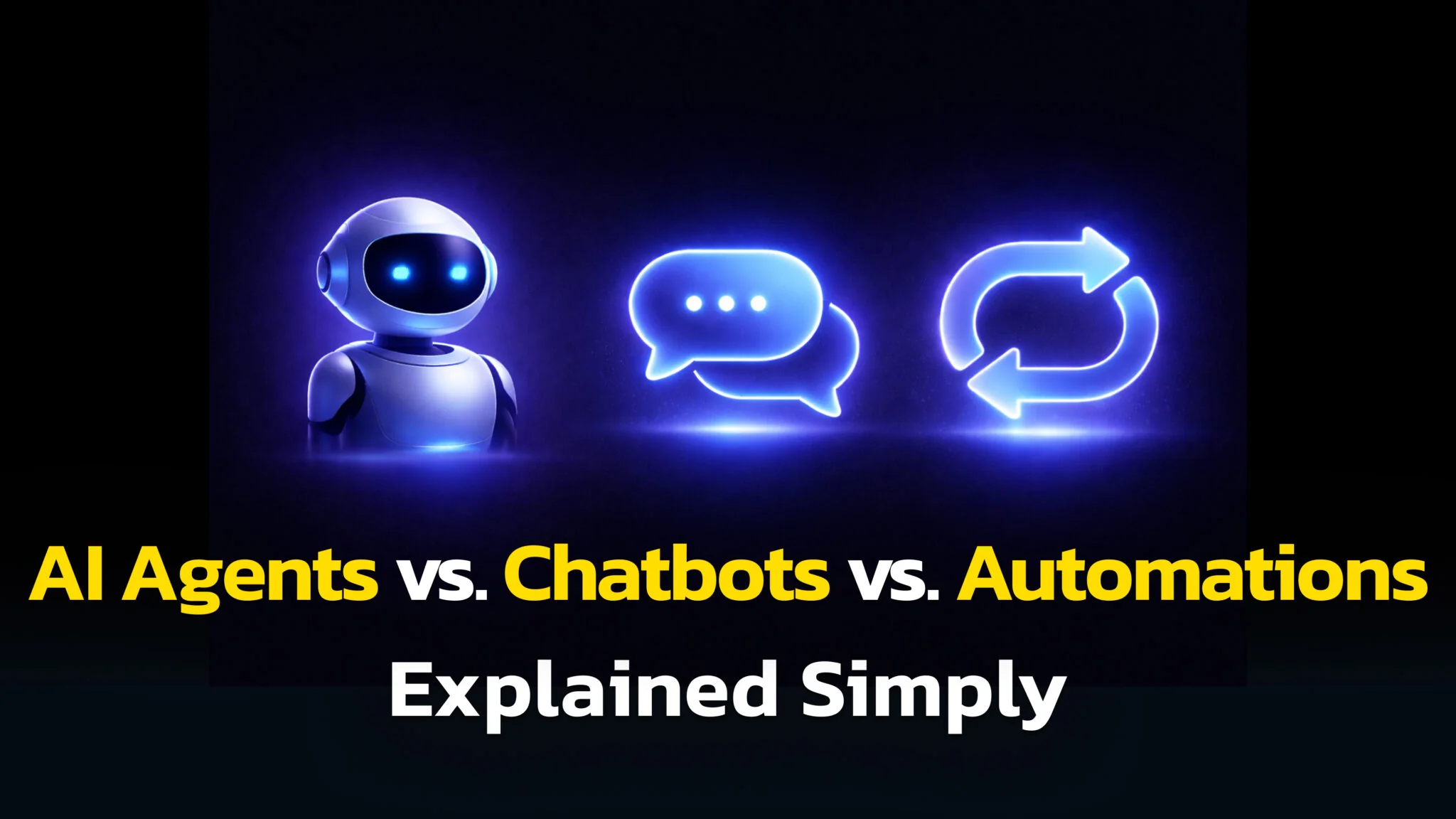
Gartner expects more than 40% of agentic AI projects to be cancelled by the end of 2027, and it has a name for a big part of the problem: agent washing, vendors rebranding ordinary chatbots, robotic process automation and generative AI assistants as autonomous “agents.” That is exactly why agentic AI vs generative AI is the comparison that actually matters in 2026, and why so many buyers pay agent prices for chatbot capabilities.
This guide compares four distinct ways to automate work, honestly and with real 2026 prices: traditional automation, RPA, generative AI, and agentic AI. Most articles pit just two against each other and miss the point, because these approaches sit on a spectrum and real solutions almost always combine more than one. No buzzwords, no hype, just the product names, the numbers, the failure modes, and a decision framework you can use to pick the right tool for a specific job.
The Key Takeaways
- Generative AI answers; agentic AI acts. Generative AI produces content when you prompt it. Agentic AI takes a goal, plans the steps, uses tools, and carries out the task. Both run on the same large language models.
- “Agentic AI” and “AI agents” are near-synonyms. Agentic AI is the capability; an AI agent is a specific piece of software that has it. The real trap is agent washing, chatbots sold as agents.
- Real 2026 prices: traditional automation $50–500/mo; RPA from about $25/mo (UiPath Basic) into six figures at enterprise scale; generative AI support like Fin at $0.99 per resolution; agentic tools like Claude Cowork at $20–200/mo.
- Most of the cost is hidden. For RPA, licensing is only about 25–30% of total cost of ownership (HFS Research), and 45% of firms report their bots break weekly or more often (Forrester, commissioned by Tricentis).
- The hype has a ceiling. Gartner found 72% of CIOs are breaking even or losing money on AI, and expects over 40% of agentic AI projects to be cancelled by 2027. Pick the simplest tool that does the job.
Agentic AI vs Generative AI: The Core Difference
Start here, because this is the distinction most people get wrong. Generative AI and agentic AI run on the same underlying large language models, the GPT, Claude and Gemini families. The difference is not the model. It is what the software around the model is allowed to do.
Generative AI is reactive. You give it a prompt, and it produces an output: a paragraph, an image, a block of code, an answer. It does not act in the world, it does not chain steps together on its own, and when the response is finished, it stops and waits for you. Plain ChatGPT, Claude in a chat window and Gemini are generative AI. So, despite the marketing, are most “AI chatbots.”
Agentic AI is goal-directed. You give it an objective rather than a prompt, and it plans a sequence of steps, calls tools (web browsers, APIs, files, code), checks its own progress, adapts when something fails, and keeps going until the goal is met or it hits a checkpoint you set. The model is the brain; the agent is the brain plus hands, memory and a plan. One line to remember: generative AI answers, agentic AI acts. For a plain-English primer on the concept, read our full agentic AI guide.
| Dimension | Generative AI | Agentic AI |
|---|---|---|
| Trigger | A prompt from you | A goal you hand off |
| Behaviour | Produces one output, then stops | Plans and runs multiple steps to completion |
| Tool use | None, or a single lookup | Browsers, APIs, files, databases, code execution |
| Acts in the world | No, it returns text or media | Yes, it takes actions on your behalf |
| Adapts mid-task | No | Yes, reroutes when a step fails |
| Human role | You act on the output | You approve and supervise the actions |
| Typical products | ChatGPT, Claude chat, Gemini, Intercom Fin | Claude Cowork, ChatGPT Work, n8n AI agents |
The practical upshot: generative AI makes you faster, agentic AI tries to do the task for you. That is a real capability jump, and a real price jump, which is why it pays to know which one a vendor is actually selling. For the full definition and the anatomy of a real agent, see our explainer on what an AI agent actually is.
Agentic AI vs AI Agents: Is There a Difference?
Short answer: barely, and not one worth losing sleep over. Agentic AI is the broad capability, the property of a system that can pursue goals autonomously. An AI agent is a concrete piece of software that has that capability. It is the same relationship as “machine learning” (the field) and “a model” (the artifact), or “aviation” and “a plane.” Agentic AI is the adjective; an AI agent is the noun.
Vendors and analysts use the two interchangeably, and you can too. Where it matters is the third term nobody advertises: agent washing. Gartner coined it to describe vendors rebranding assistants, RPA bots and chatbots as “agents” with no new autonomy underneath. If a product is called an agent, the honest test is whether it plans multi-step tasks, uses multiple tools, and reasons about situations it was not scripted for. If it cannot do all three, it is generative AI or automation wearing an agent label.
The Automation Spectrum (Not a Binary)
Zoom out from the two-way fight and the picture gets clearer. Automation is not a binary choice; it is a spectrum with five points, from doing everything by hand to handing a goal to an autonomous agent.
Fully Manual --> Scripted Automation --> Rule-Based Bots (RPA) --> Generative AI (Chatbots/LLMs) --> Agentic AI (Agents)
     |                  |                       |                              |                          |
  Humans do         Cron jobs,              UiPath,                       ChatGPT, Claude chat,      Claude Cowork,
  everything        ETL pipelines,          SS&C Blue Prism,               Intercom Fin,              ChatGPT Work,
                    email rules             Automation Anywhere           Zendesk AI                 n8n AI agents
The key insight is that most real-world solutions are hybrids. A company might use traditional automation to pull data from a database, feed it to an agent that analyses it and drafts a report, then hand that report to a chatbot that answers employee questions about it. The useful question is not “which one should I use?” but “what combination fits my workflow?”
A driving analogy makes the four automation styles concrete. Traditional automation is cruise control: you set a speed and it holds it, blind to traffic or turns. RPA is adaptive cruise control: it still follows a fixed behaviour but reacts to the car in front, and it gets confused when that car (the on-screen UI) changes. Generative AI, the chatbot, is GPS navigation: it understands your destination and talks you through it, but it does not drive; you still execute. An agentic AI is a self-driving system: you give it a destination, and it plans the route, handles obstacles, reroutes, and completes the journey, with a human ready to take over for the hard moments.
The Complete Comparison Table
This is the side-by-side matrix across the four approaches. Every cell reflects how each one works in practice rather than in a marketing deck, and the prices are what you actually pay in 2026.
| Dimension | Traditional Automation | RPA | Generative AI (Chatbot/LLM) | Agentic AI (Agent) |
|---|---|---|---|---|
| What it does | Executes predefined rules (if X then Y) | Mimics human clicks and keystrokes on screen | Produces language, answers, or content on request | Plans and executes multi-step tasks autonomously |
| Decision-making | None, follows fixed logic | None, follows recorded scripts | Matches intent to a response; no real planning | Contextual reasoning; evaluates options and picks actions |
| Data handled | Structured only (databases, CSVs, APIs) | Structured via UI elements (fields, buttons) | Text, voice, images (natural language) | Structured and unstructured (text, images, PDFs, web) |
| Adaptability | None, breaks if inputs change | Low, breaks if the UI layout changes | Medium, handles phrasing within its trained scope | High, reasons through novel situations |
| Multi-step tasks | Sequential scripts only | Sequential scripts only | No, built for single-turn replies | Yes, chains tool calls and adjusts mid-task |
| Tool use | Fixed integrations set at build time | Screen-level clicks and keystrokes | None, or a single API lookup | APIs, file systems, browsing, databases, code |
| Human oversight | Setup and configuration only | Ongoing monitoring and exception handling | Escalation rules for unresolved queries | Review gates and approval checkpoints for high-stakes actions |
| Maintenance | High, brittle to any process change | High, 45% of firms report weekly bot breakage (Forrester/Tricentis, 2020) | Medium, periodic retraining and content updates | Lower over time, but initial tuning is significant |
| Cost range | $50–500/mo | From ~$25/mo (UiPath Basic) to $5K–50K+ at enterprise scale | $20/mo (ChatGPT, Claude) to per-outcome fees (Fin $0.99) | $20–200/mo (consumer) to $50K–500K+ (enterprise) |
| Examples | Cron jobs, ETL, email rules, Zapier | UiPath, SS&C Blue Prism, Automation Anywhere | ChatGPT, Claude chat, Intercom Fin, Zendesk AI | Claude Cowork, ChatGPT Work, n8n AI agents |
For a broader look at the actual agent products worth trying today, see our roundup of the best AI agents.
When to Use Each (Decision Framework)
Use this to narrow down which approach fits a specific task. Start at the top and follow the branches; the goal is always the simplest tool that reliably does the job.
Is the task repetitive and rule-based?
|
+-- YES: Does it involve a GUI or legacy system with no API?
|   |
|   +-- YES ---> RPA
|   |            (entering data into a legacy ERP with no API)
|   |
|   +-- NO ----> Traditional Automation
|                (cron jobs, ETL pipelines, Zapier/Make workflows)
|
+-- NO: Does it require understanding natural language?
    |
    +-- YES: Is it single-turn Q&A (user asks, system answers)?
    |   |
    |   +-- YES ---> Generative AI (chatbot / LLM)
    |   |            (FAQ bot, drafting, product recommendation)
    |   |
    |   +-- NO: Does it need planning, tool use, or multi-step execution?
    |       |
    |       +-- YES ---> Agentic AI (agent)
    |       |            (research, multi-system workflows, analysis)
    |       |
    |       +-- NO ----> Generative AI with escalation to a human
    |
    +-- NO: Is it a complex analytical or creative task?
        |
        +-- YES ---> Agentic AI (agent)
        |            (competitive analysis, report generation, code review)
        |
        +-- NO ----> Reassess, maybe this task does not need automation
A few rules of thumb tie it together. If your process has not changed in twelve months and runs on structured data, traditional automation is almost certainly the cheapest and most reliable option. If you are automating a system with no API, RPA is the pragmatic choice, but budget for maintenance. If users need to ask questions in natural language and get quick answers, generative AI is the fit. And if the task needs judgment, multiple tools, or adapting to unexpected inputs, an agent is what you actually need. If that last case is yours and you plan to build it yourself, our comparison of agentic AI frameworks ranks the eight main options by learning curve.
5 Real-World Scenarios Compared
For each scenario below, here is how all four approaches would handle the same task, and which one actually makes sense. This is where the abstract spectrum turns into a concrete recommendation.
Scenario 1: Processing Invoices
| Approach | How it handles it | Verdict |
|---|---|---|
| Traditional automation | Works only if every invoice has an identical format. A scheduled script reads fixed fields and loads them into your accounting system. Falls apart the moment a vendor sends a different PDF layout. | Good for standardized internal invoices. |
| RPA | A bot reads specific fields from a PDF viewer and types values into accounting software. UiPath and Automation Anywhere both ship invoice-processing templates. Breaks when the viewer updates or a vendor changes their layout. | Common, but maintenance-heavy. |
| Generative AI | Not a fit on its own; there is no conversation to have. It can summarise an invoice if you paste one in, but it will not run the workflow. | Not applicable. |
| Agentic AI | Reads invoices in varying formats (PDF, email, scanned images), extracts line items using vision and language, flags anomalies like duplicate charges, routes for approval, and enters the data. Handles format variation without breaking. | Best for variable-format invoices at scale. |
Bottom line: if every invoice arrives in the same format from the same system, a $50/month cron job beats everything. If you receive invoices from dozens of vendors in different formats, an agent is the only approach that does not need constant manual fixes.
Scenario 2: Answering Customer Questions
| Approach | How it handles it | Verdict |
|---|---|---|
| Traditional automation | Keyword routing. Emails containing “refund” go to the refund queue. No understanding of the question. | Useful for triage, not resolution. |
| RPA | Not a fit; RPA does not handle natural language. | Not applicable. |
| Generative AI | Handles common questions from a knowledge base, recognises phrasing variations, and escalates complex issues. Intercom Fin charges $0.99 per resolution. | Best for high-volume, straightforward support. |
| Agentic AI | Resolves multi-step issues end to end: looks up the order, checks shipping, initiates a replacement, and emails the customer, without a human in the loop for routine cases. | Best for complex, multi-step resolution, with oversight. |
The Klarna reality check: Klarna’s assistant handled 2.3 million conversations in its first month, doing work the company equated to 700 full-time agents and cutting resolution time from 11 minutes to under 2, per its OpenAI case study from February 2024. It handled about two-thirds of chats, and nobody was laid off to hit those numbers; 700 was an equivalent-work figure. By late 2025 Klarna said the assistant did the work of 853 agents. But in May 2025 CEO Sebastian Siemiatkowski started rehiring humans, saying cost had become “a too predominant evaluation factor” and quality slipped. Support and operations costs actually rose, to $50 million in Q3 2025 from $42 million a year earlier, even against roughly $60 million in AI savings. The AI worked; leaning on it too hard still cost them.
Bottom line: most companies want generative AI for Tier 1 support and either humans or agents for Tier 2 and up. A hybrid, chatbot for common questions, agent for complex cases, human for sensitive ones, is the practical path for the vast majority of organizations.
Scenario 3: Building a Weekly Report from Multiple Sources
| Approach | How it handles it | Verdict |
|---|---|---|
| Traditional automation | A scheduled SQL query pulls data, formats a table, and emails it as a CSV or PDF. Perfect if the structure and sources never change. | Cheapest and most reliable for static reports. |
| RPA | A bot logs into several dashboards, copies data, and pastes it into a template. Fragile; breaks when any dashboard UI updates. | Works, but maintenance is painful. |
| Generative AI | Not a fit for the data gathering, but it can turn numbers you give it into readable narrative and commentary. | Useful only as the write-up layer. |
| Agentic AI | Queries multiple databases and APIs, synthesises the data into a narrative report with analysis and recommendations, formats it, and answers follow-up questions. | Best when you need analysis, not just aggregation. |
Bottom line: if your weekly report is just “pull these numbers and format them,” a cron job is almost free and never hallucinates. If you need narrative analysis, trend spotting and recommendations, an agentic tool such as Claude Cowork adds genuine value by doing the reasoning as well as the fetching.
Scenario 4: Employee Onboarding
| Approach | How it handles it | Verdict |
|---|---|---|
| Traditional automation | Triggers account provisioning (email, Slack, SSO) when a new-hire record is created, and sends welcome emails on days 1, 3, 7 and 30. | Handles the mechanical parts well. |
| RPA | Fills forms across HR systems that lack APIs: benefits enrollment, badge requests, equipment orders. | Good for legacy data entry. |
| Generative AI | Acts as an onboarding FAQ bot. New hires ask “How do I set up my VPN?” and get instant answers from a knowledge base. | Reduces HR interruptions. |
| Agentic AI | Orchestrates the whole process: provisioning, a personalised plan by role, conversational answers, follow-ups on incomplete tasks, meeting scheduling, and escalation to HR. | Best for end-to-end orchestration, but real setup. |
Bottom line: onboarding is a textbook hybrid. Traditional automation handles provisioning, a chatbot handles questions, and an agent can tie it all together, but only if you onboard enough people to justify the setup. A company hiring five people a year does not need an agent for this; a company hiring fifty a month probably does.
Scenario 5: Competitive Research
| Approach | How it handles it | Verdict |
|---|---|---|
| Traditional automation | Monitors competitor pages for changes; a script checks a pricing page daily and alerts you if the HTML changes. | Good for simple monitoring. |
| RPA | Scrapes competitor pricing pages, extracts data points, and populates a spreadsheet. Breaks on any redesign. | Common use case, brittle. |
| Generative AI | Not a fit for gathering, but it can summarise and compare material you feed it into a tidy brief. | Useful only as the synthesis layer. |
| Agentic AI | Searches the web across many sources (sites, press releases, job postings), reads and understands the content, builds a structured comparison, and highlights meaningful changes since last time. | Best for synthesis and analysis across many sources. |
Bottom line: if you just need to know when a competitor changes their pricing, a $5/month monitoring script is the right answer. If you need a synthesised intelligence brief drawn from many sources, a browsing agent such as ChatGPT Work in its agent mode does in ten minutes what used to take an analyst a full day.
The Honest Cost Conversation
Most articles cite the vendor’s advertised price and stop. Here is what they leave out, and why the sticker price is only the beginning of what you pay.
Advertised Price vs Real Cost
The price on the vendor’s website is the starting point, not the total. Per-outcome fees for generative AI support scale with usage: a chatbot handling 10,000 resolutions a month at Intercom Fin’s $0.99 rate is $9,900 a month, and Fin carries a 50-outcome monthly minimum, so even a tiny deployment has a floor around $49.50. Integration time is usually the biggest hidden cost; connecting an agent to your databases, CRM and ticketing takes developer weeks, two to eight for a basic integration, three to six months for enterprise. Then there is compute for self-hosted tools, plus training and change management to get your team to actually use the thing.
The Maintenance Problem Nobody Prices In
The majority of automation cost is maintenance, not deployment. For RPA specifically, licensing accounts for only about 25 to 30% of total cost of ownership (HFS Research, 2018); the remaining 70 to 75% goes to implementation, maintenance and support. Roughly 45% of firms report their RPA bots break weekly or more often, a figure from Forrester Consulting research commissioned by Tricentis in 2020, so treat it as vendor-sponsored but directionally useful. Invert the HFS number and real RPA total cost runs roughly three to four times the license price, which is our arithmetic off their figure, not a headline finding.
Agents have lower maintenance in theory, since they adapt rather than break, but they introduce new categories: prompt tuning, guardrail updates, monitoring for hallucinations, and managing model-version upgrades. The work does not disappear; it changes shape.
The ROI Reality
In a Gartner survey of 506 CIOs conducted in May 2025 and published in October 2025, 72% of CIOs said their organizations are breaking even or losing money on AI. That does not make AI a bad bet; it means most organizations underestimate the total cost and overestimate the speed of returns. The enthusiasm is still there, Gartner expects AI investment to grow more than 35% year over year, and 64% of technology executives plan to deploy agentic AI within 24 months, but the short-term reality is messier than the pitch.
The clearest warning sits in Gartner’s own forecast that more than 40% of agentic AI projects will be cancelled by the end of 2027, undone by cost, unclear value and weak controls. Set against Gartner’s separate prediction that 40% of enterprise apps will feature task-specific agents by the end of 2026, up from under 5% in 2025, the message is not “avoid agents,” it is “most first attempts fail, so scope tightly and prove value before you scale.”
When Traditional Automation Wins on Cost
If your process is stable and rule-based, traditional automation at $50 a month beats an agent at $200 a month every time. Do not pay agent prices to do what a $5 cron job handles. The most cost-effective organizations are ruthless about using the simplest tool that works for each specific task, and they reserve agents for the jobs that actually need reasoning.
Full Cost Comparison
| Approach | Upfront | Monthly | Hidden costs | Break-even |
|---|---|---|---|---|
| Traditional automation | Low ($0–5K) | $50–500 | Maintenance when processes change; developer time | 1–3 months |
| RPA | Medium ($5K–50K) | From ~$25/mo (UiPath Basic); $500–5K+ per bot at scale | UI-change breakage, monitoring, 70–75% of TCO is post-deployment | 6–12 months |
| Generative AI (chatbot) | Low ($0–2K) | $20/mo (ChatGPT, Claude) or per-outcome (Fin $0.99, 50/mo minimum) | Token costs at scale, knowledge-base curation, escalation handling | 1–6 months |
| Agentic AI (consumer) | $0 | $20–200 (Claude Cowork on Pro/Max; n8n from ~€20) | Token overages, learning curve, prompt iteration | Immediate to 1 month |
| Agentic AI (enterprise) | High ($50K–500K+) | $5K–50K+ | Integration development, governance, monitoring, model-migration costs | 12–24 months |
Two pricing notes worth flagging, because the old numbers circulate widely. UiPath has no “Pro” tier priced in the mid-hundreds per month that older guides quote; its public entry point is Automation Cloud Basic at $25/month, with a free Community edition, and enterprise pricing quoted on request. Automation Anywhere publishes no public pricing at all, so any “$750/month starter” figure is an estimate, not a list price.
The Hybrid Approach: Combining Them
The most effective automation strategies rarely pick one approach. They combine several, using each where it performs best and letting the others cover its weaknesses.
Example Hybrid Architecture
Picture a realistic stack for an accounts-payable team. Traditional automation runs a nightly ETL job that pulls new invoices from the mail server into a processing queue. RPA handles data entry into a legacy ERP that has no API, filling forms through the UI. An agent reads each invoice, extracts the data regardless of format, validates it against purchase orders, flags anomalies, and routes exceptions for human review. And a chatbot answers vendor questions like “Has my invoice been processed?” by querying the accounting system. Each component does what it is best at, and nothing wastes expensive agent tokens on a simple database lookup.
The “Brain and Hands” Model
A customer of SS&C Blue Prism put this pattern better than any vendor deck. Emile Schjeldsøe Berg, an IT developer for AI and machine learning at Frende, a Norwegian insurer, described his team’s setup in a Blue Prism case study: “Blue Prism is the hands that do all the work inside the system, and the generative AI creates a brain that decides what work the hands should do.” The agent reasons and plans; the RPA bot executes inside legacy systems that need screen-level interaction. It works because agents are strong at reasoning but clumsy at precise UI manipulation, while RPA bots are precise at UI manipulation but cannot reason.
When Hybrid Adds Unnecessary Complexity
More layers means more integration points, more failure modes, and more systems to maintain. A hybrid makes sense when your workflow spans systems with different interface types, when different steps need fundamentally different capabilities (reasoning versus screen interaction versus conversation), and when the volume justifies the integration cost. It does not make sense when a single approach handles 90% of the task adequately, when the integration cost exceeds the efficiency gain, or when your team cannot realistically maintain several systems at once. When in doubt, start with the simplest single tool and add layers only when it visibly strains.
Common Mistakes to Avoid
These are the errors we see most often when organizations choose between agentic AI, generative AI and old-fashioned automation. Most of them come down to buying more capability, and more risk, than the task needs.
1. Using an Agent for a Simple Rule-Based Task
If the task is “when a new row appears in this spreadsheet, send an email,” you do not need an agent. You need a Zapier trigger or a cron job. An agent here means paying for tokens on every run, adding latency (API calls take seconds; a rule fires in milliseconds), and inviting a new failure mode, the model hallucinating the email. Use the simplest tool that gets the job done.
2. Using RPA for Tasks That Require Reasoning
RPA bots follow scripts and cannot handle cases they were not programmed for. If your invoices arrive in 15 formats, building and maintaining 15 scripts as those formats drift is far more expensive than an agent that handles variation natively. Ernst & Young found that 30 to 50% of initial RPA projects fail (its 2016 “Get ready for robots” study), usually because the process was too variable for a script in the first place.
3. Falling for “Agent Washing”
Adding “agentic” to a product name does not change what it does. Gartner coined agent washing for exactly this, vendors relabelling assistants, RPA and chatbots as agents. Before buying any “AI agent,” ask three questions: Can it plan multi-step tasks? Can it use multiple tools? Does it reason about situations it was not scripted for? If the answer to all three is no, it is a chatbot or a script with an LLM call, and you should pay accordingly.
4. Ignoring Maintenance in the ROI Calculation
The vendor quotes $500 a month per bot and your ROI model shows a six-month payback. But you did not count the developer who spends ten hours a month fixing broken bots, the monitoring subscription, or the quarterly re-scripting when the target app changes its UI. Real RPA total cost runs roughly three to four times the license fee. Build maintenance into every automation ROI calculation from day one, or the payback date you promise your boss will quietly slip by a year.
5. Not Having a Human Review Process for Agent Outputs
Agents make mistakes. They hallucinate data. They misinterpret ambiguous instructions. They take actions you did not intend. Every agent deployment needs human review checkpoints for high-stakes outputs, financial transactions, customer communications, data modifications. The question is not whether your agent will err; it is whether you catch the error before it does damage. For how this is reshaping day-to-day roles, see our analysis of how AI agents are changing jobs and workflows.
The Bottom Line
The four approaches are not rivals so much as rungs on a ladder. Traditional automation is cheapest and most reliable for stable, structured, rule-based work. RPA bridges to systems with no API, at the price of ongoing maintenance. Generative AI is unbeatable for language: answering, drafting, summarising, single-turn. Agentic AI is the only one that plans and acts across steps, and it is worth its premium precisely when a task needs reasoning that the cheaper rungs cannot provide. For the concrete side of that, our roundup of agentic AI use cases works through eight real-world examples. A fifth rung is starting to appear in the form of System One models, which return a typed decision and a confidence score instead of text.
So resist the pull of the most impressive option. Match the tool to the task, start with the simplest rung that works, and add capability only when the job clearly demands it. Given that 72% of CIOs are not yet making money on AI and Gartner expects 40% of agentic projects to fail, the organizations that win in 2026 will not be the ones that bought the fanciest agent. They will be the ones that knew when they did not need one.
FAQ
What is the difference between agentic AI and generative AI?
Generative AI produces content in response to a prompt, then stops; a paragraph, an image, some code, an answer. Agentic AI takes a goal instead of a prompt, then plans steps, uses tools, acts in the world and adapts until the goal is met. Both run on the same large language models. The short version is that generative AI answers and agentic AI acts. Plain ChatGPT and Claude chat are generative; Claude Cowork and ChatGPT Work in agent mode are agentic.
Is agentic AI the same as AI agents?
Practically, yes. Agentic AI is the capability, a system that pursues goals autonomously, and an AI agent is a concrete piece of software that has that capability. It is the same relationship as machine learning (the field) and a model (the artifact). Vendors use the terms interchangeably. The thing to watch is not the wording but agent washing, where chatbots and RPA bots are relabelled as agents without any new autonomy.
Is agentic AI the same as automation?
No. Agentic AI is one type of automation, the most flexible and autonomous end of the spectrum, but traditional automation and RPA follow fixed rules or scripts without reasoning. Agentic AI uses large language models to plan and adapt, which makes it far more capable and considerably more expensive and complex to deploy. For stable, rule-based work, traditional automation is usually the better and cheaper choice.
Will AI agents replace RPA?
Not entirely, at least not soon. Agents are poor at precise, repetitive UI interactions with legacy systems, which is exactly what RPA is built for. The likelier path is convergence: RPA platforms like UiPath and SS&C Blue Prism are adding AI reasoning, while agent platforms are adding execution. Gartner expects 40% of enterprise apps to feature task-specific agents by the end of 2026, up from under 5% in 2025, but the RPA market still grew to about $3.6 billion in 2024, so both will coexist for years.
What is the difference between an AI agent and a chatbot?
A chatbot, which is generative AI, handles single-turn conversation: you ask, it answers. An AI agent handles multi-step tasks: you set a goal, and it plans actions, uses tools like APIs and browsers, adapts when things go wrong, and delivers a result. A chatbot is reactive; an agent is proactive. Many products blur the line, Intercom Fin is marketed as an AI agent but functions mostly as a sophisticated chatbot, which is why the three-question test (planning, tools, reasoning) is worth applying.
How much does agentic AI cost to implement?
For individuals, $20 to $200 a month for consumer tools like Claude Cowork, which is included on paid Claude plans (Pro around $20, Max around $100 to $200). For teams, n8n’s agent workflows start at about €20 a month in the cloud, or free if you self-host, with LLM API costs on top. Enterprise deployments run $50,000 to $500,000 or more upfront for custom development plus ongoing costs for APIs, infrastructure and monitoring. Prices verified as of July 2026.
What is agent washing?
Agent washing is a term Gartner coined for vendors rebranding assistants, chatbots and RPA bots as autonomous “AI agents” without adding real autonomy. It matters because agents command a price premium, so buyers can end up paying for capabilities that are not there. Gartner cited it alongside its forecast that over 40% of agentic AI projects will be cancelled by the end of 2027. The defence is simple: check whether the product can plan, use multiple tools, and reason about novel situations before you pay agent money for it.