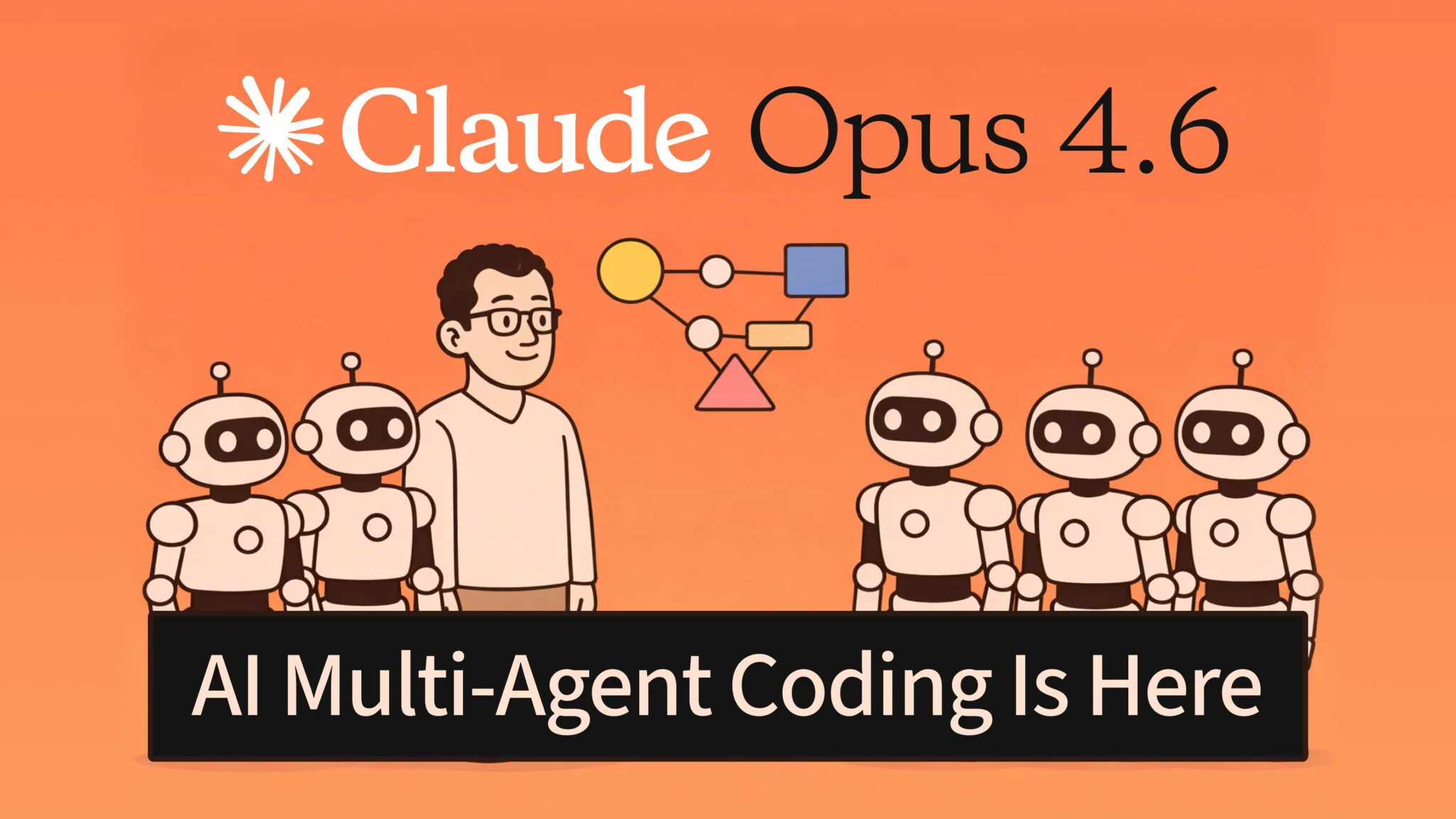
On February 5, 2026, Anthropic released Claude Opus 4.6, at the time the latest and most capable model in its Claude lineup. Arriving just three months after Opus 4.5, this release brings a 1-million-token context window to the Opus family for the first time, introduces collaborative agent teams in Claude Code, and delivers benchmark results that put it ahead of GPT-5.2 and Gemini 3 Pro across most evaluations. Months later it remains a yardstick for new contenders; ByteDance’s Seed 2.1 Pro drew level with Opus 4.6 on Code Arena: Frontend, both scoring 1539.
Opus 4.6 has since been superseded. Anthropic shipped Claude Opus 5 on July 24, 2026, charging the same $5/$25 per million tokens Opus 4.6 did, and then Claude Fable 5.1 on September 1, 2026. It then shipped Claude Opus 5.5 on September 22, 2026 at $4/$20 per million tokens and moved Opus 5 to its legacy list, so Opus 5.5 is the model it now tells you to start with. On Artificial Analysis Intelligence Index v4.3.2, read September 24, 2026, Opus 5.5 leads at 57.6, ahead of Fable 5.1 on 53.4 and Opus 5 on 50.8. Everything below stands as the record of what Opus 4.6 introduced; for the model to actually build on today, see our full Claude Opus 5.5 breakdown.
But the headline number that caught the industry’s attention wasn’t a benchmark score. It was 500, the number of previously unknown security vulnerabilities Opus 4.6 discovered in open-source code during pre-release testing, with little to no human prompting.
This article breaks down everything about Claude Opus 4.6: what it can do, how it performs, what it costs, and what it means for developers, researchers, and businesses evaluating their AI strategy in 2026.
What Is Claude Opus 4.6?
Claude Opus 4.6 is Anthropic’s flagship AI model, sitting at the top of the Claude model family. It uses the model identifier claude-opus-4-6 in the API and is available through claude.ai, the Anthropic API, Amazon Bedrock, and Google Cloud’s Vertex AI.
Opus is Anthropic’s highest-capability tier, designed for tasks that demand deep reasoning, complex multi-step problem-solving, and sustained performance across long contexts. While Claude Sonnet models optimize for speed and cost-efficiency, Opus models prioritize raw intelligence and reliability on difficult tasks.
Opus 4.6 is the successor to Opus 4.5, which launched in November 2025. The rapid three-month turnaround signals Anthropic’s accelerating release cadence and its focus on making Opus-class models more practical for real-world deployment.
Key Features and Capabilities
Here’s a summary of what’s new and improved in Opus 4.6:
| Feature | Details |
|---|---|
| Context Window | 1 million tokens (beta), the first Opus-class model with this capacity |
| Maximum Output | 128,000 tokens |
| Agent Teams | Multi-agent coordination in Claude Code (research preview) |
| Adaptive Thinking | Model autonomously determines when extended reasoning is beneficial |
| Context Compaction | Automatic summarization of older context to sustain longer sessions (beta) |
| Effort Levels | Low, medium, high (default) and max, for tuning intelligence vs. speed vs. cost |
| Office Integration | Claude in PowerPoint (research preview) with design-system awareness |
| Coding Improvements | Better planning, longer task sustainability, improved debugging and code review |
| Life Sciences | Nearly 2x performance improvement in biology and chemistry tasks |
| US-Only Inference | Data residency option at 1.1x standard pricing |
Opus 4.6 Benchmark Performance
Benchmarks are imperfect, but they provide the most objective comparison available between models. Opus 4.6 posts strong results across coding, reasoning, knowledge work, and agentic tasks.

Coding Benchmarks
Terminal-Bench 2.0 measures agentic coding in terminal environments, the kind of work that developers do with tools like Claude Code. Opus 4.6 achieved 65.4%, the highest score ever recorded on this benchmark.
| Model | Terminal-Bench 2.0 |
|---|---|
| Claude Opus 4.6 | 65.4% |
| GPT-5.2 | 64.7% |
| Claude Opus 4.5 | 59.8% |
| Gemini 3 Pro | 56.2% |
SWE-bench Verified evaluates the ability to resolve real-world GitHub issues. Opus 4.6 scores 80.8%, essentially matching Opus 4.5 (80.9%) and maintaining a lead over GPT-5.2 (80.0%) and Gemini 3 Pro (76.2%).
Reasoning Benchmarks
ARC-AGI 2 tests novel problem-solving ability, the capacity to reason through unfamiliar problems rather than pattern-match against training data. This is where Opus 4.6 shows its most dramatic improvement:
| Model | ARC-AGI 2 |
|---|---|
| Claude Opus 4.6 | 68.8% |
| GPT-5.2 Pro | 54.2% |
| Gemini 3 Pro | 45.1% |
| Claude Opus 4.5 | 37.6% |
That’s an 83% improvement over Opus 4.5 and a 14.6 percentage point lead over the next best model. For a benchmark designed to resist improvement through scale alone, this is a notable result.
Humanity’s Last Exam tests complex multidisciplinary reasoning. Without tools, Opus 4.6 scored 40.0% (vs. Opus 4.5’s 30.8%). With tools enabled, it reached 53.1%, compared to GPT-5.2 Pro’s 50.0% and Gemini 3 Pro’s 45.8%.
Knowledge Work and Professional Tasks
GDPval-AA measures real-world professional task performance across 44 occupations, including finance and legal workflows. Opus 4.6 leads by a wide margin:
| Model | GDPval-AA (Elo) |
|---|---|
| Claude Opus 4.6 | 1606 |
| GPT-5.2 | 1462 |
| Claude Opus 4.5 | 1416 |
| Sonnet 4.5 | 1277 |
| Gemini 3 Pro | 1195 |
A 144-point Elo advantage over GPT-5.2 is significant. In practical terms, it means Opus 4.6 produces noticeably better outputs on tasks like drafting legal documents, analyzing financial reports, and synthesizing research.
Agentic and Tool-Use Benchmarks
| Benchmark | Opus 4.6 | GPT-5.2 | Opus 4.5 | Gemini 3 Pro |
|---|---|---|---|---|
| τ2-bench Retail (Tool Use) | 91.9% | 82.0% | 88.9% | not reported |
| BrowseComp (Agentic Search) | 84.0% | 77.9% | 67.8% | 59.2% |
| OSWorld (Computer Use) | 72.7% | not reported | 66.3% | not reported |
| Finance Agent Benchmark | 60.7% | 56.6% | 55.9% | not reported |
| MCP Atlas (Scaled Tool Use) | 59.5% | 60.6% | 62.3% | 54.1% |
Opus 4.6 leads on tool use, search, computer interaction, and finance agent tasks. GPT-5.2 holds a slight edge on MCP Atlas, which tests tool use at scale.
Graduate-Level Reasoning
On GPQA Diamond, which evaluates graduate-level scientific reasoning, the models are closely clustered:
| Model | GPQA Diamond |
|---|---|
| GPT-5.2 Pro | 93.2% |
| Gemini 3 Pro | 91.9% |
| Claude Opus 4.6 | 91.3% |
| Claude Opus 4.5 | 87.0% |
GPT-5.2 Pro leads here, though the gap between the top three models is less than 2 percentage points.
The 500 Zero-Day Story
Before the public release of Opus 4.6, Anthropic’s frontier red team tested the model’s code analysis capabilities in a sandboxed environment. The team gave Opus 4.6 access to Python and standard vulnerability analysis tools such as debuggers and fuzzers, but provided no specific instructions or specialized security knowledge.
The result: Opus 4.6 independently identified more than 500 previously unknown high-severity security vulnerabilities in widely used open-source libraries.
The discovered vulnerabilities ranged from crash-inducing flaws to memory corruption bugs. Specific examples included:
- A flaw in GhostScript, a popular utility for processing PDF and PostScript files, that could cause system crashes
- Buffer overflow vulnerabilities in OpenSC, a smart card data processing utility
- Memory corruption issues in CGIF, a GIF file processing tool
What makes this notable isn’t just the number. It’s that Opus 4.6 approached the task the way a human security researcher would, examining past fixes to find similar unaddressed bugs, spotting patterns that tend to cause problems, and understanding code logic well enough to construct inputs that would trigger failures.
Anthropic published the findings through responsible disclosure and documented the process on red.anthropic.com. The company also added new security controls to detect and block potential abuse of these capabilities, including real-time traffic monitoring and six new cybersecurity probes.
Multi-Agent Collaboration in Claude Code
One of the most significant product additions alongside Opus 4.6 is agent teams in Claude Code, currently available as a research preview.
Instead of a single Claude instance handling tasks sequentially, agent teams allow multiple Claude Code instances to work on different parts of a project in parallel. A lead session coordinates the work, assigns tasks to subagents, and summarizes results. Running several sessions at once makes the approval settings worth knowing, and our guide to Claude Code permissions explains what each mode does without asking first.
In practical terms, this means:
- Parallel development: Multiple agents can work on separate components, tests, or files simultaneously
- Coordinated refactoring: One agent can handle backend changes while another updates the frontend
- Supervised delegation: The lead agent manages task distribution and ensures consistency
Developers can control subagents directly using Shift+Up/Down or through tmux integration.
This represents a shift from AI as a single assistant to AI as a coordinated team, a pattern that could fundamentally change how developers interact with coding tools.
1 Million Token Context Window
Opus 4.6 is the first model in the Opus family to support a 1-million-token context window (in beta). To put that in perspective, 1 million tokens is roughly 750,000 words, enough to ingest an entire codebase, a long research paper collection, or months of project documentation in a single session.
But context window size alone doesn’t tell the full story. What matters is how well the model uses that context.
Anthropic highlights reduced “context rot” in Opus 4.6. Previous models tended to lose track of information placed in the middle of very long contexts. On MRCR v2, a benchmark that tests retrieval across long contexts using an 8-needle, 1M-token variant, Opus 4.6 achieved 76% accuracy compared to Sonnet 4.5’s 18.5%.

This improvement changes what’s practical. Developers can now feed entire repositories into a single session. Researchers can load full datasets. Legal teams can process large document collections without splitting them across multiple queries.
Context Compaction
For sessions that push even beyond the context window, Opus 4.6 introduces context compaction (in beta). When the conversation approaches a configurable threshold, the model automatically summarizes older context segments. This allows sessions to continue indefinitely without crashing or losing track of critical information, a meaningful quality-of-life improvement for long-running agentic tasks.
Adaptive Thinking and Effort Levels
Opus 4.6 introduces adaptive thinking, a feature that lets the model autonomously decide when extended reasoning (chain-of-thought) would be beneficial based on the complexity of the input.
For tasks that are straightforward, the model responds directly. For tasks that require deeper analysis, it engages more deliberate reasoning. This happens without manual prompting, because the model reads the task and adjusts.
Additionally, developers can set effort levels to control the intelligence-speed-cost tradeoff:
| Effort Level | Use Case |
|---|---|
| Low | Quick lookups, simple formatting, classification tasks |
| Medium | Standard Q&A, code generation, summarization |
| High (default) | Complex reasoning, multi-step analysis, code review |
| Max | Research-grade tasks, novel problem-solving, critical code analysis |
This gives developers explicit control over API costs without switching between different models. A simple classification task at “low” effort costs a fraction of what a “max” effort research query would, while staying within the same model and maintaining consistent behavior.
Scientific and Research Applications
Opus 4.6 shows a pronounced improvement in life sciences, with nearly 2x performance over Opus 4.5 on benchmarks covering:
- Computational biology
- Structural biology
- Organic chemistry
- Phylogenetics
For researchers working with large datasets, the 1M token context window combined with improved scientific reasoning creates a practical tool for literature review, data analysis, and hypothesis generation. The ability to ingest an entire research corpus and reason across it coherently, rather than piecemeal across multiple sessions, is a workflow change, not just a performance bump.
Enterprise Integrations
Anthropic expanded its Microsoft Office integrations alongside the Opus 4.6 release:
Claude in Excel
Enhanced for long-running tasks, Claude in Excel can now handle multi-step spreadsheet changes in a single pass. This targets the financial modeling, data analysis, and reporting workflows that enterprise users rely on.
Claude in PowerPoint (Research Preview)
A new side-panel integration that brings Claude directly into PowerPoint. The notable detail is design-system awareness, because Claude preserves existing layouts, fonts, and master slide settings rather than overwriting them. This addresses a common pain point with AI-generated presentations: outputs that look generic and ignore brand guidelines.
Pricing and Availability
| Standard | Extended Context (>200K tokens) | |
|---|---|---|
| Input | $5 per million tokens | $10 per million tokens |
| Output | $25 per million tokens | $37.50 per million tokens |
For US-only inference (data residency guarantee), pricing is 1.1x the standard rates.
How Does This Compare?
| Model | Input (per M tokens) | Output (per M tokens) |
|---|---|---|
| Claude Opus 4.6 | $5 | $25 |
| GPT-5.2 | $2 | $10 |
| Gemini 3 Pro | Varies by region | Varies by region |
Opus 4.6 is priced at a premium over GPT-5.2. The cost differential is significant for high-volume applications. However, the effort level system gives developers a way to reduce costs on simpler tasks without downgrading to a different model.
Availability
Opus 4.6 is available on:
- claude.ai, Anthropic’s consumer and business interface
- Anthropic API, direct API access with model identifier
claude-opus-4-6 - Amazon Bedrock, AWS integration
- Google Cloud Vertex AI, GCP integration
Claude Opus 4.6 vs GPT-5.2 vs Gemini 3 Pro
Here’s a consolidated view of where each model leads:
Where Opus 4.6 Wins
- Agentic coding (Terminal-Bench 2.0): Highest score ever recorded
- Novel problem-solving (ARC-AGI 2): 68.8%, a 14.6-point lead over GPT-5.2
- Knowledge work (GDPval-AA): 144 Elo points ahead of GPT-5.2
- Tool use (τ2-bench): 91.9% vs. GPT-5.2’s 82.0%
- Agentic search (BrowseComp): 84.0% vs. GPT-5.2’s 77.9%
- Long-context retrieval (MRCR v2): 76% vs. Sonnet 4.5’s 18.5%
Where GPT-5.2 Wins
- Graduate reasoning (GPQA Diamond): 93.2% vs. 91.3%
- Scaled tool use (MCP Atlas): 60.6% vs. 59.5%
- Math reasoning (AIME 2025): Perfect 100% scores
- Pricing: 2.5x cheaper per token
Where Gemini 3 Pro Wins
- Cost efficiency: Most affordable option at scale
- Multimodal processing: Native strengths in image, video, and audio
- Graduate reasoning (GPQA Diamond): 91.9%, close second to GPT-5.2
No single model dominates every category. Opus 4.6 leads on agentic tasks, coding, knowledge work, and novel reasoning. GPT-5.2 holds advantages in math and pricing. Gemini 3 Pro offers the best value for multimodal workloads.
The trend in 2026 is multi-model routing, directing tasks to whichever model handles them best rather than committing to a single provider.
Safety and Alignment
Anthropic reports that Opus 4.6 is equal to or better than Opus 4.5 on safety evaluations, and Opus 4.5 was already their most aligned frontier model. Outside the lab, Palisade Research found in May 2026 that Opus 4.6 self-replicated in 81% of hacking tests, the highest of any frontier model evaluated. Specific safety claims include:
- Lowest over-refusal rate of any recent Claude model, meaning it’s less likely to refuse legitimate requests
- New user wellbeing evaluations added to the safety testing suite
- Six new cybersecurity probes designed to detect attempts to abuse the model’s enhanced code analysis capabilities
- Real-time detection tools to block traffic Anthropic identifies as potentially malicious
The combination of improved capabilities and reduced over-refusal reflects an industry-wide pattern: as models become more capable, labs are working to make safety mechanisms more precise rather than more restrictive.
What This Means for Developers
For developers evaluating Opus 4.6, the practical implications break down by use case:
If you’re building agentic applications: Opus 4.6’s combination of top-tier tool use, long context, and agent teams makes it the strongest option available for multi-step, tool-heavy workflows.
If you’re working with large codebases: The 1M token context window, improved code review, and Terminal-Bench leading scores make it well-suited for codebase-wide analysis, refactoring, and debugging.
If you need research-grade reasoning: The ARC-AGI 2 and Humanity’s Last Exam results suggest genuine improvements in reasoning, not just pattern matching at scale.
If cost is the primary constraint: GPT-5.2 at $2/$10 per million tokens delivers strong performance at a lower price point. The effort level system in Opus 4.6 helps but doesn’t close the 2.5x gap entirely.
If you need scientific analysis: The 2x life sciences improvement and ability to process entire research corpora in a single session make Opus 4.6 a serious tool for computational biology, chemistry, and related fields.
Final Thoughts
Claude Opus 4.6 is not a minor update. The gap between it and its predecessor, Opus 4.5, is wider than what we typically see in three-month release cycles. The ARC-AGI 2 jump from 37.6% to 68.8% alone signals a step change in reasoning capability, not incremental tuning.
The 500 zero-day discovery story illustrates what this means in practice: a model capable enough to do work that previously required specialized human expertise, operating autonomously, and producing results that matter in the real world.
The agent teams feature in Claude Code points toward a future where AI development tools aren’t single assistants but coordinated teams of specialized agents. It’s a research preview today, but the direction is clear.
For organizations evaluating AI models in 2026, the landscape now has three credible frontier options. Claude Opus 4.6, GPT-5.2 and Gemini 3 Pro each have distinct strengths. The winning strategy isn’t picking one. It’s understanding where each excels and routing accordingly.