Stanford researchers found that AI detectors falsely flagged 61.3% of non-native English essays as machine-written. OpenAI shut down its own AI text detector in July 2023 because it correctly identified just 26% of AI-generated text. A 2024 study by Perkins and colleagues put the baseline accuracy of six major detectors at 39.5%. Yet vendors still advertise 99% accuracy, and roughly 40% of US colleges use these tools to police student work in 2026.
This guide explains how AI detectors actually work, the four studies that puncture the 99%-accuracy claim, and the seven detectors worth knowing about with current pricing. You will also find out why these tools flag honest human writing, and what to do if you have been wrongly accused. We use GPT-5.5 Instant, Claude Opus 4.7, and Gemini 3.5 Flash outputs as the reference point throughout, because those are the models detectors actually face today. We covered each in our ChatGPT vs Claude vs Gemini on Mac comparison.
The Key Takeaways
- AI detectors measure perplexity (word predictability) and burstiness (sentence variation); they do not understand meaning or intent.
- Independent studies put detector accuracy at 39.5% to 80% depending on the tool, with false-positive rates of 61.3% on non-native English essays (Stanford, 2023).
- GPTZero, Originality.ai, Pangram, Copyleaks, Winston AI, and Sapling lead the consumer market; Turnitin dominates inside universities.
- Over 50 universities including Vanderbilt, Johns Hopkins, and the University of Edinburgh have disabled their detectors over accuracy and bias concerns.
- If you have been wrongly flagged, request human review, show your draft history, cite the Stanford study, and treat the detector’s score as a signal, not evidence.
How AI Detectors Actually Work
AI detectors are statistical tools, not lie detectors. They measure two mathematical properties of text, perplexity and burstiness, then compare your text against the statistical fingerprint of AI-generated writing. AI detectors do not check whether your ideas are original, whether your reasoning is correct, or whether you actually wrote the words. They check for predictability.
Perplexity is a measure of how predictable each word is, given the words before it. A large language model writes by picking the statistically most likely next token, so AI-generated text scores low on perplexity. Humans choose surprising, personal, or stylistically unconventional words, which pushes perplexity higher. When a detector scans your essay, it runs it through a language model and measures the average perplexity across the document. A very low score suggests AI generation; a higher, more variable score suggests human authorship.
Burstiness measures variation in sentence complexity across the document. Human writers naturally produce bursty text, long complex sentences followed by short punchy ones, with rhythm that shifts as ideas develop. AI-generated text runs low on burstiness, with sentences uniform in length and structure. Burstiness is, in effect, the variance of the perplexity signal over the length of the text.
Once a detector calculates both signals, it produces a probability score between 0% and 100%. Some tools also report a per-sentence breakdown, highlighting which passages look most machine-written. The output is a probability, not a verdict, in the same way that a model picks its next word from a ranked list rather than a fixed answer, and no major detector vendor claims their results are evidence in the legal or academic sense. That guesswork is a different mechanism from the AI watermarks now embedded by the models themselves, which carry a deliberate signal instead of a statistical inference.
What detectors actually look at
A modern detector typically combines four signals. Perplexity scores how predictable each word is across the document. Burstiness measures the variance in perplexity from sentence to sentence. Vocabulary richness (lexical diversity) tracks how varied your word choices are. And statistical fingerprints, matched against patterns trained on millions of known AI-generated samples, identify whether your text resembles output from a specific model family.
The newer tools also pattern-match against the writing styles of specific models. Hastewire retrains weekly on fresh outputs from GPT-5.5, Claude Sonnet 4.5, and Gemini 3.5 Pro, while Sapling advertises detection of GPT-5, Claude 4.5, Gemini 2.5, Qwen3, and DeepSeek-V3 explicitly. The same approach is also the reason detector accuracy drops every time a new flagship model ships.
Are AI Detectors Accurate? The Honest Answer in 2026
Vendors claim 95-99% accuracy on their marketing pages. Independent academic research tells a very different story.
Stanford University, 2023. Liang and colleagues, publishing in the journal Patterns, tested seven widely used AI detectors on 91 TOEFL essays written by Chinese students and 88 essays by US-born eighth-graders. The detectors wrongly classified 61.3% of the TOEFL essays as AI-generated on average, with at least one detector flagging 97.8% of TOEFL essays at some point. The same detectors were near-perfect on the US eighth-grade essays. The bias was structural, not random. Non-native English writers use simpler vocabulary and more uniform syntax, which scores as “AI-like” on perplexity and burstiness. The full Stanford HAI write-up covers the methodology and downstream policy implications in detail.
Perkins et al., 2024. A peer-reviewed study testing six major commercial detectors against varied AI and human text found a baseline accuracy of just 39.5%. The detectors performed even worse when the AI text had been lightly edited by a human.
Weber-Wulff et al., 2023. A multi-tool benchmark concluded that most detectors scored below 80% accuracy on diverse text samples, and accuracy collapsed further on passages shorter than 1,000 characters.
OpenAI, July 2023. OpenAI launched an AI Text Classifier in March 2023, advertised as a research-grade detector for ChatGPT output. In July 2023, OpenAI quietly retired the tool, citing a “low rate of accuracy” in a TechCrunch report at the time. The disclosed numbers: the classifier correctly flagged just 26% of AI-written text and misclassified 9% of human-written text as AI. The maker of ChatGPT could not reliably detect ChatGPT.
Chicago Booth Review, December 2025. Researchers tested commercial detectors GPTZero, Originality.ai, and Pangram alongside open-source RoBERTa across roughly 2,000 human passages and AI versions from four LLMs (the full Chicago Booth Review article details the framework). Commercial tools outperformed open-source ones on medium and long texts, with Pangram approaching 100% accuracy on most categories. Performance still collapsed on passages under 50 words.
Why accuracy varies so much
Detector accuracy depends on three variables most marketing pages avoid. Text length is the first. Accuracy peaks on documents above 1,000 words and collapses on passages under 200 words; Quillbot requires at least 80 words before it will scan, and OpenAI’s retired classifier was already unreliable below 1,000 characters.
Model recency is the second. Detectors trained on GPT-3 patterns missed GPT-4 output, and the detectors trained through 2025 are now meeting GPT-5.5 Instant, Claude Opus 4.7, and Gemini 3.5 Flash, all of which produce noticeably more human-like text. Every flagship release widens the gap between what detectors saw in training and what they see in the wild.
Writer profile is the third. Native English, formal-register writers get flagged more than casual ones. Non-native English writers get flagged more than everyone. Heavy Grammarly users get flagged more than light editors.
The honest verdict: AI detectors are useful as a signal, dangerous as evidence. A high AI-probability score from a current top-tier tool is meaningful information; it is not proof.
The Best AI Detectors in 2026 (Compared)
Seven tools dominate the consumer and institutional market in 2026. Pricing is current as of May 2026 and may shift; we have linked each vendor for the latest.
| Tool | Best for | Free tier | Paid (starting) | Independent accuracy |
|---|---|---|---|---|
| GPTZero | Students and educators | 10,000 characters per scan (10,000 words/month) | from $9.99/month | Mid-high (Chicago Booth 2025) |
| Originality.ai | Publishers and SEO content | None (pay-as-you-go $30/3,000 credits) | $14.95/month | High (Chicago Booth 2025) |
| Pangram | Research-grade accuracy | Limited free trial | API tiered | Highest (Chicago Booth ~100%) |
| Copyleaks | Multilingual and plagiarism combo | Free tier with monthly credit allowance | from $13.99/month | Mid |
| Winston AI | Marketing teams | 2,000 credits, 14-day trial | $18/month | High (claimed 99.98%, lower independent) |
| Sapling | API integrations | Limited free scans | $25/month | Mid-high (97% claimed) |
| Turnitin | Universities and K-12 | None (institutional license only) | Per-seat contract | Mid (~4% false-positive rate disclosed) |
GPTZero
GPTZero is the most recognised consumer AI detector, with over 8 million users and integrations in more than 3,500 schools as of 2026. The free tier handles scans of up to 10,000 characters each, capped at 10,000 words per month; paid plans start at $9.99 per month for the Essential tier and rise to $15.99 per month for Premium, including full-document scans, plagiarism checking, writing-replay verification, and a Chrome extension that overlays AI-probability scores on any web page.
GPTZero’s main strength is institutional credibility. Its main weakness, documented repeatedly in independent benchmarks including the Stanford TOEFL study, is calibration on non-native English and short inputs, where false positives spike. GPTZero publicly states that “no AI detector can ever truly be 100% perfect” and that “results should not be used to punish or as the final verdict,” which is more honest than most vendor pages. The numbers behind that are broken down in our full GPTZero accuracy review.
Originality.ai
Originality.ai is the detector publishers and SEO teams most commonly buy. Pricing starts at $14.95 per month for 2,000 credits (1 credit per 100 words), with a one-time $30 pay-as-you-go pack of 3,000 credits that does not expire for two years. The Enterprise tier at $179/month includes 15,000 credits monthly.
In Chicago Booth’s 2025 benchmark, Originality.ai performed close to Pangram on long-form text. The product also bundles plagiarism and readability checks, which is why content agencies use it as their daily-driver QA tool.
Pangram
Pangram is the academic darling. In the Chicago Booth 2025 study, Pangram approached 100% accuracy on most content categories with false-positive rates below 1%. The trade-off is access. Pangram is API-first and aimed at researchers and platforms rather than individual writers; pricing scales by call volume.
If you are evaluating a detector for institutional use and the budget supports an API integration, Pangram is the current accuracy leader in independent testing. For one-off student checks, it is overkill.
Copyleaks
Copyleaks is the bilingual workhorse, covering over 30 languages with the same engine. The free tier offers limited monthly scan credits; the Personal plan starts at around $13.99 per month, with one credit covering up to 250 words. Copyleaks bundles AI detection with plagiarism checking, which is why educators who already buy plagiarism tools often add it as a low-friction extension rather than buying GPTZero separately.
Independent accuracy lands in the middle of the pack. On English-only short text, it trails GPTZero; on multilingual content, it pulls ahead of every English-trained competitor.
Winston AI
Winston AI advertises 99.98% accuracy on its homepage. Pricing starts at $18/month for the Essential plan (80,000 credits), with a 14-day, 2,000-credit free trial. Higher tiers add OCR for handwritten work, AI image detection, and a “HUMN-1” certification badge that publishers can display on verified human-written articles.
The 99.98% number is a vendor claim from internal testing. In independent benchmarks Winston still ranks well, particularly on marketing copy, but the gap with the field is smaller than the advertised figure implies.
Sapling
Sapling is the developer favourite. Its AI Content Detector ships with a public API, free scans, and explicit coverage of recent models including GPT-5, Claude 4.5, Gemini 2.5, Qwen3, and DeepSeek-V3. Sapling’s published accuracy figure is 97%. The use case is integration: customer-support platforms, document-management tools, and content pipelines pull Sapling’s score into their own workflows.
For individual writers, the browser tool is functional and free for short scans. For organisations, the API tier at around $25/month is the entry point.
Turnitin
Turnitin is the only detector most students will actually meet. It is sold exclusively as an institutional product, embedded inside university learning-management systems like Canvas, Blackboard, and Moodle. Individual students cannot subscribe.
Turnitin discloses a 4% false-positive rate at the sentence level, which sounds small until you do the math. In a 650-word essay, that is roughly one to two sentences wrongly flagged as AI in every honest submission. Turnitin itself states that its AI detection “may not always be accurate” and “should not be used as the sole basis for adverse actions against a student.” Many institutions ignore that caveat.
Free AI Detectors That Actually Work
If you want to self-check before submission and have no budget, the practical free options in 2026 are GPTZero (10,000 characters per scan, 10,000 words per month, no account needed below the per-scan cap), Quillbot AI Detector (up to 1,200 words per scan, six scans per day on the free tier), Copyleaks (around 300 words per scan), Sapling (limited free scans, no signup), and ZeroGPT (unlimited short scans, lower accuracy). We put every one of these through the same essays and ranked them in our full guide to the best free AI detector for 2026. ZeroGPT is the weakest of that group, and our ZeroGPT accuracy test shows exactly where it slips.
For documents longer than 1,000 words, the GPTZero Chrome extension is the path of least friction. It runs on Google Docs and most web pages, returns a probability score in under a second, and does not require pasting your text into a third-party box. For short paragraphs, Quillbot’s web tool is fast and reasonably accurate. Avoid any free detector that asks for credit-card details to “verify you are not a bot”; those are almost always paid tools wearing a free coat.
Free tiers share two limitations. They are deliberately slower than paid versions, and their detection models are usually one generation behind the paid tier. If you are anxious about a high-stakes submission, the $9.99-$15.99 monthly tier of GPTZero or Copyleaks gives you full-document scanning and detector versions trained on current model outputs. Our running list of AI deals and discounts tracks current student promotions across the detector and writing-tool space.
Do Colleges and Teachers Use AI Detectors?
Roughly 40% of four-year US colleges use AI detection tools in 2026, with another 35% actively evaluating implementation, according to GradPilot’s institutional survey. Turnitin is the dominant vendor by a wide margin, followed at distance by Copyleaks, GPTZero, and university-built internal tools.
The picture is not uniform. Over 50 institutions have disabled or banned detectors as of 2026. The list includes Vanderbilt University (cited insufficient transparency), Johns Hopkins (cited accuracy flaws), Curtin University in Australia (banned January 2026), the University of Waterloo, the University of Edinburgh, and the University of Manchester. Stanford and Carnegie Mellon have publicly criticised detector accuracy without formally banning the tools. The California State University system collectively paid Turnitin over $1.1 million in 2025, including an extra $163,000 specifically for AI detection, per CalMatters reporting.
Detection policy is also bifurcating by Ivy. Princeton requires student attestation rather than running detector scans. Yale explicitly allows AI grammar checking and frames detection as a faculty discretion call rather than an automated process. Most other top-tier schools sit somewhere between the two.
Beyond automated detection, teachers increasingly rely on three non-software signals: voice change between a student’s draft history and final submission, inability to explain claims the essay makes when asked verbally, and citations to sources that do not exist. Hallucinated citations remain the single most reliable AI tell in academic submissions, because LLMs invent plausible-sounding journal articles and book titles that fail a five-second library search. Our guide to AI for teachers goes into how teachers check for AI in more detail.
For students, the operational reality is simple. If your institution uses Turnitin or any other detector, assume your work will be scanned. If you have used AI tools at any point in the drafting process, disclose them in the methodology footnote or the equivalent, even when not required. Disclosure is almost always cheaper than appeal. Our broader take on how AI is changing classroom expectations covers the policy shifts in more depth.
Why AI Detectors Flag Legitimate Writing
The most common false-positive triggers in 2026 are predictable. Knowing them lets you adjust your writing without dumbing it down.
Non-native English patterns. Stanford’s TOEFL study is the headline finding: detectors flag 61.3% of non-native English essays as AI. The mechanism is that ESL writers use simpler vocabulary and more uniform syntax, which scores as low perplexity and low burstiness, the same fingerprint AI produces. If English is your second language and you can write naturally in your first, draft in your first language and translate, which preserves stylistic variation.
Heavy Grammarly or AI-assisted editing. Running a clean draft through Grammarly Premium or any rewrite tool smooths out the burstiness signal. Edited text scores as more “AI-like” even when the underlying writing is fully human. Apply grammar tools selectively; do not accept every suggestion.
Formal academic structure. The textbook five-paragraph essay shape (introduction, three body points, conclusion) is exactly what AI produces by default. If your structure is rigidly formal, vary sentence length deliberately, mix short and long sentences within each paragraph, and break the parallelism pattern.
Short text below 500 words. Detection accuracy collapses below 500 words and is unreliable below 200. A short cover letter, abstract, or executive summary is far more likely to misfire than a 2,000-word essay regardless of how it was written. That is one reason hiring is a poor place to run a detector at all, as we set out in the best AI for a cover letter.
Technical or formulaic writing. Engineering, legal, and clinical writing follows conventions that produce uniform sentence structure and predictable word choices. Procedure documents, method sections, and structured reports all score as low burstiness by design. If you are a student leaning on AI tools across multiple subjects, our roundup of the top AI tools for students covers which models suit which workflows.
What to Do If You Are Wrongly Flagged
This is the playbook we wish every student had on day one of an accusation.
Step 1: Do not accept the score as evidence. A detector probability is a signal, not a verdict. Cite the Stanford 61.3% false-positive figure and the fact that OpenAI shut down its own detector at 26% accuracy. Both are public, peer-reviewed or primary-source documented, and harder for an administrator to dismiss than a generic complaint.
Step 2: Produce your draft history. Google Docs, Microsoft Word, and Notion all retain version histories. Open the file, screenshot the timeline showing your draft growing over hours or days, and submit it. AI-generated text shows up in a single paste; a real draft shows revision, deletion, and structural rework.
Step 3: Request a human review with specifics. Ask your institution which detector was used, what the probability score was, on what specific passages, and what threshold triggers the academic-integrity referral. Many schools quietly use thresholds of 70% or higher; a 55% score is not actionable evidence at any honest institution.
Step 4: Read your school’s published policy. Most universities have a written AI-use policy by 2026, and your school’s disclosure rules are usually the part that decides the case. Many require disclosure rather than prohibition, and many explicitly state that detector results alone are not grounds for sanction. If your institution sits in this camp, the policy itself is your strongest defence.
If you did use AI for parts of the draft, disclose it immediately. Almost every academic-integrity board distinguishes between undisclosed AI use and acknowledged AI-assisted drafting. The first is misconduct; the second is, increasingly, just writing in 2026. Our guide to using ChatGPT for homework responsibly walks through the disclosure habits that keep you on the right side of the line.
The Honest Workflow: Writing With AI Without Getting Burned
If you use AI tools in your drafting process, the question is not how to evade detection, it is how to work in a way that produces better writing and stays defensible.
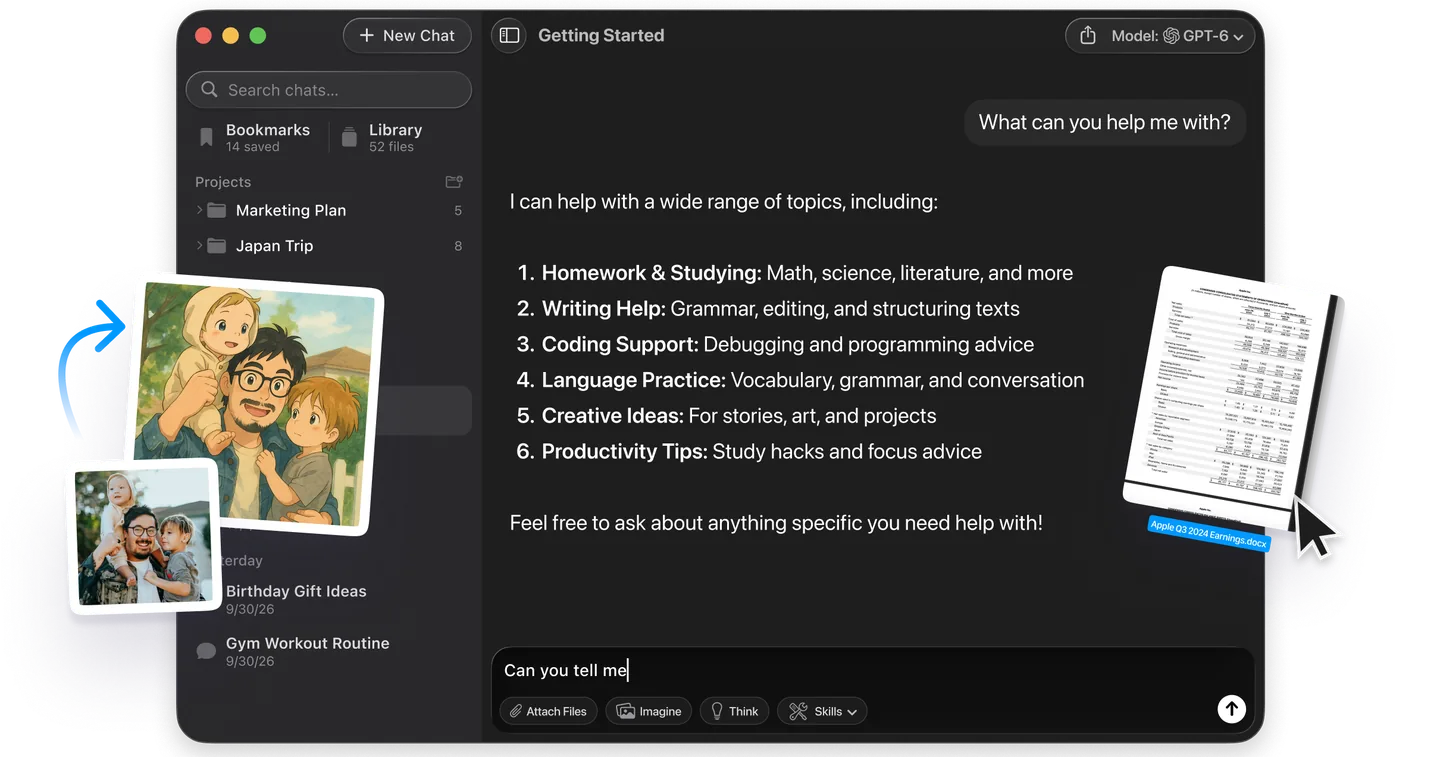
The workflow that actually works in 2026 has three stages. First, draft across multiple models to compare ideas, structures, and arguments rather than locking into one model’s voice. Running the same prompt through Claude, ChatGPT, and Gemini produces three structurally different drafts that you can mine for the best framing. Apps like Fello AI make this practical by giving you Claude, ChatGPT, Gemini, Grok, and DeepSeek through a single Mac and iPhone interface at $9.99/month. That is roughly half the cost of subscribing to any one of those models on its own.
Second, write the actual prose yourself, in your own voice, using the AI drafts as references rather than copying their sentences. Your final text should reflect your own thinking, phrasing, and rhythm.
Third, disclose the workflow in the methodology footnote, the cover letter, or wherever your institution or publisher allows. Most academic policies in 2026 permit AI-assisted research and drafting with disclosure. Most submission guidelines for journalism and academic publishing do the same. Disclosure does not make your work look worse; it makes you look like someone who reads the policy.
The workflows that get people in trouble are the ones that try to pass an AI draft as fully human. Detectors will miss most of those today and catch most of them within a year as models like Pangram improve. Disclosure is the only strategy that ages well.
The Bottom Line on AI Detectors in 2026
AI detectors are useful as a signal and dangerous as evidence. They identify patterns associated with AI text, but they cannot tell whether a specific passage was written by a person or a machine. They fail hardest on the writers least equipped to defend themselves: non-native English speakers, short-form writers, and students in formal academic registers. The accuracy gap between vendor marketing and independent research is wide enough to drive a policy through, which is exactly what 50+ universities have done by disabling their detectors.
For students, the practical takeaway is to assume Turnitin is running, write in a voice that varies in rhythm, keep your draft history, and disclose any AI assistance. For educators, a detector score is a starting point for a conversation, not the end of one. And for everyone else, the entire detection ecosystem is a moving target, and the best long-term defence against an inaccurate accusation is the document version history you create while you write.
FAQ
Are AI detectors accurate in 2026?
AI detectors have improved from the OpenAI-era 26% accuracy, but independent benchmarks still put baseline detection at 39.5%-80% depending on the tool, with false-positive rates of 61.3% on non-native English essays. Vendor claims of 99% accuracy are not corroborated by independent research.
What is the best free AI detector?
For short text, GPTZero (10,000 characters per scan) and Quillbot AI Detector (1,200 words per scan, six scans daily) are the most usable free options in 2026. For browser-based document scanning, GPTZero’s free Chrome extension is the lowest-friction tool.
Do colleges use AI detectors?
Roughly 40% of four-year US colleges use AI detection in 2026, mostly through Turnitin, which is embedded in university learning-management systems. Over 50 institutions including Vanderbilt and Johns Hopkins have disabled their detectors over accuracy concerns.
Why does AI detect my own writing as AI?
Detectors look for low perplexity (predictable word choices) and low burstiness (uniform sentence length). Non-native English patterns, heavy Grammarly editing, formal academic structure, and short text all produce the same statistical fingerprint as AI writing, which causes false positives.
Can ChatGPT be detected?
Sometimes. The newest detectors like Pangram and Hastewire approach 100% accuracy on long unmodified GPT-5.5 output in controlled tests. Accuracy drops sharply on short text, edited text, or text run through a paraphrase tool. OpenAI’s own detector was retired in 2023 because it could not reliably detect ChatGPT.
Is Turnitin AI detection accurate?
Turnitin discloses a 4% sentence-level false-positive rate, which translates to roughly one to two wrongly flagged sentences per 650-word essay. Turnitin itself states that its detection “may not always be accurate” and “should not be used as the sole basis for adverse actions against a student.”