There’s no single “best” AI anymore. Here’s which model to use for essays, research papers, math homework, and exam prep—and how to access all of them without juggling 5 different subscriptions.
You’ve probably noticed: everyone has a different answer when you ask “what’s the best AI?” That’s because there isn’t one. In February 2026, the AI landscape has splintered. Gemini 3 leads user preference polls. GPT-5.2 dominates reasoning benchmarks. Claude Opus 4.5 wins at coding. Each model has become the specialist in its lane.
For students, this creates a problem. You’re not just doing one thing. You’re writing essays, researching sources, solving math problems, and cramming for exams—sometimes all in the same week.
The answer isn’t picking one AI. It’s knowing which to use when.
Quick Picks — Student Edition
| What You’re Doing | Best AI | Why |
|---|---|---|
| Writing essays & papers | Claude Opus 4.5 | Most natural writing, follows instructions precisely |
| Research with real sources | Gemini 3 Pro (Grounding) | Cites actual sources you can verify |
| Understanding complex topics | GPT-5.2 | Best at breaking down hard concepts clearly |
| Math & problem solving | GPT-5.2 | Strongest reasoning for step-by-step solutions |
| Quick study summaries | Gemini 3 Flash | Fast, accurate, free tier available |
| Exam prep & flashcards | Claude Opus 4.5 | Great at creating structured study materials |
The reality: You’ll probably need 2-3 of these depending on your classes.
Best AI for Writing Essays & Papers
Winner: Claude Opus 4.5
You know that weird, robotic tone some AIs have? Claude doesn’t do that.
When you need to write an essay or research paper, Claude Opus 4.5 is the clear choice. Its writing sounds like an actual person wrote it—not an AI trying to sound smart by cramming in SAT vocabulary.
What sets Claude apart is how well it follows instructions. Tell it “write in first person” or “keep this under 500 words” and it actually listens. Other models drift—they’ll start in first person then slip into third, or give you 800 words when you asked for 500. Claude maintains consistency throughout. Teachers get that same consistency from the other side of the desk, which is why Claude for teachers has caught on for rubrics and lesson plans.
How to use it: Instead of asking Claude to “write my essay,” try a collaborative approach. Give it your thesis, ask for an outline, then expand each section one at a time. This way, the thinking is yours. The polish is Claude’s.
Worth knowing: Claude won’t make up citations or pretend to be original research. This protects you from submitting fabricated sources—which is a bigger problem than having to find real ones yourself.
Best AI for Research (With Actual Sources)
Winner: Gemini 3 Pro with Grounding
Here’s the problem with most AIs: they make stuff up. Ask for sources, and you’ll get citations that look real but don’t exist.
Gemini 3 Pro’s “Grounding” feature solves this. It actually searches the web in real-time and shows you exactly where information came from. Click the source—it’s real.
This matters for academic work. When your teacher asks “where did you get this statistic?” you need a real answer. Grounding also means you’re getting current information, not data that’s months or years old.
Best for: Finding scholarly sources for papers, getting background on unfamiliar topics, fact-checking claims before you include them, and current events essays where you need recent data.
How to use it: Be specific. “Find 5 peer-reviewed sources about the economic effects of climate migration published after 2023” works better than “tell me about climate change.”
Alternative: Perplexity Sonar is also solid for research—it’s built specifically for search and works well for quick fact-finding.
Best AI for Understanding Hard Concepts
Winner: GPT-5.2
Some topics just don’t click. You’ve read the textbook three times. Watched the YouTube video. Still confused.
GPT-5.2 is the best at taking complex ideas and explaining them in ways that actually make sense. It adapts to your level—ask it to “explain like I’m 15” or “explain like I’m in AP Physics” and it adjusts the entire framing, not just the vocabulary.
Its reasoning strength also matters here. When concepts build on each other, GPT-5.2 keeps the logic chain intact. It won’t skip steps or assume you know something you don’t. And it’s particularly good at finding analogies that make abstract ideas concrete.
Best for: Science concepts, historical cause-and-effect, economic theories, philosophy, literary analysis—anything where you need to understand, not just memorize.
How to use it: Don’t just ask “explain photosynthesis.” Try: “Explain photosynthesis step by step, and tell me what would break if each step failed.” Or: “I understand X but not Y—what’s the connection?” The more specific your confusion, the better the explanation.
Best AI for Math & Problem Solving
Winner: GPT-5.2
Math homework isn’t about getting the answer—it’s about showing your work. GPT-5.2 is the strongest at walking through problems step-by-step.
What makes it lead here is reasoning capability. When GPT-5.2 solves a problem, it explains why each step happens, not just what to do. This is the difference between copying an answer and learning how to solve similar problems yourself.
It’s also excellent at catching your mistakes. Paste your work, ask where you went wrong—it’ll find the specific step and explain why it’s wrong.
Best for: Algebra, pre-calc, calculus, statistics, word problems, and checking your own work before submitting.
How to use it: Ask “solve this step by step and explain each step.” After it solves a problem, ask for a similar practice problem, solve it yourself, then have it check your work. This turns homework help into actual learning.
Best AI for Study Sessions & Exam Prep
- Winner (for study materials): Claude Opus 4.5
- Winner (for quick summaries): Gemini 3 Flash
Different study tasks need different tools.
Claude Opus 4.5 excels at creating structured study materials. It’s ideal for flashcard sets (clear, concise Q&A format), building study guides from your notes, and generating practice test questions. Tell it your teacher’s format—multiple choice, short answer, essay—and it creates realistic practice questions.
Gemini 3 Flash is your tool when you’re behind and need to catch up fast. Quick chapter summaries, fast answers to “what does this term mean?”, reviewing material right before an exam. It’s fast, free (with limits), and accurate for basic tasks.
How to use them together: Start of semester—use Claude to create flashcards and study guides. During semester—use Gemini Flash for quick reviews. Before exams—use Claude for practice questions, then GPT-5.2 to understand anything you got wrong.
The Student’s Problem: Too Many Subscriptions
Here’s the annoying part: to access all these models, you’d need ChatGPT Plus ($20/month), Claude Pro ($20/month), and Google AI Premium ($20/month). That’s $60/month and you’re just scratching surface of the available AI apps… Not realistic for most students.
Access Every Model From One App
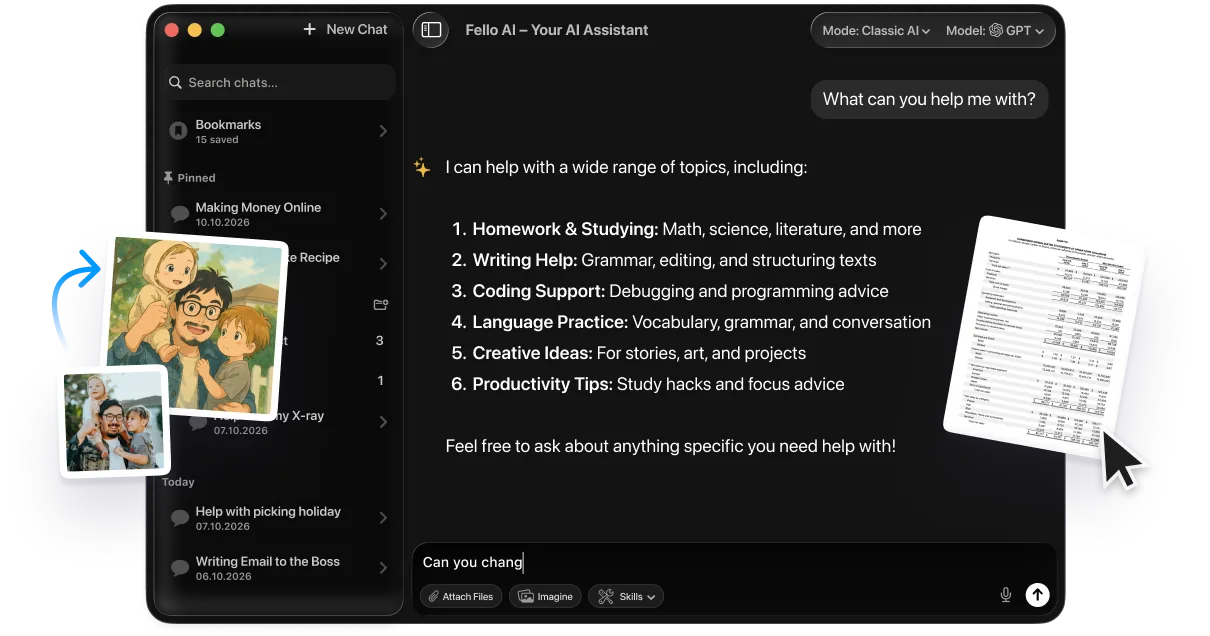
Fello AI puts all these models in one native Mac app. Switch between Claude, GPT-5.2, Gemini, and others instantly—without juggling browser tabs or multiple logins.
Start an essay in Claude, switch to Gemini to verify a source, pop over to GPT-5.2 to understand a concept—same window, seamless transitions. You can use your own API keys, paying only for what you use rather than flat monthly subscriptions.
TL;DR — Your Cheat Sheet
| Task | Use This |
|---|---|
| Essays & papers | Claude Opus 4.5 |
| Research with sources | Gemini 3 Pro (Grounding) |
| Understanding concepts | GPT-5.2 |
| Math problems | GPT-5.2 |
| Quick summaries | Gemini 3 Flash |
| Flashcards & study guides | Claude Opus 4.5 |
FAQ for Students
Is using AI cheating?
Depends on your school’s policy. Using AI to understand concepts, check your work, or improve your writing? Usually fine. Having AI write your essay and submitting it as your own? That’s a problem. Know your school’s rules.
Which free options are actually good?
Gemini 3 Flash has a solid free tier for quick tasks. ChatGPT’s free version works but has limits. For serious schoolwork, you’ll eventually hit walls with free tiers.
What about Grok and DeepSeek?
Both are solid, but neither leads for typical student tasks. Grok is great if you’re on X/Twitter. DeepSeek performs well in benchmarks but doesn’t beat the specialists above for essay writing or research.
Can teachers tell if I used AI?
AI detection tools exist, but they’re unreliable—they produce false positives on human writing and miss AI-generated text regularly. The bigger issue: if your writing style suddenly changes dramatically, or you submit work that doesn’t match your in-class performance, teachers notice. Use AI to improve your writing, not replace it. Here is how AI detectors work and why they misfire. If you would rather check your own draft first, our free AI detector comparison ranks the no-signup options and how far you can trust each score. For one tool in detail, see our ZeroGPT review.
What if AI gives me wrong information?
It happens. AI models can state incorrect facts confidently, especially for niche topics or recent events. Always verify important claims—especially statistics, dates, and quotes—before putting them in assignments. This is why Gemini’s Grounding feature matters: you can check the source directly.
How do I get better results from AI?
Be specific. “Help me with my essay” gives generic output. “I’m writing a 5-paragraph essay arguing that social media harms teen mental health. My thesis is [X]. Can you help me strengthen my second body paragraph about sleep disruption?” gives you something useful. The more context you provide, the better the output.
Can AI help with foreign language classes?
Yes, and it’s underrated for this. Use it to check grammar, explain why a sentence is wrong, practice conversations, or understand nuances between similar words. GPT-5.2 and Claude both handle major languages well. Just don’t use it to do your translations wholesale—you won’t learn anything.
Is my conversation with AI private?
Varies by service. Most AI companies state they may use your conversations to improve their models, though paid tiers often have better privacy policies. Don’t paste anything truly sensitive—personal information, passwords, or content you’d be embarrassed to have leaked. For normal schoolwork, it’s generally fine.
Should I tell my teacher I used AI?
When in doubt, yes. Many teachers are fine with AI assistance if you’re transparent about how you used it. “I used Claude to help me improve the clarity of my conclusion” is very different from pretending the work is entirely yours. Some teachers even require you to disclose AI use. Check your syllabus.
What about SAT/ACT prep?
AI is genuinely useful here. Use GPT-5.2 to understand why you got practice questions wrong, have Claude generate additional practice questions in the same format, and use Gemini to research test-taking strategies. It won’t replace dedicated prep courses, but it’s a solid free supplement.