EcoGPT is a free AI chatbot that funds tree planting as you use it. It runs small open-source models on Google Cloud servers in Finland and shows ads on its free tiers. An ad-free Pro plan costs $10 per month in the US, and EcoGPT says its users have funded 263,386 trees through the non-profit Trees for the Future. It is made by EcoGPT, Inc., a Delaware Public Benefit Corporation, and has 1M+ downloads on Google Play.
So yes, EcoGPT is legit: a real product from a real company, with a dated tree ledger you can check. It is not a one-to-one replacement for ChatGPT, and the free version has a data trade-off almost nobody mentions: its ad partners receive your recent messages. We checked every claim below against EcoGPT’s own plans, subprocessor and tree pages on October 1, 2026. For the wider picture on AI’s footprint, see whether AI is bad for the environment.
Looking for the official EcoGPT website or app? The web app is at ecogpt.com. The iPhone app is EcoGPT on the App Store, sold by EcoGPT, Inc., and the Android app is EcoGPT on Google Play. There is no Mac app. EcoGPT’s official X account is @ecogptapp.
The Key Takeaways
- EcoGPT is a tree-planting AI chatbot built by EcoGPT, Inc., a Delaware Public Benefit Corporation founded by Ethan Leonard and, by its own account, self-funded.
- EcoGPT contradicts itself on the tree rate. Its website says 200 prompts fund 1 tree (twice as fast on Pro); its App Store listing still says every 100 chats. Its tree page counts 263,386 trees funded, toward a goal of 500,000 by 2027.
- Two free tiers and one paid plan: Anonymous (60 messages a day, no account), Member (500 a day, with ads) and Pro at $10 per month on the US web, with no ads. No yearly price is published.
- Free tiers show sponsored suggestions, and EcoGPT’s subprocessor list says its four ad partners receive your recent messages, or the current prompt and response, to choose them.
- App Store: 4.8 stars from 8,403 ratings. Google Play: 4.9 stars from 10,327 ratings and 1M+ downloads.
- Under the hood it runs small open-source models it does not name, hosted on Google Cloud in Hamina, Finland, with OpenRouter as the fallback. It does not use GPT, Claude or Gemini.
What Is EcoGPT?
EcoGPT is an AI assistant for writing, studying, planning and everyday questions that sends part of its revenue to tree planting. It is built by EcoGPT, Inc., a Delaware Public Benefit Corporation, which is a company structure that has to weigh a public benefit alongside profit. The founder is Ethan Leonard, who, according to EcoGPT’s about page, left college because he believed AI should be built efficiently. The company describes its product as “regenerative, ethical, open-source AI” and says it is self-funded.
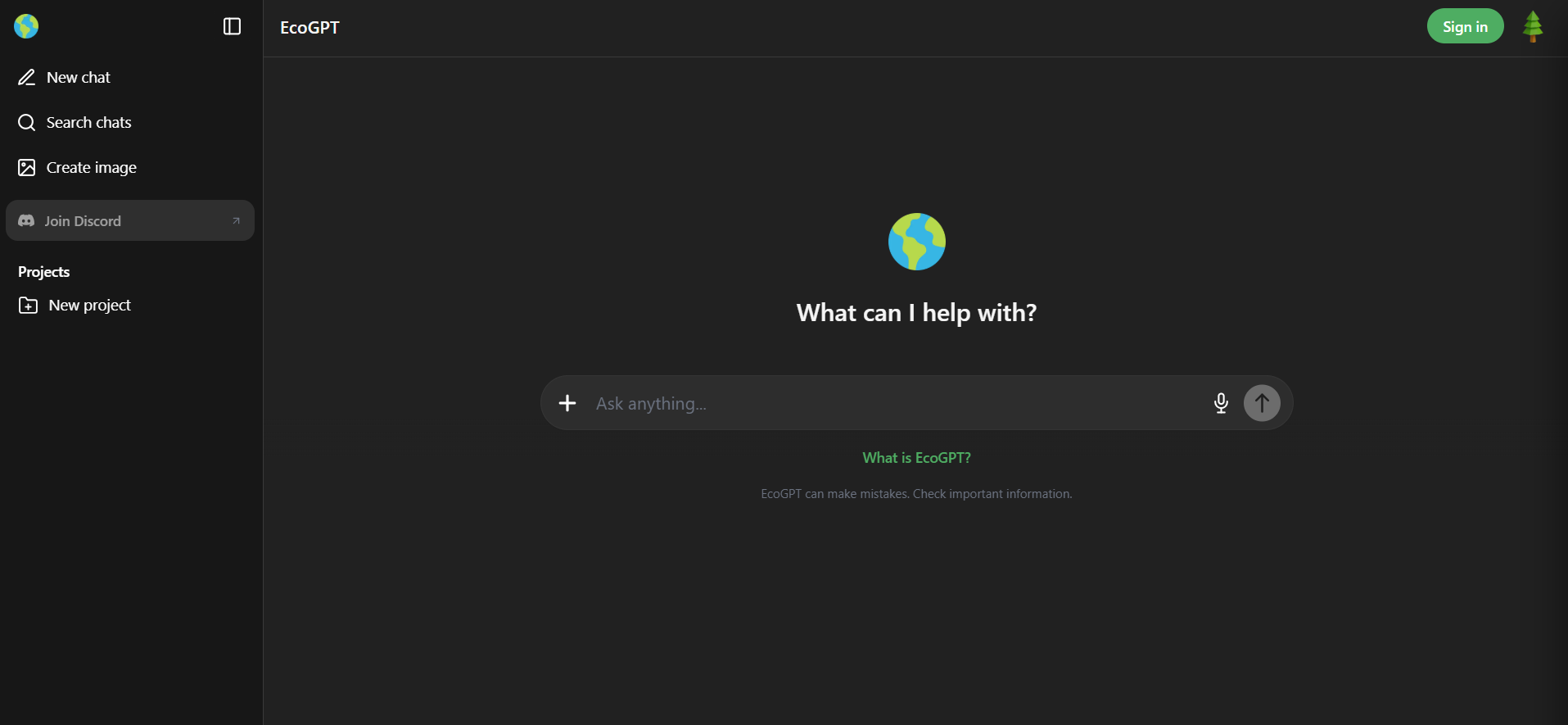
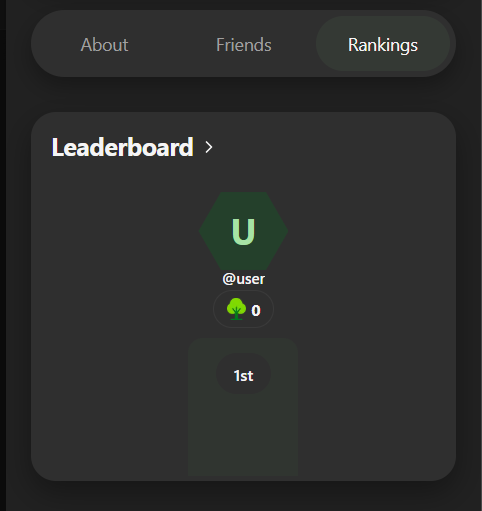
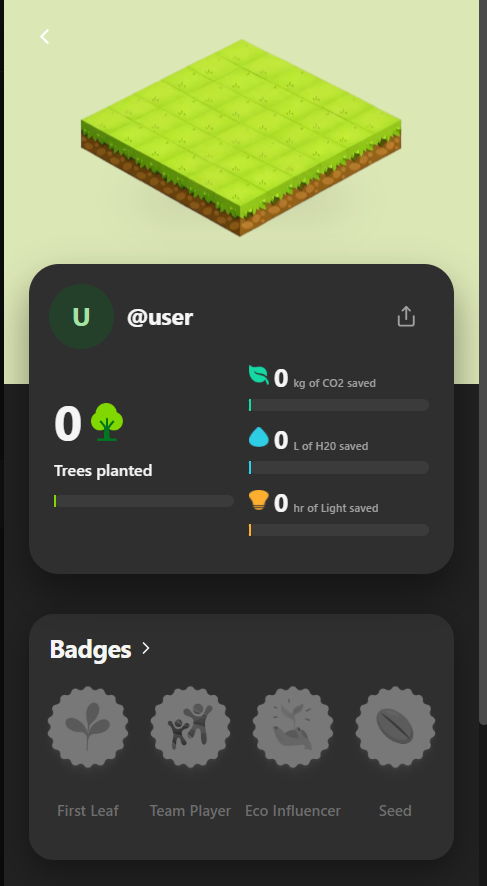
The chatbot itself looks and feels familiar. The current web app has New chat, Library, Apps and Scheduled in the sidebar, and the chat box offers web search, image creation, a quiz mode and file uploads. With a free account you can also publish simple websites, talk to it by voice and transcribe recordings. The Apps page connects accounts such as Google, Microsoft, Slack, Notion, GitHub, Linear and Canva. Your “forest” lives with your account: sign in and EcoGPT shows the trees your chats have funded. When we tested it in May 2026, the app also had a leaderboard and badges.
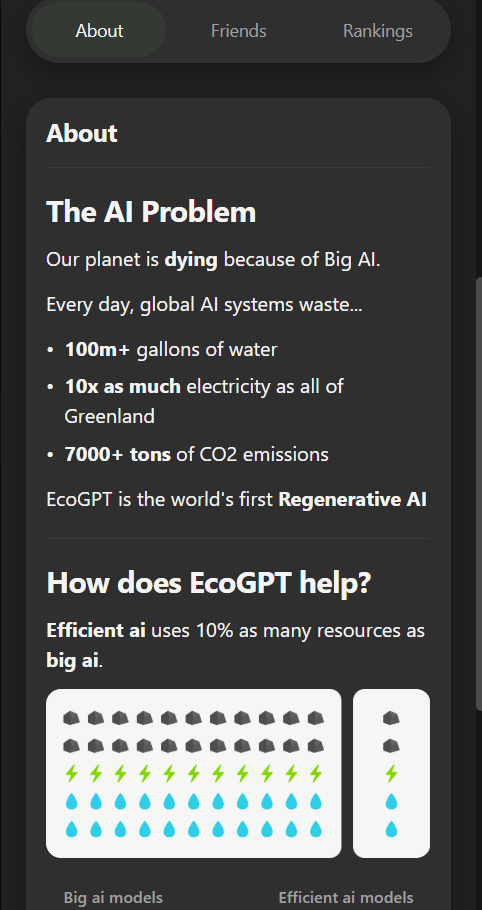
What separates EcoGPT from ChatGPT, Gemini or Claude is the model choice and the giving layer. Instead of large frontier models, EcoGPT says it uses “small, efficient open-source models with 10×+ fewer active parameters than the leading AI companies”. It hosts them in data centers with “low-to-zero carbon output, renewable energy, and seawater cooling”, according to its about page. A share of its revenue then goes to tree planting.

How Does EcoGPT Work?
EcoGPT works in three steps: your prompt goes to an open-source model on EcoGPT’s own server deployment, the answer comes back, and your usage counts toward trees funded.
- You type a prompt into EcoGPT on the web at ecogpt.com, or in the iOS or Android app. You do not need an account to start.
- The prompt goes to EcoGPT’s primary model deployment, which its subprocessor list places on Google Cloud in the europe-north1 region in Hamina, Finland. When that deployment is unavailable, EcoGPT sends your prompt and relevant conversation content through OpenRouter to other model providers instead. EcoGPT does not name the models it runs. Our May 2026 review described it as running on Groq’s LPU chips; Groq does not appear on EcoGPT’s current subprocessor list.
- EcoGPT counts your prompts toward trees, at 200 prompts per tree according to its website, and funds planting through Trees for the Future.
EcoGPT publishes planting certificates on its about page and its trees page. On October 1, 2026 the trees page showed 263,386 trees funded, 53% of a goal of 500,000 trees by 2027. Its certificates are dated May 31, July 9, July 13, August 6 and September 7, 2026.
EcoGPT also makes privacy promises that matter for how it works: it says it prefers zero-data-retention model providers and never uses your conversations to train foundation models. It promises to publish its environmental metrics “soon”; as of October 1, 2026 it has not published any.
Is EcoGPT Legit?
Yes, EcoGPT is legit. It is a registered company with a named founder, a public benefit structure, a real planting partner and a dated certificate trail. Its one named planting partner, Trees for the Future, is an established non-profit that runs agroforestry programs with smallholder farmers. EcoGPT says it works with it directly in Kenya, Tanzania and Uganda, supporting over 230 farmer families. That makes the planting claim checkable in a way that “we plant trees” marketing usually is not.
App store numbers back this up. On Apple’s App Store, EcoGPT, Inc. lists the app at 4.8 stars from 8,403 ratings, last updated September 27, 2026. On Google Play it has 4.9 stars from 10,327 ratings and 1M+ downloads, which fits EcoGPT’s own claim that “over a million people” use it.
“Legit” does not mean “frontier”, though. EcoGPT does not run the top models from OpenAI, Anthropic or Google. It runs small open-source models, which handle everyday tasks well but fall behind on hard reasoning, long documents and complex coding. If you use the latest ChatGPT or Claude every day, you will feel the gap on difficult questions. And “legit” is not the same as “private”: the free tiers carry ads, covered in the next section.
Is EcoGPT Safe? Ads and Your Data
EcoGPT is safe in the ordinary sense: it is not malware and not a scam. The privacy catch is the ads. The free Anonymous and Member tiers show sponsored suggestions. EcoGPT’s own subprocessor list, last updated September 30, 2026, says each of its four advertising partners, Gravity, Imprezia, Velocity and Koah, “receives recent messages, or the current prompt and response, to select what to show”.
Those partners also receive technical identifiers. All four get your IP address and user agent. Gravity also gets a pseudonymous user and conversation ID and, when configured, a hashed email address, and Velocity gets the advertising ID on Android. EcoGPT labels sponsored suggestions where they appear. EcoGPT Pro has no ads, so paying is the way to keep your messages away from ad partners.
The rest of EcoGPT’s data list is standard for a chatbot. Deepgram handles speech-to-text, Speechify and Cartesia spoken replies, and Firecrawl and Jina reading links and web search. Cloudflare hosts the app, PlanetScale runs the database, and Stripe, Apple and Google Play take payments. If you would not paste something into an ad-supported app, do not paste it into EcoGPT’s free tier. Our guide to the most eco-friendly AI covers greener options with different privacy models.
EcoGPT Pricing: Free vs Pro
EcoGPT is free to use, with two free tiers and one paid plan, according to its plans page (last updated September 21, 2026). Daily allowances reset at midnight UTC, and weekly image allowances reset on Monday at midnight UTC.
Anonymous (Free, No Account)
Anonymous lets you use EcoGPT without signing up, with up to 60 messages per day and 15 web searches per day. You also get 2 image creations and 2 image edits per week, and 5 file uploads per day with 100 MB of storage. You can build and preview a website but need an account to publish it, and voice and memory also need an account.
Member (Free Account)
Member is a free EcoGPT account with up to 500 messages per day and no daily search cap. It includes 10 image creations and 10 image edits per week and 50 uploads per day with 20 GB of storage. You also get 60 minutes of transcription a month and one published website. Live voice starts with 6 minutes and then refills by up to 3 minutes every 24 hours. Member includes ads between chats.
Pro ($10 per Month)
EcoGPT Pro costs $10.00 per month on the web in the United States; prices vary by region, and checkout shows the final price for your country. Pro gives unlimited messages (subject to rate limits) and 100 image creations and 100 image edits per week. It adds 200 uploads per day with 100 GB of storage, 5 hours of live voice and 10 hours of transcription a month, and up to 10 published websites. Pro has no ads. EcoGPT does not publish a yearly price.
For comparison, ChatGPT Plus is $20 per month, and ChatGPT’s free tier and $8 Go plan also show ads (see our ChatGPT Pricing Guide for the full breakdown). EcoGPT Pro costs half of ChatGPT Plus. For another green option, our GreenPT review covers a privacy-first chatbot built on lighter, energy-efficient models.
EcoGPT vs ChatGPT: Side-by-Side Comparison
EcoGPT is not better than ChatGPT at answering hard questions, but it is cheaper to upgrade and funds trees. Here is how the free and paid tiers compare as of October 1, 2026.
| Feature | EcoGPT Member (free) | EcoGPT Pro | ChatGPT Free | ChatGPT Plus |
|---|---|---|---|---|
| Price | $0 | $10 / mo (US web) | $0 | $20 / mo |
| Models | Small open-source models (unnamed) | Small open-source models (unnamed) | OpenAI’s lighter model | OpenAI’s flagship chat model |
| Messages | 500 / day | Unlimited (rate-limited) | Unlimited text chats on a lighter model | Higher limits |
| Ads | Yes, between chats | No | Yes, in supported markets | No |
| Image creation | 10 / week, plus 10 edits | 100 / week, plus 100 edits | Limited | Yes |
| Web search | Yes, no daily cap | Yes, no daily cap | Yes | Yes |
| Memory | Yes | Yes | Yes | Yes |
| Trees funded | 1 per 200 prompts (website figure) | Twice as fast as free | None | None |
| Mac app | No (web only) | No (web only) | Yes | Yes |
| Frontier reasoning | No | No | Moderate | Strong |
Where EcoGPT wins: the free Member tier is generous at 500 messages a day, Pro is half the price of ChatGPT Plus, and every prompt counts toward trees.
Where ChatGPT wins: model quality on hard reasoning, multi-step coding, long documents and image quality, plus a native Mac app. OpenAI’s flagship models are in a different weight class from the small open-source models EcoGPT serves.
If you mostly write, brainstorm, summarize and ask everyday questions, EcoGPT will handle it. If you depend on AI for research-grade reasoning or serious coding, ChatGPT Plus or Claude (see our Claude pricing breakdown) will still beat it.
How EcoGPT Plants Trees: The Math
EcoGPT’s website says it funds 1 tree for every 200 prompts, and twice as fast with EcoGPT Pro. That works out to 1 tree per 100 prompts for Pro users. Its App Store listing still says “every 100 chats helps plant one real tree”, and its X profile says “100 chats = 1 tree”. The website is the more detailed and more recent statement, so treat 200 prompts per tree on the free tiers as the working figure until EcoGPT reconciles the two. Either way, your 200th prompt does not plant a specific sapling: EcoGPT pays its planting partner, which plants in bulk.
The partner is Trees for the Future, a non-profit that runs agroforestry programs with smallholder farmers in sub-Saharan Africa. EcoGPT says it works with it directly in Kenya, Tanzania and Uganda and supports over 230 farmer families. Our May 2026 review also listed One Tree Planted and American Forests as partners; EcoGPT’s current pages name only Trees for the Future.
The count has grown fast. Our May 2026 review recorded 16,000+ trees funded; on October 1, 2026 its trees page shows 263,386. One recent App Store reviewer asked for more transparency “about where the trees are planted”, and that is fair: the certificates show dates and totals, not planting sites.
Does EcoGPT Use Less Water?
Probably, but EcoGPT does not publish a water figure, so nobody can say how much less. The case for less is structural: smaller models need less computing per answer, and EcoGPT says its servers use seawater cooling and run on 98% carbon-free energy in Finland. The case for caution is that EcoGPT has promised to publish its metrics “soon” and has not yet. Its fallback route through OpenRouter also sends some prompts to other providers whose footprint it does not report.
Some App Store reviewers call EcoGPT greenwashing; one complains that “They still use water”. Every chatbot does. The useful comparison is per answer, and the big providers that publish one put it below a milliliter. Google gives 0.26 mL for a median Gemini text prompt. OpenAI CEO Sam Altman has put an average ChatGPT query at about 0.000085 gallons, roughly 0.32 mL. Our ChatGPT water and energy impact deep-dive explains where that figure comes from.
Where EcoGPT Falls Short
EcoGPT is a good product with four weaknesses to know about before you rely on it or pay for Pro.
First, the model quality gap is real. Small open-source models are fine for daily tasks but not frontier. If you have been using the top models from ChatGPT, Claude or Gemini, EcoGPT’s answers will feel shorter, less careful on edge cases and weaker on multi-step reasoning. For students, casual writers and brainstormers, that gap probably does not matter. For coders and researchers, it will.
Second, the free tiers are paid for with ads, and the ad partners see your recent messages. That is a bigger trade-off than the message cap, which at 500 a day for Members is generous.
Third, image generation is not on the level of dedicated image models. One recent five-star reviewer said it is “very realistic on some things, but not for making real life logos or specific real life objects”. If images are why you would pay, Nano Banana or GPT Image (see our Nano Banana Pro vs GPT Image 1.5 comparison) are far stronger.
Fourth, EcoGPT is inconsistent about its own numbers: 200 prompts per tree on the website, 100 in the app listing, and environmental metrics promised but not yet published. None of that makes it a scam, but it makes the impact harder to check than the marketing suggests.
What Real Users Say
EcoGPT’s 50 most recent US App Store reviews, read on October 1, 2026, are 43 five-star, 2 four-star, 1 three-star, 1 two-star and 3 one-star. The recurring theme is relief at using AI without the guilt. One reviewer (Lev F., September 2026) wrote that the app makes them feel “MILLION times less guilty for using AI”. Another (23 Emma, September 2026) wrote: “It’s helping me learn way more than other things because it explains everything a lot better.”
The critical reviews fall into two groups. Some question the green claim itself: one one-star review, titled “GREENWASHING”, argues that EcoGPT plants trees but uses seawater. Others are about quality. A three-star reviewer (Yurimaster23317, September 2026) said EcoGPT started repeating things from past chats “without even answering the question I asked”. A two-star reviewer could not create an account by email in the iPhone app.
The dismissive take you will see in comments is “EcoGPT is just ChatGPT wrapped in green marketing.” That is not accurate. EcoGPT does not use OpenAI’s models; it runs open-source models on its own Google Cloud deployment. You can argue about how generous the tree math is, but “ChatGPT wrapper” is the wrong description.
Should You Use EcoGPT?
EcoGPT makes sense for three kinds of user:
The environmentally motivated user who wants AI but feels uneasy about its water and energy costs. Those costs are real: OpenAI CEO Sam Altman has put an average ChatGPT query at about 0.34 Wh of electricity and 0.32 mL of water. For the detail, see our ChatGPT water and energy impact deep-dive, our broader AI water use guide covering Gemini, Claude and reasoning models, and our full AI energy use breakdown.
The casual daily user who writes, brainstorms, summarizes and asks everyday questions. For that, 500 free messages a day on small open-source models is plenty, and the tree counter is a real motivator.
The value seeker who wants an ad-free assistant with unlimited messages, 100 images a week and voice for $10 per month, half the price of ChatGPT Plus.
EcoGPT is the wrong call for three others:
A researcher, coder or knowledge worker who needs frontier reasoning will hit the model-quality gap fast. Stick with ChatGPT Plus, Claude or Gemini.
Anyone who wants to use the free tier for private material, such as work documents, health questions or anything personal, should remember that free-tier ad partners receive recent messages.
An image-focused user will find EcoGPT’s image output behind the dedicated image generators.
If You Use Several AI Models on a Mac
EcoGPT is a single-provider app with no Mac app. It will not help if you already pay for two or three AI subscriptions and want one place for all of them. Fello AI is the closer fit there. One $9.99 per month subscription gets you ChatGPT, Claude, Gemini, Grok and DeepSeek in one native app on Mac, iPhone and iPad, with a free tier to try it. See our best ChatGPT alternatives for Mac roundup for the full lineup. For a multi-model chatbot built around the eco angle specifically, our Viro AI review covers a free app that funds clean energy as you chat.
The Bottom Line
EcoGPT is a real, working AI chatbot with a real tree-planting program behind it. It has funded 263,386 trees through Trees for the Future, with 1M+ downloads and strong ratings on both app stores. If your daily AI use is everyday writing, studying and brainstorming, and you care about the footprint of your AI habit, EcoGPT is worth the install. Pay the $10 per month for Pro if you want unlimited messages and, just as important, no ad partners reading your chats. For the wider field, our guide to the most eco-friendly AI ranks the greenest tools. And if you would rather green your searches than your chat, the OceanHero search engine applies the same idea to ocean plastic instead of trees.
EcoGPT is not a frontier model. If you need top-tier reasoning, serious coding help or the best image generation, you are better served by ChatGPT Plus, Claude or a multi-model app. The honest framing: EcoGPT is a good default for the easy 80% of everyday AI use, paired with a frontier model when the work demands it. If you want greener search rather than a chatbot, Ecosia’s green AI search is the closest equivalent.
FAQ
Is EcoGPT legit?
Yes. EcoGPT is built by EcoGPT, Inc., a Delaware Public Benefit Corporation. It has 4.8 stars from 8,403 App Store ratings and 1M+ Google Play downloads, and its trees page shows 263,386 trees funded through the non-profit Trees for the Future, with dated certificates.
Is EcoGPT free?
Yes. You can use EcoGPT without an account for up to 60 messages a day, or with a free account for up to 500 a day. Both free tiers show ads. EcoGPT Pro costs $10 per month on the US web and adds unlimited messages, more images and voice, and removes ads.
Does EcoGPT use ChatGPT under the hood?
No. EcoGPT runs small open-source models, which it does not name, on its own deployment on Google Cloud in Finland. When that deployment is unavailable it routes prompts through OpenRouter to other model providers. It does not use OpenAI’s GPT models as its main engine.
Is EcoGPT better than ChatGPT?
EcoGPT is better on price and environmental giving: Pro is $10 a month against $20 for ChatGPT Plus, and every prompt counts toward trees. ChatGPT is better on answer quality, hard reasoning, coding and images, and it has a Mac app.
Who owns EcoGPT?
EcoGPT is owned by EcoGPT, Inc., a Delaware Public Benefit Corporation founded by Ethan Leonard. The company says it is self-funded. EcoGPT, Inc. is also the seller on the App Store.
Does EcoGPT actually plant trees?
Yes. EcoGPT funds planting through Trees for the Future in Kenya, Tanzania and Uganda, and publishes dated certificates on its trees page, which showed 263,386 trees funded on October 1, 2026. Its website says 200 prompts fund one tree; its App Store listing says 100.
Is EcoGPT safe to use?
EcoGPT is safe in the sense that it is a real app from a real company. On the free tiers, though, its four ad partners receive your recent messages, or the current prompt and response, to choose sponsored suggestions. EcoGPT Pro has no ads. EcoGPT says it never trains foundation models on your conversations.
What is the official EcoGPT website and app?
The official website is ecogpt.com. The iPhone app is EcoGPT from EcoGPT, Inc. on the App Store, and the Android app is on Google Play. There is no Mac app. EcoGPT’s official X account is @ecogptapp.