It feels like ChatGPT 5 just arrived, and now everyone is talking about ChatGPT 5.1. In this ChatGPT 5 vs ChatGPT 5.1 comparison (and GPT-5 vs GPT-5.1 for API users), we’ll walk through what actually changed for everyday users, developers, and businesses, and whether you should switch.
The short answer is that 5.1 is a major “experience” upgrade that changes how the AI feels to talk to.
If you are wondering whether to switch your settings or update your API calls, this guide covers it all. Is ChatGPT 5.1 better than ChatGPT 5 for everyday use? Does the new model cost more to use? What are the new personality features?
The Key Takeaways
- It’s an iteration: OpenAI GPT-5.1 replaces GPT-5 as the main flagship model; it is not a completely new generation.
- Personalities are here: You can now choose from 8 styles, like “Quirky” or “Professional,” instead of relying on one dry default tone.
- Smarter speed: GPT-5.1 Instant uses adaptive reasoning to answer simple questions fast, only “thinking” hard when necessary.
- Devs get more power: New tools allow the AI to act as an agent that edits code files directly, rather than just suggesting changes.
TL;DR:
ChatGPT 5.1 is a refined “experience update” to the GPT-5 family. It introduces faster adaptive reasoning, 8 new personality presets, and improved coding agents, all while keeping the same pricing and core architecture. It also features small but real gains in reasoning and instruction-following compared to the original GPT-5.
| Feature | ChatGPT 5 (Legacy) | ChatGPT 5.1 (Current) |
|---|---|---|
| Release Date | August 7, 2025 | Mid-November 2025 |
| Best Use Case | Complex, formal reasoning | Everyday chat, coding, agents |
| Reasoning Style | Always “on” (can be slow) | Adaptive (Instant vs. Thinking) |
| Tone Options | Single (Formal/Dry) | 8 Personality Presets |
| API Pricing | $1.25 / 1M input | Same ($1.25 / 1M input) |
| Context & Limits | Limits vary by tier | Instant (16K–128K), Thinking (196K) |
| Availability | Legacy menu (limited time) | Default model in ChatGPT & API |
The Main Differences Between ChatGPT 5 and 5.1
To understand the ChatGPT 5 vs ChatGPT 5.1 debate, you first have to look at the timeline. ChatGPT 5 (powered by the GPT-5 model) launched in August 2025. It was brilliant at math and science but often felt a bit stiff.
ChatGPT 5.1 arrived in November 2025. Think of it as the “polished” version. OpenAI now positions the GPT-5.1 flagship model as the default standard for almost everyone.
- ChatGPT 5: Now considered a “legacy” option. It is great for people who built specific prompts around it and don’t want to change yet. OpenAI says it will remain available for about three months in ChatGPT’s ‘Legacy’ model menu before being phased out from the chat UI (GPT-5 will remain available in the API for now, with deprecation announced separately if it happens).
- ChatGPT 5.1: The new standard. It includes improvements in how the AI follows instructions and handles long conversations.
For most users, the update happens automatically. You generally don’t need to do anything to get the ChatGPT 5.1 update unless you are a developer changing API codes.
New Personalities and Conversational Tone
This is the change you will likely notice immediately. In the past, ChatGPT 5 had one main “voice.” It was polite and helpful, but users often described the tone as dry, robotic, or a bit too “textbook.”
ChatGPT 5.1 introduces a clear shift in tone. It is designed to be more conversational and “human” right out of the box. The default responses are less stiff, but the real magic lies in the new ChatGPT 5.1 personality presets. Instead of writing a long, complicated prompt to make the AI sound distinct (e.g., “Act like a grumpy IT guy”), you can now simply select a mode from the menu.
You can currently choose from eight distinct styles:
- Default / Professional: The standard, safe, helpful assistant.
- Friendly / Candid: ChatGPT 5.1 warmer responses really shine here; it feels like texting a friend.
- Efficient: Short, punchy answers with zero fluff.
- Quirky / Nerdy / Cynical: These radically change the vocabulary and attitude of the answer.
These presets are more than just a novelty; they practically eliminate the need for complex “roleplay” prompting. Instead of typing “Act like a senior engineer” or “Be sarcastic” every time you start a chat, you can just toggle a setting.
This flexibility allows the tool to adapt to your specific workflow instantly, whether you need a creative brainstorming buddy or a ruthless editor who cuts straight to the point.
Real-World Example: The ChatGPT 5 vs 5.1 Tone Difference
Here is how the different versions might handle a simple question like, “I deleted my file by accident.”
- ChatGPT 5 (Old): “To recover a deleted file, please check your Recycle Bin or Trash folder. If it is not there, you may need backup software.”
- ChatGPT 5.1 (Cynical Mode): “Classic move. Check the trash bin before you panic. If it’s not there, well, I hope you believe in backups.”
This makes the AI feel less like a search engine and more like a customizable partner.
Adaptive Reasoning and Speed
One of the biggest complaints about the original GPT-5 was that it sometimes felt sluggish. It tended to “over-think” even simple questions, like looking up a capital city or fixing a typo, treating them with the same heavy processing power as a complex physics equation.
GPT-5.1 adaptive reasoning largely fixes this by introducing a smarter, two-gear system. The model now automatically switches between:
- GPT-5.1 Instant: A lightweight, fast mode for everyday tasks like emails, summaries, and casual chat.
- GPT-5.1 Thinking: A deeper reasoning mode that kicks in automatically for hard logic, coding architecture, or science problems.
GPT-5.1 Auto: When Instant vs Thinking kicks in
In the new ChatGPT 5.1 auto mode, this switching happens transparently. For example, ask “What is the capital of France?” and GPT-5.1 Instant replies almost immediately. Ask it to refactor a 500-line function or explain a physics proof, and you’ll see GPT-5.1 Thinking spin up its reasoning mode before answering.
This dynamic approach answers the common question: is ChatGPT 5.1 faster? In practice, yes. not because the raw hardware is different, but because the model stops wasting brainpower on easy tasks.
Tip for Pros: When the model is in “Thinking” mode, you can now click an “Answer now” button to force it to stop planning and output its best current guess immediately.

Updates for Coding and Developers
If you write software, this update is significant. While the previous version was a helpful assistant, ChatGPT 5.1 for coding is designed to be an active partner. The biggest change is the shift toward “agentic” workflows, where the AI doesn’t just suggest changes, it actually carries them out through tools.
GPT-5.1 for agents and workflows changes the daily grind of programming. In the past, you likely used GPT-5 to generate a block of code, which you then had to copy, paste, and debug manually.
ChatGPT 5.1 introduces new capabilities to fix this:
- Direct File Editing: Using a new tool called apply_patch, the model can generate structured “diffs.” It proposes edits to specific lines in your files directly, rather than spitting out a wall of text for you to sort through.
- Command Execution: ChatGPT 5.1 for developers includes a shell capability. This allows the AI to propose terminal commands to run tests or check files, creating a loop where it plans, executes, and fixes its own errors.
- Specialized Models: OpenAI has released gpt-5.1-codex, a version tuned specifically for tools like GitHub Copilot, making it better suited to large, multi-file projects than the general chat models.
If you use editors like VS Code or GitHub Copilot, GPT-5.1-Codex is increasingly what’s running behind the scenes for code suggestions and agentic edits.
Mini Example: The “Patch” Workflow
Here is how the experience changes for a developer fixing a bug:
- The Old Way (GPT-5): You paste an error log. The AI says, “Here is the fixed function,” and prints 50 lines of code. You delete the old function and paste the new one.
- The New Way (GPT-5.1): You paste the error. The AI says, “I found the issue in line 24,” and offers a patch that only changes that one specific line. You click “Apply,” and the file is updated instantly.
Pricing and Availability
Good news: better features do not mean a higher price. The GPT-5.1 token price is exactly the same as GPT-5.
- Input: $1.25 / 1M tokens
- Output: $10.00 / 1M tokens
Because GPT-5.1 is smarter about when to ‘think,’ it can be cheaper for some workloads, since you’re not burning full reasoning effort on trivial prompts.
A Better Question Than 5 or 5.1
OpenAI ships a point release, makes it the default, and moves the old one to a legacy entry in the dropdown, as the FAQ below spells out. Keeping up with that is work nobody asked for, and it is the smaller question anyway. What changes your output is not which ChatGPT you are on, it is whether ChatGPT was the right model for this particular job.
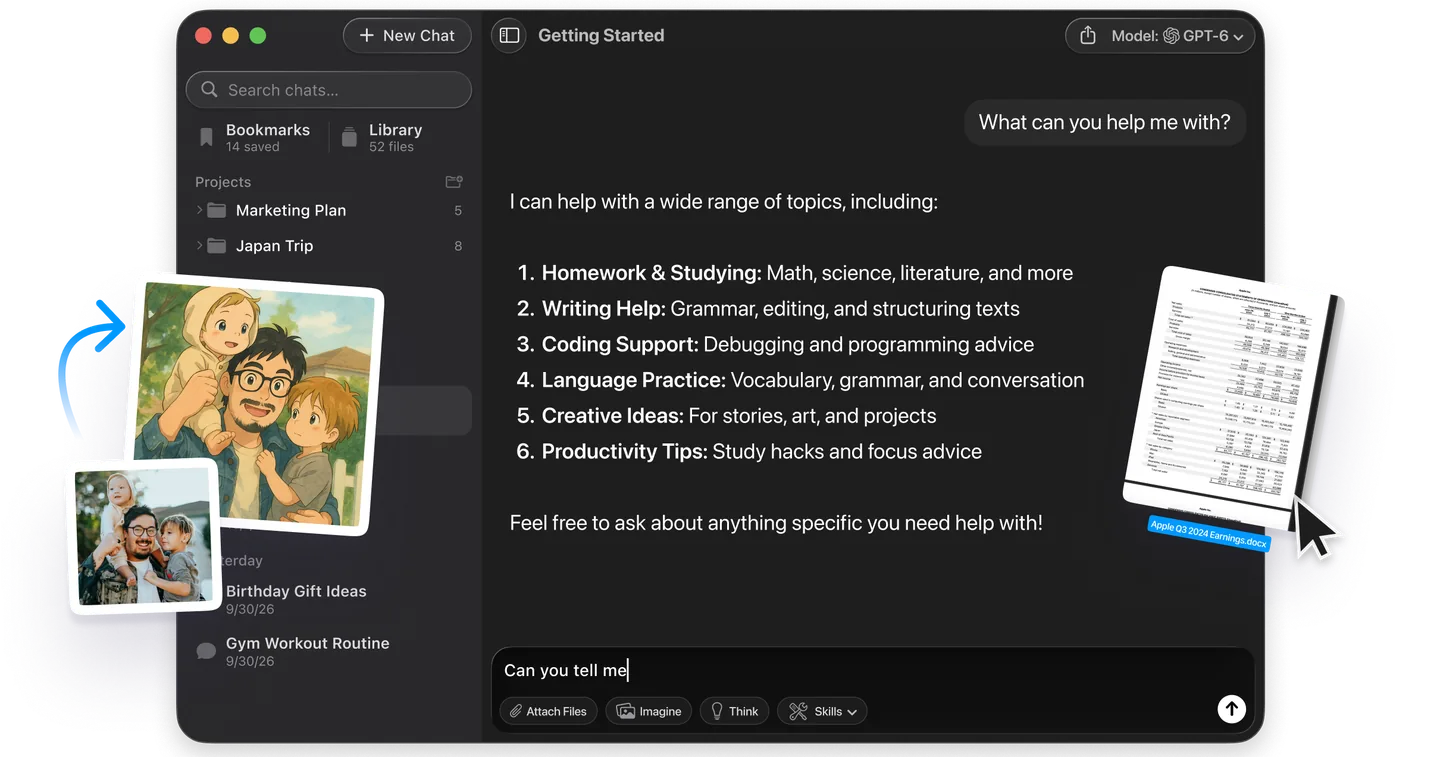
Fello AI is a native Mac, iPhone and iPad app that gives you the current ChatGPT behind one subscription, along with Claude, Gemini, Grok, DeepSeek, Perplexity, Kimi, GLM and Qwen. It starts at $9.99 a month, with a free tier to try first and a 4.7-star rating across 27,000+ reviews. The newest OpenAI model is simply there when you open it, and when a draft still reads stiff you can hand the same prompt to a rival model in the same conversation instead of waiting for the next point release to fix the tone.
Conclusion
Overall, the ChatGPT 5 vs ChatGPT 5.1 story isn’t about a new brain, it’s about making the same brain much nicer and more efficient to work with. By fixing the “dry” academic tone of the original GPT-5 and adding smart features like adaptive reasoning, OpenAI has transformed a powerful calculator into a collaborative partner that feels friendlier and works faster.
It doesn’t matter if you are a developer using the new agentic tools or a student writing an essay; the upgrade makes the AI feel less like a stiff piece of software and more like a responsive colleague.
Next Step: Open ChatGPT right now, check the model picker for GPT-5.1, and try selecting a different personality preset (like “Candid” or “Quirky”) to see just how different the conversation feels.
GPT-6 Astra has since shipped, on September 3, 2026, and our GPT-6 leak scorecard tracks which of the rumours held up. And if you run GPT-5.1 on a Mac, our guide to the ChatGPT desktop client for Mac covers the native app.
Frequently Asked Questions (FAQ)
What is ChatGPT 5.1 and how is it different from ChatGPT 5?
While the core architecture is the same, version 5.1 adds personality presets, a warmer tone, adaptive reasoning and incremental improvements in reasoning and instruction-following.
Is ChatGPT 5.1 better than ChatGPT 5 for everyday use?
For most people, yes. Users generally find ChatGPT 5.1 more enjoyable because it feels less robotic and “stiff” than the original release. It is better at handling casual conversation and simple tasks without pausing to “over-think” them.
How do I switch from ChatGPT 5 to ChatGPT 5.1 in the app?
You likely don’t need to do anything. OpenAI has made ChatGPT 5.1 the default model for almost everyone. If you specifically need the older version for a project, you can usually find “GPT-5 Legacy” in the model dropdown menu at the top of your chat window.
Is ChatGPT 5.1 free?
Yes, it is available on the Free tier, though with usage limits. Free users currently get a set number of messages (e.g., 10 messages every 5 hours) with GPT-5.1 Instant before the system switches them to a lighter, mini model. Plus and Pro users get significantly higher limits.
Is ChatGPT 5.1 faster?
Yes, in most cases. Thanks to adaptive reasoning, the model skips deep planning steps for simple questions like “Write me an email” or “What is the capital of France?” This makes the ChatGPT 5.1 update feel much snappier than the original GPT-5, which treated every prompt as a complex problem.
Does GPT-5.1 change pricing or my API code?
GPT-5.1 keeps the same token pricing as GPT-5 ($1.25 / 1M input, $10 / 1M output), so you don’t pay more. In most cases, you can switch by changing the model name in your code (e.g., from gpt-5 to gpt-5.1). However, if you have advanced system prompts tuned for GPT-5, you should test them on staging first to check for any behavior changes.
Methodology & Sources
To compare these models, we analyzed technical documentation and user reports from the November 2025 launch window.
- Comparison: We looked at release notes regarding GPT-5 vs GPT-5.1 performance and benchmarks.
- Tone Testing: We reviewed early user impressions of the new personality presets (Friendly vs. Cynical).
- Sources:
- OpenAI Platform Documentation (Accessed November 2025)
- TechRadar Hands-On Review (Published November 2025)
- OpenAI Help Center (Updated November 2025)