TL;DR: DeepSeek-V3.2 is a newly released family of open-source, 685B-parameter AI models that rival GPT-5 and Gemini 3.0 Pro in advanced reasoning benchmarks while cutting operational costs by over 50%. It features a standard “daily driver” version optimized for tools and chat, and a “Speciale” variant designed specifically for complex math, coding, and logic tasks.
| Feature | Spec / Detail |
|---|---|
| Model Type | Mixture-of-Experts (MoE), 685B Parameters |
| Context Window | 128,000 tokens (approx. 100k words) |
| License | MIT License (Commercial use allowed) |
| Best For | Coding, Agents, Complex Reasoning (Math/Logic) |
| Pricing | ~$0.28 per 1M input tokens (cache miss) |
Opening
The global AI landscape has shifted dramatically once again, this time driven by the release of the DeepSeek-V3.2 family. Unlike typical industry updates that simply add a bit more speed or a slightly larger context window, this release introduces a fundamental change in how we access frontier-level intelligence.
Between September and December 2025, DeepSeek rolled out a family of three distinct versions targeting every possible use case, from daily chatbots to gold-medal Olympiad math solvers. These open-source models are claiming to match and in some specific reasoning categories, even beat proprietary giants like GPT-5 and Gemini.
For businesses, developers, and students, this is a pivotal moment because it brings top-tier intelligence out from behind a paywall and into the open ecosystem. However, with three different versions available, it can be incredibly confusing to know which one fits your specific workflow.
This confusion leads to several critical questions that we will answer in this guide. Is the “Speciale” version actually better than the standard V3.2 for your specific needs? How does the new “Sparse Attention” technology save you money on long documents? And perhaps most importantly for the privacy-conscious: can you really run a massive 685B parameter model on your own hardware, or is it still a cloud-only luxury?
What is DeepSeek-V3.2?
DeepSeek-V3.2 represents a major architectural update to the DeepSeek open-source LLM lineup, moving beyond the traditional dense models of the past. It utilizes a sophisticated MoE (Mixture-of-Experts) architecture. To explain this simply, imagine a massive library of 685 billion experts. In a traditional model, you would ask every single expert to chime in on every single word you type, which is slow and expensive.
In a Mixture-of-Experts model, the system smartly routes your query only to the specific experts who know the answer. This means that while the model has a massive 685 billion parameters total, it only uses a small fraction of them for each word it generates. This makes it significantly smarter without being incredibly slow or expensive to run.
The headline feature here is the unprecedented performance-to-cost ratio that this architecture achieves. By optimizing how the model “thinks” and pays attention to data, the team has created a DeepSeek-V3.2 model explained by industry analysts as one of the first clear open-weights competitors to the world’s most expensive closed models. It isn’t just about raw power, it is about accessibility.
The Three Versions
It is critically important to understand that V3.2 is not a single AI model, but actually a family of three distinct models, each tuned for a different purpose:
- DeepSeek-V3.2 (Main): This is the all-rounder or the “daily driver.” It supports a “thinking” mode (where it reasons internally before answering) but maintains compatibility with external tools, JSON outputs, and complex coding tasks.
- DeepSeek-V3.2-Speciale: This is the high-power, specialized variant. It uses significantly more computing power to “think” for longer periods before outputting a single word. It is designed purely for deep reasoning like solving a hard math theorem and currently does not support external tools.
- DeepSeek-V3.2-Exp: This was the experimental prototype released slightly earlier in September. Its primary purpose was to test the new sparse attention mechanism in the wild before the main launch.
For the vast majority of developers building applications or users looking for a ChatGPT alternative, the standard DeepSeek-V3.2 is the right choice because it perfectly balances speed, cost, and the ability to use external tools.
Comparing the Variants
Choosing between the main model and the DeepSeek-V3.2-Speciale version depends entirely on your specific goal. If you pick the wrong one, you might end up overpaying for slow responses or failing to solve a complex logic puzzle.
V3.2 (Daily Driver)
This version is optimized for what engineers call “agentic” workflows. This means it is exceptionally good at planning, using search tools to find current information, and following multi-step instructions without getting confused. It supports a DeepSeek-V3.2 128k context, meaning it can remember very long conversations, read entire books, or analyze massive codebases in one single prompt. It is nimble, versatile, and cost-effective for high-volume tasks.
- Best for: Coding assistants, customer service bots, data extraction, and creative writing.
- Key Feature: Supports Function Calling and JSON mode, making it easy to integrate into software.
V3.2-Speciale (The Specialist)
Think of this version as a brilliant professor locked in a room without an internet connection. It cannot browse the web (no tool support yet), but its raw intellect is off the charts. It achieves gold-medal level performance in elite competitions like the International Math Olympiad (IMO). When you ask it a question, it doesn’t just guess; it spins up a long chain of internal “thought” tokens to verify its logic step-by-step before it even shows you the answer.
- Best for: Solving complex riddles, advanced mathematics, theoretical physics, and intense logic puzzles.
- Trade-off: It is noticeably slower and costs more per query because it generates far more internal “thinking tokens” to reach its conclusions.
V3.2-Exp (Experimental)
The DeepSeek-V3.2-Exp model serves as a technical demonstration. While powerful, it is primarily interesting to researchers who want to understand the “DeepSeek Sparse Attention” mechanism in its rawest form. It proved that you could handle massive contexts efficiently, paving the way for the stable V3.2 release.
DeepSeek-V3.2 vs. The Giants
The big question on everyone’s mind is simple: can a free, open model actually beat the paid giants from OpenAI, Google, and Anthropic? The data suggests the gap has narrowed dramatically, and on several reasoning benchmarks, V3.2 or Speciale actually pull ahead.
Reasoning, Math & Coding Benchmarks
| Domain | Benchmark | DeepSeek Performance | Competitor Comparison |
|---|---|---|---|
| Math | AIME 2025 (pass@1) | 93.1% (V3.2 Thinking) | Beats GPT-5-High (~90–91%) |
| Reasoning | IMO, IOI, ICPC | Gold Medal Level (Speciale) | Matches Gemini 3.0 Pro |
| Coding | SWE-Bench Verified | 2,537 issues solved | Beats Claude 4.5 Sonnet (2,536) |
These figures represent a stunning result for an open-weights model. Specifically, DeepSeek’s own report claims V3.2-Speciale matches Gemini 3.0 Pro on aggregated reasoning benchmarks. By allowing the model to ruminate on the problem longer, Speciale avoids the hallucination traps that faster models often fall into.
For developers, the coding battle is incredibly tight. While edging out Claude 4.5 Sonnet by a single point (2,537 vs 2,536) might seem negligible, it proves that DeepSeek is no longer a “budget alternative”—it is a peer.
Everyday Example: If you ask the standard V3.2 to “Write a Snake game in Python,” it will write the code quickly and efficiently. If you ask the Speciale version to “Prove this complex geometry theorem,” it will spend time “thinking” (generating invisible tokens) and provide a detailed, step-by-step proof that the standard model might miss or simplify too much.
New Tech: Sparse Attention (DSA)
DeepSeek’s speed comes from a breakthrough called DeepSeek Sparse Attention (DSA). While older “dense” models must re-read every single word in a document to answer a question, which is slow and expensive, DSA acts like a library index.
Instead of scanning the entire text history, it instantly finds only the specific details needed for the current query. This makes it an efficient long-context LLM, allowing you to analyze massive files like novels or contracts quickly and cheaply without sacrificing accuracy.
API Pricing & Access
DeepSeek has built a reputation for aggressive pricing strategies, effectively commoditizing intelligence. With the launch of V3.2, they announced a massive price cut that undercuts the market significantly. For the latest API costs, free tier details, and plan comparisons, see our DeepSeek pricing guide.
The current pricing structure is as follows:
- Input (Cache Miss): ~$0.28 per 1 million tokens.
- Input (Cache Hit): ~$0.028 per 1 million tokens.
- Output: ~$0.42 per 1 million tokens.
This DeepSeek-V3.2 API pricing is significantly lower than OpenAI or Anthropic, often by a factor of 10–30× depending on the specific model comparison. The real game-changer here is the “Cache Hit” price. If you structure your prompts to use “context caching” (reusing the same big documents or system prompts across many queries), the price drops by a staggering 90%. This makes it feasible to build complex applications that process heavy data loads without fear of a runaway bill.
Licensing
Beyond the price, the legal framework is just as appealing. The models are released under the DeepSeek-V3.2 MIT license. This is huge for businesses because the MIT license is one of the most permissive open-source licenses available. It permits commercial use, modification, and integration without forcing you to open-source your own proprietary code. You can take V3.2, fine-tune it on your private company data, and sell a product based on it without paying royalties to DeepSeek.
How to Run It
Since this is open source, you don’t have to use their API. You can run it yourself on your own servers. However, be warned: these are massive models, and they are not designed for the average consumer laptop.
To handle DeepSeek-V3.2-Exp local deployment, you need serious hardware. The full model weights occupy nearly 700GB of storage space just to exist. To actually run the model, you need to load those weights into VRAM (Video RAM).
- Full Precision (FP16/BF16): Requires a cluster of high-end enterprise GPUs, such as 8x Nvidia A100s or H100s.
- Quantized (Int8/FP8): You can run heavily quantized variants on smaller setups, but you are still looking at a multi-GPU rig with several high-memory cards (A100/H100/A6000-class) plus careful sharding. Check the latest community deployment guides for tested configs.
Software and Tools
Support for these models is growing rapidly in the open-source ecosystem. You can serve these models using DeepSeek-V3.2 on vLLM (a popular, high-speed inference engine) or SGLang. These tools help manage the complexity of the “Sparse Attention” mechanism automatically, so you don’t need to write custom kernel code to get it running.
Device Tip:
If you are an individual developer or student, do not try to run the full 685B model on your MacBook or gaming PC. It simply won’t fit. Instead, use the affordable API, or wait for the community to release “distilled” or smaller quantized versions (like 7B or 70B variants) on Hugging Face that retain some of the V3.2 magic but fit on consumer hardware.

How to Try It Against the Giants
Neither route above is how most people will actually use this model. A multi-GPU rig is out of reach, and an API key plus a token bill is a project rather than an afternoon. If what you want is to find out whether the benchmark gap against Gemini and GPT holds up on your own work, you need the model in a chat window next to the models it is being measured against.
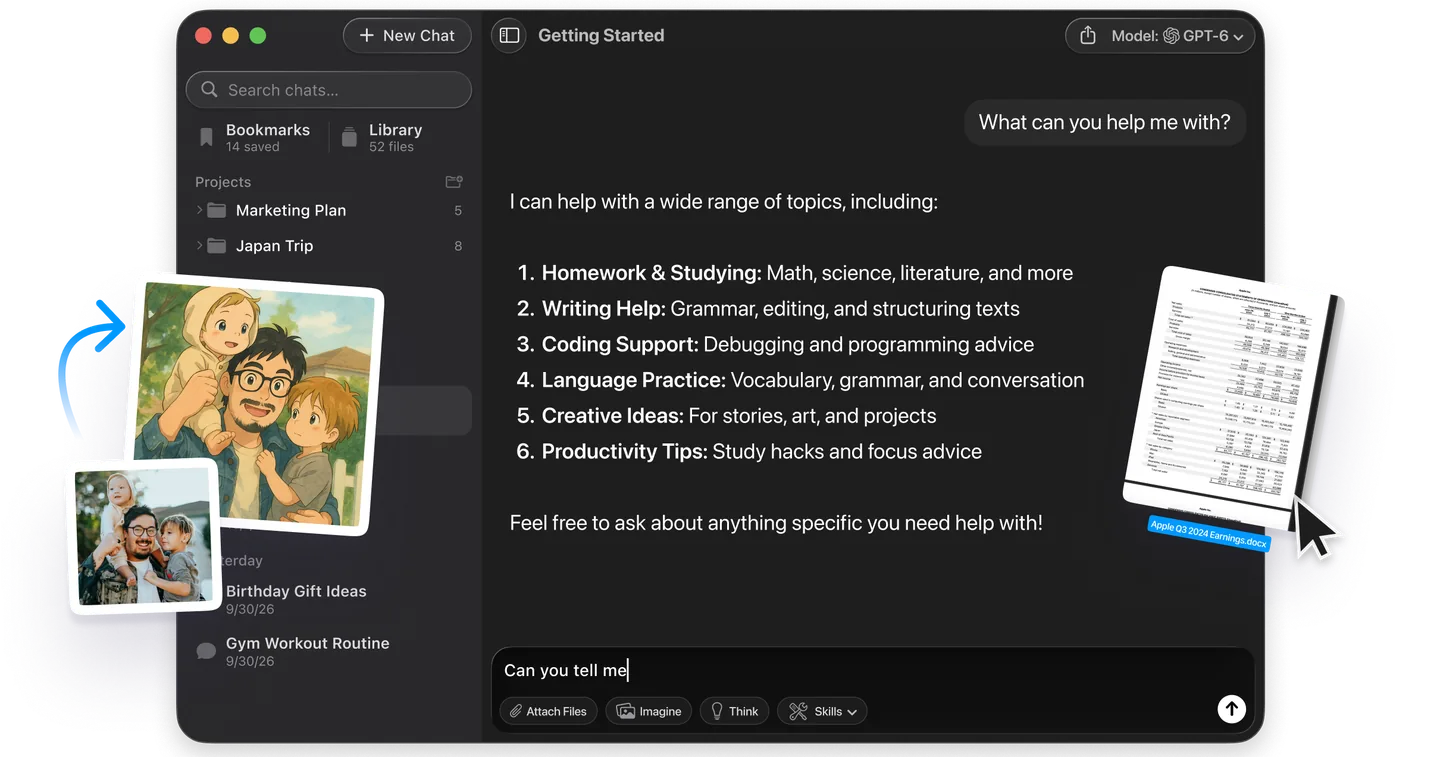
Fello AI is a native Mac, iPhone and iPad app that puts DeepSeek behind one subscription, along with ChatGPT, Claude, Gemini, Grok, Perplexity, Kimi, GLM and Qwen. It starts at $9.99 a month, with a free tier to try first and a 4.7-star rating across 27,000+ reviews. You can hand one of the reasoning problems from the comparison above to DeepSeek and to both giants inside a single conversation and read the three answers side by side, with no cluster, no API key and no second subscription.
Conclusion
DeepSeek-V3.2 represents a massive leap forward for open-source AI. By offering GPT-5 class performance with a permissive MIT license and ultra-low API costs, it effectively removes the barrier to entry for advanced AI applications.
It proves that you do not need a closed, proprietary system to access the world’s best intelligence. Whether you need the daily utility of the main model for your startup or the raw, unbridled brainpower of Speciale for research, the open-source community now has a “frontier” model to call its own.
Next Step: Visit the DeepSeek web platform to try the “Thinking Mode” yourself on a complex logic riddle, or check out the API docs to see how much you could save on your current project by switching models.
FAQ
Is DeepSeek-V3.2 really free?
Yes and no. The model weights (the “brain” of the AI) are free to download from Hugging Face under the MIT license. You do not have to pay DeepSeek to download or use them. However, running them requires electricity and expensive hardware. Alternatively, you can pay to use DeepSeek’s hosted API, which is very cheap compared to competitors but is not technically “free.”
Can I use the Speciale version for coding?
You can, but it might be overkill. Speciale is designed for deep reasoning and logic. While it understands code perfectly well, it currently does not support “tools” (like browsing the web, running the code to test it, or creating files), so for general coding assistance, the standard V3.2 is usually better, faster, and more practical.
How does the 128k context window help me?
A 128k context window allows you to paste in roughly 300 pages of text or tens of thousands of lines of code. You can upload entire instruction manuals, legacy codebases, or complex legal contracts and ask the AI specific questions about them. The model can “see” all this information at once without needing to cut it into small pieces.
What is the difference between “Thinking” and “Non-Thinking” modes?
“Thinking” mode allows the model to generate a stream of internal thoughts before it gives you a final answer. This mimics human contemplation and improves accuracy on hard problems. “Non-thinking” mode forces the model to respond immediately, which is better for casual chat, simple translations, or tasks where speed is more important than depth.
Is DeepSeek-V3.2 better than GPT-5?
It depends on the task. Benchmarks show V3.2 is roughly equal to GPT-5 in general tasks like chatting and summarizing. However, the Speciale version often beats GPT-5 in pure mathematics and logic puzzles. That said, GPT-5 may still have advantages in ecosystem integration (like working with ChatGPT Voice or DALL-E) that an open model lacks.
Methodology & Sources
This article was compiled using a combination of official technical documentation and verified third-party benchmarks to ensure accuracy.
- Source Data: We relied primarily on the official DeepSeek API documentation and the V3.2 technical reports released alongside the models.
- Benchmarks: The performance numbers cited (including AIME, SWE-Bench, and math competitions) are sourced from DeepSeek’s internal testing as well as third-party verifications from platforms like Apidog.
- Dates: All references cover the release window around late 2025, capturing the state of the art at the time of launch.
- Official Repo: You can verify these weights and details directly at the DeepSeek Hugging Face page.
- Tech Report: For a deeper dive into the math, refer to the DeepSeek V3.2 Paper.