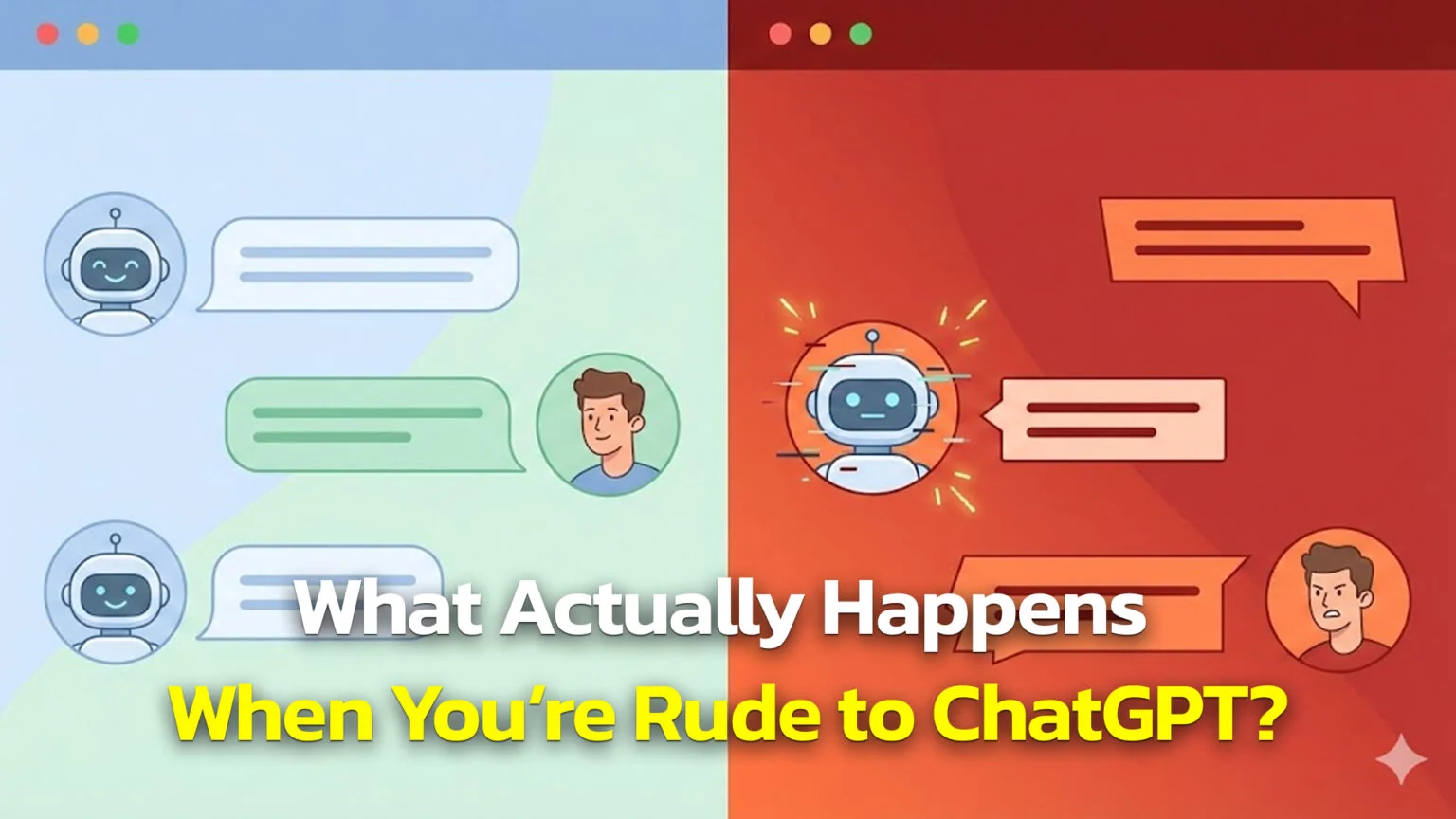
TL;DR: A 2025 study suggests that being rude or curt to ChatGPT-4o can slightly improve accuracy (by ~4%) on multiple-choice questions. However, this is likely because rude prompts are shorter and more direct, not because the AI likes the attitude. You can get the same results by being concise without being mean.
| Metric | Details |
|---|---|
| Study Name | Mind Your Tone (Dobariya & Kumar, 2025) |
| Model Tested | ChatGPT-4o |
| Accuracy Gap | Very Polite (80.8%) vs. Very Rude (84.8%) |
| Main Driver | Directness, brevity, and lack of “social fluff” |
| Recommended Strategy | Be direct and structured (neutral), not abusive. |
We have been told to treat AI chatbots like polite colleagues. Saying “please” and “thank you” to get the best results. It feels natural to use social etiquette when we are typing into a chat box that talks back to us like a human. But a new wave of research is challenging that digital etiquette. Recent tests suggest that dropping the niceties and adopting a blunt, or even rude, tone might actually force the AI to be smarter.
Does this mean you should start insulting your computer to get your work done? Not necessarily. Before you change your entire communication style, it is important to understand why this happens and if it works for every task. It is a complicated mix of computer science, psychology, and simple efficiency.
This article answers three key questions:
- Does being rude to ChatGPT really improve accuracy?
- Why do polite prompts sometimes fail?
- How can you get better answers without being a jerk?
The “Mind Your Tone” Study (2025)
In early 2025, researchers Om Dobariya and Akhil Kumar released a fascinating paper titled Mind Your Tone, which investigated exactly how prompt politeness affects LLM accuracy. They wanted to see if treating ChatGPT-4o like a respected human, or treating it like a servant, changed how well it solved logical problems.
This wasn’t just a casual experiment. They took 50 multiple-choice questions covering varied subjects like mathematics, science, and history. For each question, they crafted five distinct versions of the prompt, ranging on a spectrum from “Very Polite” to “Very Rude.”
They ran the experiment 2,500 times in total (50 questions × 5 tones × 10 runs) to check that the effect wasn’t a fluke. They also tested the theory on other models like GPT-o3 and Anthropic’s Claude to broaden the scope. It’s worth noting that Mind Your Tone is currently a preprint on arXiv and has not yet been fully peer-reviewed.
The accuracy gap
The results were surprising to many who believe in being nice to the machine. The Mind Your Tone prompt politeness study found that accuracy increased almost steadily as the prompts got meaner.
- Very Polite: “Would you be so kind as to solve the following question?” (80.8% accuracy)
- Neutral: Just the question itself. (82.2% accuracy)
- Very Rude: “Hey gofer, figure this out,” or “I know you are not smart, but try this.” (84.8% accuracy)
While a 4% difference might not seem huge, it is statistically significant. In a test of 100 questions, the rude prompter would get four more correct answers than the polite prompter. This suggests that for specific tasks like multiple-choice questions, the ChatGPT politeness study 2025 found that being overly nice might actually be holding the model back from its peak performance. It forces us to ask: are we distracting the AI with our manners?
Why Being Rude Seemed to Work
It is critically important to remember that ChatGPT does not have feelings. AI doesn’t get sad when you are mean or happy when you flatter it. It is a mathematical engine predicting the next word in a sequence. The reason rude prompts ChatGPT seemed to perform better likely comes down to how the technology processes language and attention.
Less “fluff”, more focus
Polite speech is full of what linguists call “social padding.” When we are being nice, we add extra words that soften our request to avoid sounding aggressive.
- Polite: “I was wondering if you might be able to possibly look at this when you have a moment?”
- Rude: “Do this now.”
To an AI, the polite version is “noisy.” It has to process more words (tokens) that don’t actually describe the task at hand. The model’s “attention mechanism”—the part of its brain that decides what is important—has to spread itself thinner over the polite filler words.
When researchers measured LLM accuracy for rude prompts, they found it tended to be higher mainly because those prompts were short, imperative commands. They look exactly like the “instruction-tuning” data the model was trained on. When developers train these models to follow instructions, they use clear, direct examples like “Translate this” or “Summarize this text.” They rarely train the model on inputs like “If it isn’t too much trouble, could you translate this?”
So the prompt politeness that large language models sometimes struggle with might simply come down to extra verbiage that distracts from the core instruction. The “rudeness” acts as a strict constraint. It tells the model, “Stop rambling and give me the answer,” which reduces the chance of the AI hallucinating extra information or getting lost in a conversational style.
The Case for Staying Polite
Before you start yelling at your screen or typing insults into your chat window, consider the downsides. The 4% gain in accuracy comes with trade-offs, and earlier research actually contradicts the “rude is better” narrative. For instance, the ChatGPT politeness study 2025 precursors by Yin et al. (2024) actually found that impolite prompts often led to poorer performance, while moderate politeness was usually the sweet spot, and the best tone differed across English, Chinese, and Japanese.
Energy costs & social habits
There is also a physical cost to kindness. OpenAI CEO Sam Altman has noted that the collective use of “please” and “thank you” adds tens of millions of dollars in compute costs because the AI has to process those extra tokens. Every “please” is a tiny bit of electricity and server time.
However, social psychologists worry about the human cost. If we normalize being rude to ChatGPT, it might spill over into how we treat people. This is known as “behavioral drift.” A 2025 report by analytics firm Quantum Metric found that around a third of consumers admit to being rude to chatbots out of sheer frustration, a habit that is hard to break.
This is a major concern regarding children being rude to Alexa / ChatGPT. Researchers worry that if kids learn they can bark orders at AI with no consequences, that style might spill over into how they talk to real people. Teaching them that is it okay to yell at ChatGPT creates a confusing double standard.
Maybe you would also like to know how is AI affecting students and schools.

How to Prompt Better (Without the Attitude)
You don’t need to choose between being effective and being decent. You can get “rude-level” accuracy by simply stripping away the fluff while keeping a neutral tone. This is the sweet spot for ChatGPT prompt-engineering tone. The goal is to be surgical with your language, not abusive.
Polite vs rude prompts ChatGPT handling varies by task. While rude prompts helped with multiple-choice questions, other tasks like creative writing or empathetic advice might suffer if the prompt is aggressive. If you ask for a poem but start with “Write this poem, idiot,” the model might adopt a harsh tone in the output, ruining the creative result.
Structural tricks that work
Instead of insults, use constraints. This sits between plain instruction prompting and more advanced techniques like “chain-of-thought” or “structured prompting.” Here is a mini-guide to tightening your prompts to get that 4% accuracy boost without the guilt:
- Drop the preamble: Don’t start with “I hope you are well” or “Can I ask a question.” Start with a verb.
- Set limits: Tell the model exactly how long the answer should be (e.g., “Max 50 words”).
- Be explicit: If you want a list, ask for a list. If you want code, say “Write code only.”
- Use negative constraints: Tell it what not to do (e.g., “No filler,” “No intro”).
- Add urgency: “This is very important to me.”
Example: The Neutral Direct Method
Let’s look at a concrete comparison of how to rewrite a prompt for maximum efficiency.
Don’t do this (Too Polite/Vague):
“Hey, if you have a second, could you maybe check this math problem for me? I’d appreciate it if you could explain it so I understand because I’m struggling with it.”
Don’t do this either (Too Rude):
“Hey dummy, solve this math problem right now. Don’t mess it up like you usually do.”
Do this (Direct/Neutral):
“Solve this math problem.
- Check for errors.
- Provide the final answer.
- Explain the steps in two sentences.
- It is really important because…
This prompt uses the same direct structure as a “rude” prompt but remains professional. It tells the model exactly what to do and gives you the same ‘rude-prompt’ accuracy benefits, without feeling like a bully. It engages the model’s instruction-following mode perfectly. So, does tone matter for ChatGPT prompts? Yes, but a professional, direct tone works just as well as an angry one.
A Mini-Guide for How to Talk to AI Chatbots effectively
Here is a quick reference table for converting your polite requests into high-performance commands:
| Instead of saying… | Say this… | Why? |
|---|---|---|
| “Could you please write a short email…” | “Draft a 100-word email.” | Sets a hard length constraint. |
| “I’d like to know what the capital of…” | “List the capital of…” | Uses a strong imperative verb. |
| “Maybe you could give me a few ideas…” | “Generate 5 distinct ideas.” | Quantifies the output clearly. |
| “Sorry to bother you again, but…” | [Delete entirely] | Removes noise from the context window. |
Conclusion
The idea that being mean to ChatGPT leads to higher accuracy is technically true for specific tasks, but mostly because “mean” prompts tend to be clear and concise. The AI doesn’t respect you more for being a bully; it just processes the direct commands more easily than flowery requests.
We are entering an era where “Prompt Engineering” is becoming a basic life skill, like typing or searching Google. Understanding that the machine craves structure, not kindness, allows us to be more efficient. However, we must balance that efficiency with our own humanity.
Next Step: For your next prompt, try removing all the conversational filler. Delete “Could you please” and start your sentence with a strong verb like “Write,” “Solve,” or “Analyze.” You will likely see the accuracy boost immediately without needing to lower your own standards of behavior.
FAQ
Does being rude to ChatGPT really give better answers?
Yes, in specific tests like the 2025 Penn State study, rude prompts improved accuracy by about 4% on multiple-choice questions. This is likely because rude prompts are shorter, command-based, and more direct, which helps the AI focus on the task.
Why do some studies say polite prompts are better for AI?
Older studies (like Yin et al., 2024) found that impolite prompts often produced worse results, and that moderately polite prompts tended to work best — especially for models like GPT-4o and in languages such as Japanese, where politeness markers are built into the grammar.
Should I be polite or rude when I talk to ChatGPT?
You should be direct. You don’t need to be rude to get good results. Using clear, command-style instructions (“Summarize this,” “Fix this code”) works just as well as being mean, without the negative vibes or the risk of habituating yourself to rude behavior.
Is it harmful for children to be rude to Alexa or ChatGPT?
Many psychologists think so. Allowing children to speak aggressively to AI assistants can normalize rude behavior, which might bleed over into how they speak to parents, teachers, and friends. It blurs the line between how we treat objects and how we treat subjects.
Does saying ‘please’ and ‘thank you’ to ChatGPT waste energy?
Technically, yes. Every word you type must be processed by a massive server. While one “please” is negligible, millions of users adding polite fluff creates a measurable increase in energy consumption and cost for the provider.
Does ChatGPT know when I am being rude?
It recognizes the patterns of rude language (insults, imperative demands, lack of pleasantries), but it doesn’t “feel” offended. It categorizes the input as a specific type of request and adjusts its output style to match, but it won’t hold a grudge against you in the next chat session.
Methodology & Sources
This article synthesizes data from several key sources in the field of Large Language Model research.
- The Primary Study: The core analysis is based on Mind Your Tone: Investigating How Prompt Politeness Affects LLM Accuracy (Dobariya & Kumar, 2025), a preprint available on arXiv. This study specifically isolated the variable of “rudeness” in a controlled environment.
- Testing Parameters: The study tested ChatGPT-4o using 250 unique prompts across 50 multiple-choice questions (Math, Science, History), providing a statistically significant dataset for the “rudeness” claim.
- Comparison Data: We referenced contrasting findings from Yin et al. (2024) regarding cross-lingual politeness and older model performance (GPT-3.5) to provide a balanced view that rudeness is not always better.
- Social Context: We incorporated data from Quantum Metric (2025) regarding consumer rudeness and OpenAI commentary on compute costs to highlight the real-world implications of prompt styles.
Sources: